
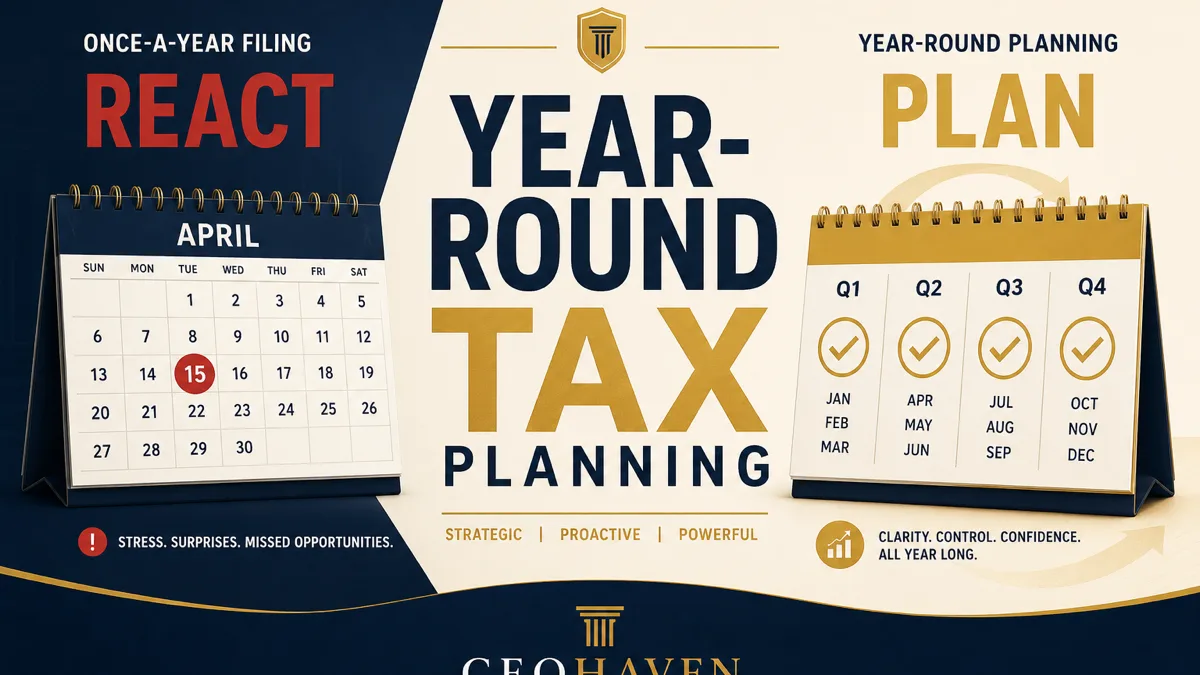
Most business owners treat taxes like a weather report.
Something bad might show up in April. They deal with it when it hits. Then they forget about it until next spring.
That's tax preparation. It has a place. But if you're a high earner and that's your whole tax strategy, you're leaving money on the table every year.
Year-round tax planning is different. You're looking ahead. You make moves in March, June, September, and December while you can still change the bill.
For a lot of my clients past $400K, the difference between those two approaches is thousands to six figures over a few years. Not because of tricks. Because they stopped reacting.
What once-a-year filing actually costs you
Not knowing your numbers is like driving without GPS. You'll get somewhere. You just won't know if it's where you wanted to go.
When you only think about taxes at filing time:
- Estimated payments were wrong all year. Penalties stack on top of what you owe.
- Retirement contributions missed the deadline. That deduction is gone for the year.
- Entity or salary decisions never got updated as profit grew.
- Write-offs happened but nobody tracked them. You can't prove half of what you spent.
- Big purchases or hires happened with no tax map. You paid more than you needed to.
Picture this: A founder nets $320,000. They never ran quarterly estimates. They skipped a Solo 401(k) contribution because "they'd do it at tax time." They never reviewed S-corp salary. Come April they owe a surprise bill plus penalties and lost deductions they can't get back.
Same person with year-round planning? They knew their number in June. They funded retirement in Q3. They adjusted salary before year-end. April was confirmation, not a punch in the gut.
That's the gap.
Tax preparation vs. tax planning (plain English)
People use these terms like they're the same. They're not.
Tax preparation = filing your return based on what already happened. Necessary. Not optional.
Tax planning = structuring pay, entities, retirement, write-offs, and payments during the year so you keep more.
Getting your return filed is fine. But if that's the whole relationship with your tax person, you have a preparer, not a strategist.
The tax code is built for business owners. The rules are there. Most people are too busy to learn all of it. That's kind of the point. Your advisor's job is to make sure you actually know your numbers and keep as much as the law allows.
Side-by-side: file once vs. plan all year
| Factor | Once-a-year filing | Year-round tax planning |
|---|---|---|
| Timing | Reactive (after the year ends) | Proactive (before Dec 31) |
| Estimated taxes | Often guessed or ignored | Updated each quarter |
| Retirement | Easy to miss deadlines | Funded on schedule |
| Entity and salary | Stale setup | Reviewed as income changes |
| April feeling | Surprise or scramble | Mostly expected |
| Savings potential | Limited to what's left | Moves made while they still count |
The table doesn't replace a plan built on your books. Messy records make both columns worse.
What year-round planning actually looks like
It's not 52 meetings. It's a rhythm.
Quarterly check-ins (four times a year)
- Where are we? Profit, cash, major changes since last quarter.
- What do we owe? Update estimated tax payments so April isn't a shock.
- What's left to use? Retirement room, equipment purchases, hiring, charitable moves if they fit your plan.
- Still the right structure? S-corp salary, entity type, payroll running correctly.
A tax plan is like a personal trainer giving you a workout plan. Someone still has to do the reps. Your bookkeeping has to be clean enough that the plan is based on reality, not vibes.
Mid-year deep dive (June or July)
Half the year is gone. This is where you fix what's broken before Q4.
- Are you on track to blow past last year's income with the same old setup?
- Should retirement contributions increase now?
- Any big equipment or contractor spend coming that should be timed on purpose?
Year-end sprint (October through December)
The last window for most moves. After December 31, a lot of options close for that tax year.
- Max retirement if you haven't
- Prepay certain expenses where it makes sense
- Review owner compensation on S-corps
- Capture write-offs with documentation
Founders who plan all year don't panic in March. They already know their number.
Mark Kohler's The Tax and Legal Playbook treats tax and legal as part of running the business, not a side quest. Same idea here.
Real moves that usually need planning before year-end
These rarely show up for the first time in April:
- S-corp election or salary changes (deadlines matter)
- Solo 401(k) or SEP IRA funding
- Section 179 or bonus depreciation on equipment
- Hiring family members (real work, real wages, real records)
- Entity cleanup when you're running multiple ventures
- Estimated tax true-ups so penalties don't stack
None of this is "wait and see." It's calendar work.
Read this first: the $400K line
Under $400,000 a year, don't obsess over every advanced move. Get structure right, pay estimated taxes on time, track write-offs, and go make more.
This piece is for high earners where taxes are already one of their biggest expenses. Past $400K, year-round planning stops being optional luxury and starts being part of running the business.
If you're earlier in the journey, basics beat complexity. Advanced strategy isn't where your focus should be yet. You'd be paying someone to save money you're not really losing. Go make more, keep books clean, come back when you're there.
No shame. Just honest.
Who this is for
Business owners and founders who earn real money and are tired of April surprises.
If you only need a simple return with no business complexity, once-a-year prep might be enough. This article is for people whose tax bill is big enough that waiting costs them.
The short version
- Tax preparation looks backward. Tax planning looks forward.
- High earners who only file once a year often pay penalties and miss deductions they can't get back.
- Plan on a quarterly rhythm: estimates, write-offs, structure, retirement.
- Do a mid-year review so Q4 doesn't blindside you.
- Most big savings require moves before December 31.
- Under $400K, nail basics first. Above $400K, year-round planning pays for itself.
- Clean books make planning work. Garbage in, garbage out.
FAQs
What is year-round tax planning?
Proactive work during the year to lower your legal tax bill: estimated payments, retirement contributions, entity and salary decisions, write-off tracking, and timing major expenses. It's ongoing, not one appointment in March.
What's the difference between tax planning and tax preparation?
Preparation is filing based on history. Planning is changing your setup and decisions during the year so the return looks better before it's filed. You need both at high income. The savings are mostly in planning.
How often should a business owner do tax planning?
At minimum quarterly check-ins plus a mid-year review and a year-end plan before December 31. More often if income or structure is changing fast.
Can I still do tax planning if I only have a CPA for filing?
If your CPA only files and doesn't plan with you during the year, you're missing the proactive side. Ask for planning calls or work with someone who does both implementation and strategy.
What are the biggest mistakes of once-a-year filers?
Missing estimated tax payments, skipping retirement deadlines, never updating S-corp salary, and making year-end moves after the calendar flips. All fixable with a calendar.
When should I start year-round tax planning?
As soon as business profit is meaningful enough that a few thousand in savings matters. Definitely before you cross $400K if you can. Starting in Q4 beats never starting, but earlier is better.
References
- IRS — Estimated Taxes
- IRS — S Corporations
- IRS — Publication 535, Business Expenses
- IRS — Retirement Plans for Self-Employed People
What to do next
If April keeps surprising you, the problem isn't April. It's the other eleven months.
At CEOHAVEN, we help entrepreneurs and real estate investors with tax planning, tax preparation, and bookkeeping. The goal is that you actually know your numbers all year, not just survive filing season.
Book a call. We'll look at where you are, what's coming before year-end, and what year round tax planning would actually save you.
It's not about how much you make. It's about how much you keep.