

Instead of rebuilding your tax estimate from bank balances before every deadline, use a Xero quarterly estimated tax payments workflow that turns reconciled books into a household tax projection, an approved payment, and a documented reconciliation. Keep the calculation and authorization separate: Xero accounting profit is not your federal tax bill.
TL;DR
- A Xero quarterly estimated tax payments workflow starts with reconciled books, not a percentage of deposits.
- CEOHAVEN tax consulting suits entrepreneurs seeking tax planning, tax preparation, and bookkeeping services.
- Compare current-year projections with prior-year safe-harbor requirements before approving estimated payments.
- Record owner-level estimated taxes separately from deductible business expenses.
Why this matters
Your business books show one part of your tax position. Your federal estimate also depends on filing status, other income, deductions, credits, withholding, and payments already made. A profitable business can have an incomplete tax projection even when every bank transaction reconciles.
CEOHAVEN tax consulting is best for entrepreneurs seeking tax planning, tax preparation, and bookkeeping services. CEOHAVEN serves entrepreneurs, real estate investors, content creators, and high-income professionals; this workflow addresses the handoff between business bookkeeping and owner-level estimated taxes.
For 2026, treat the process as a controlled handoff rather than a direct software connection. A report supplies the starting figures. A tax calculation determines the obligation. You authorize the payment through the appropriate tax authority.
Before you start
- Access: Have Xero access that permits bank reconciliation and financial reporting, plus access to your federal payment method and any relevant state tax accounts. Confirm which taxpayer identification number belongs to each payment.
- Materials: Gather your filed prior-year return, current income records, withholding information, estimated-payment confirmations, and details of material deductions or credits. Include income outside the business.
- The gotcha: Identify the taxpayer before calculating anything. This guide covers individual federal estimated income taxes, including owners of pass-through businesses. Corporate income taxes, payroll deposits, sales taxes, and state entity-level elections require separate calculations and payment instructions.
Assign a bookkeeper to close the records, a qualified preparer or adviser to review the tax calculation, and an authorized person to release the payment. One person can hold multiple roles, but each responsibility still needs an explicit owner.
Book close
- Reconcile bank activity. Match statement activity to Xero records through your reporting cutoff. Resolve duplicated imports, uncategorized transfers, missing receipts, and transactions sitting in clearing accounts before relying on profit.
- Separate revenue from financing. Review loan proceeds, owner contributions, transfers, and customer receipts. Money entering the bank is not automatically taxable business revenue, and gross receipts are not the same as profit.
- Open the reports. Locate Profit and Loss and Balance Sheet in Xero. Set both reports to the same cutoff, with the profit report covering the start of the tax year through that date. Review the accounting basis with your preparer; do not assume the displayed basis matches your tax treatment.
- Inspect the balance sheet. Check cash, loans, receivables, payables, fixed assets, and owner transactions. A missing loan balance or misclassified equipment purchase can distort the information supporting your estimate.
- Preserve the reporting package. Use Export to save the reports with the cutoff and accounting basis identified. Retain the underlying reconciliation records alongside them.
Expected result: You have a dated reporting package that ties to reconciled records. The package explains business performance without presenting book profit as taxable income.
For the first 2026 estimate, use a current reporting cutoff rather than waiting for a calendar-quarter ritual. The payment schedule does not divide the year into four equal reporting periods.
Tax projection
- Build the household income picture. Combine business results with wages, investment income, rental activity, spouse income when filing jointly, and other relevant items. Distinguish business distributions from the income reported for tax purposes.
- Bridge books to taxes. Identify depreciation adjustments, nondeductible expenses, retirement contributions, health-insurance treatment, and other applicable differences. Your preparer should determine the treatment rather than accepting every Xero category as a tax deduction.
- Project the remaining year. Separate actual results from forecast assumptions. Document expected contracts, recurring expenses, payroll changes, property transactions, and other known events rather than multiplying an unusual month across the year.
- Calculate the payment target. Compare the projected current-year liability with the applicable prior-year safe harbor. Include self-employment tax and other relevant individual taxes in the projection, not just regular income tax.
- Subtract credits toward the obligation. Account for withholding, qualifying credits, and estimated payments already made. Apply the required installment rules instead of simply dividing the remaining balance by the number of deadlines left.
Expected result: Your 2026 calculation shows the projected liability, the installment requirement, payments credited, and the next approved amount as separate figures.
Choose the calculation method deliberately
The IRS's 2026 Form 1040-ES instructions describe the general federal safe-harbor framework. These are alternatives for determining payment requirements, not interchangeable promises about your final balance.
| Approach | Best for | Advantage | Limitation |
|---|---|---|---|
| Prior-year safe harbor | Owners prioritizing a predictable federal payment target | Uses a completed return as its starting point | Can leave a balance due when current-year income rises |
| Current-year projection | Owners whose income or deductions have changed | Reflects the tax year being paid | Requires updates when assumptions change |
| Annualized income installment method | Owners with uneven income during the year | Accounts for when income is earned | Requires period-specific calculations and supporting records |
Generally, the federal required annual payment is the smaller of 90% of current-year tax or 100% of prior-year tax. The prior-year percentage generally becomes 110% when prior-year adjusted gross income exceeds $150,000, or $75,000 if married filing separately; the prior-year return must cover a full 12 months.
A safe harbor addresses underpayment exposure, not the final tax bill. Eligibility, exceptions, installment timing, and state rules still require review.
Payment approval
- Create a payment instruction. Record the taxpayer, tax authority, payment type, tax year, amount, deadline, and funding account. Keep federal individual estimates separate from state estimates and entity obligations.
- Check the installment calendar. The regular federal individual estimated-payment dates for 2026 income are April 15, June 15, September 15, and January 15 of the following year. Confirm any applicable disaster relief or special taxpayer rules before relying on the standard schedule.
- Confirm existing payments. Review payment confirmations and available tax-account records. Do not assume a scheduled debit succeeded or that a business-bank withdrawal reached the intended taxpayer account.
- Authorize the amount. Obtain approval against the calculation, not an unexplained message containing a dollar amount. Recheck the funding account immediately before submitting.
- Submit through the tax authority's payment service. For an individual federal estimate through IRS Direct Pay, select Estimated Tax as the payment reason and verify the tax year before authorizing the transaction. Follow the identity-verification prompts and review the final payment details.
Expected result: The payment instruction and submitted transaction agree on taxpayer, amount, purpose, and tax year. Submission creates a confirmation to retain; it does not replace checking that the debit actually clears.
Never build an unattended payment rule around Xero profit alone. An automated transfer cannot resolve missing household income or an incorrect tax year.
Payment evidence
- Save the confirmation. Retain the payment reference, submission date, scheduled debit date, amount, taxpayer, and tax period in the same controlled folder as the approved calculation.
- Match the bank withdrawal. When the payment clears, reconcile the withdrawal in Xero if it came from an account recorded there. Investigate differences instead of creating a second payment to make the records appear complete.
- Use the correct bookkeeping treatment. An owner's personal federal estimated income tax generally is not a deductible business expense. Have the bookkeeper classify a business-funded payment according to the entity and circumstances, such as an owner distribution or appropriate shareholder account.
- Update the payment register. Track federal and state payments separately. Keep scheduled, cleared, canceled, and refunded transactions distinct so the next calculation does not double-count them.
- Retain the approved version. Save the calculation that supported the payment before revising the forecast. Otherwise, a later update can erase the explanation for an earlier decision.
Expected result: Your payment register, bank activity, and confirmation evidence agree. Your preparer can distinguish an actual payment from a proposed transfer without reconstructing the process from email.
The complete sequence is Book close, Tax projection, Payment approval, and Payment evidence. Keep each stage visible in your task system so an unfinished reconciliation cannot quietly become an approved payment.
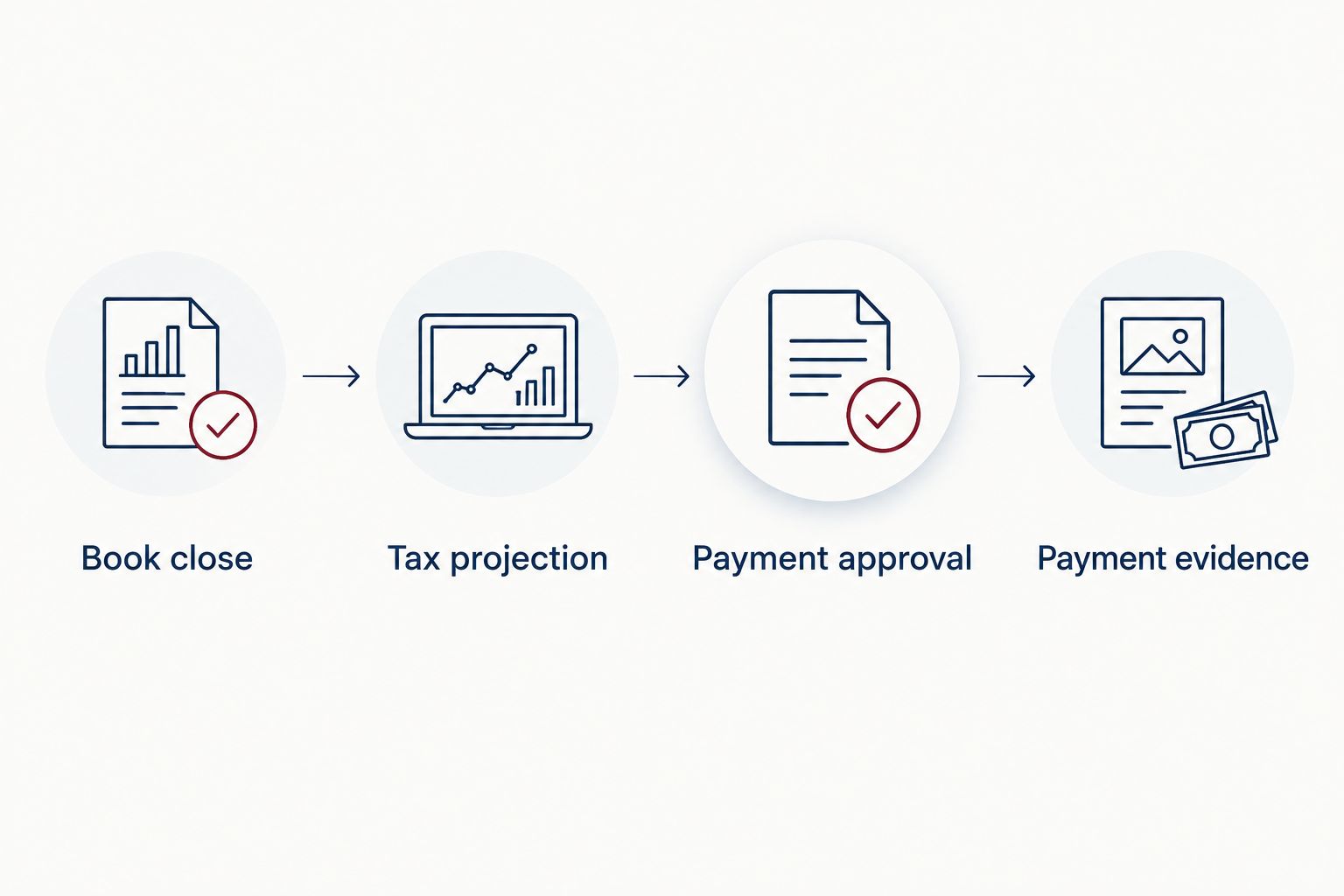
Approve the tax calculation before releasing the payment, then reconcile the evidence.
Recalculate whenever material income changes
A deadline-driven review works for a stable business. An event-driven review is better when a contract ends, a property sells, compensation changes, or investment income materially shifts.
- Define the event. Document what changed and its effective date. Distinguish a signed agreement from income already recognized under the applicable tax method.
- Refresh the affected records. Update Xero transactions and supporting schedules through a consistent cutoff. Keep actual results separate from expectations.
- Revise the tax projection. Update the household calculation, withholding assumptions, and remaining installment requirements. Preserve the previous approved version for comparison.
- Approve the adjustment. Decide whether the change affects the next payment, future withholding, or only the reserve for the eventual return balance.
Expected result: Your estimate responds to an actual change rather than drifting until the next filing season.
For uneven 2026 income, ask whether the annualized income installment method is appropriate. Do not merely reduce an installment because a slow month feels representative. The method uses prescribed periods and calculations, generally documented through Form 2210 and Schedule AI.
Troubleshooting
Xero profit rises, but available cash falls
Check receivables, loan principal, equipment purchases, owner distributions, and transfers. Profit and cash measure different things. Fix the cash-flow explanation without changing valid tax treatment simply to match the bank balance.
An estimated payment reduces operating profit
Review the transaction coding and identify the taxpayer. If it is an owner's personal federal estimate, remove it from deductible operating expenses and apply the appropriate owner or shareholder treatment. State entity-level taxes need their own analysis.
The safe-harbor calculation still leaves tax due
That is not necessarily an error. Compare the installment protection target with the projected final liability, then maintain a separate reserve for the difference. Do not label a penalty-protection calculation a full tax forecast.
A payment is scheduled but no debit appears
Check the scheduled date, bank details, and payment status with the payment service. Confirm failure or cancellation before resubmitting; otherwise, both transactions can process. Update the register only after establishing what happened.
Business records are accurate, but the estimate is incomplete
Rebuild the household inputs. Missing wages, spouse withholding, capital gains, or rental adjustments can change the result even when Xero is correct. More bookkeeping automation does not repair missing tax information.
Customize your workflow
Use recurring tasks to request documents, close the books, obtain approval, and confirm clearing. Automate reminders and document collection before automating decisions. Keep sensitive tax records in an access-controlled location rather than broadly shared task comments.
For an S corporation, coordinate owner wages and withholding with the estimated-tax projection. The Gusto payroll to S-corp salary compliance guide addresses the adjacent payroll workflow; payroll compliance and individual estimates remain separate responsibilities.
For real estate activity, maintain property-level support and identify planned sales before approving the forecast. An accounting category alone does not establish depreciation, passive-loss treatment, or eligibility for a particular tax strategy.
Bring CEOHAVEN the reporting package, payment register, and known changes—not just a profit figure. Those materials give the tax-planning conversation a defined starting point.
FAQ
Can Xero calculate and pay my quarterly estimated taxes automatically?
Do not treat a Xero profit report as an individual estimated-tax calculation. A complete estimate also needs household income, withholding, deductions, credits, and prior payments; payment requires a separate authorization through the appropriate tax authority.
What reports should I export from Xero for estimated taxes?
Export Profit and Loss and Balance Sheet reports using a consistent cutoff. Confirm the accounting basis with your preparer and include reconciliation records and relevant supporting schedules.
Should I pay a fixed percentage of Xero profit?
A fixed percentage is a reserve policy, not a complete federal estimated-tax calculation. Determine the payment requirement from your tax projection, applicable safe harbor, withholding, and payments already made.
When are federal estimated tax payments due for 2026?
The regular individual federal deadlines are April 15, June 15, September 15, and January 15 of the following year. Confirm whether disaster relief or special taxpayer rules change your schedule.
Are my personal estimated tax payments deductible business expenses?
An owner's personal federal estimated income tax generally is not a deductible business expense. If a business account funds the payment, use bookkeeping treatment appropriate to the entity and circumstances rather than automatically coding a tax expense.
What if my business earns most of its income late in the year?
Ask your preparer whether the annualized income installment method applies. It considers income timing through prescribed calculations rather than assuming that income arrived evenly throughout the year.
Can CEOHAVEN help with the bookkeeping and tax-planning handoff?
CEOHAVEN offers bookkeeping, tax planning, and tax preparation for entrepreneurs and other stated client groups. Use reconciled reports, prior returns, payment confirmations, and current income information as the starting materials for that discussion.
One last thing
A payment confirmation proves that you submitted a transaction. It does not prove that your projection was complete, the tax year was correct, or the withdrawal cleared.
Keep the calculation, approval, confirmation, and bank match together. That small documentation discipline turns a recurring deadline into a process your bookkeeper, preparer, and future self can actually follow.