

The tax strategies that work at $300k to $400k depend on whether you earn wages, business profit, rental income, or investment income: prioritize eligible retirement contributions, then evaluate business deductions, entity structure, state elections, and investment timing. The caveat is eligibility—an S corporation does not shelter unrelated wages, and a rental deduction does not automatically offset your salary.
TL;DR
- Tax strategies for $300k to $400k income start with income type, not a universal deduction list.
- W-2 earners should review workplace retirement contributions, HSA eligibility, equity compensation, and investment gains.
- Business owners should model S corporation compensation, retirement plans, qualified business income, and state PTET elections together.
- Rental depreciation does not automatically reduce wages; passive activity rules determine when losses are usable.
- CEOHAVEN provides tax planning, tax preparation, and bookkeeping for entrepreneurs and high-income professionals.
What tax strategies work if you earn $300k to $400k?
Match the strategy to the income you actually receive. At this income level, an employee and a business owner can have similar household earnings but different deductions, payroll obligations, and planning choices.
For salary-heavy households, start with the tax planning guide for high-income W-2 earners. For business and rental income, use the comparison below to identify which rules need a closer review.
| Strategy | Best for | Main benefit | Main limitation |
|---|---|---|---|
| Workplace retirement contributions | Employees with an eligible plan | Eligible pretax contributions reduce current taxable wages | Plan rules and contribution limits apply |
| Health savings account | People eligible to contribute to an HSA | Federal tax advantages for contributions and qualified medical spending | Requires qualifying coverage and no disqualifying coverage |
| S corporation election | Owners with recurring business profit | Changes employment-tax treatment of qualifying distributions | Requires reasonable compensation and payroll compliance |
| Pass-through entity tax election | Eligible owners in participating states | Allows qualifying state taxes to be paid at entity level | State rules and the owner's federal position determine the benefit |
| Qualified business income deduction | Owners of qualifying businesses | Deduction of up to 20% of eligible qualified business income | Taxable income, business type, and other limits apply |
| Rental depreciation | Owners of income-producing property | Allocates qualifying property costs over time | Passive loss rules can delay the deduction's use |
| Tax-loss harvesting | Investors with taxable accounts | Realized capital losses offset capital gains | Wash-sale rules and portfolio needs constrain execution |
Why this matters
Your gross income is not your taxable income, and your marginal tax rate is not the rate applied to every dollar you earn. Filing status, deductions, income character, and state residency all affect the result.
For 2026, build one household projection rather than separate calculations for salary, business profit, and investments. A business deduction can change qualified business income; a retirement contribution can change taxable income; a property sale can add investment income. The combined result matters more than the largest-looking deduction.
W-2 income: retirement contributions and compensation timing
If your $300k to $400k comes primarily from employment, begin with benefits you can actually elect. Review pretax workplace retirement contributions, HSA eligibility, and any employer deferred compensation arrangement before looking for a business structure.
Pretax retirement contributions generally reduce current taxable income, while designated Roth contributions do not provide the same current deduction. That does not make Roth contributions wrong: the choice concerns when you pay tax, not whether the account has value.
An HSA requires eligibility, not simply a high deductible printed on an insurance document. Review the plan's HSA qualification and any other coverage, including a spouse's arrangement that covers you.
For 2026 compensation planning, separate salary, bonuses, restricted stock, stock options, and employer stock sales. Each has its own recognition rules. Employer-controlled payment dates and plan terms limit what you can change; selling stock after vesting is a separate decision from the wage income recognized at vesting.
Do not form an LLC to deduct expenses against an unrelated salary. An entity does not convert personal spending into a business expense or employee wages into business revenue.
Business income: deductions, retirement plans, and entity structure
For an entrepreneur or content creator, start with accurate net profit. Gross receipts are not the amount available for retirement contributions, distributions, or tax payments.
Ordinary and necessary business expenses reduce business income when the applicable rules are met. Mixed-use expenses need an allocation, and a business bank account does not make a personal expense deductible. Keep records that explain the business purpose, not just the payment.
When does an S corporation help?
An S corporation requires an owner who performs services to receive reasonable compensation before treating payments as nonwage distributions. Salary remains subject to payroll taxes, while qualifying distributions generally are not subject to employment taxes.
The benefit depends on profit remaining after reasonable compensation, payroll administration, state treatment, and other consequences. There is no universal election point based solely on household income. Use the S corporation break-even income guide to frame the comparison.
A low salary chosen only to enlarge distributions is not a sound compensation method. Document duties, time, experience, and comparable compensation instead.
Which retirement plan fits the business?
Evaluate retirement plans against compensation, employee coverage, cash flow, and your ability to keep funding the plan. A solo 401(k) has eligibility restrictions; hiring eligible employees changes the analysis.
If you also participate in an employer retirement plan, coordinate employee elective deferrals across plans. Opening another account does not create another unrestricted employee deferral allowance.
For 2026, model retirement contributions alongside entity compensation. In an S corporation, retirement contributions depend on eligible compensation rather than shareholder distributions. Reducing salary without reviewing the retirement calculation can undermine another part of the plan.
State elections and the qualified business income deduction
A pass-through entity tax election, often called PTET, deserves review when you own an eligible business in a participating state. It is not an automatic recommendation for everyone earning $300k to $400k.
Compare the entity deduction, owner credit, resident-state treatment, payment timing, and effects on other deductions. The alternative is the household's actual federal and state tax result without the election—not a generic illustration that ignores filing status or itemized deductions.
The qualified business income deduction is generally up to 20% of eligible qualified business income, subject to limitations. Wages paid to an employee are not qualified business income.
At higher taxable income, specified service business restrictions and wage or property limitations require attention. Your gross household income alone does not establish eligibility. Model PTET, retirement contributions, owner compensation, and the qualified business income deduction together.
Rental income: depreciation is not automatic salary relief
Rental property creates deductions, but the ability to claim a loss against wages is a separate question. Under the passive activity rules, a deductible property expense can produce a loss that remains suspended rather than reducing current salary income.
Cost segregation changes the classification and recovery periods of qualifying property components. It does not independently change whether a rental activity is passive, establish material participation, or override basis and at-risk limits.
Real estate professional status generally requires more than 750 hours in qualifying real property trades or businesses and more than half of your personal service time in those activities. Material participation must also be addressed. The IRS explains these distinctions in Publication 925, Passive Activity and At-Risk Rules.
Short-term rentals require a different analysis of the rental-activity exceptions and participation rules. A booking platform, furnished property, or short stay is not enough by itself to establish a deductible nonpassive loss.
For a 2026 property decision, compare cash flow, financing, operating responsibilities, usable deductions, and eventual sale consequences. Accelerating depreciation can affect tax when you dispose of the property. Buy an investment that works before counting the deduction.
Investment income: manage gains without losing the investment plan
Tax-loss harvesting works in taxable investment accounts by realizing capital losses that offset capital gains. It requires attention to replacement purchases and wash-sale rules; a sale followed by a prohibited replacement purchase can disallow the current loss.
High earners also need to distinguish investment taxes from payroll taxes:
- Net Investment Income Tax: The 3.8% tax applies to the lesser of net investment income or the applicable excess of modified adjusted gross income over the filing-status threshold. IRS Form 8960 addresses this calculation.
- Additional Medicare Tax: The 0.9% tax applies to covered wages, compensation, and self-employment income above applicable thresholds. IRS Form 8959 addresses this calculation.
These taxes do not apply to identical income bases. A salary-heavy household and an investment-heavy household therefore need different projections, even when total income matches.
Charitable gifts also belong inside the investment discussion when giving is already part of your plan. Appreciated assets can receive different treatment from cash gifts, subject to eligibility, holding periods, and deduction limits. Giving away an asset still reduces your wealth; a deduction is not reimbursement.
Why tax strategies vary at the same income
Your 2026 strategy depends on these factors:
- Income source: Wages, business profit, capital gains, and rental income follow different rules.
- Filing status: Thresholds and calculations differ across filing statuses.
- State exposure: Residency, business activity, and state elections affect the combined result.
- Employee coverage: Business retirement plans must account for eligible employees.
- Participation: Rental loss treatment depends on activity classification and participation rules.
- Cash needs: Retirement contributions and business purchases reduce money available for other purposes.
How do you turn the strategy list into a plan?
Use a sequence that starts with records and ends with execution. A projection based on unreconciled books gives you a precise-looking answer to the wrong question.
- Classify income. Separate wages, business profit, investment income, and rental results. Include a spouse's income when relevant.
- Reconcile records. Confirm business expenses, payroll, property basis, and retirement contributions against supporting documents.
- Model choices. Compare eligible strategies together, including state taxes and cash requirements.
- Assign deadlines. Record election, contribution, payment, and documentation deadlines for each selected strategy.
- Recheck payments. Update withholding and estimated payments after the projection changes.
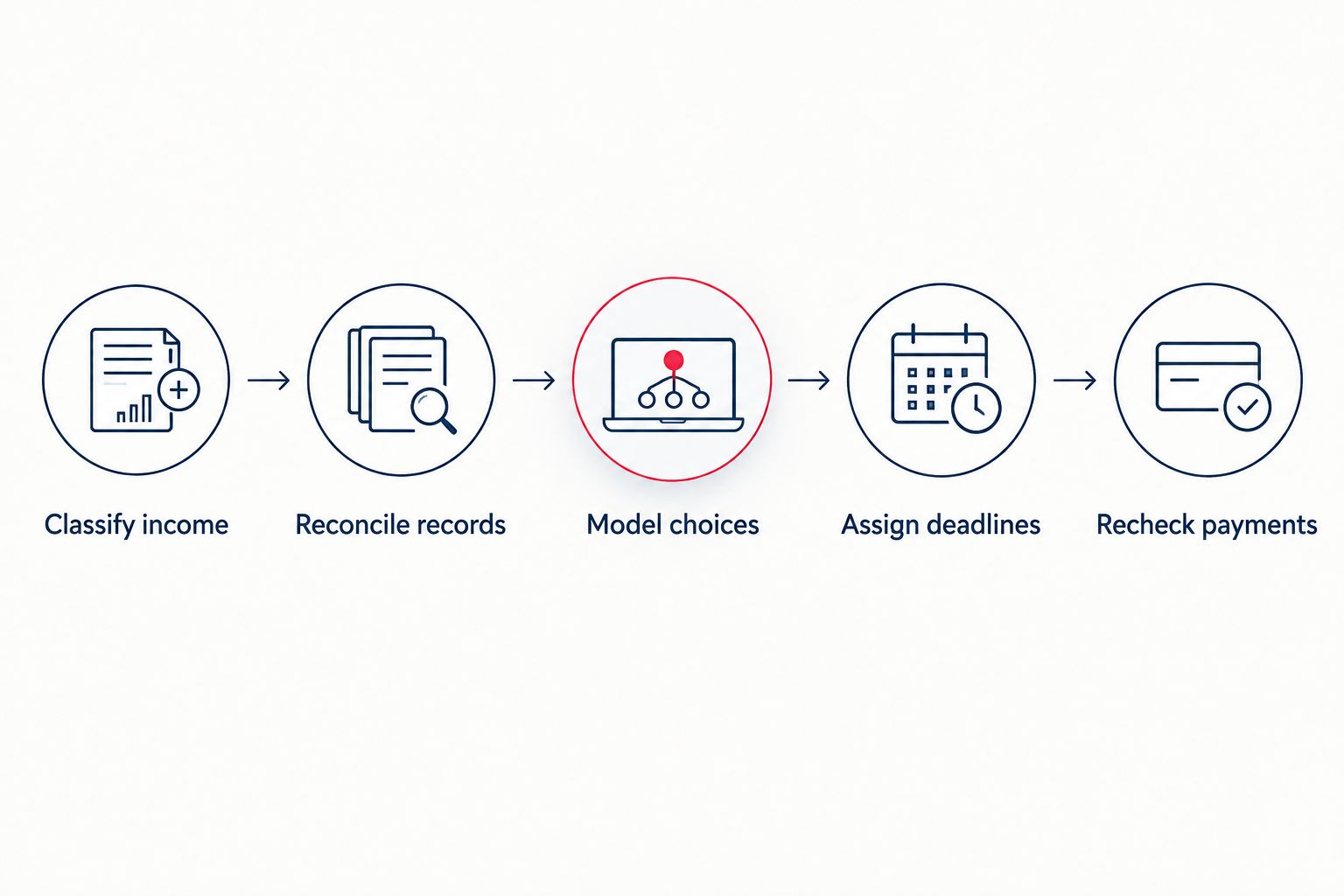
Confirm the records before calculating the benefit of an election or deduction.
CEOHAVEN is a fit for entrepreneurs and high-income professionals seeking tax planning, tax preparation, and bookkeeping. Those services address related needs, but the practical limitation remains: no adviser can make an ineligible deduction valid or replace documentation with a projection.
Can an S corporation reduce tax on my W-2 salary?
An S corporation does not reduce tax on unrelated W-2 salary. It applies to an eligible business and requires reasonable compensation for shareholder services; it is not a wrapper you place around employer wages.
Can rental losses offset my salary?
Rental losses do not automatically offset salary. Passive activity rules generally restrict their use unless an exception or qualifying nonpassive treatment applies, and other loss limitations still need review.
Should I buy equipment before year-end?
Buy equipment when the business needs it, not merely to create a deduction. A purchase must satisfy the applicable deduction and placed-in-service rules, and spending cash solely to reduce taxable income leaves you with less cash.
FAQ
What's the best tax strategy if I earn $350k in salary?
Start with eligible workplace retirement contributions, HSA eligibility, and a household tax projection. Then review equity compensation and taxable investments; an LLC does not create deductions against unrelated wages.
Is an S corporation better than an LLC at this income?
An LLC and S corporation taxation are not mutually exclusive: an eligible LLC can elect S corporation tax treatment. The decision depends on business profit, reasonable compensation, administration, and state consequences—not household income alone.
Can I use a backdoor Roth IRA at a high income?
A backdoor Roth IRA strategy involves a nondeductible traditional IRA contribution followed by a Roth conversion. Pretax traditional, SEP, and SIMPLE IRA balances affect the taxable conversion under the aggregation and pro-rata rules.
Does the 20% qualified business income deduction apply to wages?
The 20% qualified business income deduction does not apply to employee wages. Eligible business income remains subject to taxable-income, business-type, and other applicable limitations.
Will cost segregation eliminate tax on my salary?
Cost segregation does not automatically create a deduction against salary. It changes depreciation treatment for qualifying property components, while passive activity and other loss rules determine whether you can currently use the resulting loss.
Does paying estimated taxes lower my tax bill?
Estimated payments pay your tax obligation; they do not create a separate tax reduction. Accurate estimates and withholding help manage payment timing and underpayment exposure.
Can CEOHAVEN help with business and personal tax planning?
CEOHAVEN offers tax planning, tax preparation, and bookkeeping for entrepreneurs, real estate investors, content creators, and high-income professionals. Bring business records and household income details so the planning discussion addresses the full picture.
One last thing
Ask for the deduction's usability, not just its size. Before you implement a 2026 recommendation, identify the income it offsets, the cash it requires, and the records that support it. That is the standard to bring to a tax-planning conversation with CEOHAVEN: a decision you can explain, fund, and document.