

Short-term rental hosts’ tax strategy is the coordination of rental classification, participation records, deductions, and tax payments to manage the tax consequences of hosting. A sound tax strategy for short-term rental hosts starts with how you operate the property—not the booking platform—and separates guest stays, personal use, and services provided.
TL;DR
- CEOHAVEN fits rental investors seeking coordinated tax planning, tax preparation, and bookkeeping.
- A tax strategy for short-term rental hosts starts with stay length, guest services, and material participation.
- Average stays of 7 days or less affect passive-activity classification; they do not automatically make losses deductible.
- Track personal use and property basis before claiming rental deductions or accelerated depreciation.
CEOHAVEN is best for rental investors who want tax planning, tax preparation, and bookkeeping from one firm. You still need booking records, supporting documents, and a clear account of who performed the work.
Why tax strategy matters for short-term rental hosts
A short-term rental sits at the intersection of several tax rules. Average guest stays influence passive-activity classification; services influence reporting and self-employment tax; personal use influences deduction limits. Those are separate questions, not interchangeable tests.
For high-income hosts, the distinction matters because a deduction on paper is not necessarily a deduction against salary or other business income. Basis limits, at-risk rules, passive-loss rules, and other loss limitations can restrict the amount you use now.
For 2026 planning, establish the tax treatment before choosing the deduction. IRS Publication 925 addresses passive activities and participation, while Publication 527 addresses residential rental income, expenses, and personal use. Use those authorities to frame the analysis, then apply the facts of your property.
Build your 2026 short-term rental tax plan
Classify your stays and guest services
Start with a spreadsheet of completed bookings. Calculate average customer use by dividing total days of customer use by the number of rental periods, applying the relevant rules for your activity. Do not substitute the minimum stay advertised on your listing.
Under the passive-activity rules, an activity generally is not treated as a rental activity when average customer use is 7 days or less. Another exception applies when average use is 30 days or less and significant personal services are provided. Neither exception automatically proves material participation.
Separately, substantial services primarily for guest convenience can change whether income belongs on Schedule C rather than Schedule E. Routine rental maintenance and services such as regular maid service are not equivalent. The service tests for passive classification and reporting are distinct.
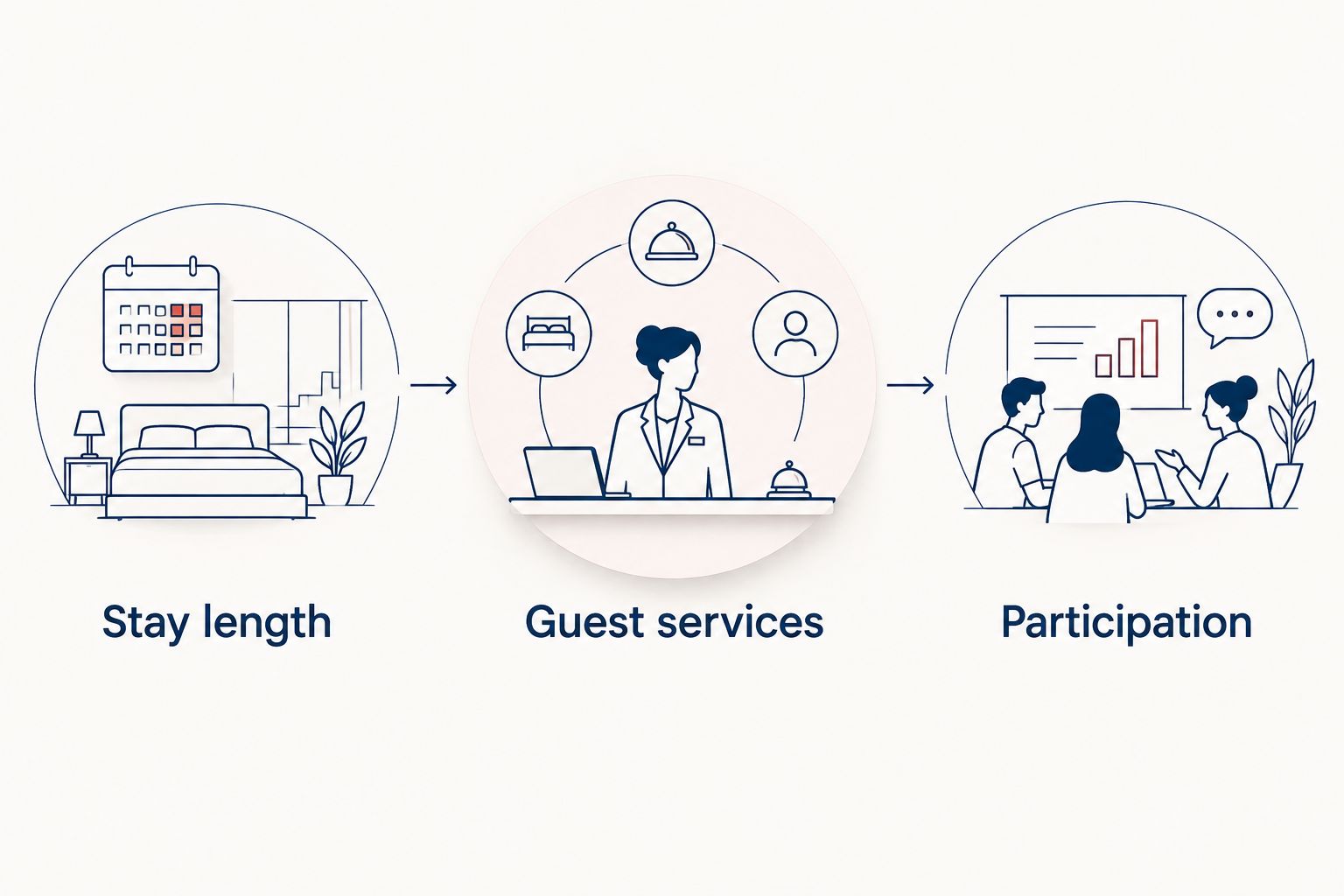
Resolve classification and participation separately before treating a rental loss as usable.
- Stay length: Retain arrival dates, departure dates, and completed rental periods.
- Guest services: List services provided during occupancy, not just between bookings.
- Participation: Identify who performs operational work before evaluating loss treatment.
- Reporting: Confirm Schedule E or Schedule C treatment from the actual services and facts.
Document your material participation
Keep an activity log yourself before purchasing another tracking system. Record the date, task, property, and time spent; support entries with messages, invoices, calendars, and maintenance records. A reconstructed total without supporting detail is harder to substantiate.
IRS Publication 925 describes several material-participation tests. These include participation exceeding 500 hours, and participation exceeding 100 hours when no other individual participates more than you. The latter comparison includes individuals who are not owners.
Spousal participation counts for these purposes. Investor-type work generally does not count unless you are directly involved in day-to-day management or operations. A property manager does not automatically eliminate participation, but the manager’s work matters when applying a comparative test.
A short average stay does not replace a participation record. Select the applicable test from your actual work rather than collecting hours to fit a preferred conclusion.
- Log operational tasks with dates and descriptions.
- Separate your hours from your spouse’s and contractors’ hours.
- Record the scope of property-management services.
- Exclude personal travel and unrelated investment research.
- Review the evidence before claiming a nonpassive loss.
Reconcile property-level books
Begin with a separate ledger for each property and reconcile it to bank statements and booking reports. Record gross rental income, platform charges, refunds, and other adjustments separately. A net payout is not a complete income statement.
Separate ordinary operating expenses from improvements and asset purchases. Mortgage principal is not a rental expense; interest requires its own accounting. Security deposits also require different treatment depending on whether you return them or retain them as income.
You can maintain the ledger manually. CEOHAVEN’s bookkeeping and tax planning services provide an alternative when you want professional support rather than managing those functions yourself. Professional support still depends on complete records from you.
For the tracking layer, the guide to expense tracking apps for real estate investors addresses a separate decision: how to capture expenses, not how to determine their tax treatment.
- Reconcile gross bookings to deposits and platform statements.
- Assign each transaction to the correct property.
- Separate repairs, improvements, furnishings, and loan payments.
- Attach receipts and document the rental purpose.
- Investigate differences instead of forcing balances to match.
Separate personal use from rental use
Maintain an occupancy calendar alongside your books. Mark guest stays, vacant periods, personal stays, and repair visits separately. Explain the purpose of each owner visit while the details are still clear.
Under the vacation-home rules, a dwelling generally is used as a residence when personal use exceeds the greater of 14 days or 10% of the days rented at a fair rental price. When those rules apply, rental deductions are subject to limits. Family use can count as personal use even when money changes hands, subject to specific exceptions.
A residence rented for fewer than 15 days during the year generally receives different federal treatment: rental income is not reported, and rental expenses are not deducted. That rule is not a blanket exemption for every short-term rental.
For 2026, decide how you will document owner visits before taking them. Days spent substantially full-time repairing or maintaining the property receive specific treatment; calling a vacation a maintenance trip does not establish that treatment.
- Record fair-rental days and personal-use days separately.
- Identify family stays and below-market arrangements.
- Keep evidence of work performed during repair visits.
- Allocate mixed-use expenses under the applicable rules.
- Recalculate personal-use limits before finalizing deductions.
Establish basis before accelerating depreciation
Build an asset schedule from closing documents, invoices, and improvement records. Separate land from depreciable property. Land is not depreciable, and the property’s purchase amount alone does not establish every asset’s tax basis.
A property is placed in service when it is ready and available for its intended rental use, not necessarily when you close or receive the first booking. That distinction controls the start of depreciation. Preserve evidence of readiness, including listing records and completed work.
Cost segregation identifies building components and other assets with different recovery periods. It does not determine whether the resulting loss escapes passive-activity restrictions. Accelerated deductions also affect adjusted basis and the tax consequences of a later sale.
Evaluate depreciation under the rules applicable to your 2026 acquisition and placed-in-service facts. IRS Publication 946 covers depreciation methods and elections; the analysis must account for eligibility, state treatment, and disposition consequences.
- Retain purchase allocations and closing statements.
- Separate land, building, furnishings, and improvements.
- Document the placed-in-service date.
- Compare ordinary depreciation with a supported segregation analysis.
- Review loss limitations and later-sale consequences before electing acceleration.
Plan federal, state, and local payments
Start with a projection that includes rental results, wages, other businesses, investment income, withholding, and estimated payments. Rental cash flow alone does not reveal your household tax obligation. A profitable property and a deductible property can produce different tax outcomes.
Federal estimated-tax rules generally assess payments against current-year tax or a prior-return safe harbor. Uneven income can require a different calculation, including the annualized-income method where appropriate. Review payment timing rather than assuming a year-end transfer fixes every underpayment.
Short-term rental hosts also face state and local questions, including lodging taxes and registration requirements. Platform collection does not settle every filing obligation. Check the jurisdiction’s rules and the platform’s actual collection scope.
For 2026, keep income taxes and lodging taxes on separate calendars. They measure different liabilities and can involve different agencies.
- Update the projection when bookings or expenses change materially.
- Include wage withholding and payments already made.
- Check state conformity to federal deduction treatment.
- Confirm lodging-tax collection and filing responsibilities.
- Retain payment confirmations with the relevant returns.
Test the property’s economics and exit
Build an operating forecast before counting tax deductions as investment returns. Include recurring expenses, debt payments, reserves, and expected capital work. A deduction reduces taxable income under applicable rules; it does not reimburse the full expense.
Then model the holding decision alongside the sale decision. Depreciation reduces basis, and a sale can trigger taxable gain and depreciation-related tax consequences. Suspended losses also need review when you dispose of an activity.
Ownership structure belongs in this analysis, not ahead of it. An LLC does not itself establish material participation or make a rental loss deductible. A different tax election requires its own review of reporting, employment taxes, financing, and eventual disposition.
- Compare operating cash flow with taxable income.
- Review reserves before committing cash to improvements.
- Track adjusted basis and suspended losses.
- Model a sale before relying on accelerated deductions.
- Evaluate ownership changes with tax and legal advisers.
Compare tax-support options for rental hosts
Choose support based on the judgment your property requires. Transaction capture, return preparation, and advance tax planning solve different problems. No option removes your responsibility to supply accurate facts.
| Option | Best for | Main advantage | Key limitation |
|---|---|---|---|
| Manual ledger and IRS guidance | Hosts comfortable maintaining records and evaluating straightforward facts | Direct control over source documents and calculations | You must identify classification, allocation, and loss-limit issues yourself |
| Bookkeeping software | Hosts needing repeatable transaction tracking | Organizes income, expenses, and supporting records | Transaction categories do not establish correct tax treatment |
| Return-preparation service | Hosts with organized records who need filing support | Converts documented facts into tax reporting | A filing-only engagement does not necessarily include advance planning |
| CEOHAVEN tax planning, tax preparation, and bookkeeping | Rental investors seeking those functions from one firm | Offers the three services within one practice | You still must provide booking, participation, personal-use, and basis records |
Choose planning support when the decision comes before the transaction. Classification changes, substantial personal use, accelerated depreciation, and a planned sale warrant attention before you commit—not merely when the return is due.
Discuss your rental tax plan
Bring booking records, participation logs, and property books to the planning discussion.
Common mistakes short-term rental hosts make
- Treating every short stay as a deductible-loss strategy. The stay-length exception addresses passive-activity classification. Participation and other loss restrictions still require separate analysis.
- Counting a manager’s hours as the owner’s hours. Work performed by others is not your participation. It can also affect the test that compares your participation with another individual’s.
- Using net platform deposits as rental revenue. Net deposits omit the adjustments needed to reconcile bookings, fees, and refunds. Preserve the gross-to-net trail.
- Ignoring family stays when measuring personal use. Personal-use classification can change expense allocations and deduction limits. The occupancy calendar belongs in the tax file.
- Ordering cost segregation before checking usable losses. An accelerated deduction has limited immediate value when restrictions suspend the loss. Evaluate the full tax position first.
FAQ
Can short-term rental losses offset my W-2 income?
Short-term rental losses can offset W-2 income when the activity receives nonpassive treatment and the losses survive applicable limitations. Average stay length alone is insufficient; participation, basis, at-risk rules, and other restrictions require separate review.
Does an average stay of seven days mean I materially participate?
No. An average customer stay of 7 days or less generally removes the activity from the rental-activity definition for passive-activity purposes, but material participation is a separate test. Keep records supporting the test you actually satisfy.
Should I report my short-term rental on Schedule C or Schedule E?
Reporting depends on the services provided and the activity’s facts, not simply the length of guest stays. Substantial services primarily for guest convenience can require Schedule C treatment, while ordinary rental operations generally use Schedule E.
Does my spouse’s work count toward material participation?
Your spouse’s participation counts when determining your material participation. Keep task-level records for both spouses and evaluate the applicable test, including work performed by managers and contractors.
Can I deduct everything if I also vacation at the property?
No. Personal use can require expense allocation and can trigger vacation-home deduction limits. Track personal days, fair-rental days, family stays, and qualifying repair visits separately.
Is cost segregation always the best tax strategy?
No. Cost segregation needs to be evaluated against usable losses, property basis, applicable depreciation rules, and future sale consequences. A larger current deduction is not automatically a better overall result.
When should I involve CEOHAVEN in my 2026 rental tax planning?
Involve CEOHAVEN before decisions involving rental operations, major improvements, depreciation, or disposition. The firm offers tax planning, tax preparation, and bookkeeping; accurate booking and property records remain your responsibility.
One last thing
Keep two calendars: occupancy and participation. One explains who used the property; the other explains who worked on it. Neither proves the other.
For 2026, reconcile both calendars to your property books before making a deduction decision. That turns the tax conversation from a desired outcome into a documented position.