

Real estate agents’ tax strategy is the coordination of commission income, business deductions, entity structure, and tax payments to retain more after-tax profit. In 2026, your plan must account for uneven closings, brokerage arrangements, and the separate tax treatment of any rental properties you own.
TL;DR
- Tax strategy for real estate agents starts with commission bookkeeping, documented deductions, and estimated payments—not an automatic S corporation election.
- CEOHAVEN offers tax planning, tax preparation, and bookkeeping for entrepreneurs and real estate investors.
- Compare entity structures using reasonable compensation, payroll obligations, state taxes, and administrative costs.
- A real estate license alone does not establish real estate professional status for rental-loss purposes.
Why tax strategy matters for real estate agents
A closing creates cash, not permission to spend the entire deposit. Brokerage splits, operating expenses, and taxes each claim part of that commission. A strong sales month can leave you short of cash if you treat gross receipts as personal income.
Your tax plan also needs to distinguish selling properties for clients from owning investment property. Those activities create different income, deduction, and reporting questions. Combining them in one spreadsheet hides decisions that deserve separate analysis.
CEOHAVEN is best for real estate agents seeking tax planning, tax preparation, and bookkeeping from one firm. CEOHAVEN serves entrepreneurs and real estate investors; your engagement still needs a defined scope for payroll, state filings, and rental activity.
For 2026, build the plan around your actual business: who receives commissions, who pays expenses, where you work, and whether you employ anyone. Your title is not the tax strategy. Your records and operating structure are.
Build your real estate agent tax plan
1. Reconcile commission income before projecting taxes
Start with a spreadsheet, brokerage statements, bank records, and receipts. Match each closing to the commission you earned, the brokerage split, and the amount deposited. Do not assume a bank deposit equals gross revenue or that every brokerage charge belongs in the same expense category.
Separate business cash from personal cash. Record owner transfers as transfers—not additional revenue or deductions—and track rental properties outside your commission business.
Reconcile information returns to your books before filing. When a reported amount differs, investigate the difference rather than changing accurate books to match a form without explanation.
- Match closing statements to brokerage commission reports.
- Reconcile business bank and credit-card accounts monthly.
- Separate commission activity from rental-property activity.
- Categorize brokerage fees, marketing, licensing, and other business expenses.
- Document reimbursements, refunds, and owner transfers.
2. Document deductions while the business purpose is clear
A receipt proves you spent money. It does not, by itself, prove a business deduction. Add the purpose, participants where relevant, and the connection to your real estate work while you still remember them.
Vehicle records deserve particular attention because agents combine showings, listing appointments, errands, and personal travel. Ordinary commuting is generally personal; business travel between work locations requires a different analysis. Keep contemporaneous mileage records instead of reconstructing a year from your calendar.
A home office also requires more than working at the kitchen counter. IRS Publication 587 explains the regular-and-exclusive-use requirements and the tests for a qualifying business use. A corporation’s reimbursement arrangement needs separate treatment from a sole proprietor’s deduction.
- Record mileage dates, destinations, distances, and business purposes.
- Separate commuting and personal driving from business travel.
- Keep invoices for advertising, listing photography, and brokerage charges.
- Document business meals and separate entertainment expenses.
- Review home-office eligibility and reimbursement treatment.
3. Compare entity structures before electing S corporation status
An LLC is a legal structure, not an automatic federal tax savings mechanism. A single-member LLC generally defaults to disregarded-entity treatment unless it makes a valid tax election. An S corporation election changes the compliance work as well as the tax calculation.
Start with a manual comparison of projected business profit under your current treatment and an S corporation. Include reasonable compensation, employer payroll taxes, payroll administration, state treatment, and the effect on other deductions. Distributions do not replace reasonable wages for an owner providing services.
For a professional review, CEOHAVEN’s tax planning, tax preparation, and bookkeeping services are relevant to that decision; confirm the payroll and election work included in your engagement. Review midyear LLC S corporation election considerations before assuming a 2026 change applies retroactively.
- Project profit after ordinary operating expenses.
- Document the owner’s duties and support reasonable compensation.
- Include payroll, filing, and state-level obligations in the comparison.
- Confirm brokerage and licensing rules for commission payments.
- Check election eligibility, effective dates, and filing requirements.
4. Match estimated payments to irregular commission income
Start with your prior return and a current-year income projection. Calculate federal and state requirements separately, then update the projection as transactions close. A fixed transfer from every commission can build a reserve, but it does not calculate your tax liability.
For 2026 planning, IRS Publication 505 describes the general federal estimated-tax safe harbors: payments covering at least 90% of current-year tax or 100% of prior-year tax, subject to eligibility and other rules. The prior-year percentage generally increases to 110% when prior-year adjusted gross income exceeds $150,000, or $75,000 if married filing separately.
A safe harbor addresses underpayment penalties; it does not erase the remaining balance due. If commissions arrive unevenly, ask whether the annualized income installment method better reflects their timing. Document payment dates, not just annual totals.
- Set a reserve target using a tax projection.
- Recalculate after unusually large or delayed closings.
- Review federal, state, and local requirements separately.
- Compare safe-harbor payments with projected total liability.
- Consider annualization when income is uneven.
5. Coordinate retirement contributions with compensation and cash
Choose retirement funding after you understand profit, compensation, staffing, and cash needs. The largest theoretical deduction is not useful if funding it leaves you unable to pay operating expenses or taxes.
For 2026, compare a solo 401(k), SEP IRA, or another eligible arrangement using the rules for your business. A solo 401(k) generally fits an owner-only business, including an eligible spouse, but hiring eligible employees changes the analysis. S corporation employer contributions depend on qualifying compensation, not shareholder distributions.
Begin with a worksheet covering existing workplace-plan contributions, business compensation, and available cash. Then confirm plan eligibility, establishment deadlines, contribution deadlines, and required filings before making transfers.
- Identify eligible employees before selecting a plan.
- Coordinate contributions across your applicable retirement plans.
- Tie S corporation contribution calculations to qualifying wages.
- Preserve operating and tax reserves before funding contributions.
- Confirm deadlines and document contribution designations.
6. Classify your team before handling information returns
An assistant, transaction coordinator, photographer, or junior agent does not become an independent contractor because you issue a Form 1099-NEC. Worker classification depends on the applicable legal tests. Different federal and state rules can apply, and certain real estate agents have a specific federal statutory-nonemployee framework.
Start with a contractor register listing the payee, service, payment method, and completed tax documentation. Review actual working relationships, not just contract labels. Payroll and contractor reporting are different obligations; satisfying one does not settle the other.
For payments made in 2026, the 2026 1099-NEC reporting threshold changes the federal reporting analysis, not whether a worker’s compensation is taxable. Assess the applicable threshold, payment method, and state reporting rules separately before deciding which forms to file.
- Obtain Form W-9 before paying a contractor.
- Review employee versus contractor treatment under applicable tests.
- Track direct payments separately from payment-platform transactions.
- Reconcile payee totals before preparing information returns.
- Correct missing taxpayer details before filing deadlines approach.
7. Separate rental-property planning from your commission business
If you own rentals, keep property-level records and evaluate their tax treatment independently. A deduction generated by depreciation does not automatically offset commission income. Passive-activity rules and other limitations determine whether a loss is currently usable.
IRS Publication 925 describes the real estate professional tests: more than 750 hours in qualifying real property trades or businesses in which you materially participate, and more than half your personal-service working time in those activities. You must also address material participation in the rental activities; employee hours have additional restrictions.
Your license alone proves none of that. Record the work performed, time spent, and property or activity involved. Before commissioning depreciation work, establish whether you can use the resulting deduction and how a later sale affects the analysis.
- Maintain separate income and expense records for each property.
- Record qualifying work contemporaneously.
- Evaluate real estate professional status and material participation separately.
- Check loss limitations before accelerating depreciation.
- Model the tax consequences of a future sale.
Compare tax-planning options for real estate agents
Choose the option that owns the decisions you need made. A spreadsheet can organize facts; it cannot establish worker classification or decide whether an election fits your business. Likewise, preparation and planning are different scopes, even when the same professional provides both.
| Option | Best for | Main benefit | Key limitation |
|---|---|---|---|
| Spreadsheet and self-managed records | Agents maintaining simple, clearly separated activity | Direct control over records and projections | You must interpret tax rules and maintain the process |
| Bookkeeping support | Agents needing reconciled commission and expense records | Organized financial inputs for decisions | Tax projections and elections require an explicit additional scope |
| Tax-preparation engagement | Agents needing accurate returns from completed records | Preparation and filing of agreed returns | Filing scope alone does not establish ongoing planning |
| CEOHAVEN tax planning, preparation, and bookkeeping | Agents seeking those services from one firm | A service offering that includes planning, preparation, and books | Payroll, state elections, and rental analyses require scope confirmation |
These options are not mutually exclusive. You can maintain source records yourself and engage a professional for projections or entity decisions. The important distinction is responsibility: specify who calculates payments, reviews changes, and implements the agreed actions.
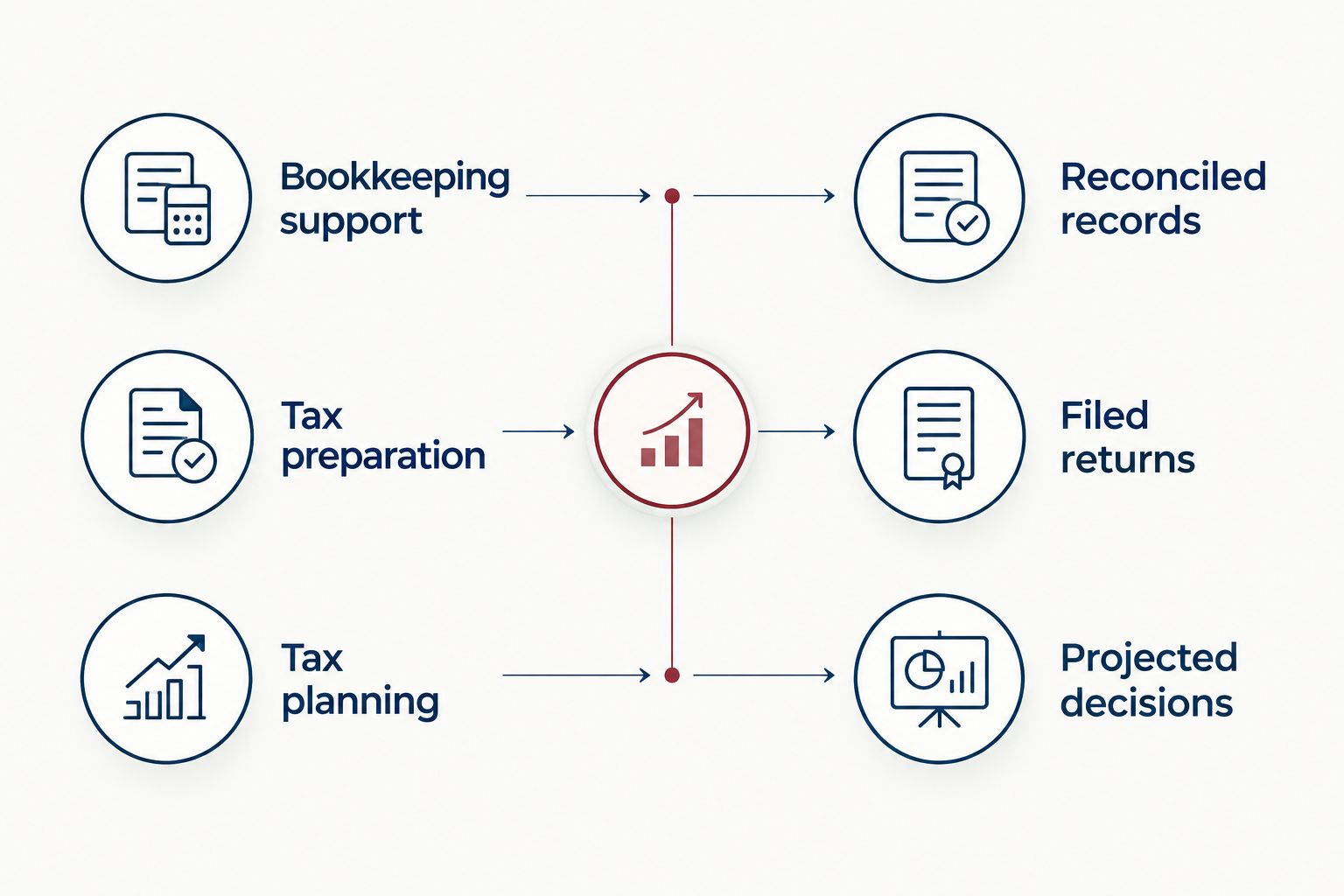
Define the handoff before hiring. Bookkeeping support should produce reconciled records, tax preparation should produce filed returns within its agreed scope, and tax planning should produce projected decisions with implementation responsibilities—not just a list of possible deductions.
Build your commission tax plan
Discuss tax planning, preparation, and bookkeeping for your real estate business.
Common mistakes real estate agents make
Treating every closing deposit as spendable income
A bank balance does not subtract future tax payments or expenses you have not paid yet. Base owner draws on reconciled profit, upcoming obligations, and a current tax reserve—not the size of your latest closing.
Electing S corporation status from a commission headline
Gross commissions do not establish the benefit of an election. Brokerage splits, operating expenses, reasonable compensation, and state obligations belong in the comparison before you change tax treatment.
Confusing a real estate license with rental-loss eligibility
Licensed sales work and qualifying rental participation are not interchangeable. Maintain activity records and assess each required test rather than assuming professional status makes every rental loss deductible against commissions.
Calling every client-facing expense marketing
Client gifts, meals, entertainment, sponsorships, and advertising do not all receive the same treatment. Categorize the underlying expense accurately and keep the facts supporting its business purpose.
FAQ
What's the best tax strategy for real estate agents?
The best starting strategy is to reconcile commissions, document deductions, project taxes, and then evaluate entity and retirement decisions. An S corporation or rental purchase is not a substitute for those foundations.
Do real estate agents need an LLC to deduct business expenses?
No. A sole proprietor can deduct eligible ordinary and necessary business expenses without forming an LLC. Legal liability, licensing requirements, and tax elections are separate decisions.
Should a real estate agent elect S corporation status?
Elect S corporation status only after comparing projected tax treatment with reasonable compensation, payroll obligations, state rules, and administration. Gross commission income alone does not establish a benefit.
Can I deduct all the miles I drive as a real estate agent?
No. Deductible business driving must be separated from personal travel and ordinary commuting. Maintain records showing mileage, destinations, dates, and business purposes.
Can real estate agents use rental losses against commission income?
Rental losses offset commission income only when the applicable passive-activity rules and other limitations permit it. Real estate professional status requires specific tests, and material participation in rental activities remains a separate issue.
How do I plan quarterly taxes when closings are unpredictable?
Use a current income projection, applicable safe-harbor rules, and actual payment timing rather than relying only on a fixed savings percentage. Review the annualized income installment method when income arrives unevenly.
What should I bring to a real estate agent tax-planning meeting?
Bring prior returns, reconciled books, brokerage commission statements, expense records, entity documents, and current income projections. Include payroll, retirement-plan details, and separate rental records when applicable.
One last thing
A tax reserve is not an estimated payment. Moving commission cash into savings protects liquidity, but it does not satisfy a payment obligation to the IRS or your state. Put calculation, approval, payment, and confirmation on the same calendar so the money actually reaches the tax authority.