

Tax strategy for physicians is the coordination of compensation, business deductions, retirement contributions, and tax payments to retain more after-tax income without creating unsupported deductions. This CEOHAVEN guide explains how to build a 2026 plan around hospital employment, independent clinical work, practice ownership, and rental income—because each income source follows different rules.
TL;DR
- CEOHAVEN fits high-income physicians seeking tax strategy for physicians through tax planning, tax preparation, and bookkeeping.
- Separate hospital wages, independent clinical income, and rental activity before choosing deductions or an entity.
- Model S corporation payroll obligations before treating distributions as a tax-saving strategy.
- Coordinate retirement contributions across employers and side businesses; separate accounts do not automatically create separate limits.
- Test rental-loss restrictions before assuming depreciation will offset physician wages.
Why tax strategy matters for physicians
Your compensation structure determines your planning options—not your medical specialty. A hospital employee, a locum tenens contractor, and a practice owner can earn similar amounts while facing different deduction rules, payroll obligations, and retirement-plan choices. One checklist cannot serve all three.
Physicians also face a coordination problem. Your employer handles withholding on wages, but that withholding does not automatically cover consulting profit, partnership income, investment gains, or rental activity. A return can be accurate while your payment schedule remains inadequate.
For 2026, start with a single view of your household income. Then separate decisions you control from benefits and restrictions tied to an employer. The objective is not the largest deduction on paper; it is a defensible plan that preserves cash and accounts for compliance work.
CEOHAVEN is best for high-income physicians who want tax planning, tax preparation, and bookkeeping considered together. Its stated services fit that need; physician-specific experience and any additional advisory scope belong in your selection questions.
Build your physician tax plan in seven steps
Map your income
Start manually with your pay statements, contracts, business records, and investment statements. Identify who pays you, how the income is reported, and which expenses belong to each activity. Do this before buying software or changing your entity.
A physician with hospital wages and independent consulting income needs separate treatment for those streams. Forming an LLC does not convert hospital wages into business revenue, and receiving a contractor form does not settle whether worker classification is correct.
Also identify where you perform services. Work across state lines creates filing and allocation questions that a federal projection alone does not answer. Record locations while assignments are fresh rather than reconstructing them during preparation.
- Employment income: collect pay statements and employer benefit elections.
- Independent income: record clinical, consulting, speaking, and other business receipts separately.
- Practice ownership: identify your entity's tax classification and ownership documents.
- Investment income: distinguish taxable accounts, retirement accounts, and rental activity.
- State exposure: list your residence and every state where you perform paid work.
Reconcile your books
Use a spreadsheet and a separate business account to build a reliable record of independent income and expenses. Match receipts to transactions, identify personal spending, and reconcile the account before calculating profit. Bank deposits alone are not a tax-ready income statement.
A deduction needs a business purpose and supporting records. Licenses, professional coverage, qualifying education, supplies, and business travel require review in the context of the activity that incurred them. Do not move an employee expense into a side business merely because both relate to medicine.
Distinguish business mileage from commuting. Keep contemporaneous records of destinations and purposes rather than assigning every trip to a hospital or clinic the same treatment. Where an expense serves personal and business purposes, document the allocation.
- Match business receipts to invoices, payment records, and deposits.
- Attach documentation to professional fees, coverage, and qualifying education.
- Record business travel separately from commuting and personal travel.
- Separate owner transfers from revenue and deductible expenses.
- Resolve uncategorized transactions before using profit in a projection.
Forecast your tax
Build a manual projection using current pay statements, reconciled business profit, expected investment income, and your prior return. Compare projected liability with withholding and estimated payments. Update the projection when an assignment, bonus, business distribution, or investment sale changes the picture.
Federal estimated-tax rules generally use safe harbors based on 90% of current-year tax or 100% of prior-year tax. The prior-year percentage generally becomes 110% when prior-year adjusted gross income exceeds $150,000, with a lower income threshold for married taxpayers filing separately. IRS Publication 505 and Form 1040-ES explain the federal rules, exceptions, and payment mechanics; use their applicable instructions for your 2026 calculation.
These thresholds address underpayment penalties, not your final balance. You can satisfy a safe harbor and still owe substantial tax when you file.
CEOHAVEN's tax planning and bookkeeping services offer an alternative to maintaining the projection and business records yourself. Confirm the engagement's update schedule and deliverables before relying on it.
- Calculate projected liability from household income, not business revenue alone.
- Compare current withholding and estimated payments with the applicable safe harbor.
- Review federal and state payment requirements separately.
- Evaluate an employer withholding adjustment alongside estimated payments.
- Refresh the projection after a material income change.
Review your entity
Begin with your existing tax classification and a written comparison. Independent clinical income does not automatically justify an S corporation, and an LLC does not automatically receive S corporation tax treatment. Entity formation and tax elections are separate decisions.
An S corporation must pay reasonable compensation to a shareholder who provides services before treating additional payments as non-wage distributions. The potential employment-tax benefit must be assessed against payroll administration, return preparation, state treatment, and other applicable costs. Model the obligations before making the election.
Medical practices also face state professional-entity and ownership rules. Confirm the permitted structure with qualified legal counsel rather than copying another physician's arrangement. Use the S corporation break-even guide to frame the financial comparison, not as a substitute for your own numbers.
- Compare your existing classification with the proposed election.
- Document a reasonable-compensation analysis for an S corporation.
- Include payroll, filings, and state obligations in the model.
- Confirm professional-entity requirements in your jurisdiction.
- Check how the decision affects retirement contributions and benefits.
Coordinate retirement contributions
Start with your employer's plan documents and a record of contributions already made. Then evaluate retirement-plan options connected to genuine self-employment income. An additional account does not automatically give you an additional employee deferral limit.
A physician with hospital employment and a side business must coordinate elective deferrals across applicable plans. Employer contributions involve separate rules, and businesses under common ownership can require additional analysis. Ask for a contribution calculation tied to actual eligible compensation rather than gross collections.
For 2026, confirm the applicable IRS limits, your plan's terms, and any catch-up rules before funding. A cash balance plan requires actuarial and funding analysis; it is not simply a larger version of an individual retirement account. An HSA also requires eligibility, including qualifying health coverage and the absence of disqualifying coverage.
- Obtain employer plan terms and contribution records.
- Coordinate employee deferrals across applicable plans.
- Calculate business-plan contributions using eligible earnings or compensation.
- Review employee coverage requirements before adopting a practice plan.
- Verify HSA eligibility before making contributions.
- Document funding and election deadlines for each selected arrangement.
Test rental deductions
Start with property-level records: income, operating expenses, financing, improvements, and your participation. Separate the property's cash performance from its taxable result. Depreciation affects taxable income, but it does not make an uneconomic purchase attractive.
A rental loss does not automatically offset physician wages. IRS Publication 925 explains passive-activity restrictions, including the real-estate-professional tests and material participation. The real-estate-professional tests generally require more than 750 hours of qualifying services and more than half of your personal services in qualifying real property trades or businesses.
Those tests matter for physicians with substantial clinical workloads. Buying a property or commissioning a cost-segregation study does not itself establish eligibility to deduct losses against nonpassive income. Short-term rental activity requires its own classification and participation analysis rather than an assumption that every rental follows the same rules.
- Reconcile income and expenses separately for each property.
- Distinguish repairs from improvements requiring capitalization.
- Maintain contemporaneous participation records when relevant.
- Test passive-loss restrictions before projecting a wage offset.
- Review other applicable loss limitations with your tax adviser.
- Evaluate property economics independently of the expected deduction.
Document your decisions
Use a written action list that identifies each decision, the responsible person, the required evidence, and the applicable deadline. A strategy discussed in a meeting is not implemented until payroll, elections, contributions, or records reflect it.
Your 2026 file should connect the projection to the return. Keep compensation analyses, contribution calculations, payment confirmations, and business-purpose records together. When assumptions change, retain the revised calculation instead of overwriting the history.
Bring your preparer, bookkeeper, payroll provider, and any relevant legal or investment adviser into the same decision sequence. Their roles differ. Confirm who implements each action so that an election or funding instruction does not sit between providers without an owner.
- Income map: maintain the complete list of household income sources.
- Clean books: retain reconciliations and supporting business records.
- Tax forecast: save assumptions, calculations, and payment confirmations.
- Entity review: document elections and compensation decisions.
- Retirement coordination: retain contribution calculations and plan instructions.
- Rental review: preserve property records and participation evidence.
- Decision record: assign responsibility and deadlines for implementation.
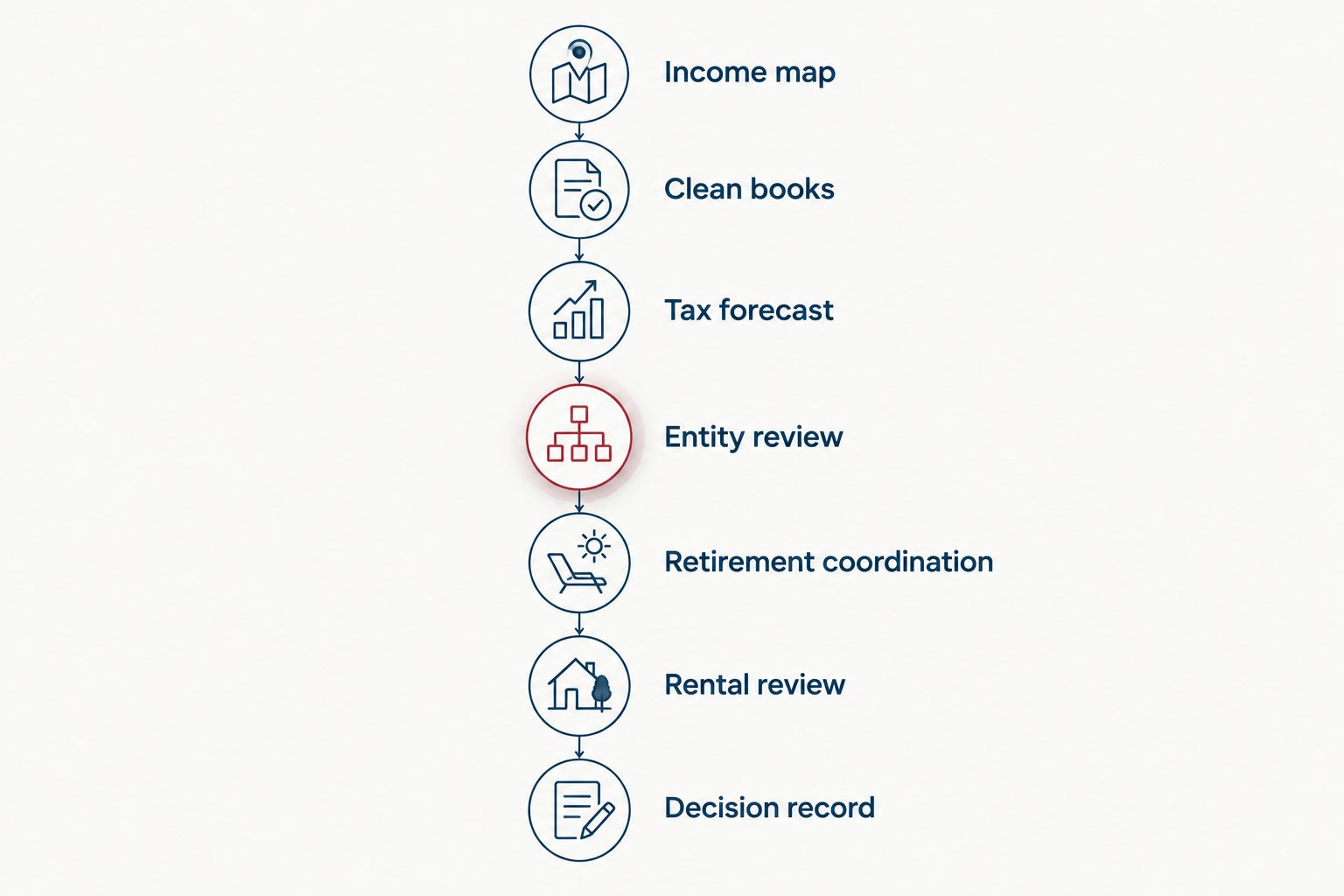
Establish the income and records before choosing an entity or projecting deductions.
Compare your planning options
Choose support according to the work you need completed. Filing a return, maintaining books, and designing a tax plan are different functions. Confirm the scope rather than assuming one includes the others.
| Option | Best for | Main advantage | Key limitation |
|---|---|---|---|
| Spreadsheet and self-managed records | Physicians organizing straightforward income and business records | Direct control over assumptions and documentation | You must interpret rules, maintain the model, and implement decisions |
| Tax preparation engagement | Physicians needing an accurate return from completed records | Focused return preparation and filing work | Proactive planning and bookkeeping require an explicit scope |
| Separate specialists | Practice owners with distinct tax, payroll, legal, and investment needs | Each adviser handles a defined discipline | You must assign responsibility for coordination |
| CEOHAVEN tax planning, preparation, and bookkeeping | High-income physicians seeking these services together | The stated offering includes planning, preparation, and bookkeeping | Confirm physician-specific experience; legal, investment, and actuarial work are not established by the stated offering |
Before selecting an adviser, ask how recommendations become completed actions. Request a clear explanation of responsibilities, documentation, and the treatment of changes between planning and filing. A useful engagement produces decisions you can implement, not just a list of possible deductions.
Build your physician tax plan
Discuss tax planning, tax preparation, and bookkeeping for your employment, business, and rental income.
Common mistakes physicians make
Applying business deductions to hospital wages
A side practice does not absorb expenses belonging to your employee role. Match each expense to the activity that incurred it and apply that activity's rules. Clinical relevance alone is not enough.
Electing S corporation treatment without payroll analysis
An election creates obligations as well as planning opportunities. Model reasonable compensation, payroll administration, and state treatment before deciding that distributions improve your result.
Funding retirement accounts in isolation
Separate employers and accounts do not eliminate contribution coordination. Review existing deferrals and eligible business earnings before sending another contribution. Correcting excess contributions adds avoidable work.
Buying rentals for a promised wage offset
Depreciation and deductible losses are different questions. Test the activity's classification, participation requirements, and loss limitations before including a deduction in your household projection.
Confusing a safe harbor with a paid tax bill
A safe-harbor payment calculation addresses penalties, not the full liability from your actual income. Maintain a separate forecast of the final balance and reserve cash accordingly.
FAQ
What's the best tax strategy for physicians in 2026?
The best tax strategy for physicians starts by separating employment wages, independent business income, practice ownership, and investment activity. Then coordinate deductions, retirement contributions, entity decisions, and payments using one household projection.
Can a physician deduct expenses against hospital wages?
Hospital wages do not automatically support deductions for unreimbursed work expenses. Review the applicable employee-expense rules and employer reimbursement arrangements; do not assign employee costs to an unrelated side business.
Should a physician with independent income elect S corporation treatment?
An S corporation election requires a comparison of reasonable compensation, potential employment-tax benefits, payroll obligations, and state treatment. The election is justified by your actual financial and compliance analysis, not by physician status alone.
Can I contribute to a hospital retirement plan and a business plan?
You can participate in an employer plan and an eligible business plan, but contribution limits require coordination. Employee deferrals and employer contributions follow different rules, and common ownership can affect the analysis.
Will rental depreciation reduce my tax on physician wages?
Rental depreciation does not automatically reduce tax on physician wages. Passive-activity rules and other loss limitations determine whether a rental loss is currently deductible against that income.
Are estimated payments necessary if my hospital withholds tax?
Hospital withholding does not automatically cover your total liability from independent work and investments. Compare household withholding and estimated payments with your projected liability and applicable federal and state payment rules.
What does CEOHAVEN offer high-income physicians?
CEOHAVEN offers tax planning, tax preparation, and bookkeeping for high-income professionals and other stated client groups. Ask about physician-specific experience, engagement deliverables, and coordination with any outside advisers you use.
One last thing
Ask for an implementation list before asking for another deduction. Every recommendation should identify what changes, who completes it, which records support it, and when it must happen. That turns your 2026 tax strategy from a conversation into an operating process.