

Best overall for coordinated tax preparation for content creators: CEOHAVEN. Best for creators with reconciled books who only need filing: a preparation-only engagement; best for a straightforward sole proprietorship you can substantiate yourself: self-directed filing. This 2026 guide compares those approaches and explains what your return needs before anyone submits it.
TL;DR
- CEOHAVEN suits content creators seeking tax preparation, tax planning, and bookkeeping from one firm.
- Preparation-only service fits creators whose books are reconciled and whose planning decisions are already addressed.
- Self-directed filing fits straightforward creator businesses, not unresolved payroll, entity, or income-reporting problems.
- Reconcile sponsorships, affiliate commissions, platform revenue, and business expenses before preparing your return.
Why this matters
Your bank deposits are not necessarily your taxable revenue. Platform fees, refunds, agency commissions, and payment timing can create differences between contracts, information returns, payout reports, and your ledger.
Tax preparation for content creators starts with explaining those differences. A polished return built on incomplete books still reports incomplete information.
For 2026, separate two questions: what belongs on your return, and which decisions still need attention before the tax year closes. Filing documents what happened; planning addresses choices you can still make.
CEOHAVEN is best for content creators who want tax preparation connected to bookkeeping and tax planning. That recommendation reflects its stated services, not a claim about competing firms or guaranteed tax savings.
What makes the best creator tax preparation approach
Choose the scope that matches your business, not your follower count.
- Income reconciliation: Your process explains gross revenue, withheld fees, refunds, and cash received without counting the same earnings twice.
- Expense support: Each deduction has a business purpose, documentation, and an appropriate allocation when personal use is involved.
- Entity fit: Your preparer identifies the correct federal filing treatment rather than assuming every LLC files the same return.
- Planning connection: Estimated payments, payroll, and retirement decisions receive attention separately from filing.
- Clear responsibilities: You know who closes the books, resolves discrepancies, prepares returns, and handles follow-up questions.
Ask prospective providers to explain their scope against these criteria. A service name alone does not establish whether bookkeeping cleanup, state returns, or planning is included.
Creator tax preparation options at a glance
| Approach | Best for | Standout feature | Key limitation |
|---|---|---|---|
| CEOHAVEN | Creators seeking coordinated financial support | Offers tax preparation, tax planning, and bookkeeping | Confirm which services your engagement includes |
| Preparation-only engagement | Creators with reconciled books and resolved planning questions | Focused return preparation | Does not replace ongoing bookkeeping or a separate planning engagement |
| Self-directed filing | Straightforward sole proprietorships with reliable records | Direct control over records and filing | You must identify reporting errors and tax-treatment issues yourself |
These are service models, not interchangeable products. Choose based on the work that remains unfinished in your business.
1. CEOHAVEN: best for coordinated creator tax preparation
CEOHAVEN offers tax preparation, tax planning, and bookkeeping for content creators and other business owners in the United States. That combination fits creators who need more than a completed return: accurate books, a filing process, and attention to decisions affecting future taxes.
Before engaging, identify whether your immediate problem is missing records, uncertain tax treatment, or an unresolved planning decision. Those are different assignments even when one firm offers all three services.
Best for: Established creators who want bookkeeping, tax preparation, and planning addressed together.
CEOHAVEN pros:
- Its stated services cover books, filing, and planning.
- Content creators are an explicitly identified client group.
- Its business tax consulting focus matches an operating creator business.
CEOHAVEN cons and scope limits:
- Offering several services does not establish what a particular engagement includes.
- Hiring a firm does not eliminate your responsibility to provide complete records and explain personal spending.
Bring your current books, entity documents, previous returns, and open questions to the initial discussion. Ask who owns each task and what information is needed before preparation begins.
Verdict: Buy the coordinated engagement when your books and tax decisions need attention alongside filing. Use the contact page to discuss the scope your business requires.
2. Preparation-only service: best for filing-ready creator businesses
A preparation-only engagement focuses on turning your completed financial records and supporting documents into tax returns. It fits when bookkeeping is current, account balances reconcile, and someone has already addressed planning questions.
This approach is not automatically inferior to ongoing support. Its limitation is scope: a filing assignment does not, by itself, establish responsibility for cleaning your books or revisiting your entity structure.
Best for: Creators with reliable financial records and a separate process for ongoing tax decisions.
Preparation-only pros:
- Keeps the engagement focused on a defined filing assignment.
- Lets you retain an existing bookkeeping relationship.
- Creates a clear handoff when records are already complete.
Preparation-only cons:
- Unresolved bookkeeping can delay preparation or require a separate assignment.
- Advice about future decisions needs an explicit scope rather than an assumption.
Ask whether the engagement covers every required business and individual return, relevant states, and questions arising during preparation. Also establish who corrects the ledger if the preparer identifies an error.
Verdict: Buy preparation-only service when the records are ready; hold when cleanup remains unresolved.
3. Self-directed filing: best for a straightforward sole proprietorship
Self-directed filing means you organize the records, determine the reporting treatment, and submit the return using the relevant forms or filing software. A straightforward sole proprietor generally reports business activity on Schedule C with an individual federal return.
The deciding factor is not whether you understand the software interface. It is whether you can support the numbers and recognize when a question requires professional judgment.
Best for: Creators with straightforward sole-proprietor activity, reconciled accounts, and no unresolved reporting questions.
Self-directed filing pros:
- Gives you direct control over data entry and submission.
- Keeps your attention on how business activity reaches the return.
- Avoids a separate preparer handoff when your records are already complete.
Self-directed filing cons:
- Software cannot supply missing business records.
- You remain responsible for identifying duplicate income and unsupported deductions.
- Entity, payroll, and multistate questions require knowledge beyond basic data entry.
Do not treat an LLC label as proof that Schedule C is correct. Tax elections and ownership affect federal filing requirements.
Verdict: Buy into self-directed filing only when you can explain every material entry; skip it while classification questions remain open.
Build the file before preparing the return
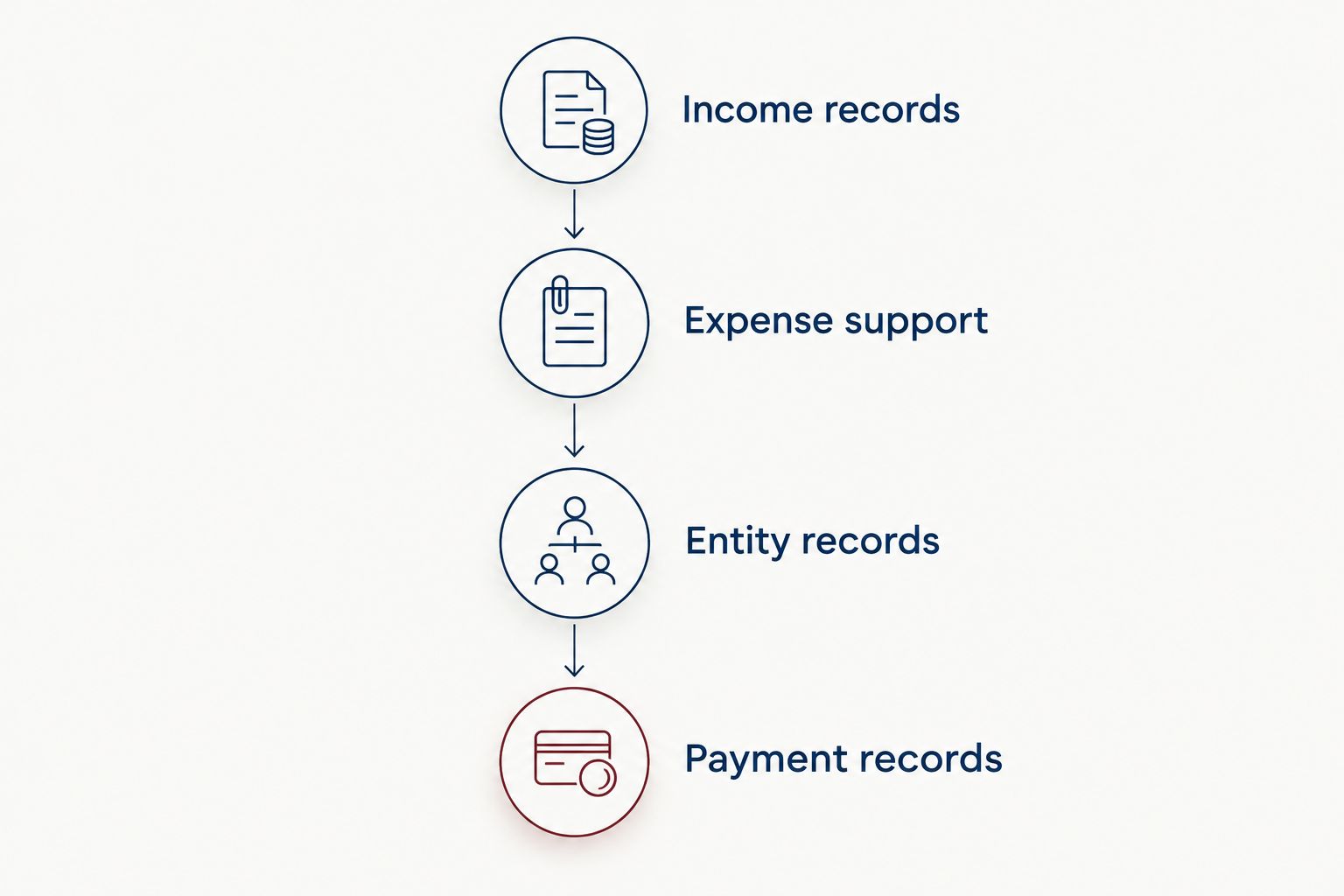
Your 2026 tax file should connect the commercial activity to the accounting records. Organize it in the following sequence so unanswered questions surface before filing.
Income records
Collect platform statements, sponsorship agreements, affiliate reports, invoices, payment-processor reports, and applicable information returns. Include business income even when a payer does not send a form.
Reconcile gross revenue to payouts. A processor deposit after fees is not the same accounting figure as gross customer payments, and an information return can overlap revenue already recorded elsewhere.
Products received as compensation for services generally require income analysis at fair market value. Do not assume that calling an item a gift resolves its treatment; retain the agreement and explain what you were expected to deliver.
Expense support
Gather receipts, invoices, statements, and notes establishing business purpose. Separate personal expenses before handing over the ledger.
Flag cameras, computers, lighting, and other equipment for review rather than assuming every purchase receives the same immediate deduction. Asset treatment depends on the applicable rules and your circumstances.
Entity records
Provide formation documents, tax-election correspondence, ownership information, and payroll records where relevant. Your legal entity name does not establish its federal tax classification.
A creator operating through an S corporation needs reasonable-compensation analysis for services performed. Distributions do not replace wages merely because the owner prefers them.
Payment records
Gather federal and state estimated-payment confirmations, payroll withholding information, and relevant prior-return figures. A transfer into a tax savings account is not a payment to a tax authority.
Confirm the tax period attached to each payment. Money applied to the wrong period needs attention before the return relies on it.
Organize the evidence before asking a preparer to finalize the return.
A useful handoff includes a short list of unresolved items, not just a folder of documents. Identify the transaction, the amount in your records, and the question you need answered.
Creator deductions that need a business explanation
Appearing in content does not automatically make an expense deductible. Federal business deductions generally require ordinary and necessary expenses, with additional rules for particular categories.
- Clothing: Ordinary clothing suitable for everyday wear generally remains personal, even when you wear it while filming. Qualifying costumes and other specialized clothing require separate analysis.
- Travel: Explain the business purpose, itinerary, and allocation of personal activity. A vacation does not become fully deductible because you recorded content during it.
- Home office: The regular-and-exclusive-use requirement generally matters, subject to specific exceptions. A room shared with personal activities needs careful review.
- Phone and internet: Support the business-use allocation rather than treating the entire household bill as business spending.
- Vehicles: Maintain records supporting business mileage or the applicable actual-expense method. Ordinary commuting is generally personal.
For every questionable expense, write down what business activity it supported and retain the evidence. Documentation does not turn a personal expense into a deduction, but missing documentation undermines an otherwise legitimate claim.
Estimated taxes belong beside the filing conversation
For 2026 federal individual estimated taxes, payments are generally required when you expect to owe at least $1,000 in tax after withholding and refundable credits, subject to the applicable payment tests and exceptions.
The general federal underpayment safe-harbor calculation compares 90% of current-year tax with 100% of prior-year tax. For higher-income taxpayers, the prior-year percentage generally becomes 110% when prior-year adjusted gross income exceeds $150,000, or $75,000 for married filing separately; prior-year return requirements also apply.
These are federal payment rules, not a universal percentage of creator revenue. State requirements differ, and payment timing matters. Meeting a safe harbor addresses underpayment penalties; it does not guarantee that nothing remains due with your return.
Review projections when a major sponsorship, launch, or change in withholding changes your income. Uneven earnings deserve attention to payment timing and whether the annualized-income method applies.
How these approaches are ranked
The ranking prioritizes scope fit: income reconciliation, supported deductions, correct entity treatment, planning coordination, and clear responsibility. It does not claim that one provider produces a particular refund or tax reduction.
Coordinated service ranks first for creators who need several connected functions. Preparation-only service wins when the upstream work is complete. Self-directed filing fits the narrowest situation: reliable records and straightforward reporting you understand.
Which approach should you choose?
Choose coordinated support when your unanswered questions extend beyond the return. A filing appointment cannot substitute for unfinished books, unreviewed payroll, or decisions that required action earlier in 2026.
Choose preparation-only service when your books are complete and planning has a separate owner. Choose self-directed filing only when you can defend the reporting treatment, not simply complete the software prompts.
Ask for a written division of responsibilities before work begins. You should know what you must deliver, what the preparer will review, and which questions sit outside the engagement.
FAQ
What's the best tax preparation approach for content creators?
Coordinated tax preparation, bookkeeping, and planning is the best fit when a creator needs help with all three functions. CEOHAVEN offers those services and explicitly serves content creators; preparation-only service fits businesses whose records and planning are already handled.
Do I report creator income if I never receive a 1099?
Yes, report taxable business income even when no payer sends an information return. Use invoices, platform statements, and payment records to establish complete revenue without counting overlapping reports twice.
Are products I receive from brands taxable?
Products received as compensation for services generally require income analysis at fair market value. Keep the agreement and document any posting or promotional obligations; the label gift does not determine tax treatment.
Can influencers deduct clothes they wear in videos?
Ordinary clothing suitable for everyday wear generally is not deductible merely because it appears in videos. Specialized costumes and qualifying work clothing require a separate analysis of the applicable rules.
Does forming an LLC mean I file an S corporation return?
No, forming an LLC does not by itself create S corporation tax treatment. Ownership, default classification, and valid tax elections determine the federal filing requirements.
Should I use my bank deposits as total creator revenue?
Not without reconciling deposits to gross revenue, fees, refunds, and other adjustments. Net payouts and information returns can describe different parts of the same transactions.
How much should a content creator set aside for taxes?
Base the reserve on a tax projection rather than a universal percentage of revenue. Filing status, deductions, other income, withholding, entity treatment, and state obligations affect the amount.
One last thing
Before approving your 2026 return, ask for a revenue bridge: gross earnings, adjustments, and deposits explained in one place. If those figures do not reconcile, resolve the difference before signing.
A smaller unexplained discrepancy is still unexplained. Precision starts with the books, not the filing confirmation.