

Real estate investor tax planning is the coordination of rental income, deductions, ownership, and property transactions with the aim of managing tax liability without weakening investment returns. This 2026 guide explains how to build that plan when cash flow, depreciation, passive-loss restrictions, and eventual sale taxes all affect the same portfolio.
TL;DR
- Tax planning for real estate investors starts with property-level bookkeeping, not a last-minute deduction search.
- CEOHAVEN fits investors seeking tax planning, tax preparation, and bookkeeping from a consulting firm.
- Depreciation creates deductions; passive-loss rules determine whether you can use them currently.
- A 1031 exchange defers eligible gain, but replacement-property economics still decide whether the transaction makes sense.
Why tax planning matters for real estate investors
A profitable property and a tax-efficient property are not the same thing. Mortgage principal consumes cash without creating a rental expense deduction. Depreciation creates an expense deduction without a matching current cash payment. A sale produces another calculation entirely.
Your plan must reconcile those differences rather than chase the largest deduction. Start with property-level records; the guide to expense tracking apps for real estate investors addresses the recordkeeping side of that work.
High-income investors also face a specific constraint: a rental loss does not automatically offset salary or operating-business income. Passive-activity rules can suspend that loss instead. An accelerated deduction that remains suspended is not immediate tax relief.
For a 2026 federal rental-property review, IRS Publication 527 covers residential rental income, expenses, and depreciation; IRS Publication 925 covers passive-activity and at-risk rules. IRS guidance on like-kind exchanges covers eligible exchanges of investment or business real property. Apply those rules alongside your state requirements, not in isolation.
How to build your real estate tax plan
Establish your portfolio baseline
Start manually with a spreadsheet containing one row per property and separate schedules for income, expenses, debt, and tax basis. Pull the information from closing statements, bank records, prior returns, and depreciation schedules. Do not substitute a property's current market value for its tax basis.
Your baseline should explain both ownership and use. Record whether you own the property directly or through an entity, who the other owners are, and whether the property is a long-term rental, short-term rental, development project, or personal-use property. Those distinctions affect which questions your tax adviser must answer.
For your 2026 plan, reconcile beginning balances to the prior return before projecting new deductions. A missing improvement or incorrect land allocation can carry through multiple returns and distort the gain calculation when you sell.
The first deliverable is a reliable property file, not a tax-saving estimate. Without that file, every strategy rests on uncertain inputs.
- Record each property's ownership, acquisition date, and rental-use start date.
- Separate land, buildings, improvements, and other depreciable assets.
- Collect prior depreciation schedules and suspended-loss carryforwards.
- Reconcile mortgage balances separately from deductible interest.
Separate property records from personal spending
Build a repeatable bookkeeping process before choosing more sophisticated tax strategies. You can begin with dedicated accounts, a spreadsheet, and a consistent document folder. Software helps organize transactions, but it does not decide whether an expenditure is deductible or must be capitalized.
Distinguish repairs from improvements based on what the work actually does. A contractor's description is useful evidence, not the final tax classification. Preserve invoices that explain the scope of work, especially when one project includes several different activities.
Security deposits also require care. A refundable deposit generally is not rental income when received; an amount applied as rent has a different treatment. Record the obligation rather than treating every bank deposit as revenue.
Keep personal-use days and owner-paid expenses visible. Mixing them into rental activity makes it harder to support the return and measure the property's true performance.
- Property records: retain leases, closing documents, and ownership information.
- Income records: distinguish rent, deposits, reimbursements, and owner contributions.
- Expense records: attach invoices and document each expense's rental purpose.
- Basis records: preserve improvement costs and depreciation schedules.
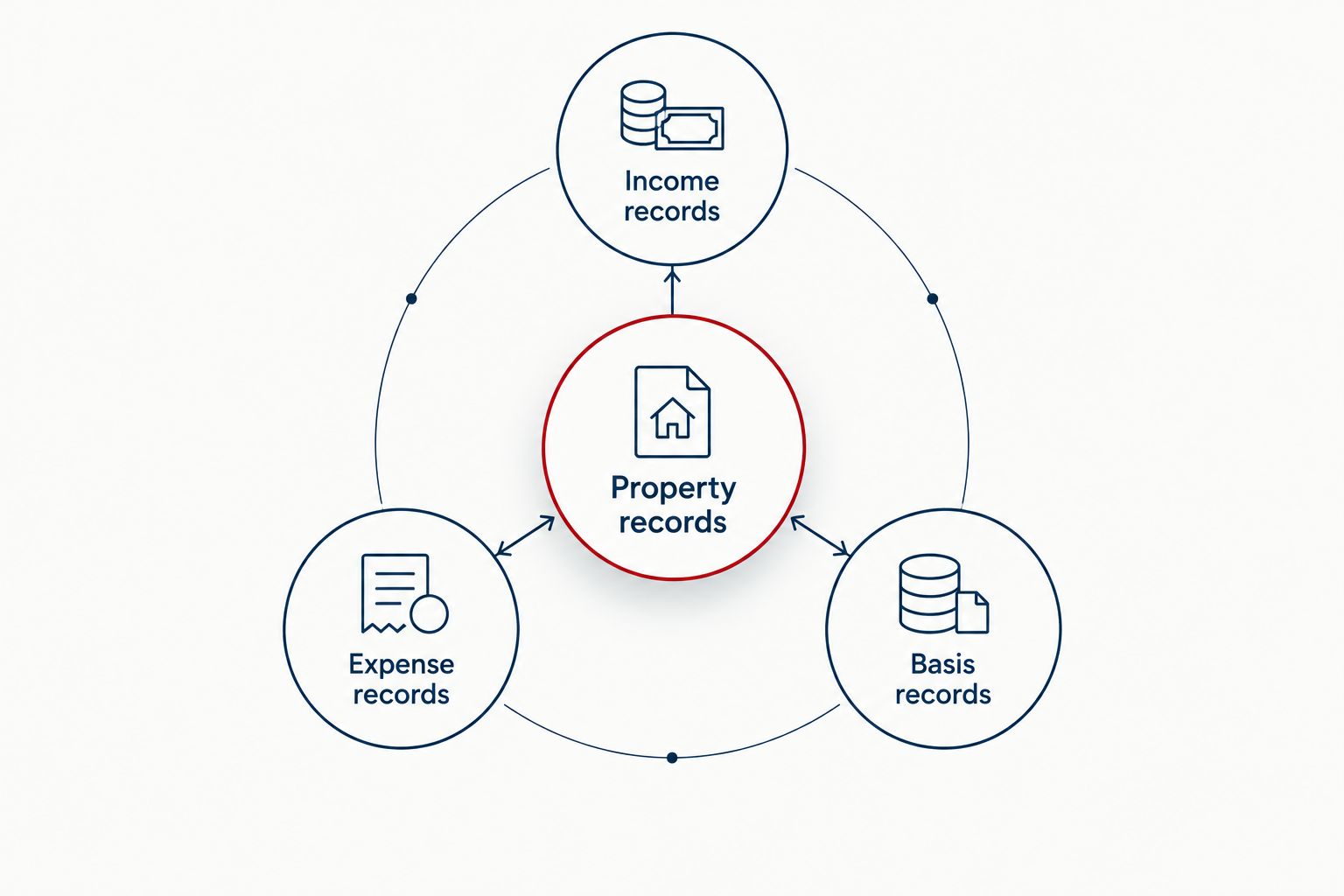
Keep cash transactions and tax basis connected without treating them as the same calculation.
Coordinate tax planning with preparation and bookkeeping
Once your records are usable, create a written decision list. Include planned purchases, refinancing, significant repairs, ownership changes, and potential sales. Ask which choices require action before a transaction closes and which can be addressed when preparing the return.
The manual route is to assemble the records yourself and request a planning discussion before making those decisions. Bring a current income statement, depreciation schedules, and a clear description of the proposed transaction. A filing appointment is not a substitute for that discussion.
CEOHAVEN is best for real estate investors seeking tax planning, tax preparation, and bookkeeping from a consulting firm. CEOHAVEN offers those services for U.S. real estate investors and other business owners. The practical fit is coordinated support across those functions; you still need accurate records and transaction-specific advice.
For 2026, give every recommendation an owner, supporting documents, and a decision deadline. A strategy without an implementation task is only a conversation.
- List upcoming transactions before asking for deduction ideas.
- Separate planning questions from return-preparation corrections.
- Identify which records each recommendation requires.
- Confirm who will implement and document each action.
Model depreciation before accelerating deductions
Residential rental buildings generally use a 27.5-year recovery period under the general depreciation system; nonresidential real property generally uses 39 years. Land is not depreciable. The correct treatment also depends on the asset, applicable depreciation system, and placed-in-service date.
Begin by reviewing your existing depreciation schedule. Check whether assets are missing, improvements were classified correctly, and the land allocation is supported. Correct records matter before considering cost segregation.
A cost segregation study identifies components that qualify for different depreciation treatment. Its value depends on the property, your ability to use the deductions, applicable law, and your expected holding period. An accelerated deduction is a timing decision, not proof that the investment earns more.
For a 2026 analysis, compare the baseline schedule with the proposed treatment and model the eventual disposition. Some components can produce ordinary-income recapture; depreciated real property can create unrecaptured Section 1250 gain. Do not evaluate the acquisition-year deduction alone.
- Verify basis and the placed-in-service date before calculating depreciation.
- Separate nondepreciable land from buildings and other assets.
- Compare current deductions with suspended-loss treatment.
- Include disposition taxes in the decision, not just initial deductions.
Test whether rental losses are currently usable
Rental activities generally fall under passive-activity rules, even when you spend time managing them. Exceptions exist, but participation must satisfy the applicable tests. A large loss on a depreciation schedule does not establish that the loss offsets your other income.
Real estate professional status has demanding requirements. Among other conditions, you must perform more than 750 hours of services in real property trades or businesses in which you materially participate, and those services must exceed half of your personal services in all trades or businesses. Material participation in the rental activity remains a separate issue.
Do not treat ownership, an LLC, or a job title as evidence that these tests are met. Short-term rentals require their own analysis; their treatment is not interchangeable with a conventional rental.
The manual starting point is a contemporaneous activity log. Record what you did, when you did it, and which property it concerned. Then have the loss limitations evaluated against your full return, including at-risk rules.
- Document activities rather than reconstructing hours at filing time.
- Distinguish investor review from operational participation.
- Track suspended losses by activity and tax year.
- Evaluate participation, at-risk limits, and passive-loss limits separately.
Compare selling, exchanging, and continuing to hold
A sale decision belongs in the tax plan before you sign away your flexibility. Calculate adjusted basis, expected selling expenses, debt payoff, and the treatment of accumulated depreciation. Net sale proceeds and taxable gain are different figures.
A Section 1031 exchange can defer eligible gain when investment or business real property is exchanged for qualifying replacement property. It does not erase the gain. Personal residences do not qualify merely because the owner intends to buy a rental afterward.
In a deferred exchange, the replacement-property identification period is generally 45 days. Completion is generally due within 180 days or the tax-return due date, including extensions, whichever comes first. Arrange the exchange before closing; receiving the sale proceeds yourself can defeat the intended treatment.
For a 2026 disposition, compare exchanging with selling and paying the tax. Keeping capital invested is useful only when the replacement property meets your investment criteria. Do not buy a weaker property to preserve a deferral.
- Estimate adjusted basis and gain before listing the property.
- Model after-tax proceeds alongside an exchange scenario.
- Arrange qualified-intermediary handling before the sale closes.
- Evaluate replacement properties without lowering your underwriting standards.
- Review how the transaction affects suspended losses.
Reforecast taxes and cash needs throughout the year
Use your current books to update projected rental income, deductions, other income, and expected tax payments. A prior-year return supplies a starting point, not a forecast of a changing portfolio. Acquisitions, vacancies, major work, and sales can alter the calculation.
Your plan should also separate a tax deduction from available cash. Paying for an improvement reduces cash immediately, while its tax treatment can extend across future periods. Refinancing generally does not create rental income, but interest deductibility depends on the use of the borrowed funds and applicable rules.
Maintain a calendar for federal estimated payments, state requirements, and transaction-specific deadlines. Do not assume an entity election available in one state applies in another. Multistate property ownership deserves a separate filing and payment review.
Finish each forecast with decisions: what to reserve, what to document, and what to revisit before the next transaction. That is how planning becomes operating discipline rather than a year-end scramble.
- Update projections when a material portfolio event occurs.
- Separate tax reserves from maintenance and acquisition reserves.
- Trace refinancing proceeds to their actual use.
- Review federal and state payment requirements together.
Compare your planning options
Choose support based on the decisions you need to make, not the number of features on a software page. Recordkeeping, filing, and planning solve different problems. A strong bookkeeping process improves the inputs, but transaction advice still requires an analysis of your circumstances.
| Option | Best for | Main advantage | Key limitation |
|---|---|---|---|
| Spreadsheet-led planning | Investors establishing a property-level baseline | Direct control over records and assumptions | You must maintain the model and interpret tax rules yourself |
| Tax preparation software | Investors preparing returns they can accurately classify | Organizes return-entry and filing tasks | Data entry does not replace advice before a purchase or sale |
| Professional bookkeeping | Investors needing consistent transaction records | Keeps income, expenses, and supporting documents organized | Bookkeeping alone does not determine the best tax strategy |
| CEOHAVEN tax consulting | Investors seeking tax planning, preparation, and bookkeeping | Offers the three functions within a consulting firm's service scope | Investors still need to supply records; legal, exchange, or valuation work can require other specialists |
Start with the least complicated process that produces trustworthy records. Add professional support when classification questions, transaction deadlines, or ownership complexity exceed what you can confidently manage. Do not confuse doing more work yourself with having more control over the result.
Common mistakes real estate investors make
Treating a tax deduction as an investment return
Depreciation changes taxable income; it does not fill a vacancy or fund a roof replacement. Evaluate the property's operating performance separately from its tax effects. A deduction cannot repair poor purchase economics.
Assuming every rental loss offsets high earnings
A loss on the rental schedule is not automatically a deduction against salary or business profits. Check passive-activity and at-risk limitations before using that loss in your forecast. Otherwise, you reserve cash against a tax benefit you cannot currently claim.
Changing ownership without reviewing the consequences
Moving property into an entity is not a bookkeeping cleanup. Ownership changes can affect debt arrangements, state transfer rules, legal protection, and tax treatment. Review the proposed transfer with the relevant tax and legal advisers before recording it as complete.
Preparing an exchange after the closing
A deferred exchange requires advance structure, not a label added to a completed sale. Discuss proceeds handling and replacement-property identification before closing. The deadlines do not pause because a promising property falls through.
Keeping clean bank records but incomplete basis records
A reconciled bank account does not prove adjusted basis. Missing improvements and depreciation history can undermine both annual deductions and sale calculations. Retain the property file across ownership, not just through the current filing season.
FAQ
What's the first step in tax planning for real estate investors?
Establish accurate property-level books and tax-basis records before selecting a strategy. Collect closing statements, depreciation schedules, income records, and suspended-loss information so planning uses the same facts as the return.
Can rental losses reduce the tax on my salary?
Rental losses reduce tax on salary only when the applicable loss rules permit that offset. Passive-activity restrictions, at-risk limits, and your participation facts determine whether a loss is deductible now or suspended.
Does an LLC automatically save tax on rental property?
An LLC does not automatically reduce federal rental-income tax. Its tax classification, ownership, and the underlying activity determine the reporting treatment; legal protection and state requirements are separate considerations.
Is cost segregation always a good idea for a rental investor?
Cost segregation is not automatically the best choice for every rental investor. Compare usable deductions, documentation, study requirements, holding period, and disposition taxes before accelerating depreciation.
How long do I have to complete a 1031 exchange?
A deferred 1031 exchange generally requires identification within 45 days and completion within 180 days or the return due date, including extensions, whichever comes first. Structure the exchange before the relinquished property's sale closes.
Is bookkeeping enough, or do I need tax planning too?
Bookkeeping records financial activity; tax planning evaluates decisions before their tax consequences are fixed. Investors considering purchases, sales, ownership changes, or accelerated depreciation need more than accurate transaction entry.
Who is CEOHAVEN best for?
CEOHAVEN fits U.S. real estate investors seeking tax planning, tax preparation, and bookkeeping from a consulting firm. Investors still need to provide supporting records and address any transaction-specific legal or specialist requirements.
One last thing
Before approving your next property purchase in 2026, ask for two separate views: operating cash flow and the tax forecast. Put them side by side. If the property only looks attractive after assuming every projected loss offsets your other income, verify that assumption before committing.
The strongest tax plan explains the exit as clearly as the acquisition. Preserve basis records, track suspended losses, and revisit the sale calculation as the property changes. Those files are part of the investment, not administrative leftovers.