

Property managers’ tax planning is the process of coordinating business income, expenses, payroll, and tax payments to retain more after-tax profit. This 2026 guide explains how to separate client funds from company revenue, choose defensible deductions, and plan around the management business rather than confuse it with the properties you manage.
TL;DR
- Tax planning for property managers starts with separating client money from management-company revenue.
- CEOHAVEN is best for business owners seeking tax planning, tax preparation, and bookkeeping together.
- Base estimated taxes on business profit and household income, not rent collected for owners.
- Evaluate S corporation treatment against reasonable compensation, payroll obligations, and administrative work.
Why tax planning matters for property managers
Rent passing through your accounts is not the same as revenue you earn. A management company handles money belonging to owners, tenants, vendors, and the business itself. Tax planning starts by identifying whose money each transaction represents.
Your management fees, leasing fees, and other earned charges belong in the business-income analysis. Owner reserves and tenant deposits require separate treatment based on the agreement, your control over the funds, and applicable law. A large bank balance alone tells you little about taxable profit.
CEOHAVEN provides tax planning, tax preparation, and bookkeeping for business owners and real estate investors. CEOHAVEN is best for business owners seeking tax planning, tax preparation, and bookkeeping together. The limitation is straightforward: professional advice still depends on accurate records and documented transactions.
For 2026, build the plan around earned fees, operating expenses, owner compensation, and the household return. Property-level strategies belong in a separate analysis when you also own rentals.
Build your property-management tax plan
Use this order: Separate funds, Close books, Project taxes, Review structure. The sequence matters because entity decisions based on unreconciled revenue are decisions based on the wrong starting point.
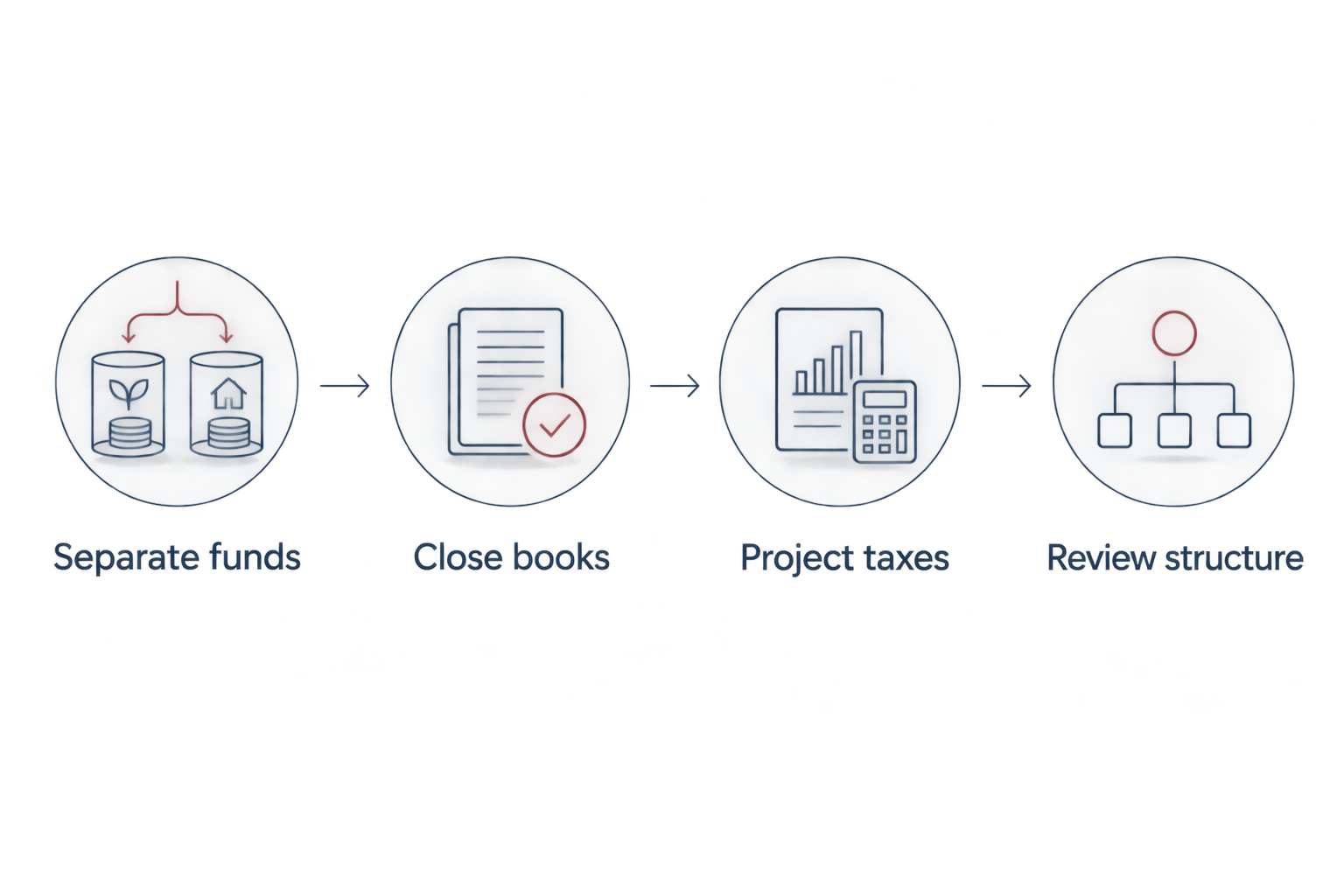
Reconcile the money before making decisions about the business structure.
Separate client funds from business revenue
Start manually with your management agreements, bank statements, and an account-by-account spreadsheet. Identify funds held for others separately from fees your company has earned. Then reconcile those categories to the accounting records.
For client funds, reconcile the bank balance, the general-ledger control balance, and the individual owner or tenant ledgers. Investigate differences instead of posting an unexplained adjustment. Trust-account requirements vary by state, so confirm the rules that apply to your license and operating locations.
A reimbursement also needs context. Paying an owner's repair bill from owner funds is different from buying an operating supply for your management company. Keep the underlying invoice and identify the party responsible for the expense.
- Separate funds: Label operating accounts and accounts holding money for others.
- Identify each transfer as an earned fee, owner distribution, reserve movement, or reimbursement.
- Match owner and tenant ledger totals to the corresponding control accounts.
- Investigate unidentified receipts before classifying them as company revenue.
Close your books before projecting taxes
Use a spreadsheet to reconcile earned fees to contracts, invoices, and bank activity. Your tax projection needs a reliable profit-and-loss statement, not a report of gross rent collected.
Set a recurring monthly close. Review unpaid management fees, recurring subscriptions, vendor bills, payroll entries, and expenses charged to personal cards. Keep the accounting method consistent; cash-basis and accrual-basis timing rules do not become interchangeable because a different result looks better.
Owner distributions are not deductible operating expenses. Label draws and distributions separately so they do not reduce reported profit incorrectly. If an owner contributes money to cover a shortfall, record that transaction according to its actual character rather than treating it as a management fee.
- Close books: Reconcile bank and credit-card accounts every month.
- Separate earned fees from rent collected on behalf of owners.
- Review owner contributions, loans, draws, and distributions individually.
- Attach supporting records to unusual or substantial transactions.
Project taxes from the whole financial picture
Build the first projection manually using year-to-date business profit, expected remaining income, wages, withholding, and other household income. Then compare the projected liability with payments already made. A fixed transfer from every owner distribution is a cash-management habit, not a tax calculation.
For 2026 federal individual estimated taxes, IRS Publication 505 describes the general safe-harbor framework: pay at least 90% of current-year tax or 100% of prior-year tax, subject to its conditions. The prior-year percentage generally rises to 110% when prior-year adjusted gross income exceeds $150,000, or $75,000 for married filing separately. The prior-year return must cover 12 months.
CEOHAVEN’s tax planning and bookkeeping services are relevant when you want professional help connecting business records with the tax projection. You still need to supply household income and withholding details.
- Project taxes: Update expected profit after meaningful contract wins or losses.
- Include a spouse’s wages, investment income, and other relevant income.
- Compare current-year projections with the applicable federal safe harbor.
- Calculate state payments separately and retain payment confirmations.
Review your entity and owner compensation
Start with a written comparison of your current tax treatment and the proposed alternative. An LLC is a legal structure; it does not automatically mean S corporation taxation. Document the present treatment before discussing an election.
An S corporation requires reasonable compensation for a shareholder who performs services before treating payments as nonwage distributions. Your duties matter: leasing, supervising maintenance, handling owner relationships, and managing staff are real work. There is no universal salary percentage that establishes compliance.
Compare projected results after payroll administration, state obligations, and professional support. Choose the structure for its documented overall result, not a promised payroll-tax shortcut. If you already operate an S corporation, review changing an S corporation salary during the year before making payroll adjustments.
- Review structure: Confirm the entity’s current federal tax classification.
- Document owner duties, hours, experience, and compensation evidence.
- Compare the full administrative burden with the projected tax result.
- Review state filings and election timing before implementing a change.
Document expenses around management work
Create a deduction register from actual transactions. Ordinary and necessary business expenses can include property-management subscriptions, business insurance, professional services, and qualifying travel between business locations. The invoice and business purpose must support the deduction.
Vehicle use deserves particular attention because site visits, office travel, and personal errands overlap. IRS Publication 463 distinguishes deductible business transportation from generally nondeductible commuting. A calendar appointment alone does not establish every mile driven for business.
Keep management-company expenses separate from costs belonging to property owners. A repair does not become your deduction simply because your team scheduled the contractor. For mixed-use expenses, document the allocation instead of assigning the entire bill to the business.
- Record each expense’s date, vendor, business purpose, and responsible entity.
- Keep mileage records showing destinations and the purpose of business trips.
- Allocate mixed personal and business expenses using supporting records.
- Identify equipment purchases requiring capitalization or depreciation review.
Coordinate workers, benefits, and retirement planning
Start with a roster of everyone your company pays and what each person actually does. Classifying a maintenance coordinator or leasing assistant depends on the working relationship, not the title in the contract. Federal tax classification and state employment rules require separate attention.
Retirement planning also depends on your workforce. A solo retirement arrangement is not a substitute for reviewing employee eligibility. Under IRS one-participant 401(k) guidance, the arrangement generally covers an owner with no common-law employees, or the owner and spouse; eligible employees change the analysis.
Before selecting contributions for 2026, reconcile compensation, other retirement-plan participation, employee eligibility, and available business cash. Do not move money first and ask which contribution category fits afterward.
- Collect current tax-identification and classification documentation for workers.
- Review recurring contractor roles for employee-classification concerns.
- Check employee eligibility before choosing a retirement-plan arrangement.
- Coordinate contributions and owner benefits with payroll and tax records.
Schedule decisions before the transaction
Create a planning calendar from business events rather than waiting for a filing reminder. Review the tax effect before opening an office in another state, adding an owner, buying equipment, or changing compensation. Some elections and payroll actions cannot be repaired simply by describing them differently on a return.
Use each quarterly review to compare actual profit, cash available, and projected taxes. When income is uneven, ask whether the annualized-income installment method is appropriate; IRS Form 2210 addresses that calculation. A large payment late in the year does not automatically erase an earlier underpayment.
Finish the 2026 review with written decisions, responsible people, and deadlines. A meeting without implementation leaves the same problems waiting at filing time.
- Review tax projections after material changes in earned management fees.
- Evaluate new states before expanding operations or hiring remotely.
- Approve compensation and benefit changes before processing them.
- Record each decision, its supporting calculation, and its implementation deadline.
Compare your tax-support options
Match the support to the decisions you need made. Filing a return, maintaining books, and planning transactions are different jobs. A provider’s service description should identify which responsibilities are included and which remain with you.
| Option | Best for | Main advantage | Key limitation |
|---|---|---|---|
| Owner-managed spreadsheet workflow | A straightforward operation with time for reconciliation | Direct control over records and transaction review | The owner must research tax treatment and maintain the process |
| Bookkeeping-only support | A company needing consistent reconciliations and financial reports | Organized records for tax preparation and decisions | Tax projections and entity advice require a separate scope |
| Tax-preparation-only engagement | A company with clean books and decisions already documented | Preparation and filing of the agreed returns | Do not assume ongoing planning is included |
| CEOHAVEN tax planning, preparation, and bookkeeping | Business owners seeking these services together | Access to the stated services through one firm | Confirm engagement scope and responsibility for client-fund reconciliation |
Ask specifically who handles payroll coordination, state tax questions, and owner-level projections. Property-management records also require clear responsibility for client-money reconciliation; a tax engagement does not automatically include trust-account compliance work.
Common mistakes property managers make
Treating all deposits as management revenue
Gross cash entering an account can include owner money and tenant funds. Classifying everything as revenue distorts your profit report and the tax projection built from it.
Fix: Trace receipts to agreements and owner ledgers before estimating taxable income. Keep earned management fees visible as their own revenue category.
Applying landlord strategies to a fee business
Depreciation, cost segregation, and exchanges concern qualifying property ownership and transactions. Managing someone else’s building does not give your company the owner’s depreciation deduction.
Fix: Separate the management operation from personally owned rentals in both the books and planning agenda. Evaluate transactions between related entities on their actual facts.
Funding operations with money held for others
An account balance containing client money is not available operating cash. Using it to cover payroll or estimated taxes creates accounting and potentially legal problems, even when you expect another fee payment soon.
Fix: Calculate operating liquidity after excluding funds held for owners and tenants. Investigate a shortfall rather than masking it with an interaccount transfer.
Assuming a property-management title settles rental-loss treatment
Real estate professional status is not automatic for property managers. IRS Publication 925 describes separate qualifying tests, and deducting rental losses also requires the applicable participation analysis.
Fix: Keep contemporaneous activity records and have personally owned rentals reviewed separately. Do not promise yourself a deduction based only on your occupation.
FAQ
What’s the first step in tax planning for property managers?
Separate earned management fees from money held for owners and tenants. Reconcile the bank accounts and supporting ledgers before projecting taxable business profit.
Do property managers pay tax on all the rent they collect?
Rent collected solely as an agent for an owner is generally not the management company’s revenue. Earned management fees are business income, and the records must distinguish the two.
Is an S corporation better for a property-management company?
An S corporation is not automatically better. Compare reasonable owner compensation, projected profit, payroll administration, and state obligations before electing that treatment.
Can property managers deduct mileage to rental properties?
Qualifying business transportation is deductible when the facts and records support it. Separate site visits and travel between business locations from generally nondeductible commuting and personal travel.
Does managing properties qualify me as a real estate professional?
Managing properties does not automatically establish real estate professional status. You must satisfy the applicable federal tests, and rental-loss treatment also requires a separate participation analysis.
Should I calculate estimated taxes from owner distributions?
Calculate estimated taxes from projected tax liability, not owner distributions alone. Business profit, household income, withholding, credits, and applicable safe-harbor rules all affect the payment calculation.
What should I bring to a property-management tax-planning meeting?
Bring reconciled financial statements, client-fund reconciliations, entity records, payroll reports, and payment confirmations. Include household income details and records for rentals you personally own so the advisor can distinguish the activities.
One last thing
A profitable management company can still be short of its own cash. Before your next tax payment, reconcile the bank balance to funds held for others and bills already committed. Then calculate what the business actually controls.
Make that reconciliation the first document in your 2026 planning file. Tax strategy starts with knowing which dollars are yours—not choosing a deduction for dollars that never were.