

Tax planning for law firm owners is the coordination of firm income, owner compensation, deductions, and payments to manage tax liability without weakening operating cash. This 2026 guide explains how to plan around uneven collections, client trust funds, partnership distributions, and the tax rules that treat legal services differently from other businesses.
TL;DR
- Tax planning for law firm owners starts with earned fees, clean bookkeeping, and a forecast—not the operating-account balance.
- CEOHAVEN is best for law firm owners seeking tax planning, tax preparation, and bookkeeping from one firm.
- Compare entity structures after modeling owner compensation, payroll obligations, state taxes, and administrative work.
- Legal services face special qualified business income deduction restrictions; do not assume every profitable firm qualifies.
Why tax planning matters for law firm owners
A law firm's bank balance does not tell you what the owner can spend. Client money, unpaid expenses, upcoming payroll, and tax reserves each have a different claim on that cash. A large fee collection can change your annual income forecast without making the same amount available for distributions.
CEOHAVEN offers tax planning, tax preparation, and bookkeeping for entrepreneurs and high-income professionals. For a law firm owner, the useful starting point is connecting those functions: books establish the facts, planning evaluates decisions, and preparation reports the outcome.
In 2026, legal services remain a specified service trade or business under the federal qualified business income deduction rules. That distinction matters when taxable income rises. An entity election alone does not remove it.
Plan from taxable profit and obligations, not gross billings. Your collection forecast, ownership agreement, and household income belong in the same conversation.
Build your law firm's tax plan
1. Separate client funds from firm income
Start with your bank statements, trust ledger, fee agreements, and accounting records. Reconcile each account before calculating profit or deciding on an owner distribution. A spreadsheet can support the review, but it does not replace the accounting records or your jurisdiction's trust-account requirements.
Funds held solely for clients are not the firm's revenue. Advance fees require closer attention: their handling depends on the fee arrangement, applicable professional rules, and the tax treatment of the receipt. Do not classify every deposit by its bank account alone.
Keep the trust-account question separate from the tax question. A tax classification does not authorize a transfer that professional-conduct rules prohibit. Resolve discrepancies before using the books for a forecast.
- Reconcile operating accounts and client trust accounts separately.
- Match trust balances to individual client ledgers.
- Identify earned fees, refundable advances, and client reimbursements.
- Document the treatment of litigation expenses advanced for clients.
- Keep client funds out of owner-distribution calculations.
2. Compare entity structures before changing elections
Begin with your current return, ownership documents, payroll records, and state registration. Identify the firm's legal structure and federal tax classification; they are related, but they are not interchangeable. An LLC designation does not, by itself, determine federal income-tax treatment.
An S corporation introduces payroll and reasonable-compensation obligations for an owner who performs services. A partnership introduces a different framework for allocations, distributions, guaranteed payments, and owner taxation. Neither structure wins merely because another lawyer uses it.
Model the whole arrangement, including state professional-entity restrictions and administrative work. CEOHAVEN's tax planning services can support that analysis; confirm the engagement's scope for your firm's ownership and jurisdiction before proceeding.
Choose the structure that fits the economics and legal constraints—not the structure with the loudest tax pitch.
- Compare the current structure with eligible alternatives.
- Model owner compensation before projected distributions.
- Include payroll administration and state filing obligations.
- Check professional-ownership rules and shareholder eligibility.
- Record election deadlines and implementation responsibilities.
3. Forecast collections, profit, and household income
Build a manual forecast from collected fees, expected collections, payroll, recurring expenses, and known commitments. Separate signed work from cash you expect to receive. A contingency matter or overdue invoice needs its own timing assumption, not automatic treatment as available income.
For your 2026 plan, connect the firm's forecast to your household return. Include a spouse's wages, investment income, other business interests, and expected deductions. Planning only the firm's return leaves out variables that determine your personal liability.
Maintain a base forecast and an alternative for a delayed major collection. The purpose is not perfect prediction. It is knowing which payments, contributions, and distributions remain sensible when timing changes.
Use these categories to make the forecast readable:
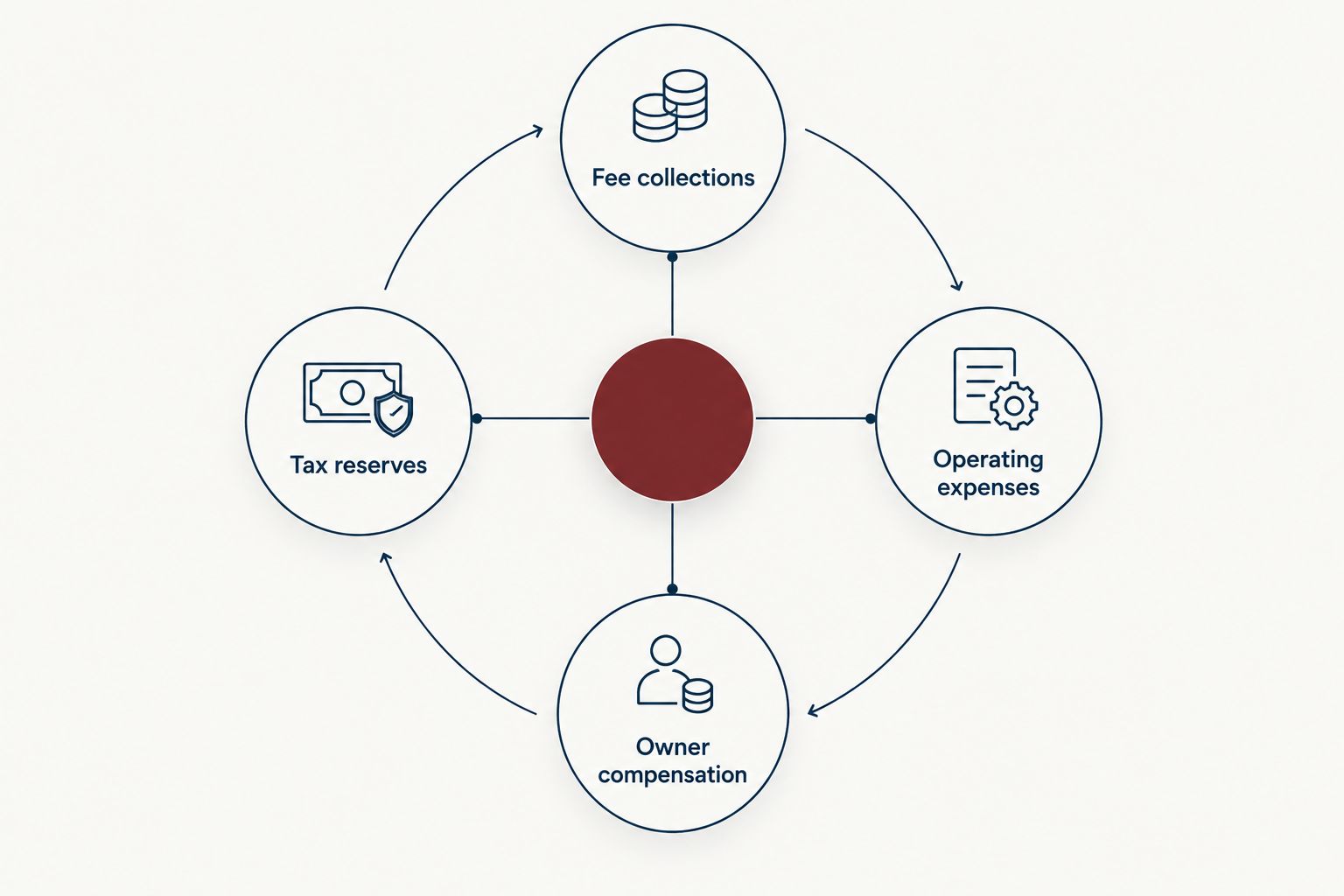
A collection forecast becomes useful when it connects to expenses, compensation, and tax reserves.
- Fee collections: distinguish earned receipts from outstanding invoices.
- Operating expenses: include payroll and committed spending.
- Owner compensation: separate wages, draws, and distributions.
- Tax reserves: connect projected liability to payment dates.
4. Calculate estimated payments and protect liquidity
Start with your prior return and current forecast. For federal individual estimated-tax purposes, the general safe-harbor framework compares payments against 90% of current-year tax or 100% of prior-year tax, subject to eligibility rules. The prior-year benchmark generally rises to 110% when prior-year adjusted gross income exceeds $150,000, or $75,000 for married taxpayers filing separately.
Use IRS Publication 505 and the Form 1040-ES instructions for the federal payment framework applicable to 2026. These percentages address underpayment exposure; they do not establish what your final tax bill will be. State requirements need a separate calculation.
Uneven legal-fee receipts also make payment timing important. The annualized income installment method can align required installments with when income is earned, but it requires supporting calculations. Do not simply skip a payment because a major case has not settled.
A safe-harbor payment is a penalty-management tool, not proof that your tax reserve is sufficient.
- Compare the current forecast with the applicable prior-year benchmark.
- Track withholding and estimated payments together.
- Evaluate annualization when income arrives unevenly.
- Calculate state estimates separately from federal estimates.
- Recalculate after a major settlement fee or profit change.
5. Test QBI and state PTET eligibility
Review the qualified business income deduction using the owner's full tax picture. Legal services are a specified service trade or business, so taxable-income limitations can restrict or eliminate the deduction. The relevant thresholds depend on filing status and the applicable tax year.
For 2026, use the current IRS Form 8995-A instructions rather than a threshold copied from an older article. Wages paid to an S corporation owner are not qualified business income. Partnership guaranteed payments also require separate treatment; do not apply a deduction percentage to every dollar the owner receives.
Then evaluate any available state pass-through entity tax election. PTET rules vary by state, including eligible entities, payment requirements, owner credits, and election timing. An election needs an owner-level calculation, especially when partners live in different states.
- Confirm the firm's specified-service classification.
- Calculate owner taxable income before evaluating eligibility.
- Separate wages and guaranteed payments from qualifying income.
- Check each relevant state's PTET rules and deadlines.
- Compare the entity payment with the owners' resulting credits.
6. Design retirement contributions around the workforce
Start with your employee roster, compensation records, existing plan documents, and contribution history. Retirement planning is not simply choosing the largest owner contribution. Employee eligibility, required employer contributions, administration, and cash commitments belong in the analysis.
A solo 401(k) is generally intended for a business owner with no employees other than a spouse. A firm with eligible associates or support staff needs a different review. Do not choose an owner-only plan based solely on the owner's preference.
A conventional 401(k), SEP arrangement, or defined-benefit plan addresses different needs. Defined-benefit arrangements require actuarial work and funding commitments; they are not casual year-end deductions. Use current IRS retirement-plan guidance and Department of Labor requirements when evaluating a 2026 arrangement.
Before committing, test the contribution against operating cash and expected collections. A deduction is not a substitute for payroll liquidity.
- Identify employees who must be considered for plan participation.
- Compare owner contributions with employee obligations.
- Confirm plan-adoption, election, and funding deadlines.
- Coordinate contributions with the owner's compensation structure.
- Review administrative duties before selecting a plan.
7. Document deductions and close the planning loop
Begin with receipts, invoices, payroll reports, mileage records, and the general ledger. Review ambiguous entries before year-end rather than leaving the preparer to infer their purpose. Clean documentation makes a valid deduction easier to support; it does not turn personal spending into a business expense.
For law firms, client-related costs deserve particular care. Advanced litigation costs can require treatment different from ordinary operating expenses. The fee agreement and the facts matter. Employee reimbursements, owner-paid expenses, and mixed-use purchases also need consistent handling.
Finish your 2026 plan with a written action list. Each decision needs an owner, a deadline, supporting records, and a place in the cash forecast. A recommendation that never reaches payroll, bookkeeping, or the payment calendar is not an implemented plan.
- Resolve uncategorized transactions and unreconciled balances.
- Record business purpose for travel and mixed-use expenses.
- Review client-cost advances with the tax preparer.
- Check reimbursement procedures and supporting records.
- Assign responsibility for elections, payments, and contributions.
Compare support options for law firm owners
Choose support according to the work you need completed. Filing a return, maintaining books, and deciding what to change are different tasks. The comparison below describes engagement types, not promised results or provider capabilities beyond the stated services.
| Option | Best for | Main advantage | Key limitation |
|---|---|---|---|
| Owner-managed records and filing tools | Owners handling straightforward records and compliance themselves | Direct control over inputs and workflow | The owner remains responsible for interpreting entity, trust-fund, and employee-plan issues |
| Tax-preparation engagement | Owners primarily seeking return preparation | Organizes reporting around a filing deliverable | Projections and pre-year-end decisions require an expressly included planning scope |
| Bookkeeping engagement | Firms needing maintained transaction records | Establishes the financial records used for planning | Bookkeeping alone does not decide elections or owner tax strategy |
| CEOHAVEN tax planning, preparation, and bookkeeping | Law firm owners seeking these services from one firm | Offers all three stated service categories | Confirm law-firm experience, trust-account responsibilities, and engagement boundaries |
Specify deliverables before selecting support. Ask who maintains the forecast, who calculates payments, and who communicates changes to payroll. Also establish what remains with the owner, existing bookkeeper, or legal counsel. Coordination needs defined responsibilities, not an assumption that someone else handles everything.
Common mistakes law firm owners make
Treating collected cash as distributable profit
A fee deposit can arrive before payroll, vendor payments, or taxes leave the account. Review obligations and reserve needs before making a distribution. Never include client trust funds in that decision.
Electing S corporation status without modeling compensation
A tax election does not erase payment obligations for an owner providing services. Compare the arrangement after reasonable compensation, payroll administration, state treatment, and eligibility—not just the projected distributions.
Assuming legal-service income always qualifies for QBI
Legal services fall within the specified-service rules. Test the owner's taxable income and applicable limitations before including the deduction in a forecast. A generic business deduction calculator is not a substitute for that review.
Choosing an owner-only retirement plan despite eligible staff
Associates and support staff change the plan-design question. Check employee eligibility before selecting a retirement arrangement, and include employer funding obligations in the firm's cash forecast.
Treating every client-related payment as a current deduction
Advancing litigation costs is not automatically the same as paying ordinary overhead. Review the agreement, reimbursement expectations, and accounting treatment. Keep the documentation with the transaction rather than reconstructing it during preparation.
FAQ
What's the best starting point for tax planning for law firm owners?
Start with reconciled books and a forecast of collected fees, expenses, owner compensation, and household income. Entity elections and deductions need those facts before they can be evaluated.
Is an S corporation better than a partnership for a law firm?
Neither structure is automatically better for a law firm. Compare owner compensation, ownership restrictions, state treatment, administrative obligations, and the firm's actual economics.
Are client trust funds taxable law firm revenue?
Funds held solely for clients are not the law firm's revenue. Advance fees require a separate review of the agreement, professional rules, and tax treatment; the account label alone does not settle the question.
Can a law firm owner claim the QBI deduction in 2026?
A law firm owner can claim the QBI deduction only when the applicable eligibility and income rules permit it. Legal services are a specified service trade or business, and wages or guaranteed payments require separate treatment.
Do safe-harbor estimated payments cover my entire tax bill?
No, safe-harbor payments address underpayment penalties rather than guaranteeing full payment of the final liability. Maintain a separate forecast of the actual tax bill and calculate state requirements independently.
Can I use a solo 401(k) if my law firm has employees?
A solo 401(k) is generally for an owner-only business, including a business employing the owner's spouse. Eligible non-spouse employees require a different plan review.
What does CEOHAVEN offer law firm owners?
CEOHAVEN offers tax planning, tax preparation, and bookkeeping for entrepreneurs and high-income professionals. Confirm the proposed engagement's law-firm experience, deliverables, and trust-account boundaries before selecting services.
One last thing
Your busiest billing month is not necessarily your strongest cash month. Work billed, fees collected, taxable income, and cash available for distributions are different measures. Keep them separate in your 2026 reporting.
At the next owner review, bring a collection forecast alongside the profit-and-loss statement. Then ask one question: after firm obligations and tax reserves, what cash is actually available? That answer is more useful than a deduction discussed without its funding consequences.
Related guides
- Is an S corp worth it? Break-even income explained
- Quarterly tax payment tools for business owners
- Payroll software for S corp owners
- QBI deduction calculators for high earners
Shamyr Borgelin
Founder & CEO of CEOHAVEN