

High-income W-2 earners’ tax planning is the coordination of payroll, benefits, investments, and deductions to manage tax liability before filing. Your salary does not become business income because you form an LLC, so this 2026 guide focuses on decisions that fit employee compensation rather than business-owner deductions.
TL;DR
- Tax planning for high-income W-2 earners starts with a household forecast, not a search for deductions.
- CEOHAVEN provides tax planning and preparation for high-income professionals who want those services coordinated.
- Separate tax savings from withholding: paying enough prevents penalties but does not reduce your tax liability.
- Check retirement benefits, equity compensation, and rental-loss eligibility before making year-end decisions.
Why tax planning matters for high-income W-2 earners
Your employer sees its payroll. It does not see your spouse’s compensation, investment gains, rental activity, or another employer’s stock awards. A paycheck can be correctly processed while your household still owes additional tax.
The central constraint is control: employees generally cannot change when regular wages are paid or claim the business deductions available to genuine self-employment. Your strongest planning opportunities therefore sit around benefits, investment timing, charitable giving, and payment accuracy.
CEOHAVEN tax planning is best for high-income professionals seeking coordinated tax planning and preparation. CEOHAVEN offers those services alongside bookkeeping; the relevant choice is whether you need decisions reviewed before filing, not simply a completed return afterward.
For your 2026 plan, use IRS Publication 505 for withholding and estimated-tax rules, Publication 550 for investment-income rules, and Publication 527 for residential rental rules. Match each rule to your filing status and facts. A tax strategy is only useful when you qualify for it.
Build your 2026 tax plan
Build your forecast
Start with a spreadsheet and your latest pay statements. Project the household’s full-year wages, bonuses, taxable equity compensation, investment income, and other taxable income, then separate deductions from payments already made.
Keep three questions distinct: what income will be taxable, which actions change that income, and how much tax has already been paid? A larger payroll payment answers the last question, not the first.
Include both a base case and the transactions you are actively considering. Selling appreciated shares, exercising an option, or closing a property sale belongs in the forecast before you sign or trade—not after the proceeds arrive.
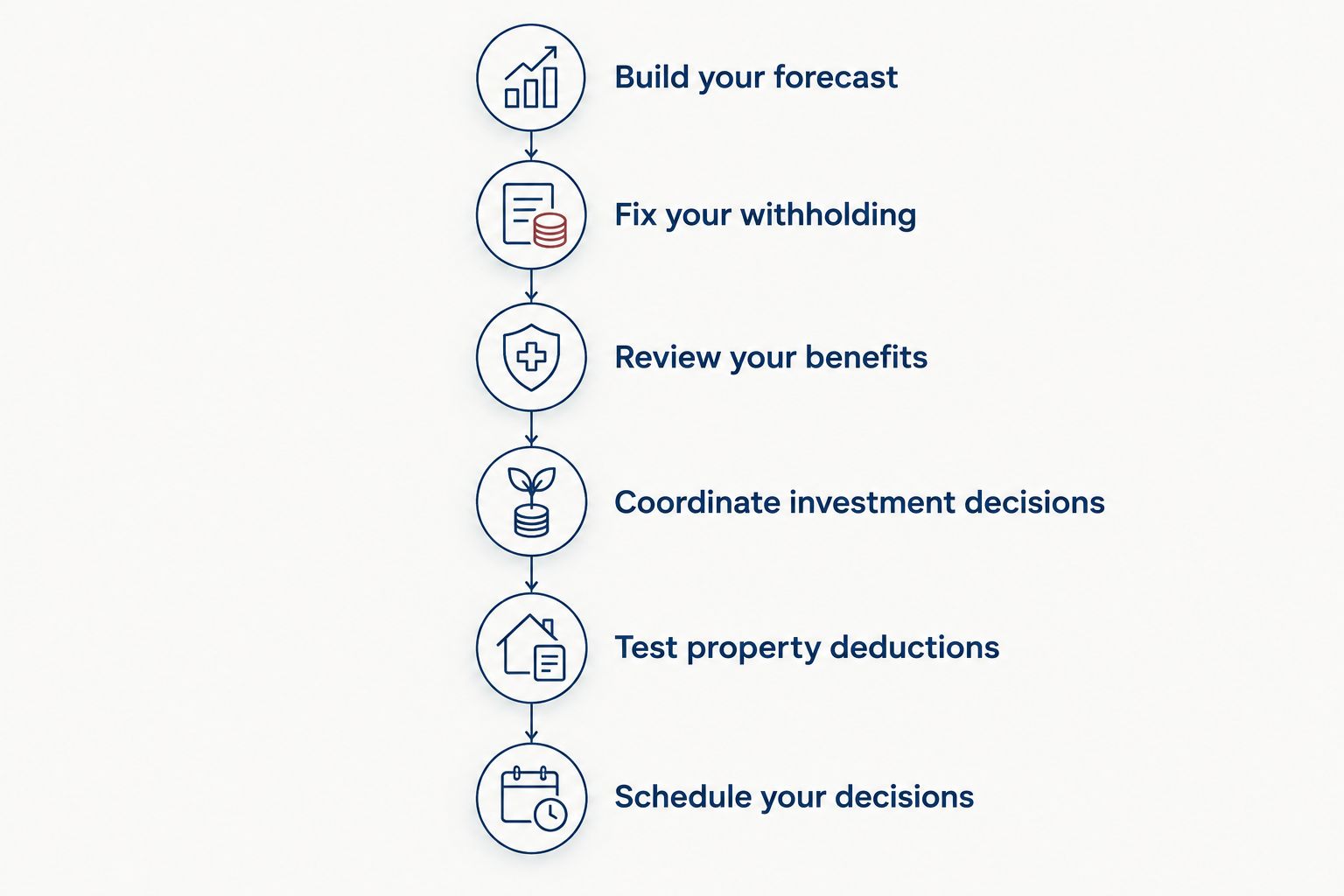
Start with the household forecast before choosing individual tax moves.
- Gather year-to-date wages and withholding for every employer.
- Separate salary, bonuses, restricted stock units, and option transactions.
- Add your spouse’s income and taxable investment distributions.
- Record filing status, dependents, and expected deductions.
- Keep a separate scenario for each proposed large transaction.
Fix your withholding
Use the IRS Tax Withholding Estimator and submit an updated Form W-4 when the forecast shows a payment gap. Check state payments separately. Federal withholding does not settle your state obligation.
The general federal estimated-tax safe harbor compares payments with 90% of current-year tax or 100% of prior-year tax, subject to timing requirements. The prior-year percentage rises to 110% when prior-year adjusted gross income exceeds $150,000, or $75,000 if married filing separately. Special rules and exceptions apply; a safe harbor prevents an underpayment penalty, not a balance due.
Federal wage withholding is generally treated as paid evenly throughout the year unless you establish actual payment dates. That makes withholding adjustments different from simply sending a late estimated payment. For uneven income, assess whether the annualized-income installment method fits your facts.
- Compare household payments with both safe-harbor calculations.
- Include all jobs when completing the multiple-jobs adjustment.
- Recheck withholding after a bonus or equity-compensation event.
- Review state withholding and estimated-payment requirements.
- Save the forecast supporting each payroll adjustment.
Review your benefits
Read your employer’s plan documents and compare them with your payroll elections. Traditional workplace retirement contributions generally reduce current federal taxable income; designated Roth contributions do not. The choice concerns tax timing, not which account sounds more sophisticated.
Check health savings account eligibility before contributing. Enrollment in an eligible high-deductible health plan is not the only condition: disqualifying additional coverage, including certain flexible spending arrangements, can affect eligibility.
Once you have gathered those documents, CEOHAVEN can provide tax planning around your compensation and benefits. Bring the actual plan terms rather than assuming an employer offers a particular feature. Tax advice cannot create a benefit your plan does not permit.
- Compare traditional and Roth elections against your household forecast.
- Check contribution limits and catch-up eligibility for 2026.
- Coordinate employee deferrals across jobs instead of treating each employer separately.
- Include employer contributions when checking applicable HSA limits.
- Review deferred-compensation elections before their specific deadlines.
Coordinate investment decisions
Review gains, losses, and compensation-related shares in one worksheet before placing trades. Restricted stock units generally produce wage income when shares are delivered at vesting; a later sale produces a separate capital gain or loss. Check the tax basis so compensation already included in wages is not taxed again through an incorrect sale entry.
Tax-loss harvesting requires more than finding a red position. The wash-sale rule generally disallows a loss when you acquire substantially identical securities within 30 days before or after the sale. Review relevant purchases across accounts, including automatic reinvestment and your spouse’s transactions.
Net capital losses can generally offset up to $3,000 of ordinary income annually, or $1,500 if married filing separately, with unused losses carried forward. That limit prevents a large realized loss from becoming an unlimited salary deduction.
- Reconcile stock-plan records with brokerage cost basis.
- Identify realized gains before selecting losses to harvest.
- Check automatic purchases around the wash-sale window.
- Distinguish short-term holdings from holdings exceeding one year.
- Review appreciated-asset donations before selling the asset.
Test property deductions
Do not buy a rental on the assumption that depreciation will offset your salary. Rental losses are generally passive, and passive losses usually cannot offset wages. The special rental-real-estate allowance is income-limited and phases out as modified adjusted gross income rises.
Real estate professional status is not a label you elect without supporting activity. It requires more than 750 hours in qualifying real-property trades or businesses and more than half of your personal services in those businesses, alongside material-participation requirements for the relevant rental activity. A full-time employee must test the actual time requirements carefully.
Short-term rental treatment requires a separate activity analysis. Certain short average stays can remove an activity from the passive rules’ rental definition, but that alone does not establish a deductible loss against wages. Material participation, personal use, and other limitations still matter.
- Classify the property activity before modeling deductions.
- Separate rental income, operating expenses, and capital improvements.
- Keep contemporaneous participation and personal-use records.
- Check passive-loss, at-risk, and other applicable limitations.
- Compare after-tax cash flow without assuming a wage offset.
Schedule your decisions
Turn the forecast into a calendar with an owner for each action: you, payroll, your investment adviser, or your tax professional. Some decisions require employer processing; others depend on completed transactions or specific election deadlines. A filing extension does not extend every planning window.
For 2026, distinguish actions tied to the calendar year from contributions or elections governed by another deadline. Do not substitute a generic year-end checklist for the terms of your retirement plan, compensation agreement, or state tax rules.
Recalculate after a material change rather than treating the initial forecast as permanent. A new job, marriage, property sale, or substantial bonus can change both your tax liability and the payments needed to avoid penalties.
- Assign a responsible person to every planned action.
- Record payroll cutoffs alongside legal deadlines.
- Review charitable-gift documentation before transferring assets.
- Confirm eligibility before making an election or contribution.
- Reconcile completed actions with the final forecast.
Compare planning options for your situation
Choose the level of help that matches the decision, not just the return’s length. Manual planning gives you visibility, software organizes calculations, and professional advice addresses eligibility and competing choices. None replaces accurate documents.
| Option | Best for | Main advantage | Key limitation |
|---|---|---|---|
| Spreadsheet and IRS guidance | Employees with straightforward wages and benefits | Direct visibility into income, payments, and assumptions | You must identify applicable rules and keep calculations current |
| Tax preparation software | Employees organizing a return and comparing supported scenarios | Structured data entry and return calculations | A completed return is not automatically a forward-looking plan |
| Employer payroll and benefits team | Employees changing withholding or plan elections | Handles employer-specific implementation | Does not provide a complete household tax analysis |
| CEOHAVEN tax planning and preparation | High-income professionals seeking coordinated professional support | Offers both planning and preparation services | Employer plan terms and legal eligibility still control available strategies |
Start manually by assembling the records and identifying the question. Professional support becomes useful when the answer depends on interacting rules, compensation arrangements, or investment and property transactions. Preparation alone serves a different purpose: reporting what happened.
Common mistakes high-income W-2 earners make
Treating an LLC as a salary deduction
An LLC does not transform wages into business revenue. Legitimate separate business activity has its own income, expenses, and reporting; personal spending does not become deductible because you route it through an entity. Keep employee compensation and actual business activity separate.
Assuming bonus withholding equals the tax owed
Withholding on a bonus is a payment mechanism, not a separate final tax rate on that income. Your return combines taxable compensation with the rest of your household income. Model the bonus in the full forecast before deciding whether payroll has withheld enough.
Buying property for a promised wage offset
Depreciation and cost segregation do not override passive-activity rules. A deduction that is suspended does not reduce current wage income. Evaluate the property’s operating economics first, then determine when its deductions are usable.
Funding accounts without checking household conflicts
A retirement or health-account contribution can be inappropriate when eligibility, income limits, employer contributions, or other coverage are ignored. Backdoor Roth planning also requires attention to the IRA pro-rata rule, including relevant traditional, SEP, and SIMPLE IRA balances. Check the entire account picture before moving money.
Waiting until preparation to ask planning questions
Tax preparation records completed events; planning evaluates choices before they become fixed. Selling shares or missing an employer election deadline limits what a preparer can change. Put the decision on the calendar while alternatives still exist.
FAQ
What is the best tax strategy for a high-income W-2 employee?
Start with a household tax forecast, then coordinate withholding, eligible benefits, and investment decisions. The best strategy depends on your compensation, filing status, account eligibility, and other income—not a universal deduction list.
Can I reduce W-2 taxes by opening an LLC?
Opening an LLC does not reduce tax on your employee wages by itself. A genuine separate business has its own tax treatment, but it does not reclassify your salary or make personal expenses deductible.
Should I choose traditional or Roth workplace contributions?
Traditional contributions generally reduce current federal taxable income, while Roth contributions do not. Compare your current tax circumstances, future withdrawal expectations, and employer plan terms before choosing.
Can rental-property losses offset my W-2 income?
Rental-property losses generally cannot offset wages when the losses are passive. Exceptions and different activity classifications require specific eligibility, participation, and limitation checks.
Why do I owe taxes when my employer already withholds?
Payroll withholding does not necessarily cover your total household tax liability. Other income, multiple jobs, your spouse’s earnings, and equity compensation can create a payment gap.
Does meeting a tax safe harbor mean I owe nothing at filing?
Meeting an applicable safe harbor generally protects against an estimated-tax underpayment penalty, not a remaining tax bill. Compare expected liability with payments separately to plan the cash needed at filing.
When should I begin my 2026 tax planning?
Begin before making compensation, investment, or property decisions that affect your 2026 return. Update the forecast after significant changes and check employer processing deadlines before requesting an election.
One last thing
A deduction is not the same as money saved. Spending solely to obtain a deduction leaves you with an expense and only its applicable tax benefit; it does not reimburse the purchase. Before approving any strategy, write down the cash required, the eligibility rule, and when the tax benefit becomes usable.
That short test separates a useful plan from an expensive distraction. Keep it beside your forecast.