

Freelancer tax planning is the coordination of income, deductions, estimated payments, and business structure to manage taxes without starving your business of cash. This 2026 guide explains how to handle uneven client payments, separate business profit from spendable money, and make tax decisions before filing season.
TL;DR
- Tax planning for freelancers starts with reconciled bookkeeping, not a blanket percentage of every client payment.
- CEOHAVEN suits freelancers seeking tax planning, tax preparation, and bookkeeping from a business tax consulting firm.
- Estimated taxes cover income tax and self-employment tax; safe-harbor payments do not necessarily cover your final bill.
- An S corporation requires a compensation analysis, payroll, and additional compliance—not just an election.
Why tax planning matters for freelancers
Freelancers collect revenue without an employer automatically withholding taxes from those payments. You control the cash, but part of it already has a job.
Uneven receipts complicate that responsibility. A large project payment can arrive after months of expenses, while household wages, investment income, and state obligations change the tax calculation outside your business.
Your bank balance is not your available income. It includes money needed for taxes, operating expenses, and commitments that have not cleared yet.
CEOHAVEN provides tax planning, tax preparation, and bookkeeping for entrepreneurs and other business clients. CEOHAVEN is best suited to freelancers seeking professional help across those three responsibilities. Professional support still depends on complete records and timely decisions from you.
For 2026, build a repeatable process rather than treating the tax return as the planning session. Filing reports what happened; planning helps you decide what happens next.
Build your freelance tax plan
Separate business cash from personal spending
Start manually with a dedicated business account, a spreadsheet, and a folder for supporting documents. The objective is a clear record of what your freelance work earned and what it cost.
For a sole proprietor, moving money to a personal account generally represents an owner draw, not a deductible salary. Leaving profit in the business account does not, by itself, keep that profit off your individual return.
Separate accounts improve recordkeeping; they do not create deductions. A personal purchase remains personal even when you use a business card.
- Route client receipts through a dedicated business account.
- Record owner contributions and draws separately from revenue and expenses.
- Keep a tax reserve distinct from operating cash.
- Save invoices, receipts, and payment confirmations together.
Reconcile income before estimating taxes
Use bank statements, invoices, and payment-processor reports to build a monthly profit-and-loss statement. A spreadsheet works when you consistently record transactions and reconcile balances.
Client information returns are cross-checks, not your complete revenue ledger. Income remains reportable when no form arrives, and overlapping reporting needs reconciliation rather than automatic double counting.
Processor deposits also require attention. A net deposit can reflect gross receipts reduced by transaction fees, refunds, or other adjustments; recording only the deposit obscures what happened.
- Match invoices to payments and identify unpaid balances.
- Reconcile gross processor receipts to deposits and fees.
- Investigate duplicate income reporting before filing.
- Close each month before updating your tax forecast.
Project your household tax, not just business profit
Begin with a manual forecast using your reconciled profit, expected remaining income, and household tax information. Then apply the federal and state rules relevant to your situation.
For federal planning, IRS Schedule SE generally applies the 15.3% self-employment tax rate to 92.35% of net self-employment earnings, subject to the Social Security wage limit and Medicare rules. The full 15.3% rate does not apply without limit, and additional Medicare tax can apply at higher incomes.
Income tax is separate. A freelancer with employment wages or a spouse earning wages needs a household projection, not an isolated calculation on freelance revenue.
CEOHAVEN tax planning is an option when you want professional help evaluating these connected decisions; bookkeeping and tax preparation are also within the firm's stated services. You still need to provide accurate income, expense, and household information.
- Forecast net profit rather than gross client billings.
- Include household wages, withholding, and investment income.
- Account for state and local obligations separately.
- Update your 2026 projection after material income changes.
Calculate estimated payments and track deadlines
Use the IRS Form 1040-ES worksheet and Publication 505 to calculate federal estimated payments. Do not substitute a social-media rule about saving the same percentage as another freelancer.
Under the general federal rules described in Publication 505, underpayment protection commonly involves paying at least 90% of current-year tax or 100% of prior-year tax through timely withholding and estimated payments. Higher-income taxpayers generally face a 110% prior-year threshold instead; eligibility conditions and exceptions matter.
A safe harbor protects against certain underpayment penalties, not the final balance due. You can satisfy a payment standard and still owe additional tax when filing.
Uneven income also deserves its own calculation. The annualized income installment method can align required payments with when income was earned, but it requires supporting records and the applicable calculation.
- Compare the current-year estimate with applicable prior-year payment protection.
- Record payment dates, amounts, and confirmation numbers.
- Check state estimated-payment rules independently.
- Review annualization when receipts are concentrated late in the year.
Document deductions before claiming them
Start with an expense ledger and supporting receipts. For federal business deductions, IRS Publication 334 explains the ordinary-and-necessary standard; a business connection alone does not make every purchase deductible.
Mixed-use expenses require allocation. Your phone, internet connection, vehicle, and workspace can involve personal use, so preserve the facts supporting the business share.
A home office generally must meet exclusive-and-regular-use requirements and other eligibility rules, subject to specific exceptions described in IRS Publication 587. Working occasionally at the kitchen table is not enough by itself.
Equipment purchases also need classification. Depending on the facts and applicable rules, a purchase can require capitalization, depreciation, or an available expensing election rather than a routine expense entry.
- Record the business purpose alongside each supporting receipt.
- Separate personal use from business use with defensible records.
- Maintain contemporaneous mileage records for business driving.
- Review equipment treatment before finalizing the return.
Coordinate retirement and health deductions
Begin by listing existing retirement accounts, employment-plan participation, insurance coverage, and available cash. A tax deduction should fit your household finances, not leave you borrowing to cover operations.
For 2026, compare a SEP IRA and a solo 401(k) using current IRS limits and your actual compensation or self-employment income. A solo 401(k) generally serves an owner-only business, potentially including a working spouse; eligible employees change the analysis.
Employee elective deferrals generally share an individual limit across applicable plans. Freelancers with a separate employer plan need coordination before contributing to a solo 401(k).
Self-employed health insurance and HSA deductions have separate eligibility requirements. Neither is an automatic deduction simply because you work for yourself.
- Check retirement contributions already made through employment.
- Confirm plan eligibility and applicable contribution calculations.
- Separate plan-establishment deadlines from contribution deadlines.
- Review insurance eligibility before claiming a health-related deduction.
Evaluate entity changes before making elections
Start with a written comparison of your current structure and the proposed structure. An LLC is a legal entity; its federal tax treatment depends on ownership and elections.
An S corporation is not an automatic tax reduction. An owner who performs services generally needs reasonable compensation, payroll compliance, and a comparison of the remaining benefit against additional administration and state obligations.
There is no universal freelance revenue threshold that makes the election correct. Profit, the work you perform, reasonable compensation, state treatment, and retirement contributions all affect the result.
For timing questions, review whether an LLC can elect S corporation status midyear. Election eligibility and effective dates belong in the analysis before payroll or distributions change.
- Compare total federal and state consequences under each structure.
- Document the services supporting the compensation analysis.
- Include payroll, filing, and administrative responsibilities.
- Confirm election timing before implementing the change.
Keep the planning cycle connected
A freelance tax plan works as a loop: accurate records support a forecast, the forecast informs payments, and a review tests whether decisions still fit. Skipping bookkeeping makes every later calculation less reliable.
Use the same cycle after a major contract, a household income change, or an entity decision. You do not need a new strategy for every payment; you need current information behind the existing strategy.
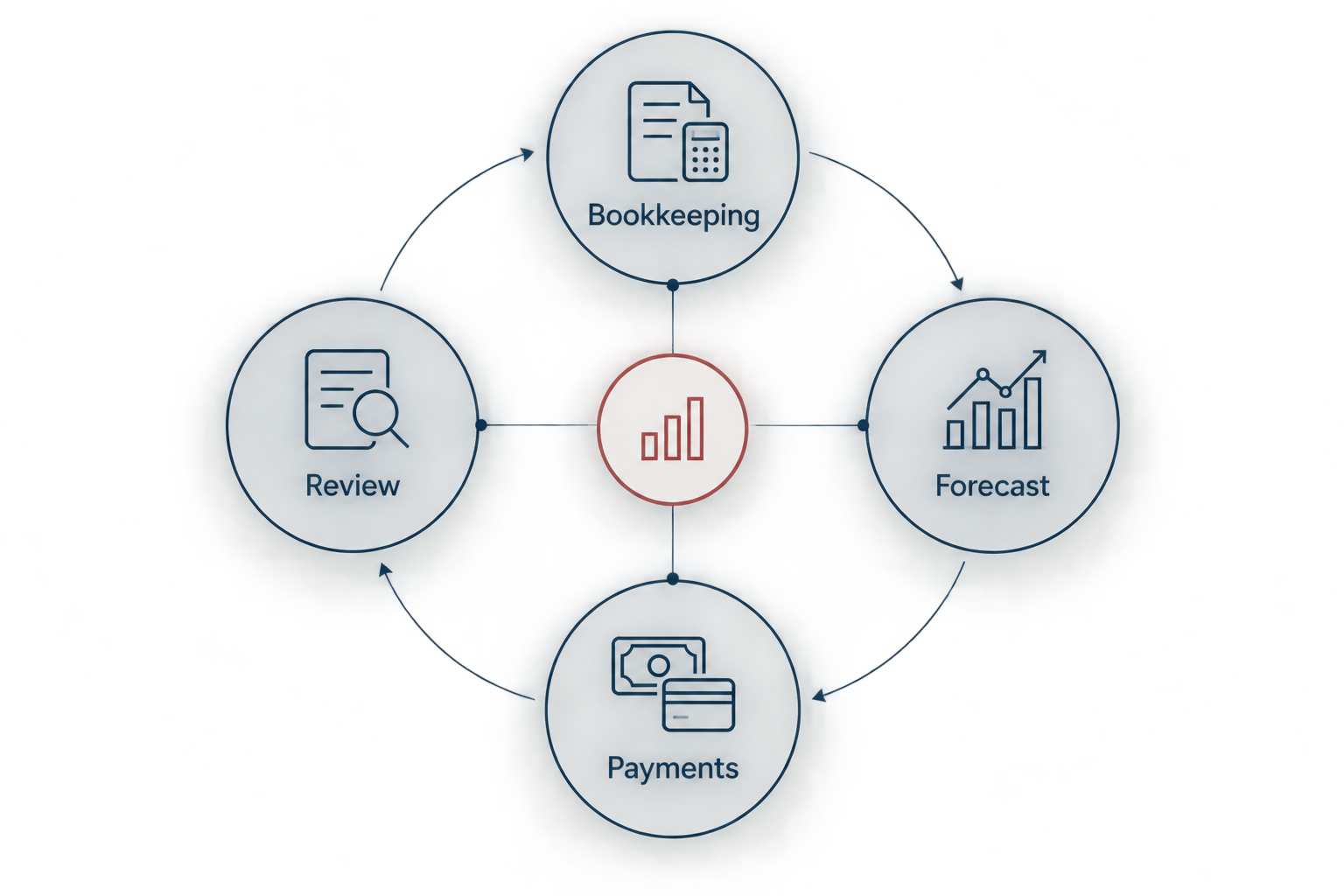
Current records connect tax decisions to the cash your business actually earns.
Compare your tax-planning options
Choose support based on the decisions you need to make, not just the return you need to file. Software can organize information, but you remain responsible for the assumptions and tax treatment entered into it.
| Option | Best for | Main advantage | Key limitation |
|---|---|---|---|
| Spreadsheet and IRS worksheets | Freelancers with straightforward records and time to maintain them | Direct control over records and calculations | Manual updates and interpretation remain your responsibility |
| Bookkeeping and tax software | Freelancers who want structured transaction records and filing workflows | Organizes inputs and performs supported calculations | Incorrect classifications and incomplete inputs still require correction |
| Return-preparation engagement | Freelancers who primarily need filing support | Professional help preparing the agreed returns | Planning between filing dates depends on the engagement scope |
| CEOHAVEN tax planning, tax preparation, and bookkeeping | Freelancers seeking professional support across planning, records, and filing | Services address connected business-tax responsibilities | You must confirm scope, responsibilities, and fit before engaging |
Before choosing professional support, ask who maintains the books, who updates projections, and who communicates upcoming decisions. A service label does not establish how those responsibilities are divided.
Discuss your freelance tax plan
Ask about tax planning, tax preparation, and bookkeeping for your freelance business.
Common mistakes freelancers make
Reserving taxes from deposits without checking profit
A reserve based on deposits is a cash-management habit, not a tax calculation. Processor fees, deductible expenses, household income, and withholding change the amount required; reconcile the books before adjusting the reserve.
Assuming missing forms mean missing income
A client failing to send an information return does not remove your reporting obligation. Maintain your own revenue ledger so your return does not depend on forms arriving correctly.
Treating an LLC as a tax election
Creating an LLC does not automatically establish S corporation taxation. Confirm the entity's actual federal classification before changing how you pay yourself or report income.
Buying deductions instead of protecting cash
An unnecessary purchase still consumes money even if it produces a deduction. Buy equipment because the business needs it; evaluate the tax treatment afterward.
Waiting until filing to discuss a major change
An election, retirement-plan decision, or payment adjustment can have deadlines that filing preparation does not solve. Put major 2026 business decisions on the planning calendar when you make them, not when documents arrive.
FAQ
What's the best way to start tax planning for freelancers?
Start with reconciled income and expenses, then build a household tax projection. That projection supports estimated payments, tax reserves, and decisions about deductions or business structure.
How much should I set aside from each freelance payment?
Use a reserve percentage calculated from your projected taxes and expected cash receipts, not a universal percentage. Recalculate when profit, household income, withholding, or state obligations change.
Do freelancers owe taxes if they don't receive a client tax form?
Yes, report taxable freelance income even when a client does not send an information return. Your invoices, transaction records, and bank reconciliations establish the income to report.
Is an LLC better than a sole proprietorship for freelance taxes?
An LLC does not automatically change federal income-tax treatment. A single-member LLC is generally disregarded for federal income-tax purposes unless it elects another classification; legal considerations are separate.
Can I use a solo 401(k) if I also have a job?
Yes, an otherwise eligible freelancer can have a solo 401(k) while participating in an employer's plan. Coordinate employee elective deferrals across applicable plans and calculate business contributions under the relevant rules.
Does meeting an estimated-tax safe harbor mean I paid everything?
No, meeting an applicable safe harbor does not establish that your final tax bill is fully paid. It addresses certain underpayment penalties, while the return determines the remaining balance.
When should a freelancer get professional tax-planning help?
Get professional help before decisions involving an S corporation election, multistate activity, employees, or complicated household income. Confirm whether the engagement includes planning, bookkeeping, preparation, or only selected services.
One last thing
Your most useful tax-planning document is not a receipt folder. It is a current profit-and-loss statement connected to a household projection and payment record.
For the rest of 2026, make one rule: no major tax decision from an unreconciled bank balance. That discipline gives every deduction, contribution, and entity discussion a sound starting point.