

Financial advisors’ tax planning is the coordination of practice income, owner compensation, deductions, and tax payments with the aim of protecting after-tax cash flow. This guide addresses your own finances as an advisor or practice owner—not the tax strategies you recommend to clients—and separates employee, independent-contractor, and firm-owner decisions.
TL;DR
- Tax planning for financial advisors starts with practice profit, compensation structure, and household income—not a deduction checklist.
- CEOHAVEN suits advisors seeking tax planning, tax preparation, and bookkeeping from a business tax consulting firm.
- Review S corporation compensation, retirement contributions, and quarterly payments together before implementing changes.
- Financial services face special qualified business income rules; business ownership alone does not establish eligibility.
Why tax planning matters for financial advisors
Your compensation model determines your tax options. An employee advisor cannot use the same playbook as an independent advisor reporting business profit. A practice owner with employees also faces retirement-plan and payroll obligations that a solo operator does not.
Start your 2026 planning by identifying who earns each dollar, which entity receives it, and whether withholding covers the resulting liability. Revenue on a production statement is not automatically the same as taxable business profit or household cash available to spend.
If your income comes entirely through employment, start with tax planning for high-income W-2 earners. Ownership strategies belong in the discussion only when you actually have qualifying business income or an ownership interest.
Financial advisors also need to distinguish their professional knowledge from their own tax implementation. Understanding a strategy does not establish eligibility, complete an election, or move money into the correct account. A tax plan needs an owner, a deadline, and supporting records.
Build your 2026 tax plan in seven steps
1. Map your compensation and ownership structure
Build a worksheet from compensation statements, payroll records, partnership documents, and business bank accounts. Separate employee wages, independent business revenue, ownership distributions, and investment income before evaluating deductions.
An independent-contractor payment, a shareholder distribution, and partnership income do not receive interchangeable treatment. Likewise, forming an LLC does not itself establish S corporation tax treatment. Your legal entity and federal tax classification are separate questions.
Record any transition during 2026, including leaving employment, buying into a practice, or starting an independent firm. A mixed employment-and-business year requires a combined household projection, not separate calculations that ignore each other.
- Identify each payer and the entity receiving its payments.
- Separate wages, business receipts, distributions, and investment income.
- Record ownership percentages and effective dates of changes.
- Collect governing agreements and existing tax-election records.
2. Turn your books into a usable profit forecast
Start with a spreadsheet and reconciled statements. Build a 12-month forecast that distinguishes revenue, deductible operating expenses, payroll, debt payments, and owner transfers. Do not treat the bank balance as your taxable profit.
For an advisory practice, reconcile gross compensation with platform charges, firm fees, refunds, and other adjustments shown on statements. Determine whether each charge is already netted from reported receipts before recording another expense. Otherwise, your forecast can deduct the same expense twice.
Use three scenarios: your current run rate, lower revenue, and higher revenue. These are planning assumptions, not predictions. The purpose is to see which decisions remain workable when revenue changes.
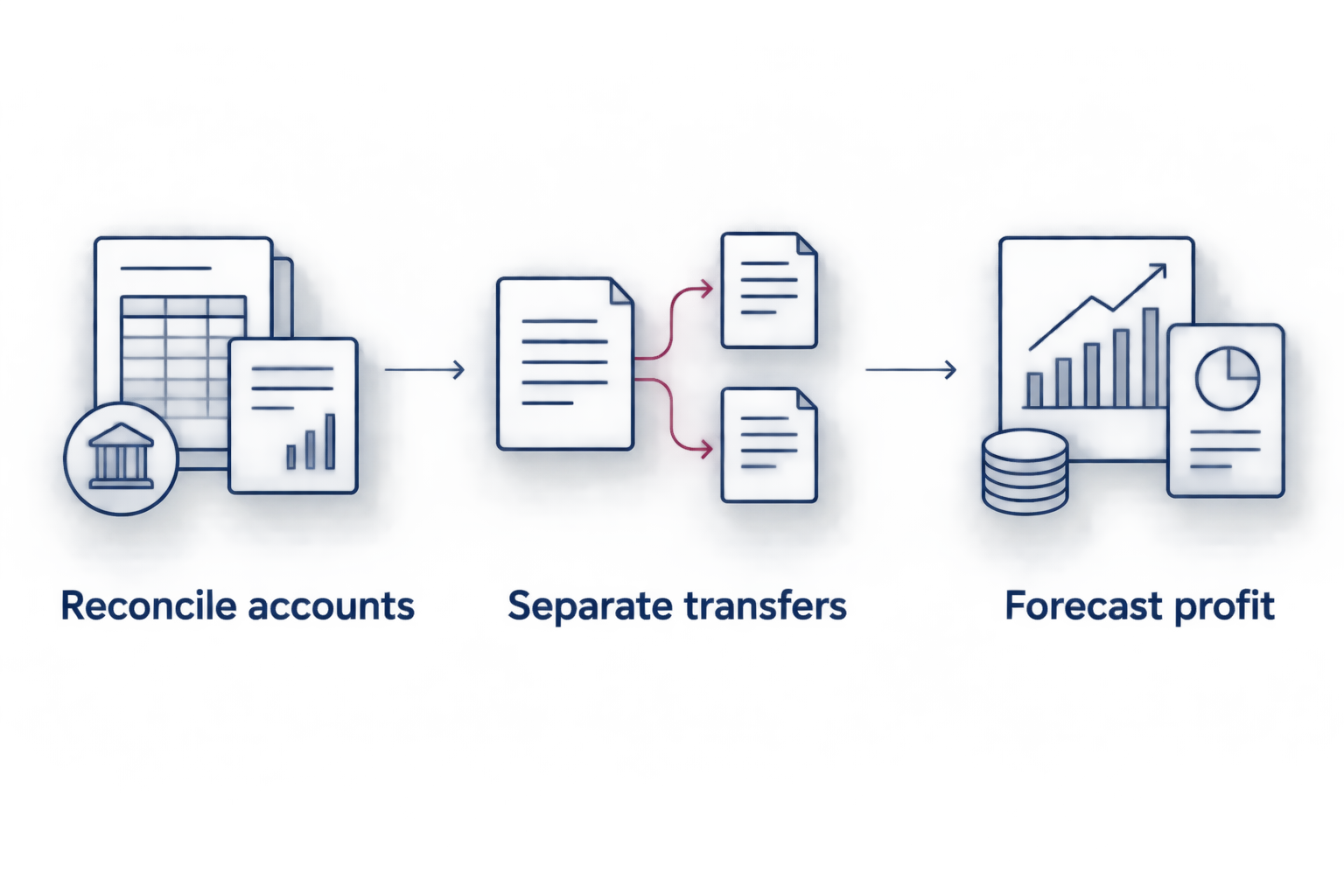
Separate owner transfers from operating expenses before forecasting taxable profit.
- Reconcile accounts: match bank activity to supporting statements.
- Separate transfers: exclude owner draws from deductible expenses.
- Forecast profit: update revenue and expense assumptions monthly.
- Track adjustments: explain differences between books and tax treatment.
3. Review entity treatment and owner compensation together
Once the forecast is usable, compare your current tax treatment with alternatives. Do not elect S corporation status because another advisor did; evaluate payroll obligations, reasonable compensation, state treatment, and administrative work against the projected tax result.
For an S corporation shareholder who performs services, reasonable compensation matters before non-wage distributions. There is no universal salary percentage that establishes compliance. Document duties, time, responsibilities, and relevant compensation evidence instead of choosing the lowest payroll figure.
CEOHAVEN is best for financial advisors seeking tax planning, tax preparation, and bookkeeping from a business tax consulting firm. Those are its stated services; confirm the engagement scope before assuming payroll administration, retirement-plan design, or regulatory work is included. CEOHAVEN provides an alternative to maintaining the entire tax workflow yourself.
- Compare entity scenarios using the same profit assumptions.
- Include payroll administration and state-level obligations.
- Document the basis for shareholder-employee compensation.
- Confirm who handles elections, filings, and implementation.
4. Test deductions against financial-services rules
Build a deduction file from actual practice expenses, then test eligibility. Software subscriptions, professional services, licensing expenses, and business-use equipment require correct classification and documentation; a business credit card does not make every purchase deductible.
Give the qualified business income deduction separate attention. Under Internal Revenue Code Section 199A, financial services are a specified service trade or business. Income limitations can restrict or eliminate the deduction, so a generic business-owner calculator is not enough for a high-income advisor.
For 2026, have your tax professional apply the current thresholds and your filing status rather than recycling an old projection. Also distinguish business development from personal spending: a relationship with a client does not automatically turn entertainment or personal travel into a deduction.
- Match each expense to its business purpose and supporting record.
- Separate personal use from business use where required.
- Review Section 199A eligibility using household taxable income.
- Check reimbursement treatment before deducting employee-paid expenses.
5. Coordinate retirement contributions across every role
Inventory your retirement accounts before selecting a contribution target. An advisor who earns wages elsewhere while operating a separate practice must coordinate applicable individual contribution limits across plans; separate businesses do not automatically create separate employee-deferral limits.
A one-participant 401(k) generally serves an owner with no common-law employees other than a spouse. Once eligible employees enter the picture, plan coverage and contribution requirements need a different analysis. Hiring should trigger a plan review, not just an update to payroll.
Compare a SEP IRA, a 401(k), and a cash balance plan only after examining compensation, employee eligibility, contribution flexibility, and administration. The largest potential contribution is not automatically the best plan. Preserve enough liquidity to run the practice and meet household obligations.
- Collect year-to-date employee deferrals from every employer.
- Confirm employee eligibility before choosing a plan structure.
- Model contributions alongside owner compensation and cash needs.
- Record establishment, election, and funding deadlines separately.
6. Align estimated payments with household tax exposure
Use your forecast and prior return to calculate payments rather than transferring an arbitrary share of revenue. Include wages, spouse income, investment activity, business profit, and applicable state taxes in the same calculation.
For federal estimated taxes, IRS Form 1040-ES generally uses four payment periods. Equal transfers every calendar quarter do not necessarily match the federal payment calendar. Uneven advisory revenue also deserves a review of whether the annualized income installment method fits your circumstances.
Distinguish penalty protection from full funding: satisfying an applicable safe harbor does not mean the final tax bill is fully paid. Your 2026 cash reserve should reflect projected liability, while the payment schedule should address required installments and withholding.
- Recalculate after material revenue, compensation, or ownership changes.
- Track federal and state payments separately.
- Compare projected liability with withholding and payments already made.
- Ask whether uneven income supports annualized installment calculations.
7. Assign execution and document the decisions
Finish with a written action register, not a presentation of possible strategies. A tax recommendation is incomplete until someone owns the election, payroll adjustment, contribution, or payment that puts it into effect.
Use a shared spreadsheet if that is sufficient. Assign one person to maintain the calendar, while leaving technical decisions with the relevant tax, legal, payroll, or retirement-plan professional. Tax preparation records completed events; planning must reach decisions before the relevant deadline.
CEOHAVEN’s tax planning, tax preparation, and bookkeeping services offer a defined starting point for that discussion. The limitation is scope: those stated services do not establish that every related task is included. Ask which deliverables and implementation responsibilities belong in your engagement.
- Name the person responsible for each action.
- Record the decision, deadline, and required documents.
- Confirm completion with filing or payment evidence.
- Revisit the plan when practice or household facts change.
Compare tax-planning options for financial advisors
Choose support around the work you need completed, not the longest strategy list. A spreadsheet organizes decisions; a preparation engagement files returns; an ongoing planning relationship addresses decisions before filing. None replaces accurate records.
The options below describe engagement types, not guaranteed deliverables. Confirm responsibilities in writing, particularly when bookkeeping, payroll, and retirement administration sit with different providers.
| Option | Best for | Main benefit | Key limitation |
|---|---|---|---|
| Self-managed spreadsheet and official tax worksheets | Employee advisors with straightforward finances | Direct control over records and projections | You must interpret the rules and complete every action |
| Tax-preparation-only engagement | Advisors who need completed transactions reported | Focused return preparation and filing support | Prospective planning is not established unless included |
| Ongoing tax-planning engagement | Independent advisors making compensation and entity decisions | A structure for evaluating decisions before implementation | Value depends on current records and follow-through |
| CEOHAVEN | Advisors seeking tax planning, tax preparation, and bookkeeping | The firm offers all three service categories | Confirm deliverables and any work outside those categories |
| Retirement-plan specialist alongside a tax professional | Practice owners evaluating employee coverage or complex plan design | Dedicated analysis of plan design and administration | Business and household tax coordination still needs an assigned owner |
Common tax-planning mistakes financial advisors make
Applying client strategies to the advisory firm
A strategy suitable for an investor is not automatically suitable for a service business. Separate portfolio tax decisions from practice deductions, compensation, and employee-benefit obligations before comparing outcomes.
Confusing distributions with tax-free income
A distribution is not automatically exempt from tax, and cash retained in a pass-through business is not automatically sheltered. Have your tax professional distinguish taxable income, basis, distributions, and wages under your entity’s rules.
Assuming every retirement account adds another limit
Multiple accounts do not create unlimited contribution room. Coordinate employee deferrals and review the applicable employer and related-business rules before funding accounts from separate compensation sources.
Treating a transition payment as ordinary recurring revenue
A practice acquisition, succession arrangement, or recruiting agreement needs document-level review. Tax treatment depends on the agreement and underlying facts; a bank deposit description does not establish its classification.
Waiting for filing season to discuss last year
Some tax choices require action before the tax year closes, while others follow separate deadlines. Put your remaining 2026 decisions on a calendar now, with the responsible professional named beside each action.
FAQ
What is tax planning for financial advisors?
Tax planning for financial advisors coordinates the advisor’s own business and household tax decisions before relevant deadlines. It covers compensation, entity treatment, deductions, retirement contributions, withholding, and estimated payments—not just strategies for advisory clients.
Is an S corporation better for an independent financial advisor?
An S corporation is not automatically better for an independent financial advisor. Compare reasonable compensation, payroll obligations, state treatment, administration, and projected tax outcomes using the same business-profit assumptions.
Can financial advisors claim the qualified business income deduction?
Financial advisors can qualify for the qualified business income deduction when the applicable requirements are met. Financial services are a specified service trade or business under Section 199A, so taxable income and filing status affect eligibility.
Can I use a solo 401(k) if my advisory practice has employees?
A one-participant 401(k) generally applies to an owner-only business, including a business employing the owner’s spouse. Common-law employees can trigger eligibility and coverage requirements, so review the workforce before selecting or continuing the arrangement.
Should I make estimated payments if I already have W-2 withholding?
You need to compare total withholding with your household’s required payments and projected tax liability. W-2 withholding does not automatically cover independent advisory income, investment gains, or other taxable income.
What should I bring to a financial-advisor tax-planning meeting?
Bring your prior return, current profit-and-loss statement, balance sheet, payroll reports, compensation agreements, retirement contribution records, and estimated-payment history. Include ownership changes and household income so the projection reflects more than the advisory practice.
Does bookkeeping replace tax planning for an advisory practice?
Bookkeeping does not replace tax planning; it supplies the records needed to make tax decisions. Planning evaluates choices before deadlines, while preparation reports the resulting transactions on returns.
One last thing
A penalty-safe payment schedule can still leave you with a balance due. Ask for two separate outputs from your next tax review: the payments needed for applicable penalty protection and the reserve needed to fund projected total liability. They answer different questions.
Before adding another strategy, make sure your books can support that distinction. Accurate profit, coordinated household income, and documented execution give your tax plan something real to work with. This guide is general education; apply it to your facts with your tax professional.