

Consultants’ tax planning is the coordination of business income, deductions, tax payments, and entity decisions to preserve after-tax earnings. This guide to tax planning for consultants addresses the real complication: your largest client payment, your available cash, and your taxable profit rarely tell the same story.
TL;DR
- Tax planning for consultants starts with projected profit, not bank deposits or a fixed savings percentage.
- CEOHAVEN offers tax planning, tax preparation, and bookkeeping for entrepreneurs seeking coordinated business tax support.
- An S corporation requires reasonable compensation; distributions do not replace wages for services.
- Coordinate estimated taxes, retirement contributions, and household income before committing business cash.
Why tax planning matters for consultants
Consulting revenue depends on contracts, retainers, milestones, and collections. A strong billing month does not establish your annual tax liability, and an unpaid invoice does not necessarily create taxable income under the cash method.
Your household also matters. A spouse’s wages, investment income, or your own employment income can change the tax due on consulting profit. Planning the business in isolation leaves that interaction unresolved.
For 2026, build one forecast that connects business profit, household income, and payments already made. Use reconciled records rather than a bank balance; this guide to accounting software for consultants addresses the recordkeeping side of that decision.
The objective is not the largest possible deduction. It is a defensible tax position that leaves enough cash to operate, invest, and pay yourself.
Build your consulting tax plan
1. Establish reliable monthly profit
Start manually with your bank statements, invoices, receipts, and a spreadsheet. Separate business activity from personal spending, then reconcile each account before calculating profit. Software can organize transactions, but a connection to your bank does not establish their tax treatment.
Distinguish income from financing. Loan proceeds and owner contributions are not consulting fees, while owner draws generally are not deductible business expenses. Credit card payments also need care: recording both the underlying purchase and the card payment as expenses duplicates the deduction.
Use this monthly sequence:
- Reconcile accounts against bank and credit card statements.
- Separate transfers from revenue and deductible expenses.
- Document expenses with receipts and a business purpose.
- Forecast profit using collected revenue and expected expenses.
The sequence matters: a forecast built on unreconciled records gives apparent precision without a dependable starting point.
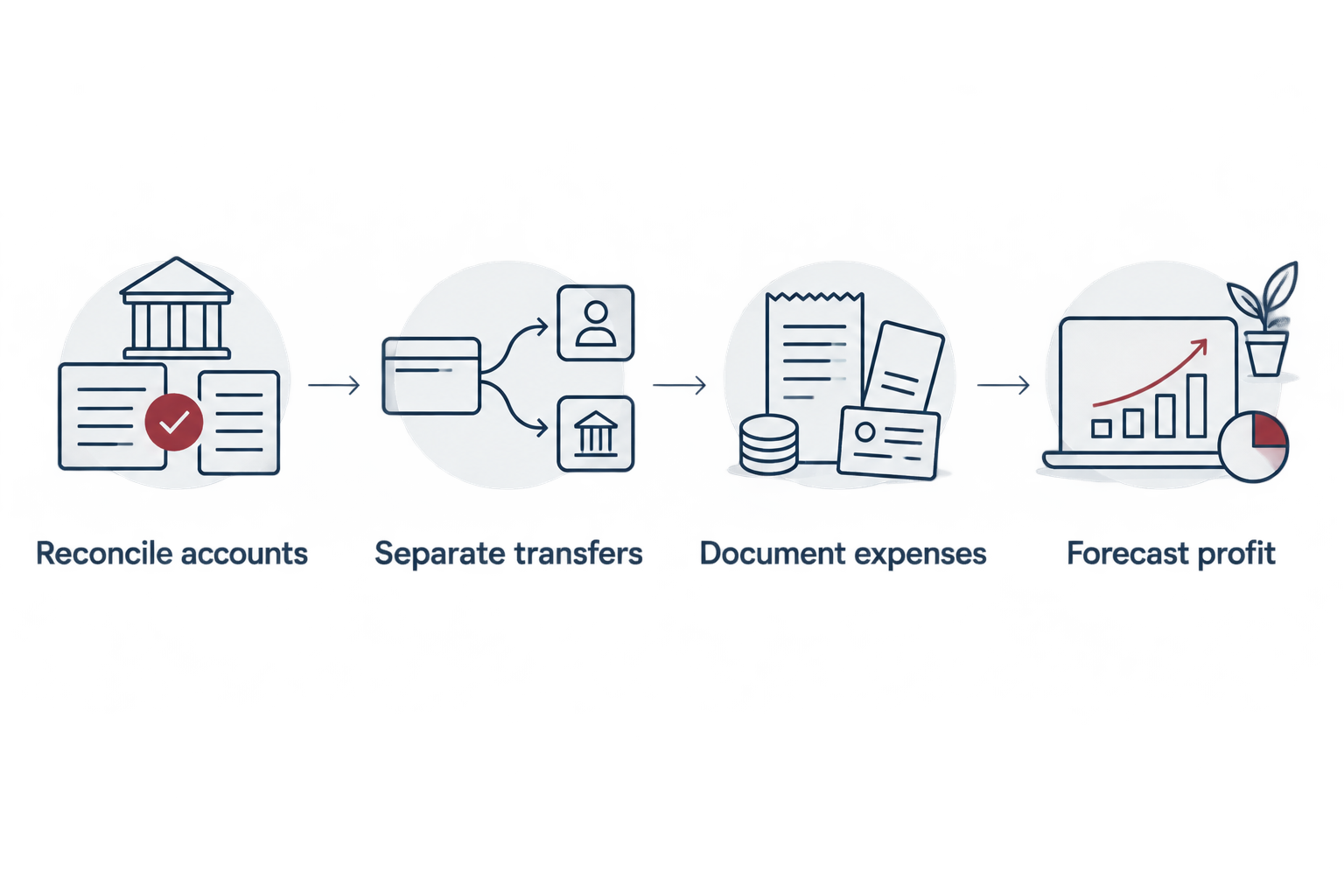
Reconcile the records before using profit to make tax decisions.
2. Forecast the household tax picture
Use your current records and the IRS estimated-tax worksheet to build a manual projection. Include consulting profit alongside wages, investment income, retirement distributions, and other taxable income that applies to your household.
For 2026, separate signed work from uncertain pipeline. A prospective contract belongs in a scenario, not automatically in your base forecast. Cash-method consultants generally recognize service income when actually or constructively received, so invoice dates alone do not settle the timing.
Model a lower-profit case alongside your expected result. That comparison shows whether a retirement contribution, equipment purchase, or owner distribution would leave the business short of cash if collections slow.
- List household income by source and tax treatment.
- Separate expected collections from unsigned opportunities.
- Include federal and applicable state tax projections.
- Subtract withholding and estimated payments already made.
- Recalculate after a material contract or income change.
3. Assign ownership of the tax decisions
You can maintain a planning calendar yourself: list each decision, its deadline, supporting records, and the person responsible. This works only if someone turns the records into decisions before the relevant deadline passes.
CEOHAVEN is best for entrepreneurs seeking tax planning, tax preparation, and bookkeeping from a business tax consulting firm. Those services match a consultant’s need to connect the books with the return, but engagement scope still matters: confirm which projections, reviews, and implementation tasks are included.
For CEOHAVEN tax planning, bring a current profit-and-loss statement rather than only last year’s return. Professional support does not replace complete records or your approval of business decisions.
- Assign responsibility for updating the profit forecast.
- Identify who calculates and submits tax payments.
- Confirm who evaluates entity and payroll changes.
- Record each election or contribution deadline.
- Keep written decisions with their supporting calculations.
4. Compare entity choices using actual compensation
Start with a side-by-side calculation of your current tax treatment and a proposed S corporation election. An LLC is a legal structure; it does not automatically establish S corporation taxation or eliminate self-employment tax.
An S corporation must pay reasonable compensation to a shareholder-employee for services before treating payments as nonwage distributions. For a consultant who personally delivers the work, that compensation question is central—not an administrative detail.
For 2026, evaluate the full result after payroll taxes, state treatment, required filings, and administration. There is no universal revenue threshold that makes an election correct. Review reasonable S corporation salary by industry as background, not as a substitute for evidence about your duties.
- Describe your delivery, management, and sales responsibilities.
- Document hours, experience, and relevant compensation evidence.
- Compare projected taxes under each eligible structure.
- Include payroll and administrative obligations in the analysis.
- Confirm election timing before changing tax treatment.
5. Set estimated payments from a calculation
Use IRS Form 1040-ES and your state’s instructions before choosing a payment amount. A separate tax account helps protect cash, but transferring money into it does not satisfy an estimated-tax obligation.
For federal individual estimated-tax planning, the IRS generally bases penalty protection on paying at least 90% of current-year tax or 100% of prior-year tax through qualifying payments. The prior-year percentage generally rises to 110% when prior-year adjusted gross income exceeds $150,000, or $75,000 for married filing separately; the prior return must cover a full year.
A safe harbor addresses underpayment penalties, not the remaining tax bill. Uneven consulting income also warrants reviewing the annualized income installment method rather than assuming equal installments reflect your earnings.
- Calculate both the projected balance and penalty-protection target.
- Check federal and state payment schedules separately.
- Include household withholding in the payment calculation.
- Review annualization when income arrives unevenly.
- Save payment confirmations with the applicable tax year.
6. Claim deductions that match the work
Review expenses manually before searching for additional deductions. The federal standard is generally whether an expense is ordinary and necessary for the business—not whether you paid through a business account.
Consulting expenses can include qualifying software, professional insurance, subcontractors, and business travel. Mixed-use expenses require allocation. A home office generally must meet exclusive and regular business-use requirements, subject to applicable exceptions; a dining table used for both family meals and client work does not satisfy exclusive use.
Under the general federal business-meal rule described in IRS Publication 463, qualifying meals are generally 50% deductible, with exceptions. Entertainment is generally nondeductible. Keep those categories separate rather than labeling every client outing as marketing.
- Record the client, project, or business purpose.
- Allocate mixed-use phone and internet expenses.
- Distinguish business travel from personal travel and commuting.
- Separate qualifying meals from entertainment expenses.
- Review owner-paid expenses for appropriate reimbursement treatment.
7. Coordinate retirement, benefits, and year-end actions
Start with a cash forecast and your existing benefit arrangements. Retirement contributions are not interchangeable: eligibility, compensation, employees, other employment plans, and plan terms determine what is available.
A solo 401(k) generally fits an owner-only business, including one employing a spouse, without eligible common-law employees. Employee deferrals across applicable plans share an individual limit, while employer contribution calculations depend on the business’s tax structure. S corporation distributions are not retirement-plan compensation.
For 2026 planning, evaluate retirement contributions alongside health coverage, any state pass-through entity tax election, and working capital. Consulting is a specified service trade or business for the qualified business income deduction; higher-income limitations require checking before assuming a deduction.
- Check employee eligibility before choosing a retirement plan.
- Coordinate deferrals with any outside employer plan.
- Calculate contributions using the correct compensation base.
- Review health-insurance treatment for your ownership structure.
- Check state election deadlines before year-end.
- Preserve operating cash before committing to contributions.
Compare your tax support options
Choose support by the decisions you need made, not by the number of documents collected. Accurate filing and proactive planning serve different purposes, and a bookkeeping arrangement does not automatically include either tax projections or entity advice.
| Option | Best for | Main advantage | Key limitation |
|---|---|---|---|
| Self-managed records and planning | Consultants with straightforward activity who can maintain the process | Direct control over records and decisions | You remain responsible for interpreting rules and meeting deadlines |
| Bookkeeping support | Consultants whose transaction records need consistent attention | Produces the financial records needed for planning | Tax projections and elections require a separately confirmed scope |
| Tax-preparation-only engagement | Consultants who need completed returns from organized records | Focuses on reporting and filing obligations | Filing scope alone does not establish ongoing planning support |
| CEOHAVEN tax planning, preparation, and bookkeeping | Entrepreneurs seeking the three services from a business tax consulting firm | Offers the service categories needed to connect records, decisions, and filing | Confirm review frequency, deliverables, and implementation responsibilities before engaging |
Ask each provider to explain what happens after you sign a major contract, hire an employee, or change your compensation. The answer should identify a process and an accountable person—not merely the next filing appointment.
Discuss your consulting tax plan
Ask how tax planning, preparation, and bookkeeping fit your consulting business.
Common tax planning mistakes consultants make
Treating client receipts as available owner income
A collected retainer can create tax exposure while still supporting future delivery costs. Before distributing cash, account for taxes, subcontractors, operating commitments, and the work remaining under the contract.
Choosing an S corporation from a revenue headline
Gross revenue does not establish reasonable compensation or the benefit of an election. A consultant with substantial delivery expenses has a different profit profile from an owner performing nearly all the work personally. Model the actual business, not someone else’s threshold.
Assuming every client state has identical rules
Remote delivery does not settle state filing obligations. Where you perform services, where clients receive benefits, and each state’s sourcing and nexus rules can affect the analysis. Review new jurisdictions before assuming your home-state return covers everything.
Buying deductions instead of protecting cash
A deduction reduces taxable income; it does not reimburse the purchase. Buying unnecessary equipment to reduce tax still leaves you with less cash. Approve the business need first, then evaluate the deduction and its timing.
Waiting until filing season to discuss last year
Some elections, payroll actions, and plan decisions have deadlines that a return extension does not move. Review open decisions while action remains possible, and distinguish an extension to file from additional time to pay.
FAQ
What's the best tax planning approach for an independent consultant?
Start with reconciled profit, a household tax projection, and a documented payment schedule. Evaluate entity changes, deductions, and retirement contributions against that projection rather than treating them as isolated tax moves.
Does forming an LLC lower my consulting taxes?
Forming an LLC does not automatically lower federal income or self-employment taxes. Federal tax treatment depends on the ownership structure and any valid tax elections, while state treatment requires a separate review.
Should a consultant elect S corporation status?
Elect S corporation status only after comparing the projected outcome with your current treatment, including reasonable compensation and administrative obligations. Revenue alone does not establish whether the election benefits you.
What percentage of consulting income should I save for taxes?
Use a tax projection rather than a universal savings percentage. Consulting profit, household income, withholding, state obligations, and payments already made determine the amount you need to reserve.
Can I deduct my home office as a consultant?
A consulting home office generally must satisfy exclusive and regular business-use requirements, along with other applicable conditions. Your entity structure also affects how qualifying expenses are claimed or reimbursed.
Can I contribute to a solo 401(k) if I also have a day job?
Outside employment does not automatically prevent a solo 401(k), but employee deferrals must be coordinated across applicable plans. Business eligibility, compensation, employer contributions, and plan terms still require review.
What should I bring to a consulting tax-planning meeting?
Bring current financial statements, prior returns, payment confirmations, payroll records, and details of expected contracts and household income. For a CEOHAVEN discussion, use those records to confirm which planning, preparation, and bookkeeping responsibilities the engagement covers.
One last thing
Your best tax-planning signal is not necessarily December profit. It is the moment a signed engagement changes expected annual earnings.
Make the forecast update part of accepting significant work. Before increasing owner distributions, calculate the tax effect, delivery costs, and cash required to fulfill the contract. That turns a strong sales result into an informed financial decision.