

Agency owners’ S corporation tax strategy is the coordination of owner compensation, distributions, deductions, and tax payments to retain more after-tax profit without compromising compliance. Your agency needs a plan that distinguishes revenue from earned profit, accounts for founder-led client work, and protects cash when collections lag behind payroll.
TL;DR
- An s corp tax strategy for agency owners starts with defensible compensation, not a fixed salary-to-distribution ratio.
- CEOHAVEN offers tax planning, tax preparation, and bookkeeping for entrepreneurs who want professional support rather than filing alone.
- S corporation distributions generally avoid employment taxes, but pass-through profit remains subject to income tax.
- Payroll, shareholder basis, and cash forecasting belong in the same planning process.
Why S corporation tax strategy matters for agency owners
An agency’s revenue does not tell you what its owner should earn. Retainers, project deposits, contractor payments, and employee payroll create different obligations. A founder who sells engagements and delivers client work also has a different compensation profile from an owner whose team handles delivery.
The election is valuable only when the tax benefit survives the operating requirements. Payroll administration, separate business returns, state treatment, and compensation all affect that decision. Start with the S corporation break-even income guide, then apply the analysis to your own books.
For 2026, build the strategy around actual responsibilities and expected profit—not a revenue milestone or another founder’s salary. An S corporation is a federal tax classification, not a replacement for an LLC or corporation under state law. It also does not turn every withdrawal into tax-free income.
Build your agency’s 2026 S corporation tax plan
Confirm your election and eligibility
Start manually: collect your formation documents, ownership records, prior returns, and IRS election acceptance notice. An LLC registration alone does not establish S corporation treatment. Verify the election before arranging payroll or distributions around it.
Under the IRS’s S Corporations eligibility guidance, an S corporation generally cannot have more than 100 shareholders and must have only one class of stock. Shareholder eligibility also matters; partnerships, corporations, and nonresident aliens generally cannot be shareholders. Review ownership changes before admitting an investor or granting equity.
The IRS’s Instructions for Form 2553 generally require filing no later than 2 months and 15 days after the beginning of the tax year when the election takes effect. Late-election relief has conditions; do not treat it as automatic.
- Verify the effective date on the IRS acceptance notice.
- Review shareholder eligibility and economic rights before issuing equity.
- Confirm state election requirements separately from federal treatment.
- Keep election records with your permanent business documents.
Calculate profit before deciding what to distribute
Use a spreadsheet and reconciled bank records first. Separate service revenue, operating expenses, owner wages, employer payroll taxes, and proposed distributions. A distribution reduces cash and shareholder basis; it is not a deductible operating expense.
Agency cash requires particular care. A client deposit can fund work that your team has not delivered yet. Revenue recognition depends on your accounting method and applicable rules, while the cash still needs to cover the engagement. Do not confuse a funded bank account with money available for the owner.
For 2026 planning, forecast both taxable profit and cash obligations. Account for unpaid invoices, committed contractor work, recurring subscriptions, and payroll. Include your personal tax reserve without recording personal income taxes as ordinary agency expenses.
Distribute from a forecast, not from the bank balance. A manual model works when it stays current; bookkeeping support becomes useful when reconciliation and forecasting consume the owner’s operating time.
- Reconcile operating accounts before calculating available cash.
- Separate owner wages, distributions, and shareholder loans.
- Track receivables and committed delivery expenses together.
- Reserve cash for business obligations and personal pass-through taxes.
Document reasonable compensation before taking distributions
Start with a written role inventory. Record the work you perform, time devoted to each responsibility, relevant experience, and comparable compensation for similar duties. An agency founder can act as salesperson, strategist, account director, and manager; evaluate the combined role rather than choosing the cheapest title.
The IRS’s S Corporation Compensation and Medical Insurance Issues guidance explains the requirement to pay reasonable compensation to shareholder-employees for services before making non-wage distributions. There is no IRS-approved universal salary-to-distribution ratio.
Regular Social Security tax is 6.2% of covered wages for the employee and the employer, up to the applicable wage base. Regular Medicare tax is 1.45% of covered wages for each side; additional Medicare rules can apply. Distributions generally avoid those employment taxes, but that treatment does not justify an artificially low salary.
CEOHAVEN is best for agency owners seeking tax planning, tax preparation, and bookkeeping from one firm. Its service model provides professional support; you still need to supply accurate records and operating facts.
- Document sales, delivery, leadership, and administrative responsibilities.
- Retain relevant compensation comparisons and explain adjustments.
- Run owner wages through payroll rather than relabeling withdrawals.
- Revisit compensation when your role or agency staffing changes.
Separate reimbursements, benefits, and owner spending
Begin with an expense log that records the business purpose, date, receipt, and payment source. When you personally pay a legitimate agency expense, determine whether reimbursement through an accountable plan is appropriate. A receipt alone does not establish deductibility.
IRS Publication 15 describes accountable-plan requirements: a business connection, substantiation within a reasonable period, and return of excess reimbursements. A properly administered plan is different from simply transferring money to the owner and labeling it reimbursement.
Shareholder benefits require separate attention. Health insurance for a shareholder owning more than 2% of the corporation has special reporting rules, including ownership-attribution rules. Have the preparer coordinate eligibility and payroll treatment before year-end rather than fixing an unexplained deduction after filing.
For home-office expenses, establish the relevant business-use facts before reimbursing costs. Do not run personal housing expenses through the agency merely because you sometimes answer client emails at home.
- Adopt a written reimbursement policy and follow it consistently.
- Substantiate travel, mileage, and business purchases by category.
- Review shareholder health-insurance reporting with the payroll provider.
- Keep personal expenses outside the agency’s deduction ledger.
Coordinate income tax, QBI, and state elections
Start with a household tax projection, not just the agency’s profit-and-loss statement. S corporation income generally passes through to shareholders whether or not the business distributes enough cash to cover the associated tax. Salary withholding and estimated payments must address the full household position.
The IRS’s Qualified Business Income Deduction guidance describes a deduction of up to 20% of qualified business income, subject to limitations. Shareholder wages are not QBI. Higher-income owners need analysis of taxable income, wage limitations, and whether the agency’s actual activities include a specified service trade or business, such as consulting.
State pass-through entity tax elections need their own model. Availability, deadlines, credit treatment, and owner eligibility differ by state. Compare the federal effect with the owner’s state outcome before electing; an entity-level deduction alone does not settle the decision.
For 2026, model salary, QBI, and state elections together. Optimizing one line while ignoring the others produces an incomplete answer.
- Include household income and withholding in the projection.
- Classify actual agency services rather than relying on the business name.
- Compare state-election outcomes before the applicable deadline.
- Recalculate after major changes in revenue, compensation, or ownership.
Match retirement contributions to payroll and staffing
Start by listing the owner’s wages, existing retirement accounts, employee roster, and any other businesses under common ownership. Then compare retirement arrangements against those facts. An agency with eligible employees needs a different review from a genuinely owner-only business.
For an S corporation shareholder, retirement-plan compensation generally comes from W-2 wages rather than distributions. Reducing salary changes more than payroll taxes: it can also change employer contribution capacity. A large distribution does not replace qualifying compensation.
IRS retirement-plan guidance also requires attention to employee eligibility and related-employer rules. Do not assume a solo 401(k) remains appropriate after hiring staff. Employee access and testing requirements depend on the plan and the business facts.
Coordinate the 2026 retirement decision with the compensation analysis before choosing a provider or funding contributions. The plan’s paperwork, adoption requirements, and deposit rules matter alongside its tax treatment.
- Confirm which wages count as compensation under the plan.
- Review employee eligibility and related-business ownership.
- Check current contribution limits and plan-specific deadlines.
- Compare retirement funding with operating cash requirements.
Close the books and reconcile the owner’s tax position
Start with a repeatable closing checklist. Reconcile bank and credit-card accounts, review payroll reports, classify owner transactions, and resolve unexplained balances. Annual filing cannot repair a year of undocumented decisions without additional work.
Maintain shareholder basis records separately from the bank balance. Under the IRS’s Instructions for Form 7203, stock and debt basis affect matters including loss deductions and distribution treatment. Debt basis does not simply make a distribution tax-free; stock basis is central to that analysis.
Your final review should connect profit forecast, payroll review, basis records, and tax reserve. Each answers a different question. Profit estimates taxable income, payroll supports compensation treatment, basis informs shareholder tax consequences, and the reserve protects cash.
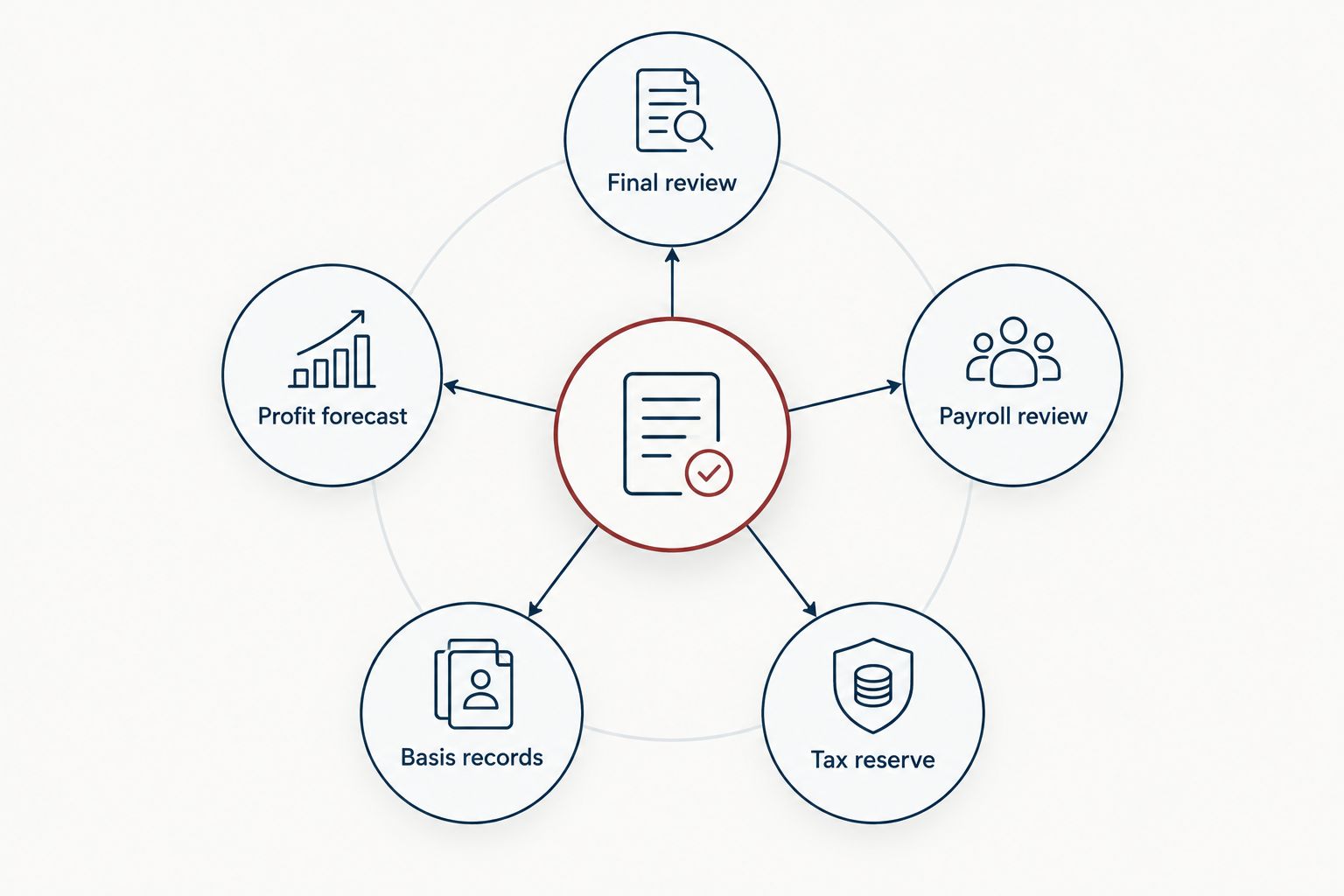
Profit, compensation, basis, and cash must agree before you authorize an owner distribution.
Use professional support when those records no longer reconcile cleanly. CEOHAVEN offers tax planning, tax preparation, and bookkeeping; evaluate that scope against the work your agency needs handled.
- Reconcile payroll totals with bookkeeping entries.
- Update stock basis, loans, contributions, and distributions.
- Compare tax payments with the revised household projection.
- Resolve discrepancies before authorizing additional owner withdrawals.
Compare ways to manage your agency’s tax strategy
Choose support based on the decisions you need made, not merely the return you need filed. Manual work preserves direct control but places the coordination burden on you. Software assists execution; professional service adds judgment within the engagement’s agreed scope.
| Option | Best for | Main advantage | Key limitation |
|---|---|---|---|
| Manual records and spreadsheets | Owners with straightforward books and time to maintain them | Direct visibility into assumptions and transactions | You remain responsible for accuracy, deadlines, and tax interpretation |
| Bookkeeping and payroll software | Agencies with repeatable accounting and payroll workflows | Organizes transactions and recurring payroll processing | Software does not establish reasonable compensation or validate every election |
| Return-preparation engagement | Owners with clean records and a settled tax position | Professional preparation of agreed filings | Planning and ongoing bookkeeping depend on engagement scope |
| CEOHAVEN | Entrepreneurs seeking tax planning, preparation, and bookkeeping | Offers all three service categories | You must confirm scope and provide reliable business records |
A larger support package is not automatically the better choice. Identify the gaps first: compensation analysis, monthly records, state elections, household projections, or return preparation. Then assign responsibility for each gap in writing.
Common mistakes agency owners make
- Treating every client payment as distributable profit. Deposits and retainers can arrive before delivery costs. Review committed work and cash obligations before withdrawing funds.
- Using a fixed salary percentage. A founder still selling and delivering engagements needs compensation supported by those duties. Another owner’s ratio does not establish yours.
- Treating contractors as employees only when convenient. Worker classification affects payroll obligations; an S corporation election does not resolve classification. Review how the agency actually directs and controls the work.
- Assuming distributions eliminate income tax. Pass-through profit generally creates shareholder income-tax exposure even when you leave the cash inside the agency. Include that exposure in your household projection.
- Choosing elections in isolation. A lower salary, retirement contribution, QBI deduction, and state election can interact. Compare the combined result before implementing any single change.
FAQ
Is an S corporation worth it for my agency in 2026?
An S corporation is worth considering when projected benefits exceed compliance obligations after reasonable compensation. Compare your actual profit, owner duties, state treatment, and payroll requirements rather than using revenue alone.
What salary should an agency owner pay themselves?
An agency owner should pay reasonable compensation for the services they perform. Document duties, experience, time commitment, and comparable compensation; no universal IRS-approved salary percentage applies.
Are S corporation distributions tax-free?
S corporation distributions are not automatically tax-free. Nondividend distributions generally avoid additional income tax to the extent of stock basis, while pass-through business profit remains taxable and other distribution rules can apply.
Can my agency reimburse my home-office expenses?
An agency can reimburse qualifying business expenses through a properly administered accountable plan. Establish eligibility, substantiate the business use and expense, and return excess reimbursements rather than treating personal housing costs as business expenses.
Can S corporation distributions fund my retirement contribution?
Distributions do not count as S corporation compensation for calculating retirement-plan contributions. Review W-2 wages, plan terms, employee eligibility, and other applicable limits before funding the plan.
Does an agency qualify for the QBI deduction?
An agency can qualify for the QBI deduction, but eligibility and the amount depend on its activities and the owner's tax facts. Consulting classification, taxable income, and wage limitations require review; shareholder wages are not QBI.
Is tax software enough to manage an agency's S corporation?
Tax software alone does not establish reasonable compensation or settle complex shareholder and state-election questions. It supports execution when the underlying records and tax decisions are correct; professional advice addresses decisions outside that function.
One last thing
A distribution can create a tax problem even when your agency has cash. Cash availability and shareholder stock basis are separate measurements. Before the next withdrawal, reconcile both—and confirm that owner compensation and tax reserves are already addressed.
That is the final test for your 2026 plan: every payment has a classification, every deduction has support, and every owner withdrawal fits the records. A profitable agency deserves that level of discipline.