
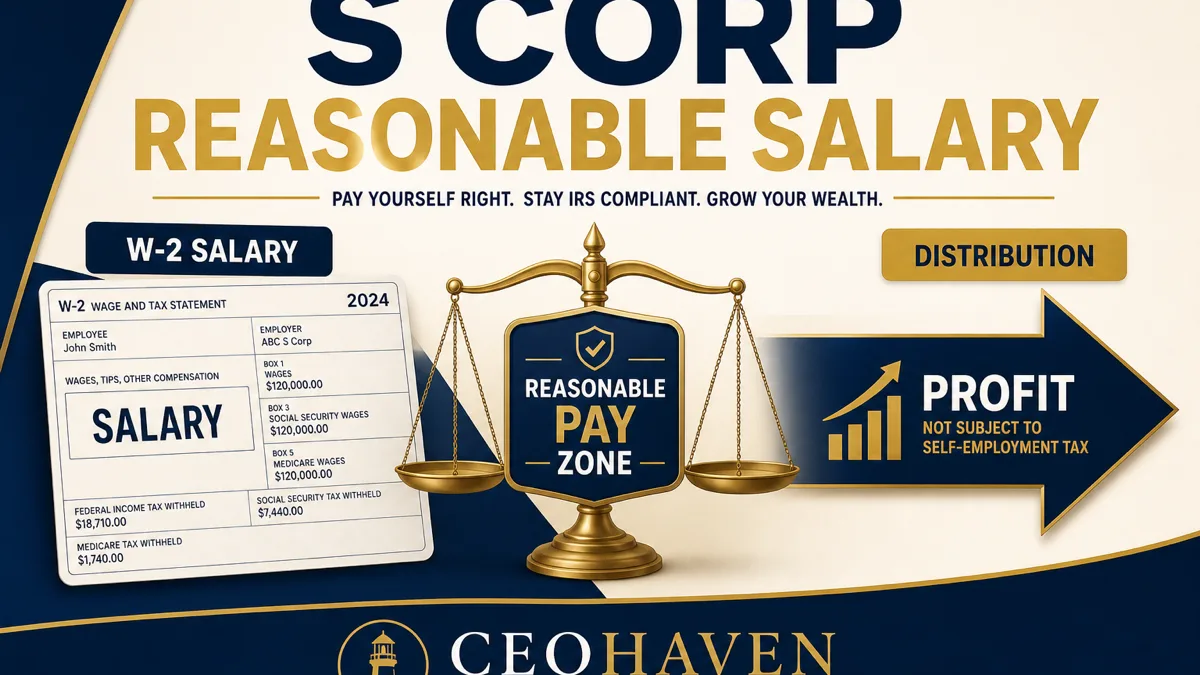
The whole point of an S-corp is splitting your pay.
Salary on a W-2. Profit as distributions. Less hit from payroll taxes on the distribution chunk.
But the IRS has one rule that ruins it for people who get lazy: reasonable compensation. You can't pay yourself $30,000 when you're clearly running a business that earns $400,000. They will notice.
Most S-corp owners I talk to are scared of two things at once. Audit if the salary is too low. Overpaying payroll tax if the salary is too high. Both fears are valid. Both are fixable with a real number, not a guess.
What goes wrong when you wing it
Not knowing your numbers is like driving without GPS. You'll get somewhere. You just won't know if it's the right place.
Mistake #1: You lowball salary to max distributions.
You net $350,000. You pay yourself $40,000 and take $310,000 as distributions. The IRS reclassifies a chunk of those distributions as wages. Now you owe back payroll taxes, penalties, and interest. The "savings" you thought you had? Gone.
Mistake #2: You set salary once and never touch it again.
Year one you made $120,000 and paid yourself $70,000. Fine. Year three you're at $500,000 and still on $70,000. That stopped making sense a long time ago.
Mistake #3: You treat payroll like optional.
An S-corp means real W-2 wages, real withholdings, real filings. Skip that and you're not really running an S-corp. You're just hoping nobody asks.
An S-corp is like being both an employee and the owner. The IRS taxes those two parts differently. Your job is to make both parts honest.
What "reasonable salary" actually means
The IRS requires reasonable compensation for shareholder-employees who provide services to the business.
Plain English: What would you pay someone else to do your job?
Not the lowest number you're brave enough to type. Not what your cousin said on a group chat. What the market would pay for your role, skills, location, and hours.
Factors the IRS looks at:
- Your training and experience
- Duties you actually perform
- What similar businesses pay for similar work
- Your company's dividend history and profit
- Whether you pay other employees more for less work
There's no single IRS chart that says "if you make X, salary must be Y." That's why people mess this up. It's a judgment call backed by documentation.
How to think about your number (with real math)
Start with profit, not vibes.
Example: You net $280,000 after expenses. You work full-time in the business as the main producer (agency owner, consultant, creator with a team, etc.).
A reasonable salary might land around $120,000 to $160,000 depending on industry and location. The rest can flow as distributions.
Payroll taxes (Social Security and Medicare) hit the salary. Distributions skip self-employment tax. That gap is the savings.
If you set salary at $50,000 on the same $280,000 profit, you're telling the IRS you hired yourself for peanuts while the business prints money. That's the audit profile.
If you set salary at $250,000 with no plan, you might erase most of the S-corp benefit. You kept the paperwork and lost the point.
Having a tax advisor is like having a brain surgeon instead of a general doctor. At this income level, "I guessed" isn't a strategy.
Side-by-side: salary too low vs. salary in range
| Factor | Salary too low | Salary in reasonable range |
|---|---|---|
| Audit risk | High | Lower with documentation |
| Payroll tax | Underpaid (until reclassified) | Paid correctly on wages |
| Distributions | Often challenged | Supported by remaining profit |
| Paper trail | Weak | Written reasoning + payroll records |
| Peace of mind | Low | You know your number |
The table doesn't pick your salary. Your industry, role, and profit do. Run the math on your actual business.
How to document it (so you're not guessing later)
You don't need a 40-page memo. You need proof you thought about it.
- Write down your role. CEO, sales, delivery, ops. What do you actually do each week?
- Pull comps. Salary surveys, job postings, industry data for your market.
- Show the math. Profit, proposed salary, remaining distributions, payroll cost.
- Run real payroll. Gusto, QuickBooks Payroll, or a provider who files on time.
- Review every year. Income changed? Salary probably should too.
Keep it in a folder. If anyone asks, you're ready. A tax plan is like a personal trainer giving you a workout plan. Someone still has to do the reps. Payroll every month is a rep.
Read this before you optimize: the $400K line
Under $400,000 a year total, don't spiral on S-corp salary games. Get your structure clean, run basics right, and focus on making more.
Electing S-corp when profit is tiny often means paying for payroll to save a few thousand. Bad trade.
This article is for owners already on an S-corp (or clearly heading there) with real profit and real owner work in the business. Past $400K, payroll tax on the wrong salary split can cost five figures fast.
Is the S corp 60/40 rule real?
No. There is no IRS rule that says "pay yourself 60% salary and take 40% as distributions" (or 50/50, or any fixed split).
People search for the 60/40 rule because influencers love round numbers. The IRS cares about reasonable compensation for the work you actually do, not a percentage meme. Two owners with the same profit can have very different salaries if one is a full-time operator and the other barely works in the business.
If someone sold you a fixed percentage with no role analysis, comps, or documentation, that's not strategy. That's hope.
Do I need to run payroll in an S corp?
Yes, if you work in the business and take pay. Distributions alone usually don't replace wages for an active owner.
Real payroll means a W-2, withholdings, and filings through a provider (Gusto, QuickBooks Payroll, or similar). "I'll true it up in December" with no payroll trail is how reasonable-salary cases get ugly.
Common questions I get from S-corp owners
"Can I take $0 salary?"
If you work in the business, almost never. Zero salary with active owner work is a red flag.
"What if I'm the only employee?"
Still need reasonable pay for the work you perform. "I'm the only one" doesn't mean "I pay myself nothing."
"Can my spouse be on payroll instead?"
Maybe, if they actually work in the business for real wages. Paying family for fake work is its own audit problem. That's a legal and facts question. Get your attorney involved before you move.
"Does reasonable salary affect the 20% QBI deduction?"
Yes. W-2 wages you pay yourself generally are not QBI, and wages can also feed limitation tests for some businesses. We break that tradeoff down in QBI deduction explained. Salary isn't just about payroll tax. Balance both sides with your advisor.
"How does salary tie to retirement contributions?"
Employee deferrals into a Solo 401(k) usually need W-2 wages. Skip payroll and you can kneecap retirement funding even if the company is profitable.
Who this is for
S-corp owners who work in the business and want a defensible salary split without living in fear of an IRS letter.
If you're still on a default LLC making $60K net, S-corp salary rules aren't your first problem. Structure and growth are. Come back when the numbers justify the setup.
No shame. Just honest.
The short version
- S-corp savings come from splitting W-2 salary and distributions.
- The IRS requires reasonable compensation for owners who work in the business.
- Lowball salary is one of the most common S-corp audit triggers.
- Set salary from profit, role, and market comps. Document your reasoning.
- Run real payroll all year. Don't "true up" in December with no records.
- Review salary annually as profit changes.
- Under $400K, keep it simple. Above $400K, getting this wrong gets expensive.
- There is no official 60/40 salary rule. Document real work and market comps.
- Active owners need real payroll, not just distributions.
- Pair salary decisions with QBI and Solo 401(k) planning, not in isolation.
- Still choosing a structure? Start with S-corp vs LLC.
FAQs
What is a reasonable salary for an S-corp owner?
What you'd pay a qualified employee to do your job, based on duties, experience, industry, location, and company profit. The IRS doesn't publish one number. You need documented reasoning, not a random percentage from the internet.
How do I calculate reasonable compensation for my S-corp?
Start with net profit and your actual role. Research market wages for that role. Propose a salary that fits the work you do, leave room for distributions, and compare payroll tax cost to the savings. Revisit when profit moves up or down.
What happens if my S-corp salary is too low?
The IRS may reclassify distributions as wages, assess payroll taxes on the reclassified amount, and add penalties and interest. You lose the benefit you thought you had and pay more on top.
Can I change my S-corp salary mid-year?
Yes, if your compensation is actually changing and you can support it. Run payroll through a provider, update withholdings, and keep records of why the change happened.
How often should I review my S-corp owner salary?
At least once a year before year-end planning. Any time profit jumps significantly, review again. A salary that made sense at $150K profit may not at $400K.
Does every S-corp owner need a W-2 salary?
If you perform services for the corporation, you generally need W-2 wages. Passive owners with no services may differ. Most small business owners I work with are active and need real pay.
Is there an IRS 60/40 rule for S corp salary?
No. The IRS does not publish a 60/40 or 50/50 salary rule. Reasonable compensation is based on your role, market pay, and company facts, not a fixed percentage.
Do I need payroll to pay myself from an S corp?
If you're taking wages for services, yes. Run real payroll with W-2 reporting. Don't replace wages with unlabeled transfers and hope April cleans it up.
References
- IRS — S Corporations (reasonable compensation)
- IRS — Form W-2, Wage and Tax Statement
- IRS — Self-Employment Tax
- IRS — Qualified Business Income Deduction (Section 199A)
What to do next
On an S-corp but not sure your salary would hold up if someone looked? Or never updated pay since you elected years ago?
At CEOHAVEN, we help entrepreneurs and real estate investors with tax planning, tax preparation, and bookkeeping. You should actually know your numbers, not just file and hope the salary guess was close enough.
Book a call. We'll run your profit, your role, and what a defensible S corp reasonable salary looks like for you.
It's not about how much you make. It's about how much you keep.