

Best for accelerated deductions: cost segregation. Best default: standard depreciation. Best low-complexity priority: documented operating expenses. These real estate tax deductions ranked by savings focus on usable tax benefits in 2026—not a promised dollar ranking that ignores your property, income, or loss limitations.
TL;DR
- Real estate tax deductions ranked by savings start with depreciation, but usable losses matter more than deduction size.
- Cost segregation accelerates eligible depreciation; standard depreciation remains the default for rental buildings.
- Interest, repairs, and operating expenses deserve attention before you commission a depreciation study.
- CEOHAVEN offers real estate investors tax planning, tax preparation, and bookkeeping—not just deduction lists.
Why this matters
A large rental deduction does not automatically reduce the tax on your salary or business income. Passive activity rules, basis limits, and at-risk limits determine whether you use a loss now or carry it forward.
CEOHAVEN is best for real estate investors seeking tax planning, tax preparation, and bookkeeping together. Start with CEOHAVEN when your question is how the property fits your broader tax position, not merely where an expense belongs.
For 2026, separate three questions: Is the expense deductible? When is it deductible? Can you use the resulting loss? A strategy that answers only the first question is incomplete.
What makes the best real estate tax deduction?
- Current usability: A deduction against taxable income today has different value from a suspended loss.
- Deduction size: Start with your actual basis and expenses, not a promoter's sample property.
- Timing: Distinguish an immediate expense from depreciation over several years.
- Cash required: Recover expenses you already incurred before spending solely for a write-off.
- Documentation: Support business purpose, classification, allocation, and payment.
- Exit consequences: Account for basis reductions and potential depreciation recapture when you sell.
Real estate deductions at a glance
This ranking prioritizes acceleration potential, recurring deduction value, and practical usability. It is a review order, not a prediction of your savings. Cost segregation and standard depreciation overlap; they are not deductions you stack on the same basis.
| Rank and deduction | Best for | Standout feature | Key limitation |
|---|---|---|---|
| 1. Cost segregation | Owners evaluating accelerated depreciation | Separates qualifying components into shorter recovery periods | Loss limitations can postpone the benefit |
| 2. Standard depreciation | Long-term rental building owners | Recovers eligible building basis over time | Land is not depreciable |
| 3. Rental interest | Investors financing rental activity | Deducts qualifying interest rather than principal | Loan use and interest limits matter |
| 4. Repairs and maintenance | Owners maintaining existing property condition | Qualifying repairs receive current expense treatment | Improvements generally require capitalization |
| 5. Operating expenses | Owners with recurring rental overhead | Captures ordinary, necessary rental expenses | Personal costs and mixed use require separation |
| 6. Rental property taxes | Owners paying taxes on rental property | Separates rental expenses from personal itemized deductions | Assessments and personal allocations need review |
| 7. Qualified business income deduction | Eligible rental business owners with profit | Adds a deduction based on qualifying income | Eligibility and income-based limits apply |
Here, Buy means prioritize the tax treatment or recordkeeping—not purchase property or create an expense. Hold means resolve eligibility and usability first.
1. Cost segregation: best for accelerated depreciation
Cost segregation identifies building components that qualify for shorter depreciation periods instead of treating the entire depreciable building alike. Eligible components can also qualify for bonus depreciation under applicable acquisition and placed-in-service rules.
For 2026, model the deduction alongside your passive losses and planned holding period. A larger first-year deduction is not proof of larger lifetime savings.
Cost segregation pros:
- Accelerates recovery of qualifying property basis.
- Separates components with different tax lives.
- Supports a property-specific depreciation analysis.
Cost segregation cons:
- Requires defensible classifications and supporting records.
- Creates little immediate benefit when losses remain suspended.
- Changes future deductions and potential recapture exposure.
Best for: Owners with meaningful depreciable basis and a clear route to using accelerated deductions.
Before proceeding, compare the study expense, usable tax reduction, and sale consequences. Do not evaluate the deduction in isolation.
Verdict: Hold until the loss-usability analysis supports acceleration.
2. Standard depreciation: best for long-term rental ownership
Standard depreciation spreads eligible property basis across its recovery period. Under the general depreciation system, residential rental buildings generally use 27.5 years; nonresidential real property generally uses 39 years.
Land does not depreciate. Your allocation between land and building therefore affects the deduction, and the placed-in-service date determines when depreciation begins.
Standard depreciation pros:
- Recovers building basis without another annual cash outlay.
- Provides a repeatable annual deduction.
- Creates a baseline for evaluating cost segregation.
Standard depreciation cons:
- Recovers building basis gradually.
- Requires accurate basis and land allocations.
- Reduces adjusted basis, affecting a later sale.
Best for: Rental owners who need a sound depreciation schedule before considering acceleration.
Check inherited schedules when changing preparers or acquiring records. Depreciation generally affects basis even when an allowable deduction was missed; correcting it requires the right procedure.
Verdict: Buy—establish the correct depreciation baseline first.
3. Rental interest: best for financed investment property
Interest on borrowing used for rental activity is generally a rental expense, subject to applicable limitations. Mortgage principal is not an interest deduction; paying down debt and deducting interest are different transactions.
The use of borrowed funds matters. A loan secured by a rental does not automatically make interest deductible against rental income when you spend the proceeds personally.
Rental interest pros:
- Captures a recurring financing expense.
- Uses loan statements as a starting record.
- Connects financing decisions to taxable rental results.
Rental interest cons:
- Requires tracing when borrowed funds have mixed uses.
- Business interest restrictions can limit deductions.
Best for: Investors using debt to acquire, improve, or operate rental property.
For your 2026 review, reconcile lender statements to the books and separate principal, interest, escrow deposits, and loan-related charges. An escrow transfer is not itself proof of a deductible expense.
Verdict: Buy—reconcile qualifying interest before pursuing complex strategies.
4. Repairs and maintenance: best for existing-property upkeep
A repair generally maintains property without creating an improvement that must be capitalized. Betterments, restorations, and adaptations to a new or different use generally require capitalization rather than an immediate repair deduction.
Replacing a small component and replacing a building system are not interchangeable tax events. The scope of the work matters more than the contractor's invoice label.
Repairs and maintenance pros:
- Qualifying expenses receive current deduction treatment.
- Maintenance records support the property's operating history.
- Detailed invoices help distinguish repairs from improvements.
Repairs and maintenance cons:
- Larger projects require careful classification.
- Combining unrelated work on one invoice obscures treatment.
Best for: Owners maintaining existing rentals rather than substantially upgrading them.
Ask contractors to describe the actual work, affected systems, and separate project components. Review applicable capitalization safe harbors and elections instead of assuming every renovation belongs in repairs.
Verdict: Buy—document legitimate repairs; capitalize genuine improvements.
5. Operating expenses: best for recurring rental overhead
Ordinary and necessary rental expenses include qualifying management fees, insurance, advertising, professional services, and owner-paid utilities. The deduction follows the rental purpose and applicable accounting rules—not simply the bank account used.
CEOHAVEN's real estate tax planning and bookkeeping services address related needs: planning identifies the treatment, while the books preserve the underlying expense records.
Operating expense pros:
- Captures expenses already incurred running the rental.
- Creates a repeatable monthly bookkeeping routine.
- Makes property-level results easier to review.
Operating expense cons:
- Personal expenses do not become deductible through an LLC.
- Mixed-use expenses require reasonable allocations.
Best for: Owners with recurring overhead or several properties needing consistent records.
Separate each property's expenses and retain invoices alongside payment evidence. A bank transaction proves money moved; it does not establish every fact needed for a deduction.
Verdict: Buy—clean up recurring expenses before adding complexity.
6. Rental property taxes: best for separating rental and personal taxes
Real estate taxes attributable to rental activity generally belong with rental expenses rather than personal itemized deductions. The personal state and local tax deduction rules are not a blanket cap on properly classified rental property taxes.
Special assessments for local improvements generally require different treatment from ordinary real estate taxes. Review the bill, not just the amount paid.
Rental property tax pros:
- Captures a recurring property ownership expense.
- Usually has an identifiable taxing-authority record.
- Keeps rental and personal tax treatment distinct.
Rental property tax cons:
- Mixed personal and rental use requires allocation.
- Improvement assessments are not ordinary property taxes.
Best for: Owners reviewing tax bills, escrow disbursements, or mixed-use property allocations.
For 2026, reconcile the actual tax payment and your accounting method. Do not deduct the same payment through both rental expenses and personal itemized deductions.
Verdict: Buy—claim the correct rental portion once.
7. Qualified business income deduction: best for eligible rental profit
The qualified business income deduction can reach 20% of qualifying income, subject to applicable limits. Rental activity must meet the relevant trade-or-business standard or qualify under an applicable rental real estate safe harbor; ownership alone is insufficient.
This is not another property operating expense. Calculate qualifying business income after the relevant deductions, then apply the deduction's separate eligibility and limitation rules.
Qualified business income deduction pros:
- Does not require a matching new expenditure.
- Can apply to qualifying rental business profit.
- Adds another planning consideration beyond Schedule E expenses.
Qualified business income deduction cons:
- Taxable income and other restrictions affect the result.
- Wages, qualifying property, and business classification can matter.
Best for: Profitable rental operations that meet the applicable business requirements.
Do not assume that maximizing depreciation also maximizes this deduction. Reducing qualifying business income can reduce the amount used in its calculation.
Verdict: Hold until rental eligibility and the full calculation are confirmed.
How the ranking works
Cost segregation leads on acceleration potential, while standard depreciation establishes the baseline. Interest and operating deductions follow because they recover actual ownership expenses; qualified business income comes last because it uses a separate eligibility framework.
The federal framework comes from IRS Publication 527 for residential rentals, Publication 946 for depreciation, Publication 925 for passive activity and at-risk rules, and Form 8995-series instructions for qualified business income. For 2026 planning, apply the instructions and law governing the relevant tax year and transaction dates.
Calculate savings before choosing a strategy
Use this sequence before approving a deduction-driven decision:
- Verify eligibility: Confirm ownership, business use, basis, and expense classification.
- Check limitations: Test basis, at-risk, passive activity, and other applicable restrictions.
- Model current savings: Measure the change in your actual tax liability, not just the deduction.
- Review exit effects: Include future depreciation, adjusted basis, and potential recapture.
A deduction is not a credit. Multiplying a deduction by a marginal tax rate is only a starting estimate; interactions and suspended losses change the result.
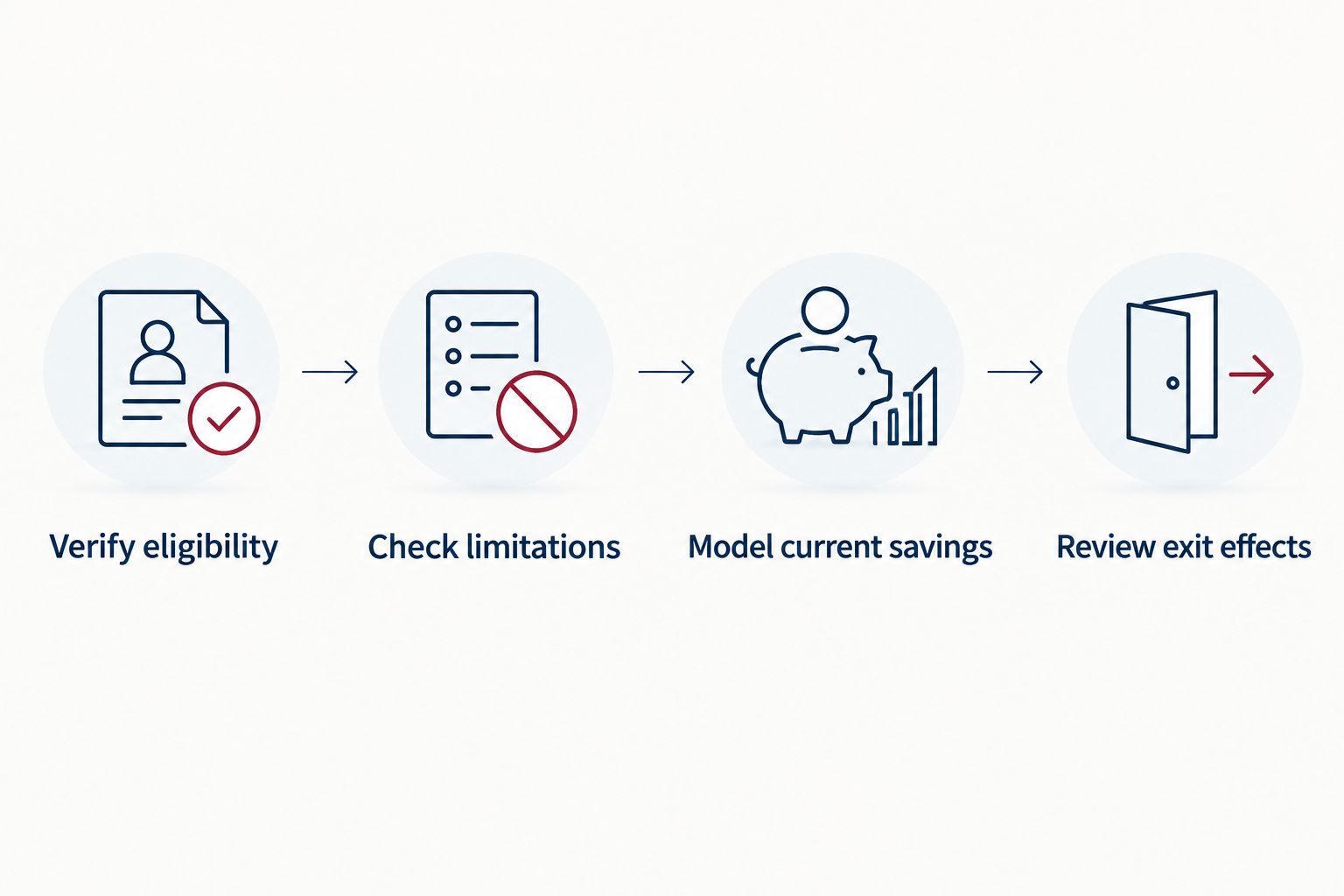
Check whether you can use the deduction before treating it as current tax savings.
Which deduction should you prioritize?
Start with standard depreciation and complete expense records. Evaluate cost segregation after you know whether accelerated losses are usable; evaluate qualified business income after the underlying rental calculation is correct.
CEOHAVEN's real estate tax planning services fit investors who need that coordinated review. A property-level write-off should support your overall tax position—not distract from it.
FAQ
What's the biggest real estate tax deduction in 2026?
There is no universal biggest deduction; the answer depends on property basis, expenses, financing, and eligibility. Cost segregation can accelerate substantial depreciation, but a suspended loss does not automatically reduce current taxes.
Is cost segregation better than standard depreciation?
Cost segregation is better for accelerating eligible depreciation when the resulting deductions are usable and the overall economics support it. Standard depreciation remains the baseline, and both methods recover property basis rather than create separate deductions on the same amount.
Can rental losses reduce my W-2 income?
Rental losses generally cannot offset W-2 income when passive activity rules suspend them. Exceptions and special allowances have specific requirements; real estate professional status also requires material participation for the relevant rental activity to be nonpassive.
How many hours do I need for real estate professional status?
You generally must perform more than 750 hours of services in qualifying real property trades or businesses and spend more than half your personal service time in those activities. You must also satisfy the separate material participation rules for the rental activity to receive nonpassive treatment.
Can I deduct my entire mortgage payment on a rental?
No, your entire mortgage payment is not deductible as a rental expense. Qualifying interest and properly treated tax or insurance payments differ from principal repayment and escrow deposits.
Does an LLC create more rental property deductions?
An LLC does not automatically create additional rental deductions. Federal tax classification, business purpose, property use, and the underlying expense determine the treatment.
Is a 1031 exchange a real estate tax deduction?
A qualifying 1031 exchange defers recognition of eligible gain rather than creating an operating deduction. Evaluate exchange requirements and replacement-property economics separately from annual rental deductions.
One last thing
A suspended loss is not necessarily a failed deduction. It can retain future value under the applicable rules, but it is not current cash savings. Ask for both figures: the deduction generated and the tax reduction you can actually use.