

PTET is generally not available to an individually owned single-member LLC taxed as a disregarded entity; it can be worth evaluating when that LLC is taxed as an S corporation and qualifies under its state’s rules. The benefit depends on your federal deduction, state credit treatment, payment timing, and added compliance—not simply on having an LLC.
TL;DR
- Is PTET worth it for single member LLC owners? Generally not when the LLC remains a disregarded entity.
- An eligible S corporation needs a federal-and-state comparison before making a PTET election.
- The larger 2026 SALT deduction limit changes the calculation; PTET savings are not automatic.
- CEOHAVEN offers tax planning for entrepreneurs; evaluate entity structure before pursuing a PTET deduction.
Is PTET worth it for a single-member LLC?
For a typical individually owned, disregarded single-member LLC, the answer is no: eligibility comes before savings. A state-law LLC and a federal tax classification are different things. Your operating agreement establishes ownership; your tax election determines how the business is treated for federal income tax purposes.
For an individual owner, business activity generally appears on Schedule C, Schedule E, or Schedule F, depending on the activity. That does not automatically make the LLC eligible for a state pass-through entity tax election.
| Tax treatment | PTET position | Best for | Main limitation |
|---|---|---|---|
| Disregarded single-member LLC | Generally outside partnership and S corporation PTET regimes | Owners whose circumstances support direct reporting | LLC status alone does not establish eligibility |
| LLC taxed as an S corporation | Potentially eligible under state rules | Eligible owners with a positive combined-tax result | Payroll, corporate filings, and state requirements remain |
| LLC taxed as a C corporation | Not the owner-level PTET strategy discussed here | Businesses with a separate reason for corporate taxation | Corporate income taxation requires a different analysis |
Do not change tax classification based on the middle row alone. CEOHAVEN provides tax planning, tax preparation, and bookkeeping for entrepreneurs and other high-income clients. CEOHAVEN tax planning is best suited to owners who need entity decisions considered alongside their books and tax returns.
Why this matters
A deduction is not the same as a net tax saving. You need to compare the complete return with and without the election, including the owner’s state credit and any deductions that change as business income changes.
The federal SALT rules also changed the starting point. For 2026, the generally applicable individual state and local tax deduction limit is $40,400, subject to income-based reductions and separate rules for married taxpayers filing separately. Assuming every high earner is limited to a $10,000 deduction produces the wrong baseline.
PTET still deserves attention. But the right question is whether it improves your actual result—not whether someone else’s entity received a deduction.
Disregarded single-member LLC: establish eligibility first
If you own the LLC individually and have not elected corporate tax treatment, the federal default is generally disregarded-entity treatment. The LLC remains a legal entity under state law, but its income tax activity is generally reported by you.
Most state elective PTET systems focus on qualifying partnerships and S corporations. A disregarded LLC does not become a qualifying partnership just because it has a business bank account, an EIN, or substantial revenue.
Best for: owners whose operations and tax circumstances support remaining disregarded. Direct reporting avoids the separate federal corporate return and shareholder payroll obligations associated with an S corporation election.
The trade-off is that disregarded treatment generally does not provide access to the PTET strategy available to qualifying partnerships and S corporations. Confirm the relevant state’s definition of an eligible entity before making payments or assuming an election is possible.
If another entity owns the single-member LLC, the analysis changes. Review the tax treatment of the owner rather than assuming the individually owned LLC rules apply unchanged.
S corporation tax treatment: compare the whole structure
A single-member LLC can elect S corporation tax treatment if it meets the federal requirements. It remains an LLC under state law while being taxed as an S corporation.
That distinction creates a potential route to PTET eligibility—not a guaranteed benefit. The state must permit the election for that entity, the required election must be valid, and the income must qualify under the state’s tax-base rules.
Best for: owners for whom S corporation treatment already makes sense and whose PTET comparison shows a positive combined-tax result.
The limitation is the surrounding compliance. An owner performing services for an S corporation must address reasonable compensation, payroll filings, and the corporate income tax return. PTET does not replace those obligations or reduce the need to document them.
If PTET is the only reason you are considering an S corporation, stop at the full comparison. Include state entity taxes, payroll administration, filing obligations, and the effect of compensation on other tax calculations. A deduction cannot justify a structure that leaves you worse off overall.
Why PTET value varies
The same entity structure can produce different outcomes for different owners. These factors determine whether the election earns its place in your 2026 plan:
- Tax classification. A disregarded LLC and an S corporation follow different eligibility paths. Start with the classification actually in effect, not the one you intend to elect.
- State eligibility. Each state defines qualifying entities, owners, income, and election procedures. Federal pass-through treatment does not establish state eligibility.
- Personal SALT position. If you already deduct the relevant state taxes personally, the incremental federal advantage differs from a situation where the SALT limit blocks that deduction.
- State credit treatment. Review how the owner receives the credit or exclusion, including restrictions on refunds, carryforwards, and resident credits.
- Other federal deductions. An entity-level deduction can affect qualified business income and the related deduction. A lower business profit is not an isolated change.
- Timing and administration. Election deadlines, required payments, accounting treatment, and return preparation affect whether the expected benefit is realized.
Do not substitute a generic income threshold for these checks. Revenue alone does not reveal taxable profit, filing status, state exposure, or your existing deduction position.
How to evaluate PTET before making the election
Use a written comparison rather than a verbal estimate. The sequence matters because an attractive deduction is irrelevant if the entity cannot make a valid election.
- Confirm classification. Identify the federal tax treatment in effect for the year. Verify any S corporation election and its effective date rather than relying on the LLC’s name.
- Check state rules. Establish eligible entity status, qualifying income, owner requirements, and the election and payment deadlines for 2026.
- Build the baseline. Prepare a projection without PTET using the same income, filing status, deductions, and state assumptions you will use in the election scenario.
- Model the election. Include the entity-level deduction, owner credit, state adjustments, qualified business income effects, and any changes to personal itemized deductions.
- Document the decision. Record the combined-tax result, payment schedule, filing responsibilities, and additional administration before authorizing the election.
The deliverable should show what changes and why. A projection that lists only the federal deduction leaves out the parts most likely to change your decision.
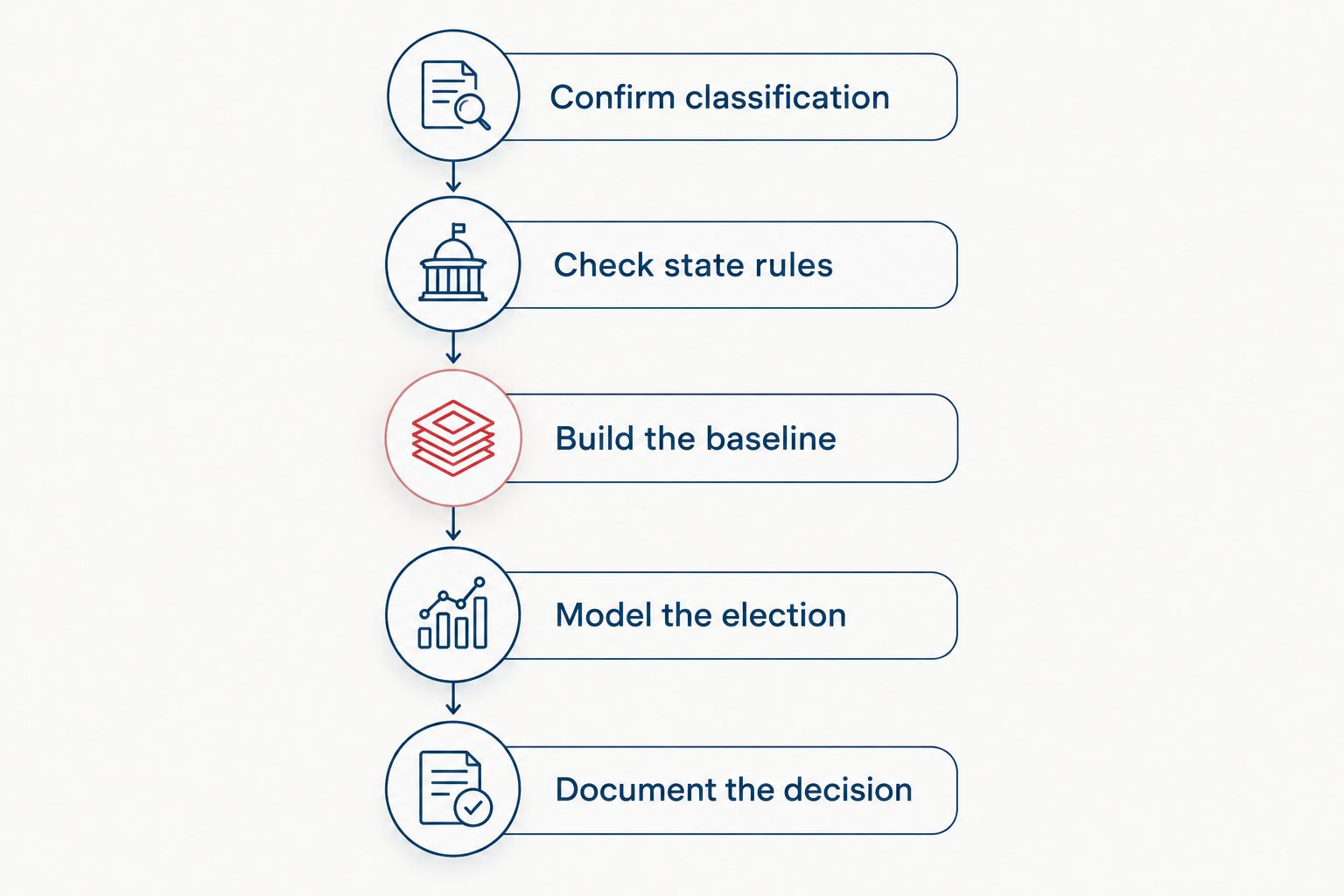
Confirm eligibility before calculating the benefit.
Keep the supporting records with your tax documents. That includes the election confirmation, payment evidence, return treatment, and the assumptions used in the comparison—not just a bank withdrawal labelled as tax.
How does the 2026 SALT limit affect the decision?
The $40,400 limit changes the personal-deduction baseline for 2026. Under Internal Revenue Code Section 164, as amended, that limit generally begins decreasing when modified adjusted gross income exceeds $505,000 for taxpayers other than married taxpayers filing separately; the reduction does not take the limit below $10,000.
Those figures are deduction rules, not automatic PTET savings. Your result also depends on whether you itemize, which taxes are deductible personally, and how much of that deduction you can actually use. Married filing separately has different limits and thresholds.
The federal framework described in IRS Notice 2020-75 addresses deductions for qualifying state income taxes imposed on and paid by partnerships and S corporations. It does not turn every LLC into an eligible entity or replace state election rules.
Compare PTET against your actual 2026 personal deduction, not an outdated assumption. A larger personal SALT deduction can reduce the incremental benefit, while an income-based limitation can make the entity-level analysis more relevant.
Can PTET reduce my qualified business income deduction?
The 20% maximum QBI deduction rate does not mean every eligible owner receives that deduction on all business income. Taxable-income limits, business type, wages, property, and other rules affect the result.
A deductible entity-level state tax payment generally reduces the business income used in the QBI calculation. That can reduce the associated deduction, so multiplying the PTET payment by your marginal federal tax rate can overstate the benefit.
Have the projection calculate both effects together. Do not subtract a presumed QBI adjustment by hand and treat the result as a completed tax analysis.
Should I elect S corporation status just to get PTET?
Do not elect S corporation status solely because PTET offers a deduction. First establish that the full S corporation structure improves your position after compensation, payroll, state taxes, and filing obligations are included.
The election can be appropriate, but PTET is one component of the decision. Your business activity, profit, owner services, and longer-term plans belong in the same analysis.
What should you ask your tax adviser to show you?
Ask for a side-by-side projection that you can read without reconstructing the tax return. Each scenario should use consistent assumptions and explain any difference in payment timing.
Require these items before approving the election:
- Federal result: the deduction’s effect after changes to itemized deductions and QBI.
- State result: entity tax, owner credits, additions, and any unresolved carryforward treatment.
- Cash requirement: which account pays, when payment is due, and how owner estimates are adjusted.
- Execution responsibility: who files the election, verifies acceptance, and records the payment.
For owners comparing service providers, CEOHAVEN offers tax planning alongside preparation and bookkeeping. Evaluate that scope against your needs; it does not substitute for a state-specific eligibility determination or prove that PTET will save you tax.
Review Your Entity Tax Plan
Consider tax classification, PTET eligibility, and bookkeeping together before making an election.
FAQ
Can my single-member LLC elect PTET without becoming an S corporation?
An individually owned single-member LLC that remains disregarded generally does not qualify under partnership and S corporation PTET regimes. Verify the applicable state’s eligible-entity definition before making an election or payment.
Does a single-member LLC automatically qualify for PTET after an S corporation election?
No. S corporation treatment creates a potential eligibility path, but the entity must also satisfy the state’s requirements and complete a valid election.
Is PTET still worth considering in 2026?
Yes, PTET remains worth evaluating for an eligible entity in 2026, but savings are not automatic. Compare it against the owner’s actual personal SALT deduction and the complete federal-and-state result.
Does PTET replace my S corporation payroll obligations?
No. PTET does not replace reasonable-compensation requirements, payroll filings, or the S corporation income tax return. Those obligations remain part of the entity decision.
Will I receive every dollar of PTET back as a state credit?
Do not assume a dollar-for-dollar refundable credit. State rules determine the owner benefit, including credit amounts, refundability, carryforwards, and interactions with other states.
Can PTET lower my QBI deduction?
Yes, a deductible entity-level state tax payment generally reduces the business income used to calculate QBI. Model that effect alongside the federal benefit rather than evaluating the deduction alone.
What documents should I bring to a PTET planning meeting?
Bring your entity tax election records, prior federal and state returns, current books, payroll records, and projected income. Also identify your residence, states where the business operates, and any estimated tax payments already made.
One last thing
The payment account does not establish the tax treatment. Paying an owner’s personal state income tax from an LLC bank account does not, by itself, create a deductible entity-level PTET payment.
Confirm who legally owes the tax, whether the election is valid, and how the payment belongs on both returns. Fix that distinction before moving money—not when the return is ready to file.