

Usually, no: forming your business in another state is not worth it when you continue living and operating in your home state. For 2026, out-of-state formation makes sense when a specific investor requirement, governance need, or operating footprint justifies it; otherwise, you risk adding registration and reporting obligations without removing your existing tax exposure.
TL;DR
- Is it worth incorporating in a different state? Usually not when your operations and tax obligations stay home.
- Delaware incorporation does not erase taxes owed where your business operates or where you reside.
- CEOHAVEN tax planning serves entrepreneurs who need formation decisions connected to their actual tax obligations.
- Choose a formation state for a documented business reason, not an advertised tax shortcut.
Is it worth forming your business in a different state?
Out-of-state formation earns its place when it solves a problem that home-state formation does not. A financing requirement is a concrete reason. A promise that an out-of-state mailing address eliminates your home-state taxes is not.
Keep formation separate from federal tax classification. An LLC's formation state does not determine whether an S corporation election makes sense; review whether an S corporation is worth it as a separate decision.
| Formation approach | Best for | Main advantage | Main drawback |
|---|---|---|---|
| Form where you operate | Owner-operated businesses concentrated in their home state | Keeps formation and operating-state administration aligned | Does not satisfy an investor's different formation requirement |
| Form in an investor-required state | Businesses with a documented financing requirement | Matches the proposed financing structure | Adds obligations if the business operates elsewhere |
| Form elsewhere for a specific legal purpose | Businesses with a counsel-supported governance or ownership need | Addresses the identified legal requirement | Requires separate analysis of registration, taxes, and administration |
The right formation state solves a business problem; it does not substitute for tax planning. Before filing, identify what changes legally, what changes economically, and what stays exactly the same.
Why this matters
Your formation certificate answers where your entity was created. It does not answer every question about where your business must register, file returns, withhold payroll taxes, or collect sales tax.
That distinction matters for a founder running a profitable company from a home office. Moving the entity's paperwork without moving the work does not establish that the company's operating-state obligations disappeared.
For your 2026 decision, examine the full structure: your residence, management location, employees, property, customers, ownership, and tax classification. A state-selection decision is incomplete until someone maps the obligations outside the formation state.
Home-state formation: best for locally concentrated operations
Home-state formation is the starting point when you manage the business there and conduct its activities there. Its advantage is administrative alignment, not a special tax exemption.
You still need the registrations, licenses, returns, and records that apply to your business. The benefit is avoiding an additional formation jurisdiction without a reason to maintain it.
The limitation is straightforward: home-state formation does not answer every investor or governance requirement. If financing documents call for a different structure, resolve that requirement with legal counsel before accepting funds or issuing equity.
For an entrepreneur without that constraint, ask a harder question than which state sounds attractive: What measurable business benefit would the extra jurisdiction deliver? If the answer is only a general claim about lower taxes, request an analysis tied to your actual facts.
Delaware formation: best for a documented financing need
Delaware has an established corporate-law system, including the Court of Chancery. That legal infrastructure is a reason to discuss Delaware with counsel when your financing or ownership arrangements call for it.
It is not a reason to assume every founder needs a Delaware corporation. Confirm whether prospective investors require that structure and whether their requirement applies to the transaction you are actually pursuing.
The downside appears when the business is formed in Delaware but operates elsewhere. You must evaluate qualification in the operating state and maintain the applicable obligations in Delaware as well.
For 2026, treat investor preference as a fact to verify, not a financing strategy by itself. Incorporating in Delaware does not secure investment, and it does not remove another state's authority to tax activity connected to that state.
Another formation state: best for a specific legal requirement
An alternative state deserves consideration when counsel identifies a legal feature that matters to your ownership or governance arrangement. Name that feature before discussing the filing.
Privacy also needs a precise definition. Public filing disclosures differ by state, but limiting information in a public database is not the same as avoiding bank identification requirements, tax reporting, or legal disclosure obligations.
The drawback is complexity without a corresponding benefit. A registered agent's address does not establish that your business has moved its employees, management, property, or income-producing activity.
Do not buy an entity structure before you understand the obligation it is supposed to solve. Request a written explanation of the benefit, its limits, and the responsibilities that remain in other states.
Why the answer varies by business
The formation decision depends on facts, not a state's reputation. These factors determine whether another jurisdiction serves a purpose:
- Operating location. Offices, employees, management activity, and property affect your registration and tax analysis.
- Owner residency. Your personal residence remains relevant to state income taxation even when your entity is formed elsewhere.
- Financing requirements. A specific investor requirement carries more weight than a general statement about investor preferences.
- Entity classification. An LLC, an S corporation, and a C corporation raise different federal and state tax questions.
- Governance needs. Ownership arrangements, equity rights, and dispute-resolution considerations belong in counsel's analysis.
- Administrative obligations. Registered agents, reports, tax returns, and license renewals require ongoing attention wherever they apply.
No single factor settles every case. A remote business with employees across state lines needs a different review from a founder working alone in the state where they live.
How to evaluate an out-of-state formation in 2026
Use this sequence before submitting formation documents. It keeps a legal choice from becoming an expensive correction project later.
- Map operations. List where you live, manage the company, employ people, hold inventory, and own business property. Identify customer locations separately because different taxes use different connection rules.
- Confirm purpose. Write down the exact reason for considering another state. Distinguish a financing requirement or legal need from an unsupported tax claim.
- Review registration. Ask counsel where the entity must qualify to conduct business. Registration analysis and tax nexus analysis are related, but they are not interchangeable.
- Model taxes. Have your tax adviser evaluate entity-level taxes, owner-level taxes, payroll obligations, and relevant elections. Compare the proposed structure with your current structure using the same business facts.
- Assign compliance. Document who handles registered agents, filings, tax returns, and renewals. Do not assume the formation provider handles ongoing tax compliance.
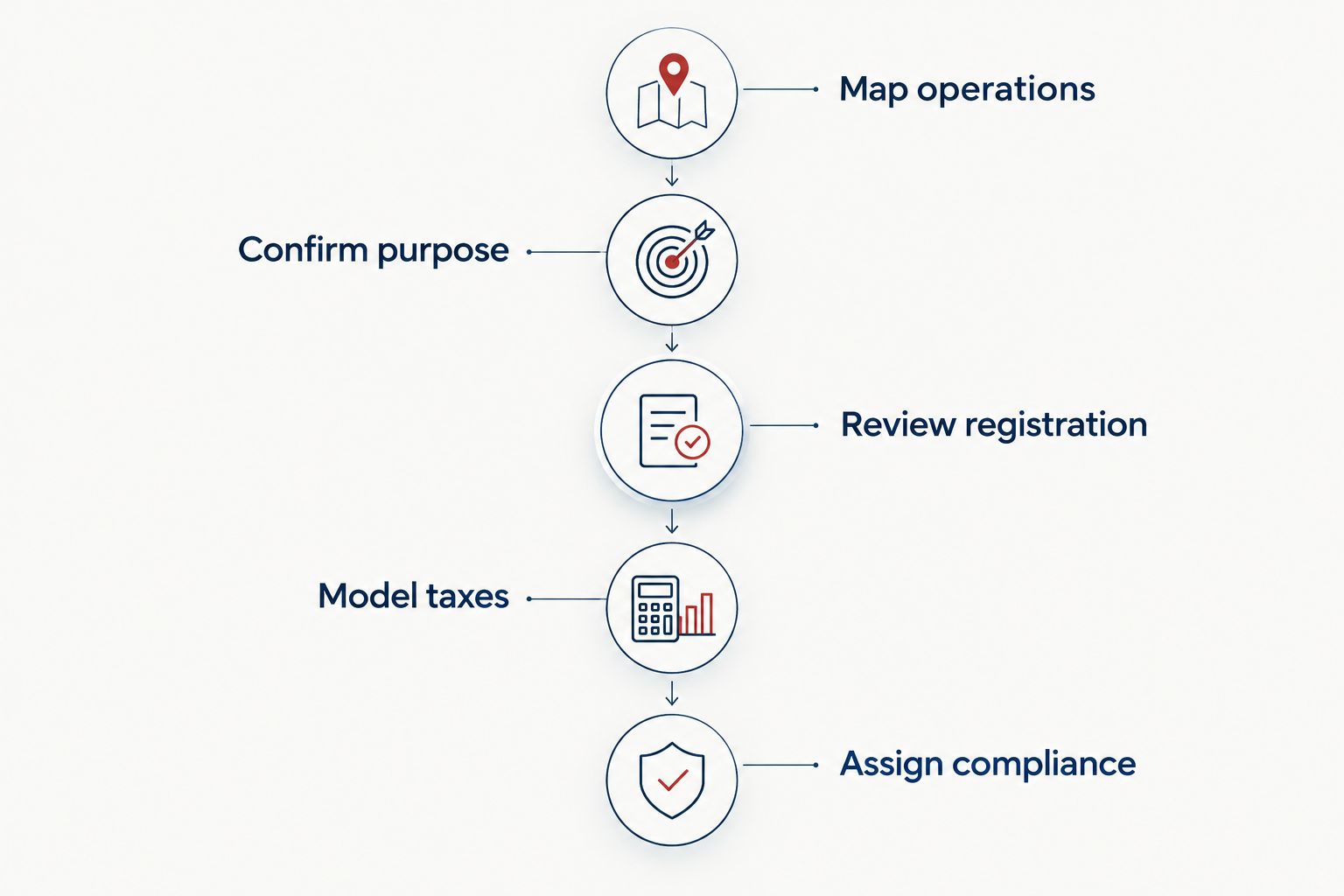
Review operating-state obligations before committing to a formation state.
End with a written decision, not just a filing confirmation. The decision should explain why the chosen state fits, which other states remain relevant, and what would trigger a future review.
If you already formed elsewhere, apply the same sequence before making changes. Closing or replacing an entity introduces its own legal and tax questions; do not treat a new filing as an automatic repair.
Formation state and federal tax status are different decisions
An LLC is a state-law entity. Its federal tax treatment depends on ownership and applicable elections, not simply the state printed on its formation documents.
For 2026 federal tax planning, IRS guidance distinguishes the default treatment of eligible LLCs from elections to be taxed as corporations. A single-member LLC is generally disregarded for federal income tax purposes unless it elects otherwise; an LLC with multiple members is generally treated as a partnership unless it elects otherwise.
An S corporation election introduces separate eligibility rules. IRS S corporation guidance includes a limit of 100 shareholders and generally permits 1 class of stock. Shareholder eligibility restrictions also apply, so meeting those numerical limits alone does not establish eligibility.
A C corporation generally faces a 21% federal corporate income tax rate, before considering state taxes and shareholder-level consequences. That federal rate is not a benefit created by choosing a particular formation state.
These distinctions explain why a state-shopping conversation can miss the real decision. Your ownership, compensation, distributions, retained earnings, and exit plans belong in the tax analysis before anyone presents a formation state as the answer.
What should your advisers deliver before you file?
Ask for a decision memo you can use, not a list of attractive jurisdictions. It should separate legal recommendations from tax conclusions and identify who is responsible for each.
The tax portion should connect your business records to the proposed structure. Without reliable books and an accurate picture of owner compensation and distributions, the comparison rests on incomplete information.
CEOHAVEN tax planning is best for entrepreneurs who need entity decisions connected to business taxes and bookkeeping. CEOHAVEN offers tax planning, tax preparation, and bookkeeping; formation-state legal questions still require counsel.
That division matters. Tax advice does not replace a legal opinion on governance, registration, or asset protection, and legal formation work does not automatically include ongoing tax planning.
Can I avoid my home state's taxes by forming elsewhere?
No: out-of-state formation alone does not eliminate home-state tax obligations. Resident taxation, business activity, income sourcing, and entity-specific state rules still require review.
If you continue managing and performing the work from your home state, that activity belongs in the analysis. Do not confuse a new registered address with a change in where the business operates.
Is a remote business free to choose any state's tax rules?
No: operating online does not let you elect which states can tax your activity. Employees, inventory, property, sales, and other connections can create obligations under the rules relevant to each tax.
An online business needs an activity map, not merely a mailing address. Review income tax, sales tax, payroll, and entity registration separately rather than assuming one answer covers all of them.
Should I change formation states when I move?
A personal move does not automatically require a new entity. Review the old state's continuing connections, the destination state's registration requirements, and the legal methods available for changing the entity's jurisdiction.
For a 2026 relocation, coordinate the legal work with residency documentation, payroll, banking, licenses, and tax filings. Moving yourself, moving business operations, and changing an entity's formation state are separate actions.
FAQ
Is it worth incorporating in a different state if I work from home?
Usually not when you continue operating from your home state and have no separate legal or financing reason. Out-of-state formation does not remove obligations arising from your work location or residency.
Do I have to register my Delaware company in the state where I work?
You must evaluate your operating state's foreign-qualification rules. Whether registration is required depends on your activities and that state's law; tax obligations require a separate review.
Does forming an LLC in another state automatically lower my taxes?
No, forming an LLC elsewhere does not automatically lower your taxes. Your tax classification, residence, business activity, income sourcing, and applicable state rules determine the result.
Is Delaware better if I plan to raise investment?
Delaware deserves consideration when prospective investors require a Delaware structure or counsel identifies a relevant governance benefit. Confirm the requirement for your actual financing rather than assuming it applies to every business.
Can I get S corporation status by choosing a certain state?
No, S corporation status requires a separate federal tax election and eligibility review. IRS eligibility rules generally limit S corporations to 100 shareholders and 1 class of stock, alongside other requirements.
Does an out-of-state registered agent mean my business moved?
No, a registered agent receives designated legal documents; the agent's address does not establish where you perform business activities. Management, employees, property, and other operating facts remain relevant.
Who should review my formation-state decision?
A business attorney should review legal structure and registration, while a tax adviser evaluates tax treatment and filing obligations. CEOHAVEN provides tax planning, tax preparation, and bookkeeping, not a substitute for counsel's legal analysis.
One last thing
A state filing confirms that an entity exists; it does not confirm that your tax strategy works. Before signing formation documents in 2026, ask each adviser to identify the obligations that survive the proposed change.
That answer is more useful than a state's reputation. If you cannot identify the business problem another jurisdiction solves, keep the structure aligned with your operations and spend your attention on the tax decisions that actually apply.