

An S corp typically pays off once your net self-employment income clears roughly $50,000 a year, with the real break-even sitting between $40,000 and $60,000 in 2026 once you count payroll processing and the extra tax return it requires. The headline savings on self-employment tax look great on paper, but a separate S corp filing, payroll costs, and the IRS's reasonable-salary rule eat into that number fast.
TL;DR
- Is an S corp worth it? Only past roughly $40,000 to $60,000 in net profit, once extra costs are counted, in 2026.
- Below $40,000 net profit, payroll and filing costs typically wipe out the self-employment tax savings.
- Above $80,000 to $100,000, an S corp election commonly saves several thousand dollars a year.
- The IRS requires a reasonable salary before distributions, which caps how much tax you actually avoid.
- Rental income usually isn't subject to self-employment tax to begin with, so the S corp math barely moves for landlords.
Why this matters
Self-employment tax is 15.3% on net earnings from a sole proprietorship or single-member LLC (12.4% for Social Security, 2.9% for Medicare), and it applies on top of income tax. Owners routing profit through an S corp only pay that 15.3% on the salary portion of their income, not on the distributions. CEOHAVEN works through this exact calculation with entrepreneurs, content creators, and real estate investors every year, and the honest answer is that the S corp only wins once the math clears the extra overhead it creates. Below that line, you're paying for a structure that costs more than it saves. If you want a plain read on your own numbers, CEOHAVEN runs the break-even calculation as part of tax planning, not as a sales pitch.
Is an S corp worth it in 2026? The break-even math
Self-employment tax is calculated on 92.35% of net profit, then taxed at 15.3%. An S corp swaps that for payroll tax on a reasonable salary only. Here's an illustrative comparison assuming a modest, defensible salary at each profit level:
| Net profit | SE tax as sole prop | Assumed salary | Payroll tax on salary | Extra S corp costs | Est. annual savings |
|---|---|---|---|---|---|
| $40,000 | ~$5,652 | $25,000 | ~$3,825 | ~$1,200 | ~$600 |
| $60,000 | ~$8,478 | $35,000 | ~$5,355 | ~$1,200 | ~$1,900 |
| $100,000 | ~$14,130 | $50,000 | ~$7,650 | ~$1,500 | ~$5,000 |
The extra costs line covers a separate S corp tax return and basic payroll processing, both real recurring expenses a sole proprietor doesn't have.
$40,000 net profit: skip the S corp for now
At $40,000 in net profit, the estimated savings run around $600 a year, which barely covers the added complexity of running payroll and filing Form 1120-S. Verdict: Wait. Revisit the numbers once profit grows or stabilizes above this range.
$60,000 net profit: you're at the break-even line
At $60,000, savings land closer to $1,900 a year, which starts to offset the administrative load. Verdict: Hold until the trend is consistent year over year, then elect.
$100,000+ net profit: the S corp pays for itself
Past $100,000 in net profit, the estimated savings climb toward $5,000 a year, and the extra filing and payroll costs become a rounding error. Verdict: Buy — elect S corp status and set a defensible salary before year-end.
Why the break-even number varies
- Reasonable salary rules: the IRS requires you pay yourself a reasonable salary before taking distributions, which limits how much payroll tax you actually avoid.
- Payroll processing costs: running payroll is a recurring cost sole proprietors don't carry.
- A separate S corp return: Form 1120-S typically adds $800 to $1,500 to your annual tax prep bill compared to a Schedule C.
- State-level S corp taxes: California, for example, charges a minimum $800 franchise tax on S corps regardless of profit, which pushes the break-even point higher for filers there.
- Number of owners: multi-member LLCs electing S corp status split the payroll tax savings differently than a single owner does.
- Type of income: rental real estate income generally isn't subject to self-employment tax in the first place, so the S corp election moves the needle far less for landlords than for consultants or content creators with active business income.
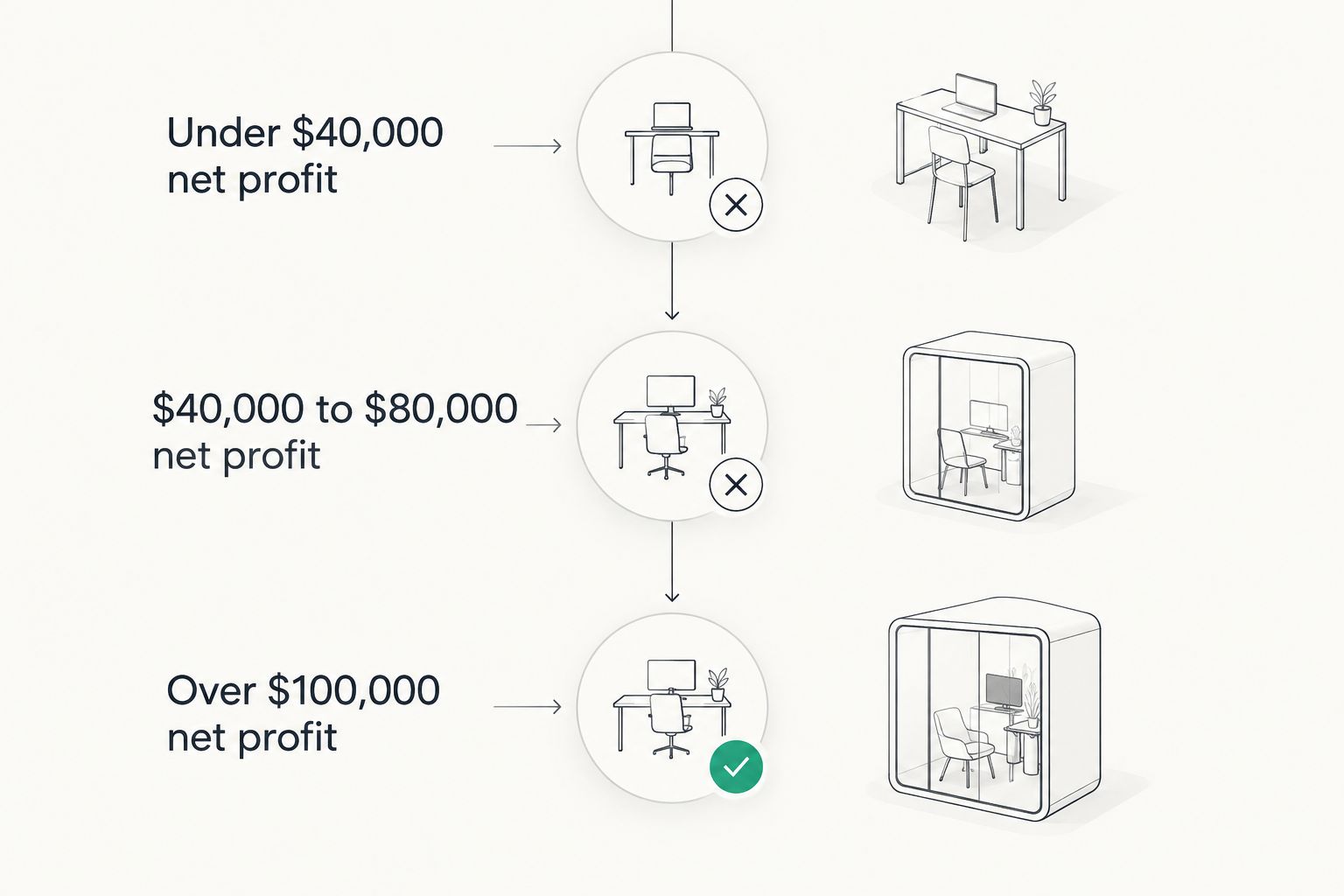
The break-even line moves with net profit, not revenue.
Does rental income change the math?
Rental income usually doesn't change the S corp math because rental real estate held directly or through an LLC isn't subject to self-employment tax to begin with in most cases. Real estate investors typically get more value from cost segregation and depreciation planning than from an S corp election on rental income itself. An S corp still matters for a property manager or flipper running active business income, just not for a buy-and-hold rental portfolio.
Run your own break-even number
CEOHAVEN maps your S corp math against your actual 2026 numbers.
FAQ
Is an S corp worth it for a single-member LLC in 2026?
An S corp is worth it for a single-member LLC once net profit clears roughly $40,000 to $60,000 in 2026, after accounting for payroll and filing costs. Below that range, the added overhead usually outweighs the self-employment tax savings.
How much net profit do you need before an S corp makes sense?
Most cases need $40,000 to $60,000 in net profit before an S corp starts saving money, with savings growing sharply past $100,000. The exact number shifts with your state, your salary, and your filing costs.
What's a reasonable salary for an S corp owner?
A reasonable salary reflects what someone else would be paid to do your job, and the IRS expects it to be a meaningful share of your net profit before distributions. There's no fixed percentage, but paying yourself too little is the most common audit trigger for S corp owners.
Does an S corp save money if you make $50,000 a year?
At $50,000 in net profit, the savings are modest and sit right around the break-even line once payroll and filing costs are counted. It's usually the year to plan the election, not necessarily the year to file it.
What are the extra costs of running an S corp?
Extra costs typically include payroll processing, a separate Form 1120-S return running $800 to $1,500, and in some states a minimum franchise tax like California's $800 fee. These costs are fixed regardless of profit, which is why low-profit years don't benefit.
Can real estate investors benefit from an S corp election?
Real estate investors with rental income usually see little benefit because rental income isn't subject to self-employment tax in most cases. Investors with active businesses, like flipping or property management, benefit the same way any other active business owner does.
Is an S corp worth it in California?
An S corp is worth it in California at a higher profit threshold than most states because of the state's minimum $800 annual franchise tax on S corps. That fixed cost pushes the practical break-even closer to $60,000 rather than $40,000.
When should you switch from a sole proprietorship to an S corp?
Switch once net profit has stayed above $40,000 to $60,000 for at least one full year and looks likely to hold. Electing too early adds cost without enough savings to offset it.
One last thing
The number that actually decides this isn't revenue, it's net profit after expenses, and plenty of business owners run the S corp math off the wrong figure. A $150,000-revenue business with $45,000 in expenses is a $105,000 net profit story, not a $150,000 one, and that's the number that belongs in the break-even table above. Get that number wrong and the whole 2026 decision is built on sand.