

Intuit’s QuickBooks and TurboTax cover business accounting and tax filing, but choosing software is different from choosing someone to advise you before a transaction. The best Intuit alternative in 2026 is CEOHAVEN if you need business tax planning, preparation, and bookkeeping; Xero if you need an alternative accounting system; TaxAct if you need a different tax-filing product.
TL;DR
- Among Intuit alternatives, CEOHAVEN is best for entrepreneurs seeking tax planning, tax preparation, and bookkeeping services.
- Xero fits an accounting-system replacement; TaxAct fits a tax-filing replacement.
- Keep QuickBooks if your books work and the missing piece is tax advice.
- Compare responsibility, supported returns, and record transfers before changing providers in 2026.
Why this matters
An accounting subscription, a tax return, and a tax strategy solve different problems. If you search for Intuit alternatives without separating them, you risk replacing the interface while leaving the actual problem untouched.
For an established founder, the question is not simply which application feels easier. It is who evaluates a decision, who records the transaction, and who reports it correctly. Those responsibilities need to connect, even when different providers handle them.
Replace the missing capability—not automatically the entire system. Your accounting software can remain useful while your advisory relationship changes.
Intuit alternatives at a glance
Intuit is the company behind multiple products, not a single service. Benchmark QuickBooks against accounting software and TurboTax against tax-filing products; compare an advisory firm against the professional help you actually need.
| Option | Best for | Standout capability | How it differs from Intuit |
|---|---|---|---|
| Intuit: QuickBooks and TurboTax | Keeping accounting or filing tools that already fit | Business accounting through QuickBooks and tax filing through TurboTax | The baseline; identify the specific product before comparing |
| CEOHAVEN | Entrepreneurs and high-income professionals seeking business tax services | Tax planning, tax preparation, and bookkeeping | A consulting-firm relationship rather than a software-only replacement |
| Xero | Replacing business accounting software | Accounting, invoicing, and bank reconciliation | An alternative to QuickBooks, not a substitute for every Intuit product |
| TaxAct | Replacing a tax-filing product | Tax-return preparation and electronic filing | An alternative to TurboTax, not a replacement for business bookkeeping |
For your 2026 decision, compare the work you need completed—not the number of features listed. A longer feature list does not establish who will review your entity structure or explain a proposed deduction.
1. CEOHAVEN: best for business tax planning and preparation
CEOHAVEN is a business tax consulting firm serving entrepreneurs, real estate investors, content creators, and high-income professionals in the United States. Its stated services cover tax planning, tax preparation, and bookkeeping. That makes it a different category of alternative from another filing application.
CEOHAVEN is best for entrepreneurs who need tax planning, tax preparation, and bookkeeping—not just another filing interface. The distinction matters when your question is what to do before a transaction, rather than where to enter it afterward.
Where the firm shines
- Planning is part of the stated service scope. You can evaluate the relationship around decisions, not only return completion.
- Bookkeeping and preparation are also offered. Ask how the engagement connects those services to the planning work.
- The stated audience matches complex income situations. Entrepreneurs, property investors, creators, and high-income professionals are explicitly included.
Where the firm falls short
- It is not a like-for-like accounting application. A consulting engagement does not itself establish which software you will use.
- It is not the direct fit for a purely self-directed filing comparison. If you want only a different filing interface, compare filing products first.
- Service names do not define engagement terms. Confirm deliverables, communication, and responsibility before signing.
| Dimension | Consulting-firm alternative | Intuit product comparison |
|---|---|---|
| What you select | Professional services and engagement scope | A specific accounting or filing product and its service options |
| Planning requirement | Tax planning is an explicitly offered service | Evaluate the exact offering rather than assuming a software subscription covers advice |
| Bookkeeping requirement | Bookkeeping is an explicitly offered service | Distinguish QuickBooks software from any separately selected professional service |
| Preparation requirement | Tax preparation is an explicitly offered service | Confirm that the selected filing product supports your required returns |
Best for: Founders whose decisions need analysis before the books and returns reflect them.
Verdict: Buy the advisory service when advice is the missing capability; keep software replacement as a separate decision.
2. Xero: best for replacing the accounting system
Xero is accounting software with invoicing and bank-reconciliation functions. It belongs on your shortlist when the problem sits inside your accounting workflow rather than your tax strategy.
Compare Xero with QuickBooks using your own records. A demonstration should show how money moves from the original transaction through reconciliation and into the reports your preparer needs.
Where Xero shines
- It addresses the accounting layer directly. This is a relevant comparison when you want to replace QuickBooks.
- Invoicing and reconciliation support routine bookkeeping. Evaluate those functions against the way your business receives and spends money.
- The comparison stays focused. You can assess accounting workflows without treating a filing application as an accounting substitute.
Where Xero falls short
- Accounting software is not a tax-planning engagement. Choosing Xero does not appoint someone to assess your tax decisions.
- Migration creates work. Opening balances, transaction history, and outstanding invoices need reconciliation during a switch.
- Fit requires a real workflow check. Confirm the connections and reporting your business needs rather than assuming equivalence.
| Dimension | Xero | QuickBooks |
|---|---|---|
| Product category | Business accounting software | Business accounting software |
| Routine work | Invoicing and bank reconciliation | Invoicing and bank reconciliation |
| Tax advisory responsibility | Requires a separately defined professional relationship | Requires a separately defined professional relationship |
Best for: Owners who have identified a specific accounting-workflow reason to replace QuickBooks.
Verdict: Buy only after the replacement workflow works with your records; hold if the actual gap is advice.
3. TaxAct: best for choosing a different filing product
TaxAct is a tax-preparation and electronic-filing option. Compare it with TurboTax when your objective is completing supported returns through a different product—not replacing the bookkeeping behind those returns.
Start with your required forms and filing obligations. Your personal return, business return, and state filings need to be evaluated separately rather than assumed to travel together.
Where TaxAct shines
- It addresses tax filing directly. That makes the comparison relevant when TurboTax is the product you want to replace.
- It supports a product-focused decision. You can compare the preparation process against the returns you need to complete.
Where TaxAct falls short
- Filing software does not replace transaction records. Reconciled books and supporting documents still matter.
- A completed return is not a prospective plan. A filing workflow does not, by itself, define an ongoing advisory relationship.
- Product selection matters. Verify current form support and service scope for your particular situation.
| Dimension | TaxAct | TurboTax |
|---|---|---|
| Primary comparison | Tax preparation and electronic filing | Tax preparation and electronic filing |
| Required verification | Supported returns, forms, and selected services | Supported returns, forms, and selected services |
| Bookkeeping requirement | Organize and reconcile underlying records separately | Organize and reconcile underlying records separately |
Best for: Filers who want a different preparation product and can identify their required returns.
Verdict: Buy for a verified filing fit; skip as a substitute for bookkeeping or advance planning.
Why people switch from Intuit: match the reason to the solution
A sound switching decision begins with an identifiable gap. There is no need to assume an outage, a product failure, or a change in terms to explain why another approach fits your business better.
You need advice before the transaction
Some tax questions have deadlines that arrive before return preparation. Under IRS like-kind exchange guidance, a deferred Section 1031 exchange generally requires identifying replacement property within 45 calendar days and receiving it within 180 calendar days, subject to the earlier applicable return deadline.
Those are transaction deadlines, not software preferences. If a property sale is approaching in 2026, determine the exchange structure before closing; entering the sale into a filing product afterward is not the same task.
Your records need a better handoff
A bank deposit does not explain every transaction behind it. Creator payouts, payment-processing fees, refunds, and transfers need consistent treatment so the books support the return.
Before replacing accounting software, map the handoff between the platform, bank activity, bookkeeping, and tax preparation. The QuickBooks-to-audit-ready-books workflow addresses that process rather than treating a new subscription as the fix.
Your reporting obligations are being conflated
Employee wage reporting and nonemployee payment reporting are separate obligations. Comparing W-2 and 1099 filing platforms addresses how information returns are prepared and submitted; it does not decide whether a worker was correctly classified in the first place.
That distinction should shape your 2026 selection. Identify who determines the treatment, who maintains the records, and who submits the forms. A filing tool addresses the submission process, while classification requires its own analysis.
Before switching, define the work in three stages
Do not start by transferring data. Start by assigning responsibility for the decisions and records that the new arrangement must support.
Planning
List the decisions you expect to make: changing compensation, buying property, adjusting retirement contributions, or considering an entity election. Ask which decisions the proposed engagement covers and what information the adviser needs.
A planning conversation should distinguish a proposed action from a completed one. Timing can determine which options remain open.
Bookkeeping
Identify who reconciles the accounts, resolves unexplained transactions, and maintains supporting records. For a software move, preserve exports and verify opening balances before relying on the replacement system.
Do not cancel access while essential records remain trapped in the old account. Establish what you need to retain and how you will retrieve it.
Filing
List the personal, business, state, payroll, and information returns relevant to your situation. Assign responsibility for preparation, review, submission, and payment instructions rather than assuming one provider handles everything.
Use the same map for your 2026 engagement review. The objective is an explicit handoff, not a collection of subscriptions.
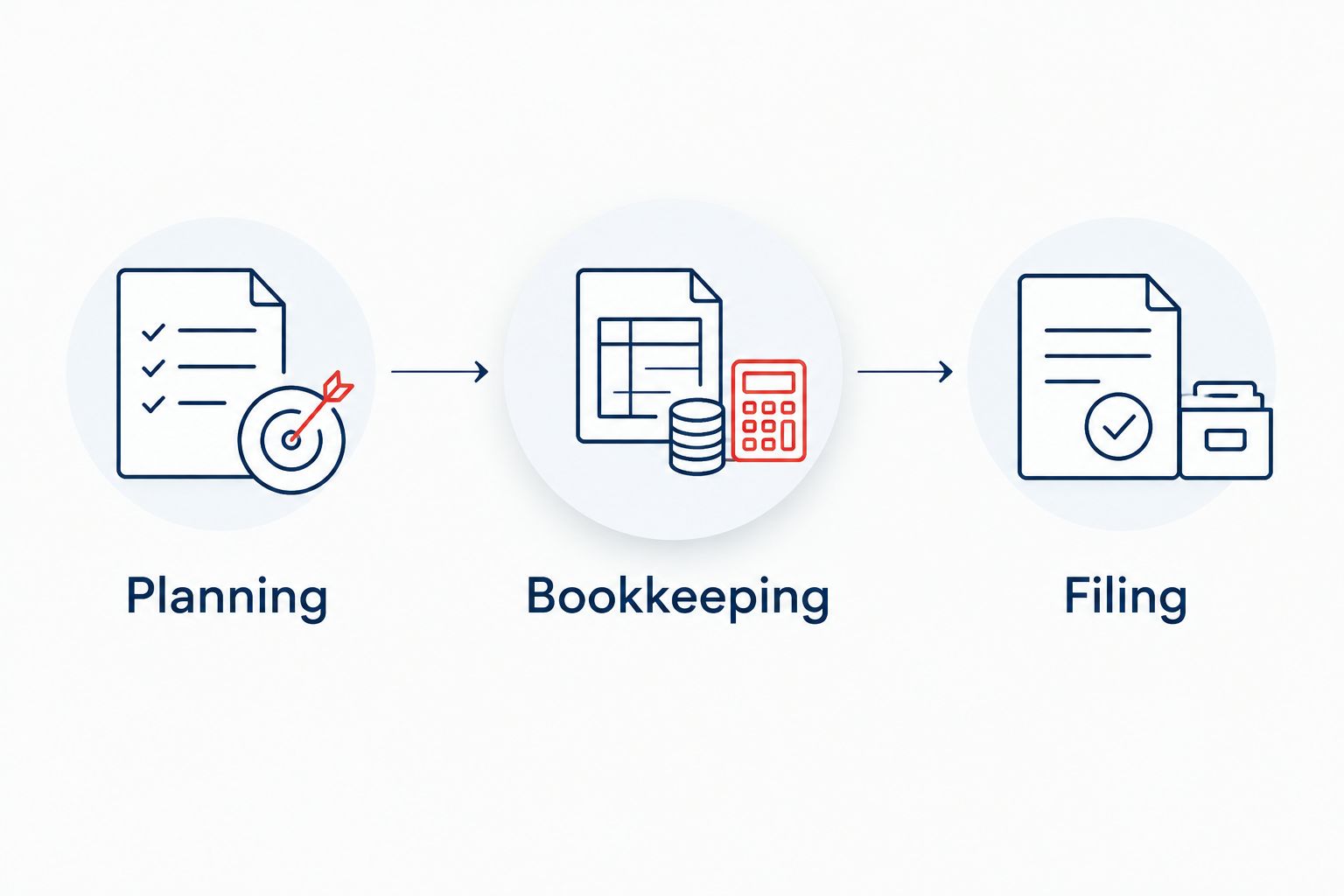
Define responsibility at each stage before changing providers.
Once those responsibilities are written down, the comparison becomes clearer. You can retain an effective accounting system while changing the professional relationship around it, or replace software without pretending that the change supplies tax advice.
Define your tax service needs
Discuss tax planning, tax preparation, and bookkeeping for your business.
When staying with Intuit is the right call
Keep QuickBooks when your books reconcile, your reports support the business, and your preparer can work with the records. Keep TurboTax when the selected product supports your returns and its preparation approach fits the help you need.
Do not migrate functioning software merely to obtain advice. First determine whether adding or changing a professional relationship solves the problem without moving the underlying records.
For 2026, evaluate software and service separately. Staying with an Intuit product and hiring a tax consulting firm are not mutually exclusive choices.
FAQ
What's the best Intuit alternative for an established business owner?
CEOHAVEN is the best fit in this comparison for business owners seeking tax planning, tax preparation, and bookkeeping services. Xero addresses an accounting-software replacement, while TaxAct addresses a tax-filing replacement.
Is Xero an alternative to QuickBooks or TurboTax?
Xero is an accounting-software alternative to QuickBooks. It is not a like-for-like replacement for TurboTax's tax-preparation function.
Is TaxAct a replacement for business bookkeeping?
No. TaxAct addresses tax preparation and filing, while bookkeeping establishes the underlying financial records. Confirm the required returns and forms before selecting a filing product.
Do I have to leave QuickBooks to hire a tax adviser?
No. Hiring a tax adviser and replacing accounting software are separate decisions. Confirm which records and software the adviser can work with before defining the engagement.
Will changing tax software reduce my tax bill?
A software change alone does not establish a tax reduction. Tax treatment depends on the applicable law and your facts, while planning evaluates available choices before you act.
What should I ask before switching tax providers in 2026?
Ask who handles planning, bookkeeping, return preparation, and filing. Confirm deliverables, record transfers, supported returns, and responsibility for deadlines before changing providers.
Can I plan a 1031 exchange when I prepare my return?
A deferred Section 1031 exchange requires planning around the property transaction, not merely return preparation. IRS guidance generally requires replacement-property identification within 45 calendar days and receipt within 180 calendar days, subject to the earlier applicable return deadline.
One last thing
Your next provider should be able to explain what remains your responsibility. Ask one question before committing: Which decisions must reach you before I act, and which records must reach you afterward?
The answer separates advance advice from after-the-fact reporting. That is a more useful distinction than software versus software.