

Instead of manually rebuilding property costs for a cost segregation study, connect rental property software to cost segregation through a reconciled property ledger, a documented study handoff, and an approved depreciation schedule. The connection is a controlled accounting workflow—not a bank feed that decides which assets qualify for accelerated depreciation.
TL;DR
- To connect rental property software to cost segregation, reconcile property costs before sending records to the study provider.
- CEOHAVEN is best for real estate investors seeking tax planning, tax preparation, and bookkeeping together.
- Keep land, building costs, improvements, and previously claimed depreciation identifiable throughout the handoff.
- Import approved asset classifications only after your tax preparer reviews the study and implementation requirements.
Why this matters
Your rental ledger records transactions. A cost segregation study analyzes property components for federal tax depreciation. Those records need to agree, but they perform different jobs.
Residential rental buildings generally use a 27.5-year recovery period under the general depreciation system; nonresidential real property generally uses 39 years. A supported study can identify components with shorter recovery periods, including qualifying 5-year or 15-year property. Land remains nondepreciable. These are federal depreciation categories described in IRS Publication 946, not automatic classifications for every property.
A study changes how eligible basis is depreciated; it does not create additional acquisition basis. Nor does an accelerated deduction guarantee an immediate reduction in your tax bill: passive activity and other loss limitations still matter.
For a 2026 implementation, settle the tax strategy before changing the asset register. The real estate investor tax planning guide provides the broader planning context.
Before you start
- Access: Obtain permission to export the property ledger, review supporting documents, and access the existing fixed-asset schedule. Identify the bookkeeper, study provider, and tax preparer responsible for each handoff.
- Materials: Gather settlement statements, purchase allocations, improvement invoices, placed-in-service dates, and prior depreciation schedules. Include previously filed returns relevant to the property's depreciation history.
- The gotcha: A previously depreciated property needs more than a replacement spreadsheet. Your tax preparer must determine whether implementation requires an accounting-method change, an amended return, or another permitted approach before anyone overwrites existing records.
The steps below are system-neutral. Software menus differ, so the bold field names are recommended working-file labels, not claims about buttons or settings in a particular application.
Property ledger configuration
The first configuration unit establishes what the property costs and where each amount came from. Keep transaction evidence separate from tax conclusions.
- Create a property key. Assign a stable identifier to each property. Carry it through exports, document folders, the study handoff, and the asset register; an address alone becomes unreliable when its formatting changes.
- Export the full ledger. Include transaction dates, accounts, descriptions, vendors, amounts, and available document references. For a property already in service, include its acquisition and improvement history rather than exporting only 2026 activity.
- Separate cost categories. Identify land, building acquisition costs, later improvements, operating expenses, financing-related items, and unresolved transactions. Do not treat every closing charge as depreciable building basis.
- Reconcile the records. Tie acquisition entries to settlement documents and improvement entries to invoices. Resolve duplicate imports, missing entries, and transfers before the study provider receives the file.
- Preserve the source. Save an unchanged export and create a separate working copy. Record corrections in the books rather than silently changing exported amounts.
Expected result: Your property ledger supports a traceable acquisition-and-improvement history. Every amount submitted for analysis has evidence or a clearly documented question awaiting resolution.
Do not estimate missing basis from bank withdrawals alone. A payment establishes cash movement; it does not establish tax treatment.
Study handoff configuration
The next configuration unit turns accounting records into an organized review package. The study provider needs the property's history, not just a folder of receipts.
- Build a property summary. Use fields such as Property ID, Ownership Entity, Acquisition Date, Placed-in-Service Date, and Document Reference. Record actual dates; do not substitute the closing date for the placed-in-service date without confirming the facts.
- Attach basis support. Include settlement documents, allocation support, construction records, and improvement invoices. Mark unresolved allocations so the provider knows which figures still need review.
- Add depreciation history. Supply the existing asset schedule, accumulated depreciation, and relevant filed-return records. Distinguish original building assets from later additions.
- Assign review responsibility. Name who answers construction questions, who resolves ledger discrepancies, and who approves tax implementation. Confirm the provider's required materials and delivery method directly.
- Transmit through an approved channel. Use an access-controlled method agreed with the recipients. Send only records relevant to the engagement, and restrict access to the people doing the work.
Expected result: The study provider can connect each property and improvement to its supporting records, while your tax preparer can identify the existing depreciation treatment.
CEOHAVEN's real estate tax planning belongs in this decision stage: assess the proposed deduction in the context of your return before implementation. A larger depreciation deduction and a currently usable deduction are different outcomes.
Asset mapping configuration
When the study arrives, translate its conclusions into a controlled asset register. Do not import the report's totals as additional property purchases.
- Check the reconciliation. Compare the study's analyzed basis with the approved acquisition and improvement records. Identify amounts outside the study's scope and any differences requiring explanation.
- Map the classifications. Carry each approved component into fields such as Asset Description, Allocated Basis, Recovery Period, Method, Convention, and Placed-in-Service Date. Preserve the study reference for each classification.
- Choose the record structure. Use the comparison below to decide where detailed tax depreciation will live. Keep a clear reconciliation regardless of the structure selected.
- Review existing assets. Have your tax preparer determine how the original building record and accumulated depreciation should be handled. Preserve history rather than deleting the original record to force agreement.
- Approve the mapping. Obtain tax-preparer approval before importing classifications into the production tax depreciation schedule. For a 2026 implementation, document the applicable treatment rather than copying assumptions from a sample report.
| Record structure | Best for | Advantage | Limitation |
|---|---|---|---|
| Detailed asset register in accounting software | Investors whose software supports the required records and whose accounting team maintains them | Keeps asset detail close to the general ledger | Accounting software records do not replace tax review or establish that every tax calculation is supported |
| Separate tax depreciation register | Investors whose rental software primarily handles transactions and property reporting | Separates tax calculations from day-to-day rental bookkeeping | Requires a maintained reconciliation to the books |
These are recordkeeping approaches, not competing tax strategies. Neither changes the evidence needed to support the study.
Expected result: Approved component allocations reconcile to the relevant depreciable basis, and the records explain where tax depreciation is calculated.
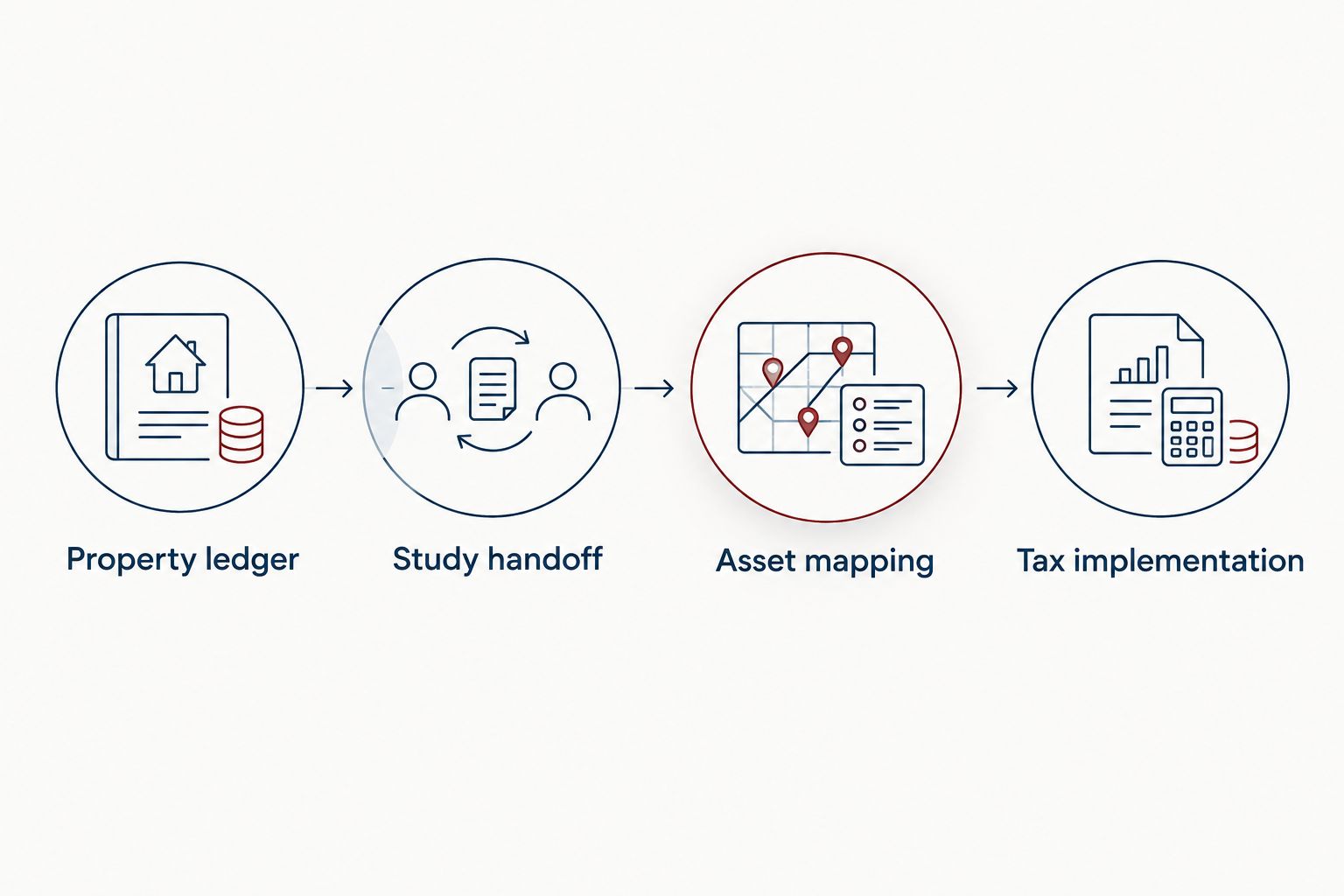
The study sits between reconciled accounting records and approved tax implementation.
Tax implementation configuration
The final configuration unit connects approved classifications to the return and the accounting records. This is where your tax preparer resolves filing mechanics.
- Determine the implementation route. For previously depreciated property, have your tax preparer assess whether Form 3115 and a section 481(a) adjustment apply, or whether another permitted procedure fits the facts. Do not assume every late study requires the same filing.
- Review deduction limitations. Evaluate passive activity restrictions, at-risk limitations, and other applicable rules before treating projected depreciation as a current tax benefit.
- Approve accounting entries. Ask the responsible accountant to specify any required entries and explain book-tax differences. Tax depreciation need not equal the depreciation used in management reporting.
- Complete a final tie-out. Reconcile the approved study, tax asset schedule, relevant return amounts, and ledger balances or book-tax reconciliation. Explain each difference rather than forcing identical totals.
- Archive the implementation package. Retain the final study, source documents, approved mapping, filed forms, and reconciliation together. Preserve earlier versions separately so the final record is identifiable.
Expected result: Your 2026 filing work and property records reflect the approved treatment without duplicate basis or unexplained changes to depreciation history.
CEOHAVEN's tax preparation and bookkeeping services address the two sides of this handoff. The study still needs its own supporting analysis; tax preparation is not a substitute for that work.
Update the workflow whenever improvements are completed
A second workflow applies after renovations or other capital projects. Do not repeat the entire original-property process every time an invoice arrives.
- Open a project record. Link the project to the property's existing identifier. Separate the project's invoices and supporting documents from ordinary operating activity.
- Capture service dates. Record when the completed improvement becomes ready and available for its intended use, along with evidence supporting that date.
- Request classification review. Ask your tax preparer to distinguish deductible repairs from capital improvements and determine whether additional cost segregation analysis is appropriate.
- Update approved records. Add assets only after review. If work replaces existing components, ask whether disposition treatment needs attention before leaving both old and new components on the schedule.
Best for: Investors completing renovations after the original acquisition study. The benefit is a continuing evidence trail; the limitation is that project-level review remains necessary.
For 2026 projects, build this handoff into project closeout. Contractor descriptions and supporting records are easier to clarify while the work remains fresh.
Troubleshooting
The study total does not match the ledger
Compare scope before changing balances. The ledger can include land, financing-related amounts, operating expenses, or improvements outside the study; identify each difference and obtain an approved reconciliation.
The import doubles the property's basis
Stop the import and preserve a backup. A study generally reallocates existing eligible basis, so importing every component as a new purchase can duplicate amounts already recorded; have the accountant correct the mapping before posting.
The export has no property identifiers
Create a documented mapping between each source transaction and its property. Investigate shared expenses separately rather than assigning them to whichever property appears first in the file.
The original depreciation schedule is missing
Request prior schedules and return records from the responsible preparer, subject to your authorization. Do not rebuild accumulated depreciation solely from the current ledger balance; have your tax preparer reconstruct the history from available evidence.
The deduction does not reduce the current tax bill
Review the return's loss limitations and carryforwards with your tax preparer. Cost segregation changes depreciation timing, but passive activity restrictions and other applicable rules can limit the deduction currently allowed.
Customize your workflow
Expand the workflow by assigning an owner to each transition: transaction cleanup, document collection, study questions, asset mapping, and return implementation. Use review status fields such as Awaiting Documents, Under Review, and Approved in your working register.
Automate file collection and reminders only after the responsibilities are clear. Keep tax classification and final approval outside unattended transaction rules. An invoice description is not enough to decide an asset's recovery period.
For portfolio reporting, retain the same property identifier across all records. That makes later improvements, refinancing reviews, and dispositions easier to trace without confusing accounting balances with tax basis.
FAQ
Can I connect rental property software directly to cost segregation?
You can connect the records through exports, supporting documents, and an approved asset mapping. A data connection alone does not perform the classification analysis or implement the resulting tax treatment.
Do I need an API to connect rental property software to cost segregation?
No. A controlled file-based handoff can support the workflow when it includes reconciled transactions, basis documents, depreciation history, and an approved implementation record.
Does rental property software replace a cost segregation study?
No. Rental property software records financial activity; a cost segregation study analyzes property components for depreciation classification. Transaction categories alone do not establish the appropriate recovery periods.
Can I use cost segregation for a property I already own?
A previously acquired property can be evaluated for cost segregation. Your tax preparer must review prior depreciation and determine the permitted implementation procedure rather than simply replacing historical records.
Should land be included in cost segregation depreciation?
No. Land is nondepreciable and must remain separately identifiable. Review the acquisition allocation before mapping building components into a depreciation schedule.
Will cost segregation reduce my taxes immediately?
Not necessarily. An accelerated depreciation deduction remains subject to applicable loss limitations, including passive activity rules. Evaluate the deduction on your actual return before relying on a projected current-year benefit.
Who should approve the final asset mapping?
Your tax preparer should approve the tax treatment and implementation, with the bookkeeper or accountant maintaining the related records. Resolve questions about the study's classifications with the study provider before filing.
One last thing
The most useful control is not another integration. It is the reconciliation that proves the component allocations did not duplicate the property's basis.
Before approving the handoff, ask for that reconciliation and the explanation of prior depreciation treatment. CEOHAVEN is best for real estate investors seeking tax planning, tax preparation, and bookkeeping together—not a substitute for a supported cost segregation study.