

Instead of manually rebuilding your shareholder health insurance total at tax time, connect Gusto payroll, corporate premium payments, and your tax preparer’s deduction workpaper into one documented workflow. The correct Gusto payroll S corp health insurance setup reports qualifying premiums as shareholder wages without treating them like ordinary cash salary or a standard employee pretax deduction.
TL;DR
- Gusto payroll S corp health insurance requires shareholder-specific reporting, not an ordinary pretax employee deduction.
- More-than-2% shareholders generally need qualifying premiums included in W-2 Box 1, but not Boxes 3 and 5.
- The corporation must pay or reimburse qualifying premiums; payroll reporting alone does not establish the deduction.
- CEOHAVEN provides tax planning, tax preparation, and bookkeeping for entrepreneurs who need these records connected.
Why this matters
Payroll reporting and the personal health insurance deduction are separate steps. Gusto records the employer-side treatment; your personal return determines whether you qualify for the self-employed health insurance deduction.
For 2026, build the process around three records: proof of premiums, proof the corporation paid or reimbursed them, and the shareholder’s wage reporting. CEOHAVEN offers tax planning, tax preparation, and bookkeeping for entrepreneurs managing that connection.
The federal framework comes from Internal Revenue Code Section 1372, IRS guidance on S corporation compensation and medical insurance, and the instructions for Form 7206. These rules distinguish more-than-2% shareholders from ordinary employees and limit the personal deduction.
Before you start
- Access and authority: Have Gusto administrator access sufficient to edit the shareholder’s payroll information, record benefits, and review payroll reports. Confirm who can approve corrections.
- Supporting records: Gather policy statements, payment evidence, corporate reimbursements, ownership information, and year-to-date payroll totals. Identify coverage months rather than relying on bank withdrawals alone.
- The ownership gotcha: More-than-2% ownership includes certain attributed family ownership. An owner’s spouse or another covered family member can require shareholder treatment even without directly holding shares; confirm status before applying pretax deductions.
The federal threshold is more than 2% ownership, not simply any ownership. The test considers ownership on any day during the tax year, so a midyear ownership change deserves review before you change payroll treatment.
Shareholder classification
- Confirm that the employer is taxed as an S corporation for the relevant period. An LLC name or state registration does not establish federal S corporation status.
- Determine whether the employee is a more-than-2% shareholder under the direct and attributed ownership rules. Document the conclusion for each affected person.
- Open People in Gusto and select the owner’s employee profile. Review the ownership information recorded for that employee.
- Confirm that Gusto recognizes the applicable S corporation shareholder status before adding health insurance amounts. If the account does not show the necessary ownership or benefit controls, ask Gusto support to confirm the correct setup before submitting payroll.
Expected result: The employee’s payroll classification matches the ownership analysis. You have not assumed that every employee receives the same health insurance tax treatment.
Keep reasonable compensation separate. Shareholder health insurance reporting does not replace the cash salary analysis covered in the Gusto payroll S corp salary compliance guide.
Premium payment records
- Identify who actually paid each premium: the corporation or the shareholder personally. Match payments to insurer statements and coverage periods.
- If the shareholder paid personally, submit supporting records and have the corporation reimburse qualifying premiums within the relevant tax year. A personal payment with no corporate payment or reimbursement does not satisfy this workflow.
- Separate eligible insurance premiums from medical bills, HSA contributions, and other reimbursements. Do not place every health-related expense into the shareholder insurance total.
- Create a reconciliation with these columns: coverage month, premium amount, payer, corporate payment or reimbursement date, and amount already recorded in payroll.
- Review all 12 monthly periods for a full-year policy. Explain gaps, premium changes, refunds, and coverage transitions rather than forcing every month to match.
Expected result: Each premium included in the payroll workpaper has payment support and a clear corporate payment or reimbursement trail.
For 2026 premiums paid outside Gusto, your reconciliation is the bridge between the insurer, bank activity, and payroll. A bank connection alone does not determine shareholder tax treatment.
Avoid reimbursement through an ordinary accountable-plan expense category without reviewing the shareholder insurance rules. Labeling a payment as a reimbursement does not establish its federal treatment.
Gusto benefit configuration
- Open Benefits and review whether the policy is administered through Gusto or outside it. That distinction determines where premium information originates and who must enter adjustments.
- Confirm the account’s method for recording S corporation shareholder health insurance. Use the designated shareholder treatment rather than a generic bonus or an ordinary employee pretax deduction.
- Enter only the qualifying amount not already captured. For externally paid premiums, distinguish the reporting entry from the actual corporate payment or reimbursement.
- Review the payroll preview before approval. Confirm that the entry does not issue cash a second time when the corporation has already paid the insurer or reimbursed the owner.
- Check the federal wage treatment with your preparer: qualifying shareholder premiums generally belong in W-2 Box 1, but not Boxes 3 and 5, when the applicable exclusion requirements are met. Confirm state treatment separately.
Expected result: Gusto reflects the intended shareholder insurance amount without duplicating a payment or treating the premium as ordinary cash compensation.
Do not substitute a generic earnings category just to make Box 1 increase. Ordinary earnings can also increase Social Security and Medicare wages, creating a different result from qualifying shareholder health insurance.
Gusto’s available controls depend on the account’s benefit arrangement and permissions. If the shareholder-specific entry is unavailable, get the correct entry method from Gusto support; do not improvise tax settings.
Payroll-to-return reconciliation
- Open Reports and review the shareholder’s year-to-date payroll and benefit totals. Compare the recorded insurance amount with the payment reconciliation.
- Investigate differences before submitting the final payroll for 2026. Check for duplicated entries, missing reimbursements, policy refunds, or amounts recorded by a prior payroll provider.
- Review the draft W-2 when available. Confirm Box 1 includes the applicable shareholder premium amount and that Boxes 3 and 5 follow the correct treatment.
- Give your preparer the reconciliation, payment evidence, W-2 information, and coverage eligibility details. Include months when you or your spouse were eligible for subsidized employer coverage.
- Have the preparer determine the allowable personal deduction under Form 7206 and the applicable instructions. W-2 inclusion alone does not establish the deductible amount.
Expected result: The corporate books, payroll reporting, and personal deduction calculation connect without counting the same premium twice.
The sequence is simple: establish ownership, document payment, record payroll, then calculate the deduction. Changing the order is how a clean-looking payroll entry ends up unsupported on the return.
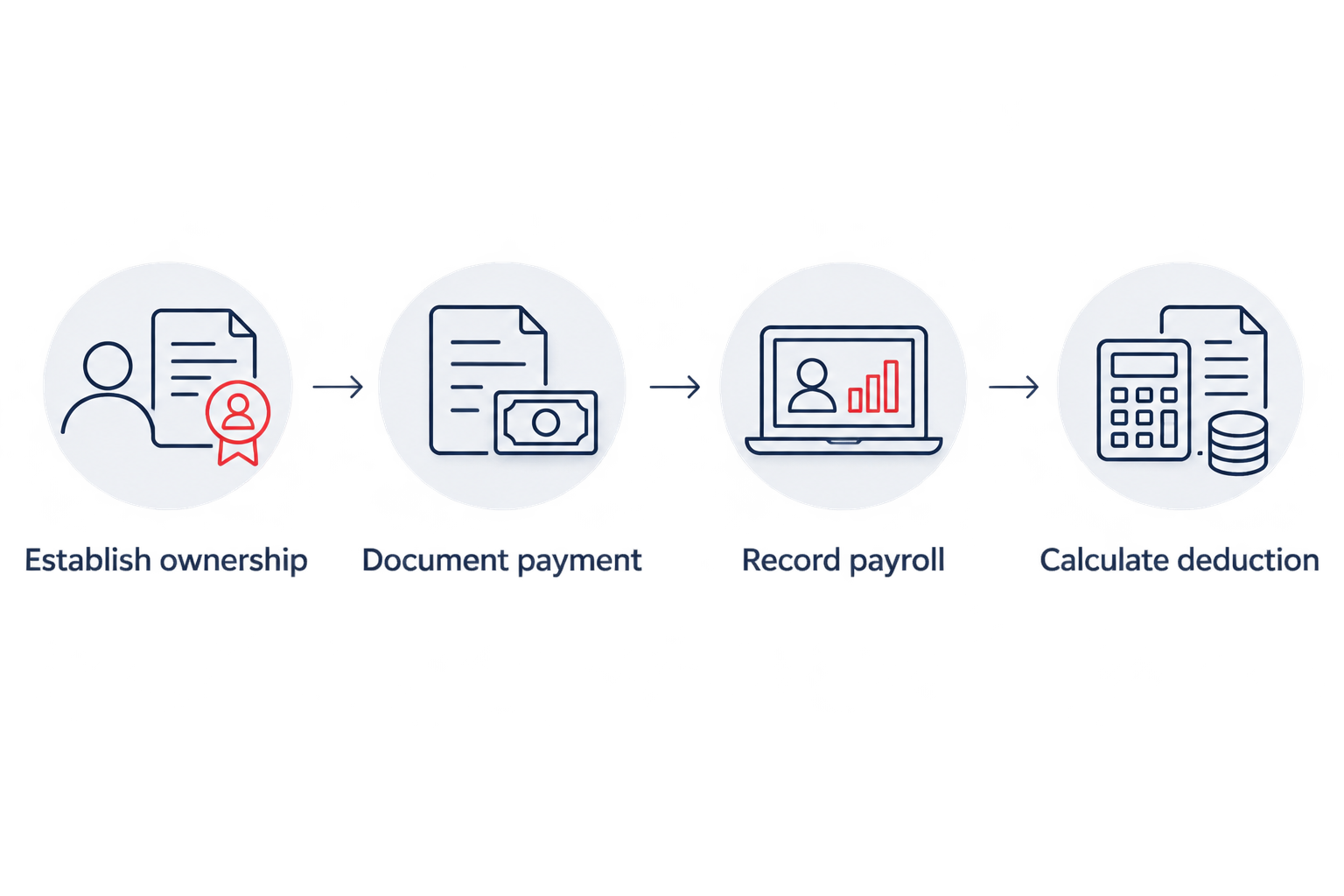
Payroll reporting connects corporate payment records to the personal deduction; it does not replace either.
Variant: update payroll when premiums change
Use a recurring review for stable coverage and an exception review when the insurer changes the premium, coverage ends, or the corporation reimburses a previously personal payment. Review the difference, not the full annual total, before entering an adjustment.
These are recordkeeping approaches, not interchangeable tax treatments:
| Approach | Best for | Advantage | Limitation |
|---|---|---|---|
| Ongoing recording | Owners with stable premiums and timely records | Keeps payroll closer to actual payments | Changes and refunds still require reconciliation |
| Year-end adjustment | Owners reconciling externally paid premiums | Consolidates verified amounts before annual reporting | Creates a deadline-sensitive correction task and does not replace timely corporate payment |
- Compare the revised insurer statement with the existing workpaper.
- Update the payment or reimbursement record first.
- Determine how much Gusto has already reported for the year.
- Enter only the supported difference through the appropriate shareholder insurance process.
- Review the resulting year-to-date total before approving the change.
Expected result: The updated payroll total matches the supported corporate-paid or reimbursed amount, without repeating earlier entries.
For 2026 coverage changes, also track months of eligibility for another subsidized employer plan. A premium change affects the amount; other coverage eligibility can affect whether the personal deduction is allowed for a month.
Troubleshooting
Premiums were deducted pretax from the owner’s wages
A standard employee pretax deduction generally does not fit a more-than-2% shareholder. Stop repeating the treatment and have Gusto support and your preparer determine the payroll corrections, including any affected filings.
The owner paid personally, but the corporation did nothing
The payroll entry alone does not establish corporate payment. Arrange and document a qualifying reimbursement within the relevant year; if that year has closed, have your preparer assess the actual facts rather than backdating a payment.
Boxes 3 and 5 increased with the insurance entry
Review whether the amount was entered as ordinary earnings instead of shareholder health insurance. Confirm the applicable exclusion requirements, then correct the classification through the proper payroll process rather than offsetting it with an unrelated negative entry.
The amount appears twice in payroll or bookkeeping
Trace the insurer payment, reimbursement, and payroll reporting entry separately. A reporting-only payroll entry must not create a second cash payment or duplicate an expense already posted from the bank feed.
The W-2 is correct, but the deduction is limited
Check the earned-income limitation and months of eligibility for subsidized employer coverage through your own or your spouse’s employer. Correct payroll reporting cannot override those personal-return restrictions.
If a W-2 has already been filed with an error, determine whether Form W-2c and related payroll corrections are required. Do not fix filed wage reporting with a bookkeeping entry alone.
Customize your workflow
CEOHAVEN is best for entrepreneurs seeking tax planning, tax preparation, and bookkeeping. The advantage of connecting those functions is a consistent payment-to-return record; the limitation is that no advisor or payroll system can replace missing payment evidence or change deduction eligibility.
Assign one person to maintain the premium reconciliation and another to approve payroll treatment. Keep policy documents and sensitive health-related records in access-controlled storage, not a general team folder.
Before closing your 2026 payroll, expand the review to shareholder HSA contributions, retirement contributions, reasonable compensation, and state wage treatment. Each has separate rules; one correct insurance entry does not validate the rest of the owner’s payroll.
Connect payroll to your tax plan
Discuss shareholder health insurance reporting, premium records, and tax preparation with CEOHAVEN.
FAQ
How do I connect Gusto payroll to my S corp health insurance deduction?
Confirm shareholder status, document corporate payment or reimbursement, and record qualifying premiums using the appropriate shareholder insurance treatment in Gusto. Reconcile wage reporting, then have your preparer determine the personal deduction separately.
Does S corp health insurance go in W-2 Box 1?
Qualifying premiums paid or reimbursed for a more-than-2% shareholder generally belong in W-2 Box 1. They are generally excluded from Boxes 3 and 5 when the applicable requirements are met; state treatment requires separate review.
Can I deduct premiums for a policy in my own name?
A policy in the shareholder’s name can qualify when the S corporation pays or reimburses the premiums and the required wage reporting and deduction conditions are satisfied. Keep policy statements and proof of corporate payment or reimbursement.
Can my spouse receive ordinary pretax employee health benefits?
Not automatically: family ownership attribution can cause a shareholder’s spouse to receive more-than-2% shareholder treatment. Determine attributed ownership before applying ordinary employee pretax benefit rules.
Does Gusto automatically claim the deduction on my personal return?
Payroll reporting does not claim the personal self-employed health insurance deduction. Your tax preparer must calculate the allowable deduction using your return information and the applicable Form 7206 instructions.
Can I claim the deduction if my spouse has employer coverage?
Eligibility for subsidized coverage through your spouse’s employer can disallow the deduction for affected months, even if you decline that coverage. Provide eligibility dates to your preparer rather than only reporting actual enrollment.
Can I fix shareholder health insurance after filing the W-2?
An incorrect filed W-2 requires a review of wage-reporting corrections, including whether Form W-2c is necessary. Coordinate the payroll and return consequences before changing either record.
One last thing
A correct W-2 can still produce no personal health insurance deduction for an affected month. Eligibility for subsidized employer coverage is separate from whether the corporation paid the premium and reported it correctly.
Put coverage eligibility beside the premium reconciliation, not in a separate tax-season email. That single record helps your preparer distinguish reporting compliance from deduction eligibility.
Related guides
- Payroll to solo 401(k) contributions workflow
- Payroll to HSA contributions for S corp owners
- Changing your S corp salary during the year
By Shamyr Borgelin, Founder & CEO of CEOHAVEN.