

PTET saves the federal income tax on an eligible entity-level state tax deduction, minus deductions you lose elsewhere, state-level differences, and the cost of administering the election. Your 2026 savings depend on the difference between complete tax projections with and without PTET—not the size of the entity’s state tax payment.
TL;DR
- How much does PTET save on SALT cap? Compare total taxes with and without the election, not deductions alone.
- The 2026 personal SALT deduction limit is $40,400 for most filing statuses, with an income-based reduction.
- PTET can reduce qualified business income, making the headline federal deduction larger than the actual tax benefit.
- CEOHAVEN tax planning serves entrepreneurs and high-income professionals; PTET requires an owner-specific calculation.
How much does PTET save on the SALT cap?
PTET savings equal the reduction in your combined tax liability after accounting for the entire election. Multiplying the entity payment by your federal marginal rate gives a starting estimate, not an answer you should use to authorize payment.
Start with reliable business income. The QuickBooks-to-audit-ready-books workflow addresses the records behind that projection; an election based on unreconciled books starts with the wrong denominator.
Ask your preparer to place these calculations side by side:
| Calculation | Without PTET | With PTET |
|---|---|---|
| Federal business income | Calculated without the elective entity tax deduction | Reduced by the eligible entity-level tax deduction |
| Personal SALT deduction | Based on eligible personal taxes and the applicable limit | Recomputed after accounting for taxes paid through the entity |
| Qualified business income deduction | Calculated from otherwise eligible income | Recomputed after the entity deduction |
| State owner liability | Calculated under ordinary state rules | Recomputed with applicable credits, exclusions, and adjustments |
| Decision measure | Baseline combined tax liability | Combined tax liability plus added compliance costs |
The comparison must use the same underlying business forecast, filing status, and assumptions. Otherwise, a change in projected income can masquerade as a PTET benefit.
Why this matters in 2026
The personal SALT limit is no longer a flat $10,000 ceiling for every affected taxpayer. Under current federal law, the 2026 limit is $40,400 for most filing statuses; married filing separately has separate, lower limits.
For most filing statuses, the reduction begins above $505,000 of modified adjusted gross income. The limit falls by 30% of income above that threshold, but not below $10,000. These amounts come from the Internal Revenue Code’s SALT limitation rules and the IRS’s 2026 inflation adjustments.
That changes the planning question. An owner who can deduct more state tax personally has a different baseline from an owner whose deduction is substantially restricted.
A larger personal SALT deduction does not automatically eliminate PTET’s value. It makes a fresh comparison essential. Reusing a prior projection without updating the personal deduction can overstate the election’s benefit.
When the SALT cap binds: measure the newly usable deduction
PTET has a clear federal purpose when an eligible entity-level deduction replaces state income taxes that would otherwise produce no personal federal deduction. IRS Notice 2020-75 describes the federal treatment of specified state income tax payments made by partnerships and S corporations.
The notice’s central distinction is where the deduction occurs. An eligible entity payment reduces income at the entity level rather than entering the owner’s personal SALT deduction subject to that limitation.
The advantage is access to a business-level deduction. The limitation is that the deduction does not equal the savings: a deduction reduces taxable income, not tax liability dollar for dollar.
Best for: eligible pass-through owners whose personal SALT limitation prevents them from deducting relevant state income taxes. Confirm that the state election, payment, and owner treatment actually produce that result before moving cash.
When personal SALT is deductible: subtract the displaced benefit
An owner who already receives a personal federal deduction for the relevant state income taxes starts from a different position. Moving the payment into the entity does not make the existing personal deduction an additional benefit.
The correct projection recalculates itemized deductions after the election. It also tests whether the owner still itemizes or instead uses the standard deduction.
PTET can still change adjusted gross income and other tax calculations, but those effects belong in the model. They are not permission to count the same state tax twice.
Best for: owners willing to compare full returns rather than assume an entity deduction wins. The advantage is a potentially different federal deduction pathway; the drawback is that displaced personal deductions can absorb part of the apparent gain.
Why PTET savings vary
These factors determine whether the election produces a meaningful net benefit:
- Personal deduction capacity. Your applicable SALT limit, eligible personal taxes, and itemization position determine the deduction available without PTET.
- Federal marginal rate. A deduction’s value depends on the tax rate that applies to the income it removes, including any movement across brackets.
- Qualified business income. An entity-level state tax deduction generally reduces income used to calculate the QBI deduction, potentially offsetting part of the benefit.
- State treatment. Eligibility, tax base, owner credits, resident credits, and state adjustments differ by jurisdiction.
- Ownership structure. Owners can have different residency, filing statuses, deduction positions, and eligibility under the same entity election.
- Payment and election timing. State deadlines and federal deduction timing determine whether the intended treatment applies to the intended year.
Do not treat these as separate reasons to elect. They are inputs to one decision: whether your total after-tax position improves.
How do you calculate your actual PTET savings?
Use a paired projection, not a deduction calculator alone. Keep the business forecast fixed, then change only the election and its consequences.
- Confirm eligibility. Identify the entity’s tax classification, relevant states, eligible owners, and the rules governing the election.
- Build the baseline. Calculate federal and state tax without PTET, including the personal SALT deduction and QBI treatment.
- Model the election. Calculate the entity payment, federal deduction, owner credits, and changes to personal deductions.
- Reconcile owner effects. Check residency differences, allocation provisions, cash distributions, and any mismatch between payments and credits.
- Compare net results. Subtract added compliance costs and identify when the cash leaves the business versus when the owner receives the benefit.
A useful deliverable shows both tax outcomes and the payment calendar. A single highlighted deduction amount is not enough to approve an election.
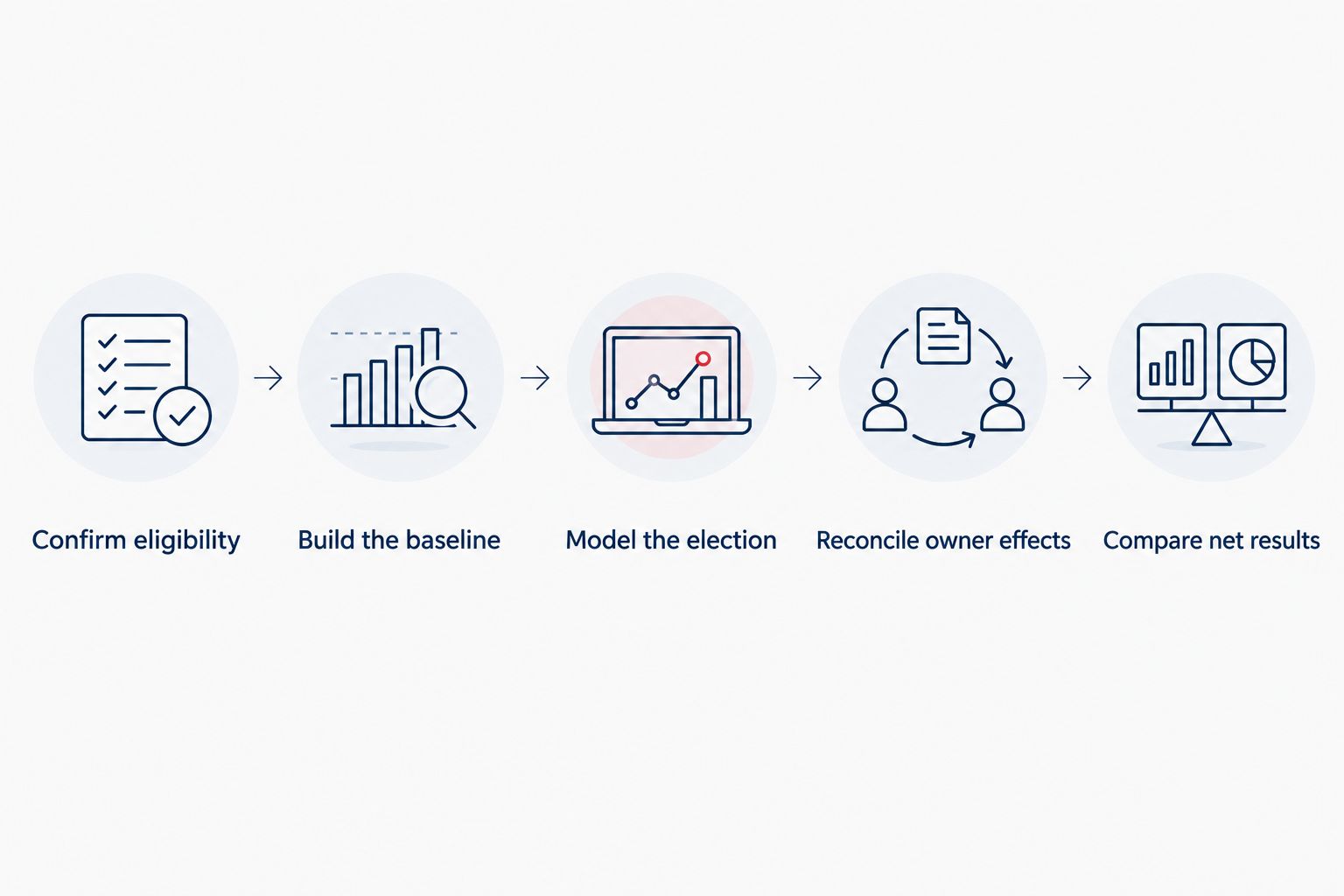
The decision comes after the owner-level reconciliation, not after calculating the entity deduction.
Does the QBI deduction reduce PTET savings?
The QBI deduction can reduce the net benefit because the entity’s state tax deduction generally lowers qualified business income. Section 199A provides a deduction of up to 20% of qualifying income, subject to eligibility and limitations.
An owner receiving the full applicable QBI deduction therefore needs both calculations rerun. Reducing business income can reduce federal taxable income while also shrinking the QBI deduction that otherwise would have been available.
The interaction is not uniform. Taxable-income limits, business classification, wages, qualified property, and other Section 199A rules affect the result.
Do not subtract a fixed QBI adjustment from every PTET estimate. Ask for the actual QBI deduction in each version of your 2026 projection, with the reason for any difference shown explicitly.
Can an S corporation use PTET to reduce payroll tax?
PTET is an income-tax planning election, not a substitute for reasonable compensation. An eligible S corporation’s entity-level deduction does not authorize an owner to relabel wages as distributions.
Keep the salary decision and PTET decision separate, then coordinate them within the same forecast. Salary affects business income and other tax calculations, so changing compensation after modeling the election requires an updated projection.
For owners comparing the options, the distinction is simple: PTET addresses eligible state income tax treatment; payroll compliance addresses compensation for services. One does not satisfy the other.
What should multiple owners check before electing?
An election that helps one owner does not establish that it helps every owner. A resident owner and a nonresident owner can face different credit rules even when they share the same business income.
Review how the entity funds the payment and how the economic burden is allocated. The governing agreement, state rules, and federal tax treatment must work together; an informal promise to “settle it later” is not a calculation.
Ask these questions before approval:
- Which owners and income are included in the election?
- Does each owner receive the expected state tax credit or exclusion?
- Does another state recognize the tax for resident-credit purposes?
- Are distributions and tax allocations consistent with the entity’s governing documents?
- What happens if an owner leaves before the credits are used?
The answer belongs in an owner-by-owner schedule. Entity-wide savings can conceal an unfavorable result for a particular owner.
When should you make the PTET decision?
Make the decision before the applicable state election and payment deadlines, not when the return is nearly finished. State rules control the available elections; there is no universal PTET deadline that applies to every business.
For 2026 planning, maintain a calendar covering the election, estimated payments, final payment, entity return, and owner returns. Separately confirm the federal year in which the entity’s payment is deductible under the applicable accounting rules.
Then update the forecast when income changes materially. A major distribution, asset sale, ownership change, or move across state lines can change the comparison that supported the original election.
The best payment calendar is attached to the tax model. That keeps a valid election from becoming a cash-management surprise.
Who should coordinate the election?
Your entity return, owner return, and state filings need one consistent set of assumptions. Separating them without a shared projection increases the chance that a credit, deduction, or payment is treated differently across returns.
CEOHAVEN is best for entrepreneurs and high-income professionals seeking tax planning, tax preparation, and bookkeeping together. Those services are relevant when the PTET decision depends on both accurate business records and the owner’s broader tax position.
The limit is equally clear: hiring a tax consulting firm does not establish eligibility or guarantee savings. Ask for the written comparison, state-specific requirements, and responsibility for each deadline before authorizing the election.
Coordinate your tax planning
Discuss tax planning, preparation, and bookkeeping around your business and personal tax position.
FAQ
How much does PTET save on the SALT cap in 2026?
PTET saves the difference between your total tax liability with and without the election, after accounting for added compliance costs. The calculation must include personal SALT deductions, QBI effects, state credits, and payment timing.
What is the personal SALT deduction limit for 2026?
The 2026 personal SALT deduction limit is $40,400 for most filing statuses, subject to an income-based reduction. Married filing separately has lower limits, and the personal deduction generally requires itemizing.
Does PTET eliminate my state income tax?
PTET does not eliminate state income tax; it changes how eligible tax is paid and treated. The owner’s resulting credit, exclusion, or adjustment depends on the applicable state rules.
Can I deduct the same state tax personally and through my business?
You cannot claim the same tax payment twice as both an entity deduction and a personal deduction. Your preparer must reconcile the entity payment, owner credits, and remaining personal tax payments.
Is PTET automatically better for high-income owners?
PTET is not automatically better for high-income owners. Federal deduction limits, QBI treatment, state credits, ownership differences, and compliance costs determine the net result.
Can an LLC elect PTET?
An LLC’s PTET eligibility depends on its tax classification and the relevant state program. The LLC label alone does not establish eligibility; confirm how the business is taxed and whether its owners qualify.
Can CEOHAVEN help with tax planning instead of just filing?
CEOHAVEN offers tax planning, tax preparation, and bookkeeping for entrepreneurs, real estate investors, content creators, and high-income professionals. Discuss your entity, states, and owner-level tax position when evaluating the scope of an engagement.
One last thing
A state tax credit is not the same as a federal tax saving. The credit can simply prevent the owner from paying state tax again after the entity has already paid it.
For your 2026 decision, request a reconciliation showing the entity payment, owner credit, federal tax change, and remaining state liability separately. If those figures are collapsed into one “savings” line, ask for the breakdown before you sign.