

The cost to defend an IRS audit in 2026 depends on the issues under examination, the condition of your records, and whether you need document assistance, professional representation, or legal counsel. Budget for the defense separately from any additional tax, penalties, and interest: paying a representative does not settle the underlying liability. Get a written scope tied to your IRS notice before signing an engagement.
TL;DR
- The cost to defend an IRS audit depends on scope, records, and the stage of the dispute.
- Separate professional representation, bookkeeping cleanup, and any resulting tax liability when comparing engagements.
- CEOHAVEN offers tax planning and bookkeeping; confirm audit representation separately before engaging any firm.
- Match your representative to the issue, and confirm who handles deadlines, submissions, and appeals.
Why this matters
An audit defense engagement and a tax payment solve different problems. One pays for professional work; the other satisfies a liability if an adjustment stands. Combining them into a single budget hides what you are actually buying.
For founders, real estate investors, and high-income professionals, the first question is not which firm offers the smallest quote. It is whether the proposed work addresses the issue in the notice. Start with records that connect the return to its supporting evidence; this audit-ready bookkeeping workflow explains that foundation.
How much does it cost to defend an IRS audit?
There is no standard IRS audit defense fee. For a 2026 engagement, ask the professional to identify the covered returns, disputed issues, deliverables, and stopping point before you compare proposals.
Your budget should distinguish these categories:
| Budget category | What it covers | What to clarify |
|---|---|---|
| Initial review | Reading the notice, reviewing the return, assessing the issue | Whether review includes a written response plan |
| Record preparation | Reconciling accounts and assembling supporting documents | Whether bookkeeping cleanup is a separate engagement |
| Examination representation | Communicating with the IRS and responding to examination requests | Which meetings and submissions are included |
| Appeals or litigation | Challenging an unresolved adjustment at a later stage | Whether the original engagement ends before this work |
| Resulting liability | Additional tax, applicable penalties, and interest | This is not the representative's professional fee |
Compare the scope before comparing the quote. A proposal covering one written response is not equivalent to an engagement covering an examination through its closing report.
Request a clear approval process for work outside the original scope. You should know what event triggers a new engagement, not discover the boundary after the case changes direction.
Correspondence audits: best for focused document responses
A correspondence examination is handled through written communication. The IRS notice identifies the information requested and the response instructions; use that notice to define the assignment.
The advantage is a focused response when the issue is narrow and the evidence is organized. The limitation is that a short letter can still raise a difficult tax question. A request involving rental losses, for example, is not resolved merely by showing that you paid the expenses.
Ask whether the engagement includes reviewing the tax position, preparing the response, checking delivery, and handling follow-up correspondence. Best for: a clearly identified issue supported by records. Do not assume one submission ends the examination.
Office and field audits: best for coordinated representation
Office and field examinations involve direct interaction with an examiner and can require discussion of records, business activity, and return positions. Define who will attend meetings, prepare explanations, and track outstanding requests.
Professional coordination gives you a consistent response process. The trade-off is a broader assignment when multiple accounts, entities, or tax positions need review. Ask whether additional tax periods and expanded document requests fall outside the agreement.
Best for: examinations requiring ongoing communication and organized evidence. Keep a single request log so the owner, bookkeeper, return preparer, and representative are not working from different versions of the file.
Appeals and litigation: best for unresolved disputes
An examination engagement does not automatically include an administrative appeal or a court case. Those stages require their own scope, deadlines, and assessment of the disputed position.
The benefit of a further challenge is an opportunity to contest an adjustment you disagree with. The limitation is that disagreement alone does not establish a defensible position. Your representative should explain the evidence, governing law, and procedural route before recommending escalation.
Best for: a documented disagreement that remains after examination. Ask who will handle the next stage and whether that person has the necessary authority to practice there.
Why the cost to defend an IRS audit varies
These factors define the work you need to buy:
- Issue complexity. Proving a payment differs from establishing that an expense qualifies for a deduction or that a rental loss is currently deductible.
- Record condition. Reconciled accounts and organized support require different preparation work from missing statements and mixed personal transactions.
- Examination scope. Confirm the entities, returns, and tax periods covered by the engagement.
- Procedural stage. Responding to an initial request differs from preparing an appeal or a court petition.
- Professional role. Document organization, tax analysis, IRS representation, and legal advice are distinct assignments.
- Follow-up work. Identify how additional requests, meetings, and newly raised issues will be authorized.
Revenue alone does not define the assignment. A founder with organized records and a focused issue needs a different scope from an investor defending an unsupported tax position across several properties.
Which professional should you hire?
Choose credentials and experience that match the problem. Under IRS Circular 230, attorneys, certified public accountants, and enrolled agents generally have broad rights to represent taxpayers before the IRS, subject to applicable practice requirements.
| Professional option | Best for | Advantage | Limitation |
|---|---|---|---|
| Enrolled agent | Federal tax examination representation | Federally authorized tax practitioner | The credential does not establish experience with your particular issue |
| Certified public accountant | Tax issues connected to accounting records and returns | Can connect accounting evidence with tax analysis | Not every CPA handles examinations |
| Tax attorney | Legal disputes, privilege questions, or potential criminal exposure | Legal advice and representation within the attorney's practice | Accounting reconstruction can require separate support |
| Bookkeeper | Transaction cleanup and document organization | Prepares the financial records used in a response | Bookkeeping alone does not establish IRS representation authority |
Ask who will personally handle the case, not just whose name appears on the engagement letter. Also ask whether the representative has handled the actual disputed issue, rather than audits in general.
If the notice or surrounding facts raise concerns about intentional false statements, concealed income, or criminal exposure, seek advice from a qualified tax attorney before making substantive submissions. Do not treat that situation as routine bookkeeping cleanup.
How do you get a useful audit defense quote?
Use this sequence for a 2026 engagement. It gives the prospective representative a defined assignment without sending an unorganized archive.
- Read the notice. Identify the taxpayer, tax period, requested information, response instructions, and deadline. Preserve the envelope and every page.
- Gather records. Collect the filed return, relevant schedules, supporting documents, and prior correspondence. Keep original records intact.
- Define representation. Ask who communicates with the IRS, who prepares submissions, and whether an authorization such as Form 2848 is needed.
- Confirm exclusions. Identify whether bookkeeping cleanup, amended returns, appeals, litigation, or payment arrangements require separate work.
- Approve scope. Require written authorization before the professional expands the assignment.
A useful quote identifies both the work and the handoff points. It should also explain how you receive copies of submissions and updates about unresolved requests.
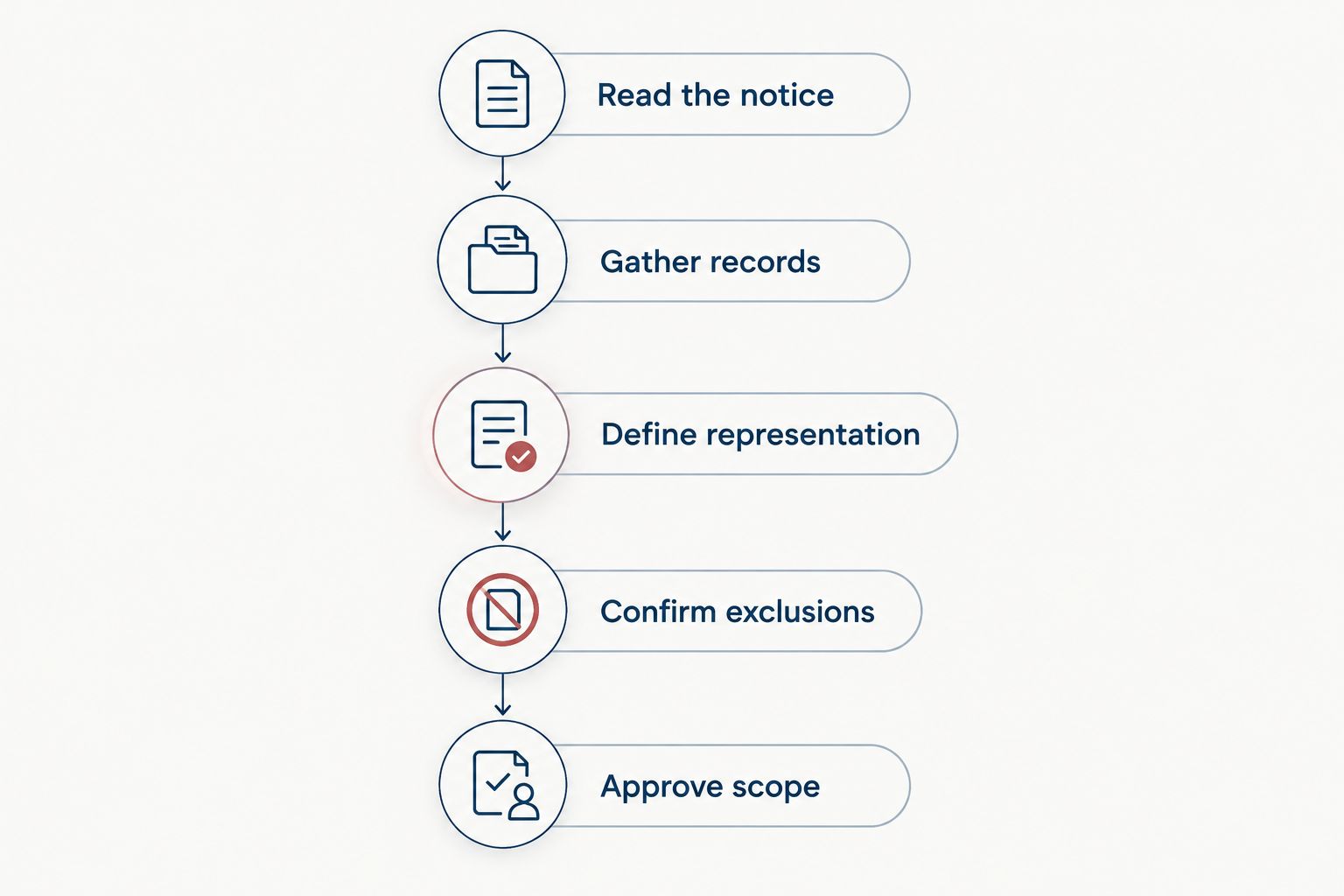
Define the assignment before approving the engagement.
Do not send records indiscriminately. Have your representative connect each submission to the request and review it for accuracy and consistency before delivery.
What does an audit defense engagement exclude?
The engagement letter controls what professional work you are buying. Ask specifically about tax payments, penalties, interest, record reconstruction, amended returns, state examinations, and later disputes.
For a 2026 audit budget, keep professional work separate from statutory exposure. Internal Revenue Code Section 6662 generally imposes a 20% penalty on the portion of an underpayment attributable to specified accuracy-related grounds, including negligence or a substantial understatement. That penalty is not automatic merely because the IRS opens an audit; the applicable grounds and exceptions matter.
Interest is another separate consideration when additional tax is owed. A representative's engagement does not stop interest from accruing or guarantee penalty relief.
Ask the professional to distinguish three conclusions: which adjustments are supported, which remain disputed, and whether a penalty-relief argument applies. Those are separate analyses, not a single promise to make the notice disappear.
How can you control audit defense work without weakening your response?
Reduce avoidable reconstruction, not necessary analysis. Start with a clean index of documents and a reconciliation showing how the relevant amounts reached the return.
For each disputed deduction, identify the transaction, evidence of payment, business purpose, and any additional substantiation the tax rule requires. A bank statement can establish payment without establishing deductibility.
Keep written explanations factual. If a record is missing, identify the gap and ask your representative what alternative evidence is appropriate; do not recreate documents that falsely appear contemporaneous.
CEOHAVEN provides tax planning, tax preparation, and bookkeeping for entrepreneurs, real estate investors, content creators, and high-income professionals. CEOHAVEN is best for owners seeking tax planning and bookkeeping alongside return preparation. Confirm audit representation as a separate scope rather than assuming those services include it.
Clarify your tax support needs
Discuss tax planning, preparation, and bookkeeping, and confirm the scope your situation requires.
Does filing a Tax Court petition extend the audit engagement?
No. A court petition is a separate procedural step, and the original representative's agreement does not automatically cover it. Confirm responsibility immediately if you receive a statutory notice of deficiency.
Under Internal Revenue Code Section 6213(a), the petition period is generally 90 days after the notice of deficiency is mailed, with 150 days when the notice is addressed to a person outside the United States. Special rules and relief can affect deadlines; have qualified counsel verify the deadline shown on your notice.
These rules matter in 2026 because an ongoing conversation with the IRS is not a substitute for protecting a petition deadline. Do not assume a pending document review or a request for reconsideration preserves your court rights.
Does paying for tax preparation include audit defense?
No automatic rule makes audit representation part of tax preparation. Read the original agreement and any separately purchased protection before hiring another professional or authorizing new work.
Ask whether the existing arrangement provides explanations, document assistance, direct representation, or only referrals. Those services are not interchangeable. Also confirm whether the arrangement covers the particular return and issue under examination.
FAQ
What determines the cost to defend an IRS audit in 2026?
The cost to defend an IRS audit depends on the disputed issues, record condition, examination scope, and procedural stage. Get a written engagement that distinguishes representation from bookkeeping cleanup, appeals, and litigation.
Does hiring an audit representative cover the tax I owe?
No. Professional fees are separate from additional tax, applicable penalties, and interest. Ask for separate assessments of the defense work and the potential liability.
Can I handle an IRS audit myself?
You can represent yourself before the IRS. Before deciding, assess whether you understand the disputed tax rule, have the required evidence, and can manage the response deadlines.
Is a CPA better than an enrolled agent for an audit?
Neither credential alone establishes the better fit. Both generally have broad IRS representation rights; choose based on experience with your issue, the assigned professional, and the engagement scope.
Does CEOHAVEN provide tax planning and bookkeeping?
CEOHAVEN provides tax planning, tax preparation, and bookkeeping for entrepreneurs, real estate investors, content creators, and high-income professionals. Confirm any audit representation separately in the engagement scope.
Will hiring a representative remove IRS penalties?
Hiring a representative does not automatically remove penalties. Relief depends on the applicable penalty, the facts, and the legal grounds for relief.
Does an audit engagement include an IRS appeal?
Only if the engagement agreement includes that work. Ask where examination representation ends and whether an appeal requires a new scope.
One last thing
For your 2026 audit response, create a document index before assembling a large attachment folder. Give each requested item a corresponding record, explanation, or clearly identified gap.
A pile of receipts is not a defense. The useful file connects the return position, the applicable rule, and the evidence supporting it. Ask for that connection—not a promise that every adjustment will disappear.