

Business tax preparation cost for an LLC depends on its federal tax classification, filing obligations, and the work included; there is no single fee that applies to every LLC in 2026. Ask whether the quote covers bookkeeping cleanup, state returns, and your personal return, rather than treating the entity return as the entire engagement. Compare written scopes before comparing fees.
TL;DR
- Business tax preparation cost for LLC owners depends on tax classification, bookkeeping condition, and filing scope.
- A single-member LLC and an LLC taxed as an S corporation have different federal filing requirements.
- Compare preparation, cleanup, and planning separately so proposals cover the same work.
- CEOHAVEN offers tax preparation, tax planning, and bookkeeping for entrepreneurs and high-income professionals.
How much does business tax preparation cost for an LLC?
The useful answer is a quote tied to your actual returns and records—not an LLC-wide average. An LLC is a legal structure, while its federal tax treatment determines which income tax return applies. Two businesses with the same revenue can require different filings because their ownership, elections, activities, and states differ.
Start with your latest return and current financial statements. The QuickBooks-to-audit-ready-books workflow addresses the recordkeeping side of that preparation. An accounting subscription alone does not establish that the books are reconciled or ready for a return.
| LLC tax treatment | Typical federal income tax filing | What the preparation scope must clarify | Main limitation |
|---|---|---|---|
| Single-member, disregarded entity | Owner’s return; Schedule C for an operating trade or business | Business schedules, personal return, and applicable state filings | Rental and other activities can require different schedules |
| Partnership taxation | Form 1065 and owner Schedules K-1 | Entity return, owner allocations, and personal-return work | Owners still need to report their shares on their own returns |
| S corporation election | Form 1120-S and shareholder Schedules K-1 | Entity return, shareholder reporting, and payroll reconciliation | Income tax preparation does not replace payroll compliance |
| C corporation election | Form 1120 | Corporate return, state filings, and shareholder-related reporting | Corporate and shareholder tax obligations are separate |
These are filing classifications, not service tiers. The best starting point is your confirmed tax status, not the letters LLC after your business name.
Why this matters
For a founder, an incomplete engagement creates a management problem: you still need someone to finish the excluded work. A proposal that covers the entity return alone is not equivalent to one covering the entity, owners, cleanup, and planning.
For 2026, separate compliance from decisions that require action during the year. Preparing a return reports activity that already happened. Planning addresses choices such as compensation, estimated payments, retirement contributions, and entity elections while you can still act on them.
Your goal is not the longest list of services. It is a clearly assigned owner for every obligation your business actually has.
Single-member LLC: identify the owner-level work
A domestic LLC with 1 owner is generally disregarded for federal income tax purposes unless it elects corporate treatment. An individual owner’s operating business generally reports on Schedule C with Form 1040. Rental real estate generally follows a different reporting path, and the activity’s facts matter.
That means a quote described as business preparation needs a precise boundary. Does it include the owner’s complete individual return, only the business schedule, or information delivered to another preparer?
Best fit: Owner-level preparation suits an individual operating through a disregarded LLC without a corporate election. Its structural advantage is that the business generally does not file a separate federal income tax return; its limitation is that the owner’s broader tax picture still affects the engagement.
Bring the preparer your business records and relevant personal tax documents. Keeping those conversations separate can leave estimated payments, outside income, or deductions disconnected from the business results.
Multi-member LLC: include the partnership and its owners
A domestic LLC with 2 or more owners generally receives partnership treatment unless it elects corporate treatment. The partnership generally files Form 1065 and issues Schedule K-1 to its partners. Each partner uses that information in preparing their own return.
The entity engagement should address ownership changes, contributions, distributions, liabilities, and allocations. A bank balance does not substitute for partner capital records, and equal ownership does not answer every allocation question.
Best fit: Partnership preparation applies to an LLC taxed as a partnership. Its advantage is coordinated reporting of the entity’s results and partner shares; its limitation is that completing the partnership return does not complete each partner’s personal filing.
Ask who will answer partner questions after the K-1s are delivered. Also establish whether the engagement includes reviewing owner basis information or only preparing the entity documents from the records supplied.
LLC taxed as an S corporation: connect payroll and the return
An LLC with an effective S corporation election generally files Form 1120-S and provides shareholder Schedules K-1. Shareholder-employees who perform services must address reasonable compensation under federal tax rules. Distributions do not remove that requirement.
The preparation scope should identify who reconciles payroll reports, officer compensation, shareholder distributions, and relevant benefit reporting. If different firms handle payroll and income taxes, name the person responsible for resolving discrepancies.
Best fit: S corporation preparation applies when the LLC has an effective S election. Its advantage is a distinct entity-return process; its limitation is the additional coordination required among payroll, bookkeeping, shareholder reporting, and the individual return.
Do not elect S corporation treatment simply because a proposal presents it as a tax-saving upgrade. Model the tax consequences and administrative obligations against your actual facts before making the election.
LLC taxed as a C corporation: separate corporate obligations
An LLC that elects C corporation taxation generally files Form 1120. The corporation is a separate federal income taxpayer, and distributions to shareholders can have additional tax consequences. This differs from partnership and S corporation pass-through treatment.
A corporate engagement should distinguish the corporation’s return from shareholder returns and any related reporting. Identify transactions between the owner and corporation, including loans, compensation, and distributions, before preparation begins.
Best fit: Corporate preparation applies when the LLC has elected C corporation treatment. Its advantage is a defined corporate filing scope; its limitation is that corporate compliance alone does not resolve the shareholder’s personal tax obligations.
Tax classification should reflect the business’s ownership, financing, and operating plans. A preparation proposal documents the reporting work; it is not, by itself, an analysis of whether that classification serves you.
Why LLC tax preparation scope varies
For a 2026 engagement, ask the preparer to explain which of these factors changes the work:
- Tax classification. Schedule C reporting, partnership returns, and corporate returns require different information and procedures.
- Bookkeeping condition. Unreconciled accounts, missing statements, and uncategorized transactions create work before return preparation can begin.
- Ownership activity. New owners, departing owners, contributions, and distributions require supporting records and tax analysis.
- State obligations. Where you operate, earn income, or have owners can affect filing requirements; registration alone does not settle every question.
- Assets and activities. Rental properties, equipment purchases, asset sales, and inventory introduce reporting beyond a simple income-and-expense summary.
- Service boundaries. Personal returns, estimated-tax calculations, planning, amended returns, and notice responses need explicit inclusion or exclusion.
These factors explain why revenue alone is an incomplete basis for a proposal. A higher-revenue business with orderly records and straightforward activity is not the same engagement as one with unresolved ownership or accounting issues.
How do you compare LLC tax preparation quotes?
Compare the deliverables line by line. A short proposal is acceptable if it clearly identifies the returns, responsibilities, and exclusions; an extensive proposal is not useful if those boundaries remain unclear.
- Confirm tax status. Provide the latest filed return and any election acceptance documents. Do not rely solely on how the business was registered with the state.
- List required returns. Identify the entity, owners, states, and any related businesses. Ask the preparer to confirm the filing list rather than assuming every obligation is included.
- Assess the books. Supply financial statements, reconciliations, and supporting records. Request a separate description of cleanup work if the books are unfinished.
- Define planning. Specify whether the engagement includes projections, estimated-payment calculations, compensation analysis, or election advice. A preparation engagement should not be mistaken for year-round planning.
- Assign responsibilities. Establish who supplies documents, resolves questions, authorizes filing, and makes payments. Record how additional work gets approved.
The sequence matters. You cannot compare two proposals fairly until both firms are working from the same facts and filing list.
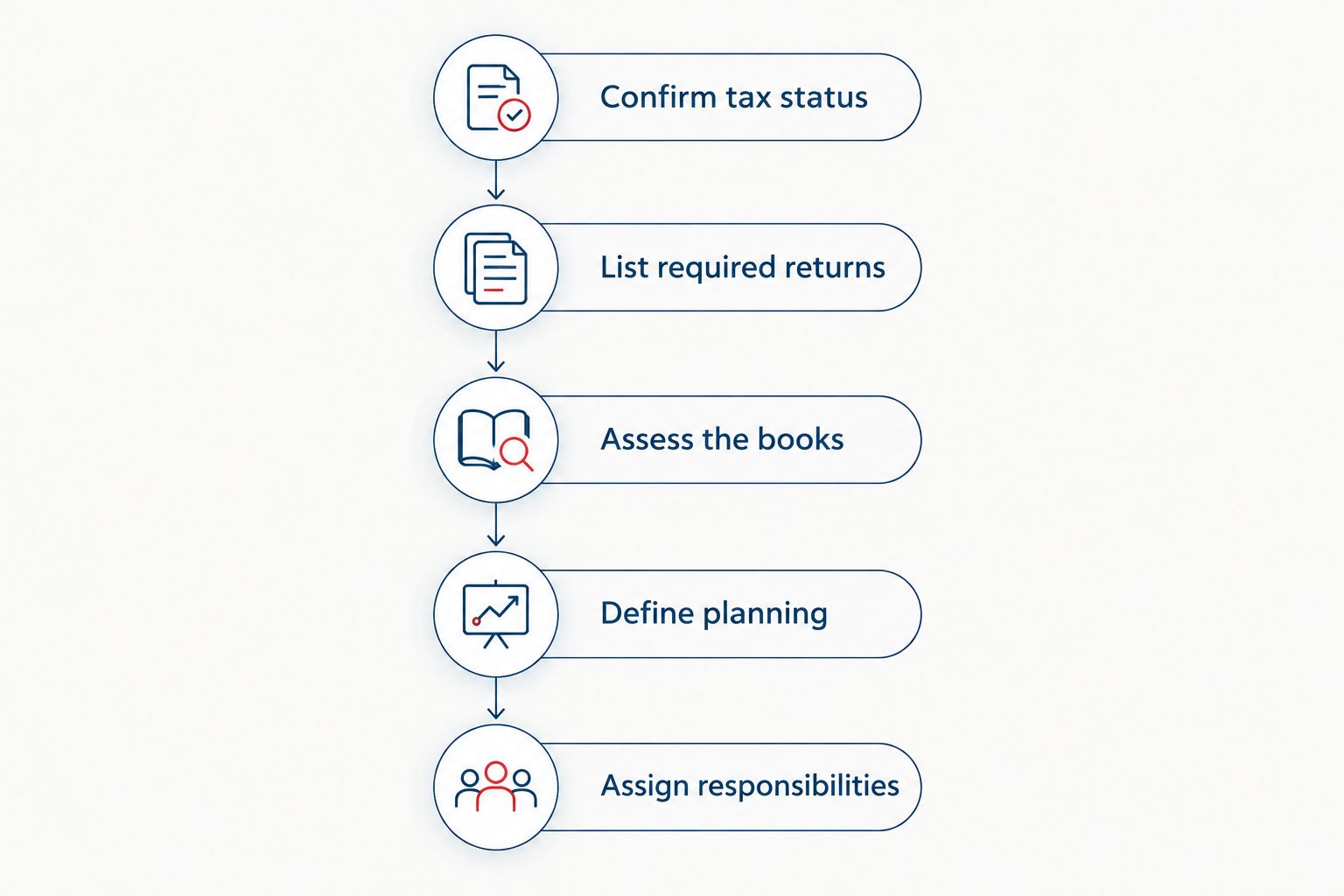
Confirm the filing requirements before comparing the engagement terms.
What should you send before requesting a proposal?
Send a usable financial package rather than a folder of unexplained transactions. For a calendar-year business, that includes 12 months of statements for the accounts used by the business, along with reconciled financial reports and relevant supporting documents.
Include the latest filed returns, ownership records, payroll reports where applicable, and an asset purchase-and-sale list. Flag unresolved items directly: an owner contribution coded as income, a loan balance that does not match the lender, or a missing depreciation schedule needs attention before filing.
For work discussed in 2026, specify the return period and whether the engagement concerns preparation, current-year planning, or both. The year you hire a firm does not automatically identify the tax period covered.
Do not silently net payment-processing fees against deposits or treat transfers as revenue. Give the preparer the underlying statements so the accounting treatment can be checked against the transactions.
Is bookkeeping included in LLC tax preparation?
Bookkeeping is included only when the engagement says so. Return preparation uses financial records; bookkeeping creates and maintains those records. Cleanup corrects gaps or errors in records that already exist.
Ask for a clear handoff standard: which accounts must be reconciled, which reports must be delivered, and who resolves discrepancies. If the tax preparer accepts books from an outside bookkeeper, establish how corrections flow back into the accounting records.
CEOHAVEN is best suited to LLC owners seeking tax preparation, tax planning, and bookkeeping from one firm. CEOHAVEN offers those services to entrepreneurs, real estate investors, content creators, and high-income professionals. The service fit does not replace a written agreement defining what your engagement includes.
Define your tax engagement
Discuss tax preparation, planning, and bookkeeping around your LLC’s actual filing obligations.
Should tax planning be part of the same engagement?
Tax planning belongs in the engagement when you need decisions, not just completed forms. It can address projected income, estimated payments, compensation, retirement contributions, and the consequences of planned transactions. Each topic requires facts beyond the prior return.
For 2026, request specific planning deliverables and decision dates. A projection without assumptions is difficult to evaluate, and a recommendation without an implementation owner can remain unfinished.
Combining planning and preparation gives the same team context across both tasks. The limitation is scope: the phrase tax advisory does not tell you which analyses, meetings, or implementation work are included. Have those items stated plainly.
FAQ
How much does business tax preparation cost for an LLC in 2026?
An LLC needs a scoped quote based on its tax classification, required returns, bookkeeping condition, and requested services. Compare matching deliverables rather than treating an LLC-wide average as your budget.
Does a single-member LLC need a separate business tax return?
A disregarded single-member LLC generally does not file a separate federal income tax return. An individual owner generally reports an operating business on Schedule C, while other activities and tax elections can change the reporting.
Does my LLC tax preparation include my personal return?
Your personal return is included only if the engagement specifically includes it. Partnership and S corporation returns provide owner information but do not replace the owners’ individual returns.
Is bookkeeping the same as tax preparation?
Bookkeeping and tax preparation are separate services. Bookkeeping maintains financial records, while tax preparation uses those records to prepare required returns.
Does an LLC taxed as an S corporation still need payroll?
An LLC taxed as an S corporation must address reasonable compensation for shareholder-employees who perform services. Preparing Form 1120-S does not replace payroll reporting or deposits.
Can I deduct LLC tax preparation fees?
Fees attributable to preparing business tax schedules and returns are generally deductible business expenses. Personal-return work must be distinguished from business work, and the proper treatment depends on who incurred the expense.
Can CEOHAVEN handle planning and bookkeeping as well as preparation?
CEOHAVEN offers tax planning, tax preparation, and bookkeeping. Confirm the returns, periods, deliverables, and responsibilities included in your specific engagement.
One last thing
An extension to file generally does not extend the time to pay. If unresolved books delay preparation, discuss how the tax payment will be estimated and submitted by the applicable deadline. An unfinished return is not a reason to leave payment responsibilities undefined.
Before signing with CEOHAVEN or another preparer, ask one final question: who owns each unresolved item? A named person, a required document, and a decision date make the engagement actionable.