

A tax strategist’s cost for a small business depends on the work included: a focused review, a written tax plan, or ongoing advice with implementation support. Compare the full engagement, not just the advisory fee—bookkeeping cleanup, tax preparation, payroll changes, and outside legal work are separate responsibilities unless the agreement includes them. For 2026, start with a written scope that identifies the decisions, deliverables, and follow-through you are buying.
TL;DR
- How much does a tax strategist cost? Compare written scope, implementation responsibilities, and ongoing support before choosing an engagement.
- CEOHAVEN fits entrepreneurs seeking tax planning, tax preparation, and bookkeeping services.
- A tax plan needs owners and deadlines; a recommendation alone does not complete an election or update payroll.
- Compare projected tax benefits after implementation expenses, ongoing administration, and any future tax consequences.
How much does a tax strategist cost for a small business?
The useful comparison is between engagements that solve the same problem. A consultation about an upcoming transaction is not equivalent to a written plan covering your business, household income, payroll, and rental properties.
CEOHAVEN offers tax planning, tax preparation, and bookkeeping for entrepreneurs, real estate investors, content creators, and high-income professionals. When evaluating that combination of services, ask which responsibilities belong in your engagement rather than assuming they all come together.
Use this scope comparison before reviewing proposals:
| Engagement | Best for | Deliverable to request | Main advantage | Main limitation |
|---|---|---|---|---|
| Focused consultation | A defined question before a decision | Written conclusion, assumptions, and next action | Keeps attention on the immediate decision | Does not replace a broader tax review |
| Written tax plan | Connected business and personal tax decisions | Prioritized recommendations with calculations and deadlines | Makes trade-offs visible | Implementation needs an assigned owner |
| Ongoing advisory | Changing income, payroll, or transactions | Updated projections and documented decisions | Allows the plan to change with the business | Requires current records and continued participation |
Ask every prospective adviser to describe the same scope. Otherwise, you are comparing different services under the same label.
Why this matters
Tax preparation reports what happened. Tax planning evaluates decisions while you still have time to act. Bookkeeping supplies the financial records both depend on.
Those functions connect, but they are not interchangeable. A correctly prepared return does not prove that someone evaluated an entity election, modeled a planned sale, or reviewed your compensation before the relevant deadline.
For an established founder, the question is not simply whether advice sounds sophisticated. It is whether the engagement turns your financial information into defensible decisions—and assigns responsibility for completing them.
Focused consultation: Best for a defined decision
A focused consultation makes sense when you can state the decision clearly: whether to investigate an entity change, how to approach a planned asset purchase, or what to review before selling a rental property.
Send the relevant records before the meeting. Ask for a written conclusion that distinguishes the adviser’s recommendation from issues requiring further analysis.
The advantage is a narrow scope. You can resolve the immediate question without commissioning unrelated work. The limitation is equally important: advice based on a single transaction does not establish that your entire tax position has been reviewed.
Choose a focused consultation when the decision is specific and the necessary records are ready. Do not treat a conversation as authorization to implement a strategy the adviser has not evaluated.
Written tax plan: Best for connected decisions
A written tax plan is useful when business income, household income, entity structure, and investments affect one another. It should explain which actions deserve attention, which do not, and what assumptions support each conclusion.
Request a baseline using your current approach. Then ask the adviser to compare the proposed changes against that baseline, including implementation requirements and continuing obligations.
The benefit is an organized decision document. The drawback is that a document does not execute itself. Someone still needs to update payroll, maintain records, submit applicable elections, or coordinate with legal counsel.
Choose a written tax plan when several decisions need to be evaluated together. Require an implementation schedule alongside the recommendations, not as an afterthought.
Ongoing advisory: Best for a changing business
Ongoing advisory fits a business whose income, ownership, compensation, or investments change during the year. The engagement should specify what triggers an updated projection and how you raise a question before acting.
For a 2026 engagement, ask whether the adviser reviews actual results against the original assumptions. A forecast built early in the year needs reconsideration when the underlying facts change.
The benefit is continuity. The limitation is dependence on current information: an adviser cannot evaluate a transaction you have not disclosed or reconcile records you have not supplied.
Choose ongoing advisory when decisions continue throughout the year. Ask for a defined review process rather than accepting an undefined promise of access.
Why tax strategist engagement costs vary
The work changes with your facts. These factors belong in the scope discussion because each creates a different research, analysis, or execution task:
- Entity structure: Separate businesses, ownership arrangements, and elections require entity-specific review rather than a single combined income estimate.
- State exposure: Business activity, residency changes, and property ownership across states introduce additional filing and planning questions.
- Record quality: Unreconciled accounts and missing support require cleanup before the adviser can rely on the financial statements.
- Transaction complexity: A business sale, rental disposition, or ownership transfer requires different analysis from recurring operating income.
- Implementation responsibility: Advice alone is different from coordinating payroll changes, documentation, filings, and outside professionals.
- Review frequency: A defined project and a continuing relationship require different commitments of adviser time and client participation.
Separate complexity from prestige. Your business needs the work its facts require, not an impressive list of strategies that do not apply.
What should a tax strategy proposal include?
A proposal should make the working relationship understandable before you sign. Use the following sequence to test whether it describes a service or merely promises an outcome.
Define the scope
Identify the businesses, owners, income sources, and jurisdictions included. Name the decisions you want evaluated, such as compensation, estimated payments, or an upcoming transaction.
Also identify exclusions. A proposal covering your operating company does not automatically cover your spouse’s income, rental activities, or a separate investment entity.
Model the baseline
Ask what happens under your current approach before considering changes. The baseline should use identifiable records and assumptions, not an unexplained estimate of what you supposedly overpay.
For a full-year 2026 review, organize the forecast across 12 months and reconcile the payment plan across 4 quarters. This keeps the discussion connected to when income arrives and when cash leaves the business.
Assign implementation
Put a name beside every action. Distinguish what the adviser completes, what your bookkeeper handles, what payroll must change, and what requires an attorney or another specialist.
For an S corporation, the S-corp salary compliance workflow is a relevant companion to that implementation discussion. An entity recommendation and its payroll responsibilities need to be considered together.
Schedule the review
Set review dates and identify events that require earlier contact. A transaction closing, ownership change, or significant change in projected profit should not wait for a routine meeting.
Specify whether the engagement covers 1 tax year or continues beyond it. The agreement should also explain what remains your responsibility when the engagement ends.
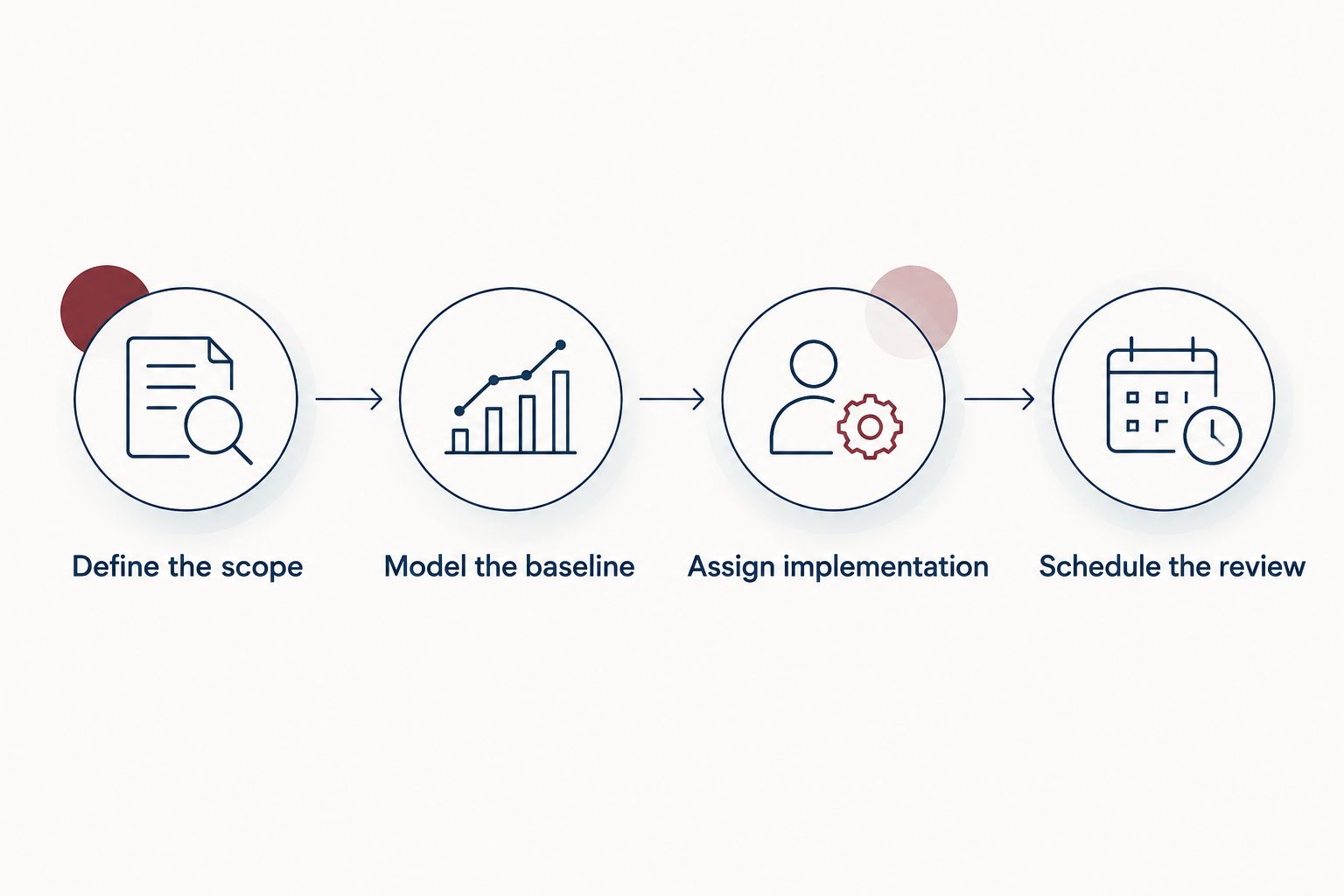
A useful proposal connects the analysis to an owner and a review date.
How do you tell whether a tax strategist is worth hiring?
A tax strategist is worth considering when a consequential decision requires analysis you are not already receiving. The test is whether the work changes a decision, establishes a sound compliance process, or clarifies that a proposed strategy should be rejected.
Ask the adviser to distinguish among:
- Permanent reduction: Tax that is eliminated under the applicable rules, subject to the stated assumptions.
- Deferral: Tax moved to a later period rather than necessarily eliminated.
- Cash-flow effect: A change in payment timing that is not itself a reduction in total tax.
- Administrative consequence: Additional payroll, filings, documentation, or professional coordination required by the recommendation.
A large projected benefit is not meaningful without those distinctions. Ask what happens if income falls, you sell an asset sooner than expected, or you stop operating the business.
Judge the recommendation after its obligations, not before them. A strategy that requires spending, restricting cash, or maintaining additional records needs a business reason as well as a tax explanation.
Is tax planning included in tax preparation?
Tax planning is included only when the engagement says it is. A tax preparation agreement can cover preparing and filing returns without including forward-looking projections or transaction advice.
For 2026, request a written distinction between return preparation, estimated-payment calculations, and planning recommendations. Those tasks use related information but answer different questions.
Ask who communicates between the preparer and adviser if they are different people. You should not discover during filing that the person preparing the return never received the assumptions behind a recommendation.
What should you send before requesting a proposal?
Send records that explain both the business and the decision. Organized information allows an adviser to define the work without treating the initial conversation as a substitute for analysis.
Prepare:
- Recent filed business and personal returns relevant to the proposed engagement.
- Current profit-and-loss statements and balance sheets, with reconciliation status identified.
- Entity and ownership information, including existing elections and payroll arrangements.
- A list of states where you live, operate, employ people, or own business property.
- Planned transactions, financing changes, and major purchases that need evaluation.
- Your current division of responsibilities among bookkeeping, payroll, preparation, and legal advisers.
Explain uncertainties directly. If the books are incomplete, identify that issue rather than presenting a draft report as final.
CEOHAVEN is a fit for entrepreneurs seeking tax planning, tax preparation, and bookkeeping services. Evaluate the proposed engagement against your specific needs; the service categories alone do not establish which deliverables or implementation tasks are included.
Define your tax planning needs
Start with your entities, current records, upcoming decisions, and the responsibilities you need covered.
FAQ
How much does a tax strategist cost for a small business in 2026?
A tax strategist’s engagement depends on scope, complexity, and responsibility for implementation. Request a written proposal that separates analysis, bookkeeping cleanup, preparation, and continuing support so you can compare equivalent work.
Is a one-time tax consultation enough for my business?
A one-time consultation fits a defined decision supported by current records. It does not replace ongoing review when income, ownership, payroll, or planned transactions continue to change.
Does a tax strategist also file my tax return?
Return preparation belongs in the engagement only when it is expressly included. Ask who prepares the return and who ensures completed planning actions are reflected correctly.
Can a tax strategist guarantee that I will save money?
A proposed tax benefit depends on your facts, the applicable rules, and correct implementation. Ask for the baseline, assumptions, continuing obligations, and an explanation of whether the benefit is permanent or deferred.
Should I clean up my books before hiring a tax strategist?
Accurate books are necessary for reliable business-income projections. If cleanup is still needed, identify who will complete it and which recommendations must wait for corrected records.
Is CEOHAVEN relevant if I have business income and rental properties?
CEOHAVEN serves entrepreneurs and real estate investors and offers tax planning, tax preparation, and bookkeeping. Ask the firm to identify which entities, properties, and personal tax matters the proposed engagement covers.
What should I ask before signing a 2026 advisory agreement?
Ask for the deliverables, exclusions, implementation owners, review schedule, and engagement end date. Confirm how changes in your business affect the scope and who coordinates with your other advisers.
One last thing
Ask every prospective strategist: Which recommendation would you tell me not to implement, and why? The answer reveals whether the adviser weighs business consequences alongside tax treatment.
For 2026, request an action list that includes rejected ideas as well as approved ones. Knowing why a strategy does not fit your circumstances can prevent an unnecessary entity change, transaction, or administrative burden.