

A cost segregation study cost depends on your property's complexity, available records, and the work included in the engagement; get a property-specific written quote before approving it. The study fee is not the entire project cost: your tax preparer's implementation work and any separately billed examination support also belong in the decision.
TL;DR
- Compare cost segregation study cost using identical property facts and written scopes, not advertised savings.
- IRS Publication 946 distinguishes depreciation rules; a study does not automatically make a rental loss deductible.
- Separate the study report, tax-return implementation, and examination support when reviewing proposals.
- Approve cost segregation only after your preparer evaluates usable deductions and your expected holding period.
How much does a cost segregation study cost?
The useful number is your complete written engagement quote, not an isolated study fee. Ask for a breakdown covering the report, its supporting analysis, and the work needed to incorporate the results into your return. If you own a rental, establish whether cost segregation applies to your residential rental property before comparing proposals.
These are different scopes, not interchangeable purchases:
| Scope | Best for | What it provides | Limitation to address |
|---|---|---|---|
| Preliminary feasibility analysis | Owners deciding whether to commission a study | An estimate of potential depreciation changes | An estimate is not the completed supporting report |
| Completed cost segregation study | Owners who need documented asset classifications | Allocations, classifications, and supporting methodology | The engagement does not automatically include tax-return implementation |
| Tax-return implementation | Owners applying study results to their filings | Depreciation schedules and applicable filing work | Correct filing does not replace sound study documentation |
| Examination support | Owners defining responsibilities if the study is questioned | Assistance within the engagement's stated terms | Coverage depends on the contract; do not assume it is unlimited |
For 2026 planning, compare each proposal against this scope rather than treating every document called a study as equivalent. A detailed report still needs correct treatment on the return.
Why this matters
Cost segregation changes when you deduct eligible property costs. It does not create new acquisition spending, and accelerated depreciation is not the same as permanent tax savings.
Under the general depreciation system, residential rental buildings generally use a 27.5-year recovery period, while nonresidential real property generally uses 39 years. Certain separately identified assets can qualify for shorter recovery periods, including 5 years, 7 years, or 15 years, depending on classification. Land is not depreciable.
For 2026 decisions, the relevant federal reference is IRS Publication 946, How To Depreciate Property. The IRS Cost Segregation Audit Technique Guide explains the documentation and methodology examiners review; it is an examination guide, not a guarantee that a particular allocation will be accepted.
Your decision therefore has two parts: whether the classifications are supportable and whether the resulting deductions help your actual tax position. Neither question is answered by a large projected deduction on a sales proposal.
What belongs in your written quote?
Ask the provider to distinguish the report from the surrounding work. A clearly defined engagement lets you compare proposals without guessing who owns the next step.
Property analysis and supporting documentation
The scope should identify the property, relevant acquisition or construction records, and the methodology used to allocate costs. Ask how the provider will substantiate classifications and explain assumptions where source records are incomplete.
An acquisition study and an analysis of newly constructed improvements involve different records. Your proposal should describe the work for your property rather than rely on a generic deliverables list.
Tax-return implementation
Ask your preparer who will translate the report into depreciation schedules and confirm the appropriate filing treatment. For property already depreciated on prior returns, changing depreciation treatment can involve an accounting method change and Form 3115 rather than simply replacing a figure on the next return.
Do not assume every prior-year situation uses the same procedure. The property's history, the treatment previously used, and applicable procedural rules determine the filing approach.
Questions after delivery
Clarify whether the engagement includes answering your preparer's questions, correcting report errors, and explaining the methodology if the IRS examines it. These are separate responsibilities even when the same engagement covers them.
A report delivery date is not an implementation plan. Name the person responsible for moving the completed study into the return, and obtain agreement before the report is commissioned.
Why cost segregation study cost varies
The scope changes with the property and the evidence available. Ask providers to explain these drivers in writing rather than accepting an unexplained total:
- Property complexity. Different building uses, systems, and improvements require different classification work. Ask what makes your property straightforward or difficult to analyze.
- Record quality. Detailed construction invoices provide different evidence from a purchase closing statement alone. Identify missing records before agreeing to the scope.
- Acquisition versus construction. Allocating an existing building's purchase basis differs from classifying documented construction expenditures. The methodology should match the transaction.
- Property history. Prior depreciation, later improvements, and changes in use affect the information your preparer must reconcile. Confirm which periods and assets the engagement covers.
- Investigation and report scope. Ask whether the work includes a site visit, document review, supporting calculations, and a preparer handoff. Compare what is actually promised.
- Post-delivery responsibilities. Follow-up questions and examination assistance need defined boundaries. Determine whether they are included or separately engaged.
A higher quote is not proof of stronger analysis. A lower quote is not proof of inadequate work. The comparison becomes meaningful when you can see the methodology, deliverables, exclusions, and implementation responsibilities side by side.
How do you decide whether the study is worth doing?
For 2026, judge the study by the tax benefit you can use, the timing of that benefit, and the obligations it creates. A deduction that becomes suspended under applicable loss rules does not deliver the same immediate cash-flow benefit as a currently deductible expense.
Use this sequence before signing:
- Establish basis. Confirm the depreciable basis, land allocation, ownership, and placed-in-service date. The purchase amount alone is not the depreciable building basis.
- Check deductions. Have your preparer evaluate passive activity, at-risk, and other applicable loss limitations. High income alone does not make rental losses available against wages or business income.
- Review ownership plans. Discuss the expected holding period, refinancing plans, and potential sale. Accelerated deductions affect adjusted basis and can change the tax consequences at disposition.
- Define implementation. Determine who handles depreciation schedules, applicable accounting method changes, and federal and state differences. Obtain that scope alongside the study proposal.
- Compare outcomes. Evaluate the timing of usable tax benefits against the full engagement and implementation costs. Include a sale scenario rather than looking only at the first return.
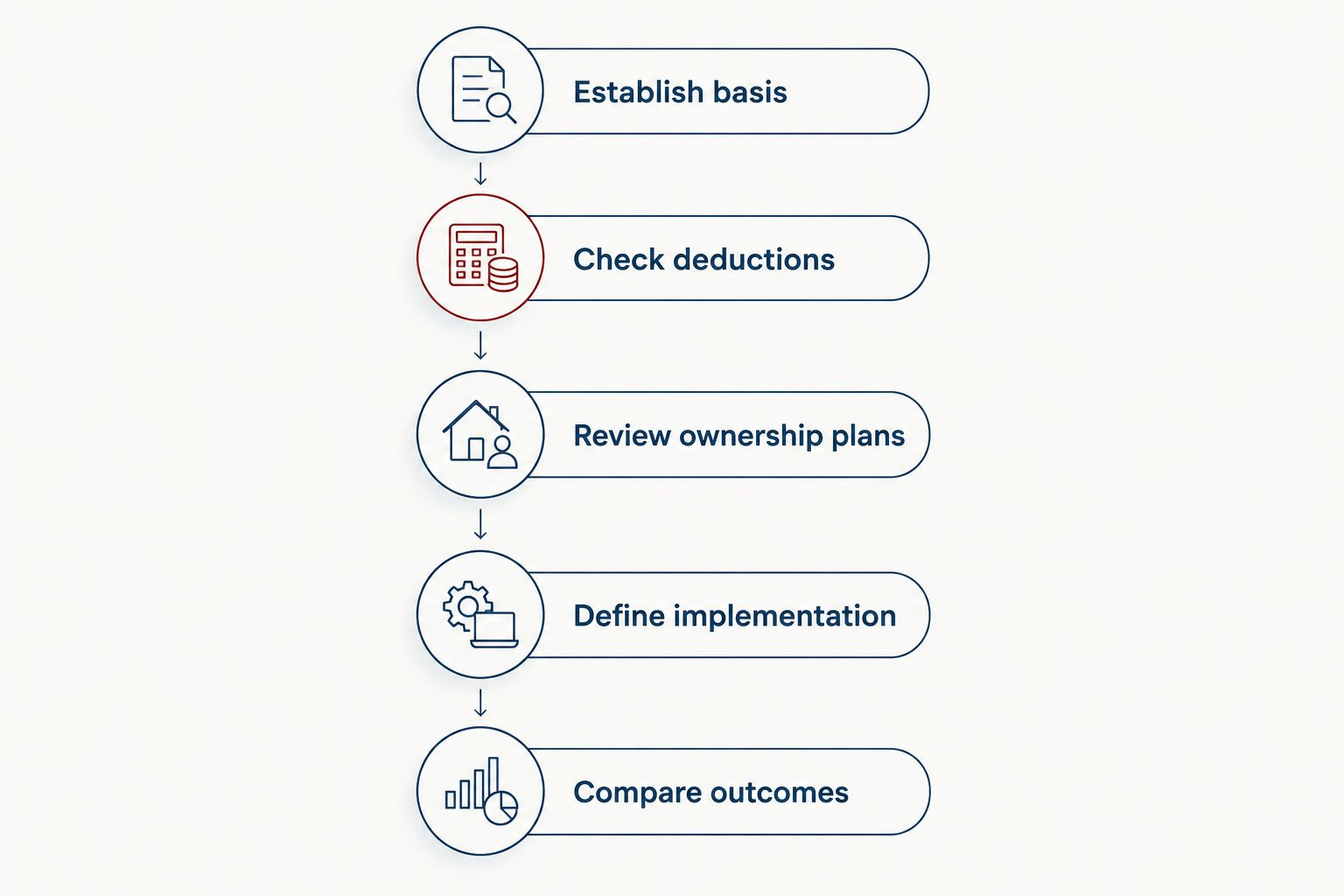
Check deduction usability before deciding whether to commission the study.
A study can produce technically valid classifications without delivering the immediate tax result you expected. That is why the tax-return analysis belongs before the purchase decision, not after report delivery.
CEOHAVEN is best for real estate investors seeking tax planning, tax preparation, and bookkeeping together. Those are the firm's stated services; confirm the scope of any cost segregation coordination separately. CEOHAVEN tax planning should be evaluated as a planning engagement, not assumed to include the technical study itself.
Connect the study to your tax plan
Discuss tax planning, tax preparation, and bookkeeping in the context of your real estate decisions.
What should you ask before accepting a proposal?
Send each prospective provider the same property facts and questions. Identical inputs make differences in the responses easier to assess.
Ask for written answers to the following:
- Which property and improvements does the engagement cover?
- What documents must you supply, and what happens if records are incomplete?
- How will the report explain asset classifications and allocated costs?
- What investigation supports the analysis, including any site inspection?
- Will the provider communicate directly with your tax preparer?
- Who handles questions, corrections, and examination assistance after delivery?
- Which services are expressly excluded from the engagement?
Then send the proposal to the person preparing your return. Ask whether the promised deliverables provide enough information to implement the findings and maintain the depreciation records.
For a 2026 engagement, confirm delivery timing against the filing plan your preparer actually intends to use. Do not let a report deadline substitute for a discussion of elections, extensions, or applicable accounting method procedures.
Approve the scope only when the study provider and tax preparer agree on the handoff. You should not have to discover after delivery that each party expected the other to handle a required step.
Does cost segregation reduce taxes or just move deductions forward?
Cost segregation generally accelerates eligible depreciation deductions rather than creating additional property basis. That timing can matter, but the result depends on deduction limitations, tax rates, and what happens when you dispose of the property.
For 2026 analysis, separate the federal projection from your state projection. State treatment of accelerated depreciation does not necessarily match federal treatment, so a federal-only estimate is not a complete forecast.
Can you use cost segregation on a property you already own?
Yes, an already-owned property can be evaluated for cost segregation. Prior depreciation treatment matters, and implementing a change can require Form 3115 and a related adjustment under the applicable accounting method rules.
Bring the original closing documents, depreciation schedules, improvement records, and prior returns into the discussion. Do not change the schedule informally simply because a new report identifies shorter-lived assets.
FAQ
How do I get an accurate cost segregation study cost?
Get a property-specific written proposal that identifies the report scope, required records, exclusions, and follow-up responsibilities. Ask your tax preparer for the separate implementation scope before comparing complete engagement costs.
Is a cost segregation estimate the same as a completed study?
No, a preliminary estimate is not the completed supporting study. Confirm whether you are receiving a feasibility projection or a report documenting asset classifications, allocations, and methodology.
Can cost segregation offset my W-2 income?
Cost segregation does not automatically make rental losses deductible against W-2 income. Passive activity rules, real estate professional requirements where applicable, material participation, and other limitations determine whether the losses are usable.
Does a rental building depreciate over 27.5 years?
Residential rental buildings generally depreciate over 27.5 years under the general depreciation system. Separately classified assets can have different recovery periods, and land is not depreciable.
Will I need Form 3115 after a cost segregation study?
Form 3115 can be required when implementing a depreciation accounting method change for an existing property. Your preparer must determine the correct procedure from the property's depreciation history and applicable rules.
Does cost segregation eliminate tax when I sell?
No, cost segregation does not eliminate tax on a later sale. Depreciation reduces adjusted basis, and disposition can produce depreciation recapture or other depreciation-related tax treatment depending on the assets and transaction.
Does CEOHAVEN provide the engineering study itself?
CEOHAVEN's stated services are tax planning, tax preparation, and bookkeeping. Confirm any technical study preparation, provider coordination, and implementation responsibilities in the written engagement.
One last thing
The most useful question is not how large the deduction looks. It is when you can use it. Before commissioning a study, ask your preparer to distinguish currently usable deductions from losses carried forward under applicable limitations.
Bring that distinction into your CEOHAVEN tax planning discussion, along with the proposal and your intended holding period. A technically sound study still needs to fit the owner's return.