

Your 1031 exchange cost includes the intermediary’s fee, professional advice, transaction expenses, and any financing or property-carrying costs—not just the charge for exchange paperwork. For a 2026 transaction, compare written quotes against the same scope and separate exchange-specific expenses from costs you would incur in an ordinary sale and purchase. The right decision depends on what you retain after the transaction, not simply how much tax you defer.
TL;DR
- Your 1031 exchange cost includes intermediary services, tax advice, closing expenses, and any financing or carrying costs.
- CEOHAVEN provides tax planning for real estate investors; exchange administration is a separate responsibility.
- A deferred exchange generally requires identification within 45 days and completion within 180 days, subject to earlier filing deadlines.
- Compare exchanging with selling and paying tax before committing to a replacement property.
How much does a 1031 exchange cost?
There is no single all-in charge: your total depends on the exchange structure, the provider’s scope, and the underlying property transactions. Start with a written budget that distinguishes the exchange itself from the sale, acquisition, and financing.
Your tax planning for real estate investments should establish the taxable-sale alternative before you approve that budget. A fee comparison without a tax calculation answers only part of the question.
| Cost category | What to confirm | What the headline fee can miss |
|---|---|---|
| Qualified intermediary | Documents, coordination, proceeds handling, identification procedures | Additional properties, amendments, wires, cancellation terms |
| Tax planning and reporting | Eligibility, gain calculation, basis analysis, return preparation | Advice and reporting outside the intermediary’s engagement |
| Legal work | Contract language, ownership questions, document review | Separate counsel for transaction-specific issues |
| Sale and acquisition | Brokerage, title, escrow, recording, inspections | Ordinary closing expenses unrelated to exchange administration |
| Financing and valuation | Lender requirements, appraisal, loan documentation | Costs attached to the replacement property’s financing |
| Carrying expenses | Interest, insurance, utilities, property operations | Overlapping ownership or acquisition delays |
Ask each provider what triggers an additional charge. A quote becomes useful when its assumptions match your actual transaction.
Do not assume every item in this budget receives the same tax treatment. Your adviser needs to classify settlement charges individually rather than treating the entire closing statement as an exchange expense.
Why this matters
A 1031 exchange defers qualifying gain; it does not make the gain disappear. The replacement property generally carries forward deferred gain through its tax basis, subject to the applicable calculations and adjustments.
That distinction matters when a seller focuses exclusively on avoiding a current tax bill. You can complete an exchange and still make a weak investment if the replacement property has unsuitable debt, poor operating economics, or an ownership burden you no longer want.
For your 2026 decision, compare two outcomes: exchanging into a property you actually want, and selling, paying the applicable tax, and retaining flexibility. Neither outcome wins automatically.
Which exchange structure are you budgeting for?
The sequence of your transactions changes the work involved. Compare structures before comparing providers; a basic deferred-exchange quote does not describe the responsibilities of a reverse or improvement exchange.
| Structure | Best for | Advantage | Limitation |
|---|---|---|---|
| Deferred exchange | Investors who sell before acquiring replacement property | Sale proceeds can move through an established exchange process | Identification and completion deadlines constrain the search |
| Reverse exchange | Investors who need to acquire replacement property first | Addresses a purchase-before-sale sequence | Requires specialized ownership arrangements and funding coordination |
| Improvement exchange | Investors whose replacement plan includes qualifying improvements | Can incorporate qualifying work within the exchange arrangement | Construction, title, and completion timing require close coordination |
Deferred exchange: confirm the scope beyond paperwork
A typical deferred exchange uses a qualified intermediary to facilitate the exchange and restrict your access to sale proceeds. Arrange the structure before the relinquished property closes; receiving or controlling proceeds can defeat the intended treatment.
Ask whether the engagement covers multiple replacement properties, revised identification notices, and coordination with closing agents. Those questions expose differences that a single headline fee conceals.
Reverse exchange: clarify ownership and funding
A reverse exchange is not simply a deferred exchange with the dates reversed. A common safe-harbor structure involves an exchange accommodation titleholder temporarily holding property under a qualified exchange accommodation arrangement.
Before committing, establish who will hold title, how the acquisition will be funded, and what the lender permits. The benefit is transaction sequencing; the trade-off is additional legal, administrative, and financing complexity.
Improvement exchange: define what must be completed
An improvement exchange requires more than buying a property and renovating it afterward. Qualifying improvements must fit the exchange structure and applicable completion requirements before the property transfers to you.
Identify the required work, who controls construction, and which approvals could delay completion. Improvements made after you receive the property generally do not increase the replacement property value counted in the completed exchange.
Why 1031 exchange costs vary
The scope of work drives the budget. These factors deserve explicit treatment in a 2026 engagement letter:
- Transaction sequence: Selling first differs from acquiring first or arranging improvements before taking ownership.
- Property count: Multiple sales or acquisitions add documents, closings, and coordination.
- Ownership structure: Partnerships, trusts, and proposed ownership changes require eligibility review before contracts are finalized.
- Financing requirements: Lender approvals, appraisals, and loan documentation create obligations separate from exchange administration.
- Professional scope: Tax modeling, legal advice, and return preparation are distinct from holding proceeds and preparing exchange documents.
- Changes or failure: Revised instructions, canceled acquisitions, or an unsuccessful exchange can trigger contractual charges and additional work.
Ask for exclusions as carefully as inclusions. A clear scope is more valuable than a quote that leaves the difficult parts undefined.
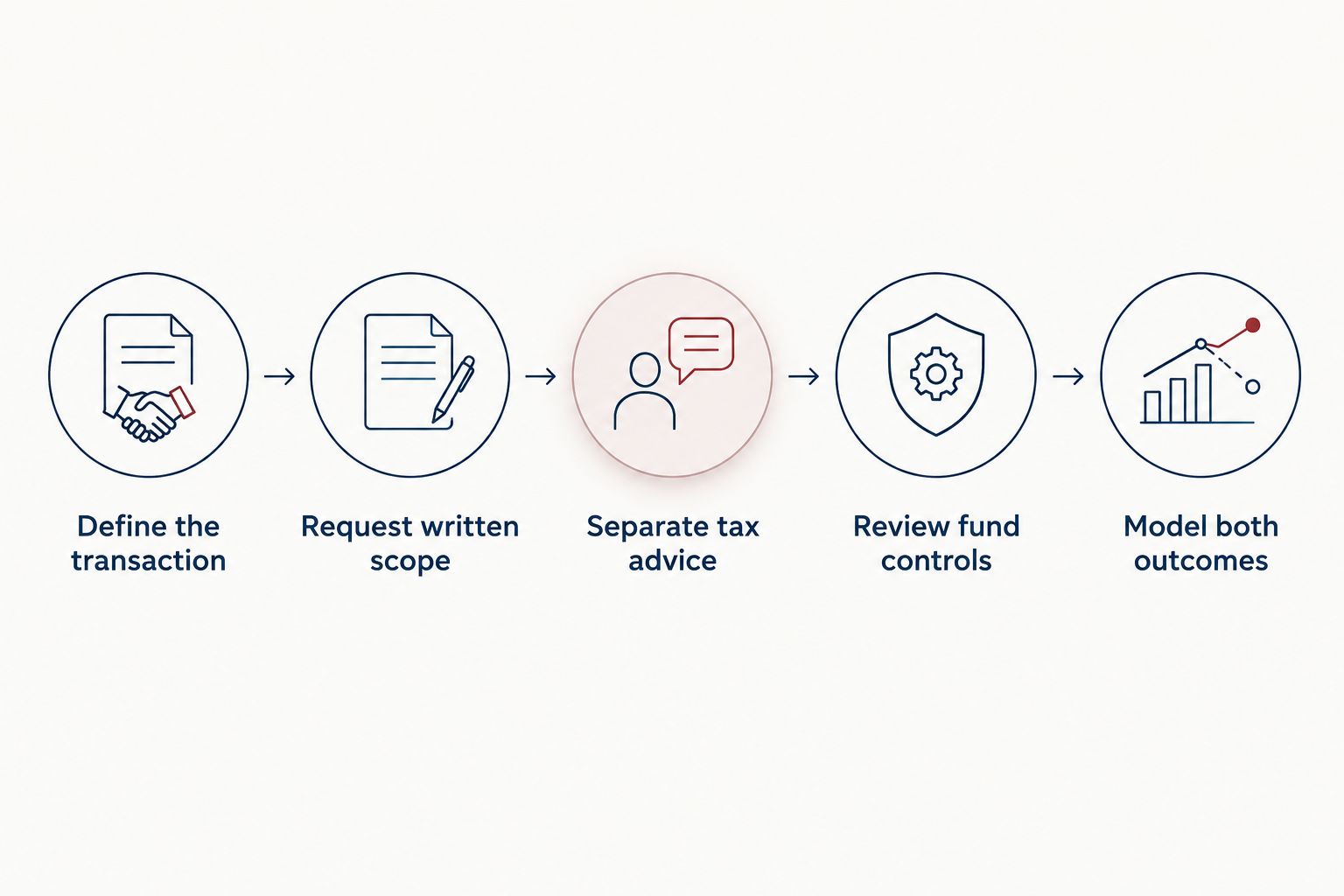
How do you compare exchange quotes properly?
Use a consistent sequence so you are comparing the same responsibilities. Do this before signing a replacement-property contract that depends on the exchange working.
- Define the transaction. State which property you are selling, the ownership entity, and the intended replacement strategy.
- Request written scope. Ask the intermediary to identify included documents, coordination, and transaction assumptions.
- Separate tax advice. Confirm who calculates gain, reviews eligibility, and prepares the exchange reporting.
- Review fund controls. Understand where proceeds are held, who authorizes transfers, and what the agreement says about interest.
- Model both outcomes. Compare a completed exchange with a taxable sale using the same property and financing assumptions.
Do not treat the intermediary’s engagement as a substitute for your tax adviser’s analysis. Exchange administration and tax planning solve different problems, even when both support the same closing.
CEOHAVEN is best suited to real estate investors seeking tax planning, tax preparation, and bookkeeping—not a substitute for a qualified intermediary. That distinction keeps the responsibilities clear without asking one engagement to cover work outside its stated purpose.
Which deadlines can turn a modest fee into a bad decision?
For a standard deferred exchange, the identification period generally ends 45 days after you transfer the relinquished property. The exchange period generally ends 180 days after that transfer or on the due date of your federal income tax return, including extensions, whichever comes first.
For a 2026 sale late in the calendar year, review the return-filing deadline with your adviser. Do not assume the full exchange period is available without checking whether an extension is needed.
IRS Publication 544 and the Instructions for Form 8824 describe these federal requirements. The deadlines run concurrently; completing identification does not start a fresh acquisition period.
The identification rules also matter. Under the 3-property rule, you can generally identify up to 3 properties regardless of their fair market values; identifying more requires satisfying another permitted identification rule.
These rules create a practical cost: reduced freedom to wait. Build a credible replacement-property search before the sale closes rather than relying on a deadline to produce a suitable investment.
Where do appraisals fit into the total cost?
An appraisal is not the intermediary’s fee. It can be a separate transaction expense when financing or another part of the deal requires a valuation, and it belongs in the acquisition budget rather than disappearing inside a generic exchange allowance.
The distinction matters when evaluating commercial appraisers for 1031 exchanges: the assignment’s property type, intended use, and delivery requirements must match the transaction. A valuation assignment and an exchange engagement have different scopes, even when both affect the same closing.
Ask your lender which appraisal process it requires before commissioning work independently. Confirm who orders the report, who can rely on it, and whether its delivery schedule fits your purchase contract.
An appraisal does not establish that a property qualifies for exchange treatment. Valuation, tax eligibility, title, and financing remain separate questions that need separate answers.
Is a 1031 exchange worth the cost?
A 1031 exchange is worth evaluating when the deferred tax supports an investment strategy you already want. It is not a reason to accept an unsuitable replacement property.
Have your adviser calculate realized gain and the tax consequences of a sale, including depreciation-related treatment and relevant state rules. Then compare the exchange’s incremental expenses, financing obligations, liquidity restrictions, and replacement-property economics.
For your 2026 comparison, use these decision tests:
- Investment fit: Would you buy the replacement property without the tax deadline?
- Cash position: Can you fund deposits, due diligence, and any required equity without depending on unrestricted access to exchange proceeds?
- Execution risk: Are the seller, lender, title team, and intermediary working toward a feasible closing?
- Ownership goals: Do you actually want continued real estate exposure and its operating responsibilities?
CEOHAVEN’s tax planning services fit the tax-analysis side of this decision. The limitation is equally important: a tax projection does not replace property due diligence or establish the quality of an investment.
Compare the entire outcome, not the intermediary’s invoice. Deferring tax while buying the wrong asset is not a successful capital-allocation decision.
Can you deduct every 1031 exchange expense?
No. An expense appearing on an exchange closing statement does not automatically make it deductible or give it the same treatment as other transaction costs.
Some qualifying exchange expenses affect the exchange calculations. Other items relate to financing, operations, prepaid expenses, or the acquisition’s tax basis and require different treatment.
Give your preparer the complete settlement statements, intermediary accounting, loan documents, and professional invoices. Labels such as administrative fee or closing cost are not enough to determine the federal tax result.
FAQ
What is included in a 1031 exchange cost?
A 1031 exchange cost includes exchange administration plus any separate tax, legal, financing, closing, and carrying expenses associated with the transaction. Separate exchange-specific charges from expenses you would incur in an ordinary sale and purchase.
Is the qualified intermediary’s fee the entire cost?
No, the qualified intermediary’s fee is only one part of the total transaction budget. Tax advice, return preparation, legal work, and property-related expenses can sit outside that engagement.
How long do I have to identify a replacement property?
You generally have 45 days after transferring the relinquished property to identify replacement property in a deferred exchange. Identification must satisfy the applicable written-notice and property-identification rules.
Do I always get 180 days to finish a 1031 exchange?
No, 180 days is generally the maximum exchange period, subject to an earlier federal income tax return due date, including extensions. Review filing-extension needs before assuming the full period is available.
Can I receive the sale proceeds and arrange the exchange afterward?
Receiving or controlling sale proceeds can defeat deferred-exchange treatment. Establish the exchange arrangement before closing and follow the restrictions on access to proceeds.
Does a 1031 exchange eliminate capital gains tax?
A qualifying 1031 exchange generally defers gain rather than eliminating it. Cash received, debt changes, and other nonqualifying consideration can produce currently recognized gain.
Should I exchange if I cannot find a good replacement property?
Do not buy an unsuitable property solely to complete an exchange. Compare the taxable-sale outcome with the financial and operating consequences of the available replacement properties.
One last thing
The most useful document is not the lowest quote. It is a side-by-side decision sheet showing the taxable sale, the proposed exchange, and exactly who owns each responsibility.
Ask CEOHAVEN to connect the tax analysis with your broader real estate records and reporting needs. Keep property selection, intermediary selection, and financing decisions explicit rather than burying them inside a single exchange budget.
Related guides
- Can you do a 1031 exchange on a short-term rental property?
- How much does a cost segregation study cost?
- Expense tracking apps for real estate investors
Shamyr Borgelin
Founder & CEO, CEOHAVEN