

The penalty for underpaying quarterly estimated taxes depends on each installment’s shortfall, how long it remained unpaid, and the IRS interest rate applicable during that period—not a flat percentage of your final tax bill. For 2026, check the federal safe-harbor rules before calculating a penalty; paying your balance by the filing deadline does not automatically erase an earlier estimated-tax shortfall.
TL;DR
- The IRS calculates the penalty for underpaying quarterly estimated taxes by installment, unpaid days, and applicable interest rates.
- Federal safe harbors can prevent an estimated-tax penalty even when you owe a balance at filing.
- Uneven income calls for an annualized-income calculation, not an assumption that every quarter earned equally.
- CEOHAVEN suits entrepreneurs seeking tax planning, tax preparation, and bookkeeping together.
Why this matters
A profitable business can have enough cash to settle its tax bill and still owe an underpayment penalty. The federal system generally requires you to pay income tax throughout the year, through withholding, estimated payments, or both.
For founders, creators, and real estate investors, the problem is often timing: a distribution arrives, a property sells, or revenue accelerates without a corresponding payment adjustment. A documented quarterly estimated tax payment workflow connects those events to a payment decision rather than leaving them for return preparation.
How much do you owe in penalties for underpaying quarterly taxes?
Your penalty is the sum of the charges on individual installment underpayments, not a single charge on everything you owe at filing. The IRS calculates those charges using the required payment, the payment credited by its deadline, the applicable rate, and the time the shortfall remained outstanding.
For an individual federal return, IRS Form 2210 and its instructions provide the calculation framework. IRS Publication 505 explains estimated-tax payments, withholding, and the annualized income installment method. Use the instructions applicable to the return you are preparing; a 2026 planning estimate is not a substitute for the final calculation.
The calculation works through these components:
| Component | What determines it | What you need to check |
|---|---|---|
| Required installment | Your applicable safe harbor or current-year calculation | Tax liability, filing status, and prior-year eligibility |
| Payment credited | Estimated payments and allocated withholding | Amounts, payment dates, and tax-year designation |
| Installment shortfall | Required payment less credited payment | Whether an earlier unpaid amount carries forward |
| Penalty period | Time the shortfall remains unpaid | Later payments and the statutory stopping date |
| Applicable rate | IRS rate for each relevant period | Whether the calculation crosses a rate change |
An outstanding shortfall that crosses an IRS rate change needs separate calculations for the relevant periods. Do not multiply your entire April balance by an annual rate and call that your penalty. That ignores installment timing, withholding allocation, and safe-harbor protection.
When is the penalty zero?
The federal estimated-tax penalty generally does not apply when the tax remaining after withholding and applicable refundable credits is less than $1,000. Other exceptions exist, including qualifying taxpayers with no prior-year tax liability.
Meeting an applicable safe harbor through timely payments also generally prevents the penalty. You can still owe tax when you file; protection from a penalty is not forgiveness of the remaining tax.
Which safe harbor applies to your 2026 payments?
For most individual taxpayers, the federal required annual payment generally uses the smaller of 90% of current-year tax or the applicable percentage of prior-year tax. The prior-year route has eligibility conditions, including a prior return covering a full 12-month tax year.
These are payment benchmarks, not deductions. They determine how much you generally need to pay during the year to avoid the estimated-tax penalty.
| Payment approach | Best for | Main advantage | Main limitation |
|---|---|---|---|
| Current-year tax method | Taxpayers with a reliable current-year forecast | Tracks the tax you actually expect to owe | Requires updates when income or deductions change |
| Prior-year safe harbor | Taxpayers wanting a benchmark based on a completed return | Reduces dependence on forecasting current-year income | Can leave a substantial balance due at filing |
| Annualized income method | Taxpayers with income concentrated later in the year | Matches required installments more closely to income timing | Requires detailed period-by-period records |
Current-year method: 90% of current-year tax
The 90% benchmark generally uses your current-year tax liability calculated under the estimated-tax rules. It does not mean paying 90% of gross revenue, business profit, or the balance shown after subtracting payments.
Best for: taxpayers whose current-year tax can be forecast reliably. The benefit is responsiveness: a lower-income year can justify a lower payment target. The trade-off is maintenance; a forecast that excludes a capital gain, spouse’s income, or self-employment tax can understate the requirement.
Prior-year method: 100% of prior-year tax
The standard prior-year benchmark is generally 100% of prior-year tax. Use the tax amount determined under the IRS instructions—not the check you wrote when filing that return.
Best for: eligible taxpayers who want a fixed planning benchmark. The advantage is a known starting point. The limitation is liquidity: a business with sharply rising income can satisfy this benchmark and still face a large balance at filing.
Higher-income method: 110% of prior-year tax
The prior-year benchmark generally rises to 110% when prior-year adjusted gross income exceeds $150,000, or $75,000 if your current filing status is married filing separately. These thresholds concern adjusted gross income, not business revenue or account balances.
Best for: higher-income taxpayers using the prior-year route. For 2026 planning, confirm the applicable threshold before setting recurring payments. Paying the standard prior-year percentage when the higher percentage applies leaves the plan short.
Why your underpayment penalty varies
Two taxpayers with the same balance due can owe different penalties. These factors explain the difference:
- Required payment: The current-year calculation and the applicable prior-year safe harbor can produce different installment requirements.
- Payment timing: A payment credited after its deadline does not have the same effect as a timely payment.
- Withholding allocation: Federal withholding is generally treated as paid evenly across installment dates unless you establish actual withholding dates under the applicable rules.
- Income timing: Annualization can reduce earlier required installments when taxable income arrives later in the year.
- IRS rate changes: A shortfall spanning different rate periods requires the applicable rate for each period.
- Exceptions and waivers: Statutory exceptions, qualifying circumstances, and applicable disaster relief can change the result.
Keep federal and state calculations separate. A federal safe harbor does not establish compliance with your state’s estimated-tax rules, and a payment to one taxing authority does not pay the other.
How do you calculate and correct the shortfall?
Start with payment records, not a rough percentage of revenue. Your goal is to identify what was required, what was credited, and what remains unpaid.
1. Confirm liability
Identify your current-year projected federal tax and the prior-year tax amount used under the IRS instructions. Include relevant household income, capital gains, and self-employment tax rather than looking only at business income.
For 2026, revisit that projection after a material transaction. A large distribution is a reason to review the tax picture, but the distribution itself does not necessarily determine taxable income.
2. Reconcile payments
Match estimated payments to IRS confirmations and your tax account records. Check the taxpayer identification information, tax year, payment type, amount, and effective date.
Then reconcile federal withholding from payroll and other sources. A bank withdrawal alone does not prove the IRS credited the payment to the intended obligation.
3. Test timing
Compare required installments with payments credited to each installment date. Estimated-tax periods are not four equal calendar quarters, so use the IRS schedule rather than simply counting three months between payments.
If income arrived unevenly, evaluate Schedule AI of Form 2210. Annualization requires records supporting when income and deductions occurred; the explanation must match the books.
4. Correct shortfalls
Paying an outstanding shortfall sooner generally reduces the time on which the penalty accrues. A later estimated payment does not retroactively make the earlier installment timely, although it can reduce the outstanding underpayment.
If you receive wages, review whether additional legitimate withholding fits your situation. Do not change compensation solely to manufacture a withholding result; payroll and reasonable-compensation obligations still apply.
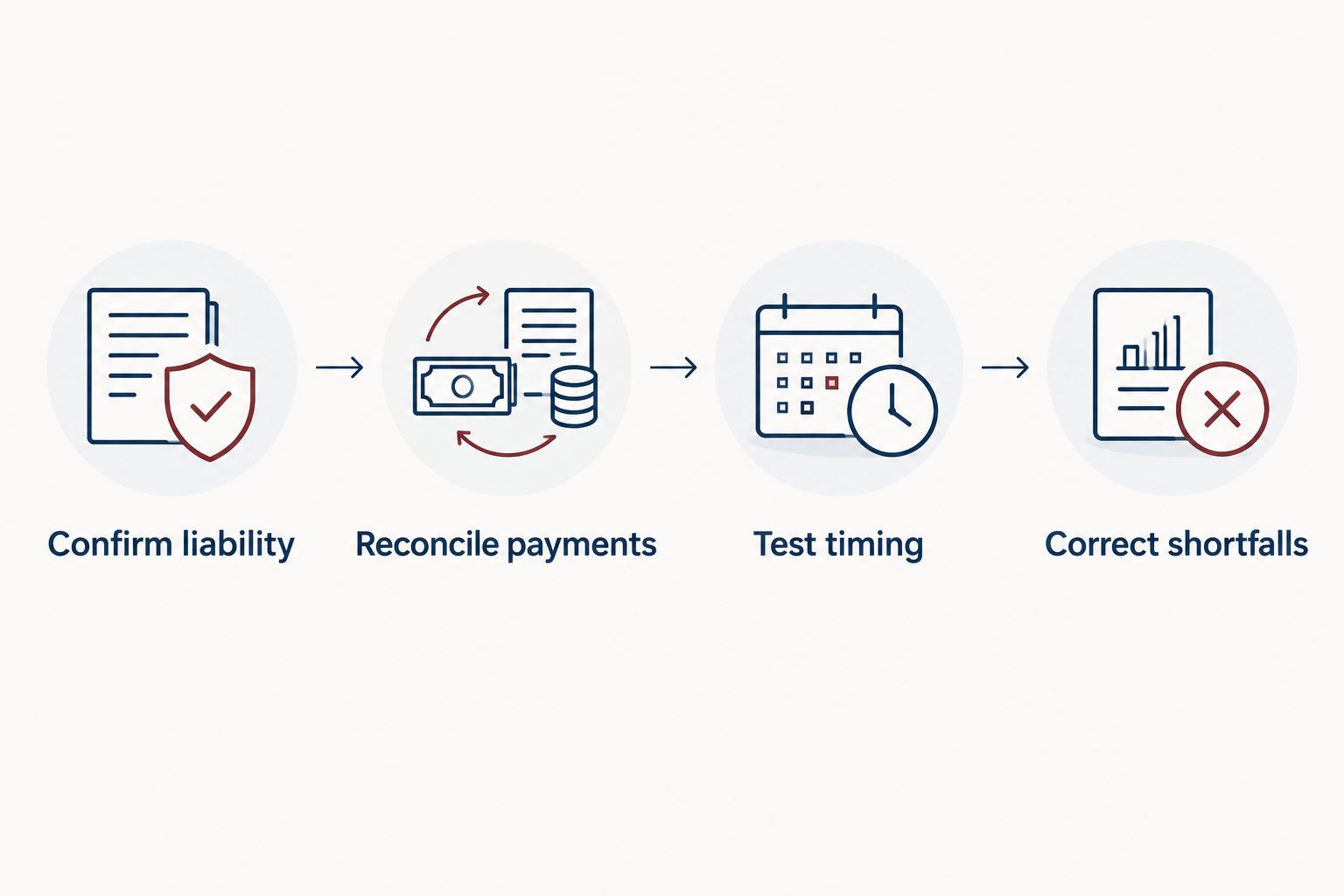
Confirm the required payment and credited payments before deciding how to correct a shortfall.
The useful output is an installment-by-installment record. Keep the liability calculation, payment confirmations, withholding records, and any annualization schedules together so the return preparer can reproduce the result.
Can a late estimated payment erase an earlier penalty?
A late estimated payment does not automatically erase an earlier underpayment penalty. It generally reduces the outstanding shortfall from the relevant payment date, subject to the IRS allocation rules.
That distinction matters when you discover an omission late in 2026. Waiting until return preparation leaves the shortfall outstanding longer; correcting the payment and documenting the calculation addresses the actual problem.
Can annualizing income reduce your penalty?
The annualized income installment method can reduce an estimated-tax penalty when income arrives unevenly during the year. It calculates required installments using income and deductions for specified cumulative periods instead of assuming a level annual pattern.
This is particularly relevant to a late-year business surge, capital gain, or other concentrated income event. It is not permission to delay payments on income earned earlier, and it adds recordkeeping and calculation work.
Should you ask for a waiver?
An estimated-tax penalty waiver is available only when you meet the applicable criteria. IRS rules include certain casualty, disaster, or unusual circumstances, plus qualifying retirement or disability situations involving reasonable cause rather than willful neglect.
Do not assume ordinary forgetfulness qualifies. Disaster postponements also depend on the designated taxpayer, location, obligation, and period; check the actual IRS relief notice rather than applying a general headline to your return.
When professional tax planning earns its place
CEOHAVEN is best for entrepreneurs who want tax planning, tax preparation, and bookkeeping together. The firm also serves real estate investors, content creators, and high-income professionals in the United States.
The benefit of coordinating those services is practical: your payment decisions can use organized books and a current tax projection. The limitation is equally clear—professional planning does not make late payments timely or guarantee penalty relief.
Bring your prior return, current financial statements, payment confirmations, withholding details, and major transaction records to CEOHAVEN. Ask for a written payment target, the method supporting it, and the events that should trigger an update.
FAQ
What is the penalty for underpaying quarterly estimated taxes in 2026?
The penalty depends on each installment’s shortfall, the time it remained unpaid, and the applicable IRS rate. It is not one fixed percentage of your final balance due.
Can I owe a penalty even if I pay everything by the filing deadline?
Yes, paying your full balance by the filing deadline does not automatically eliminate an earlier estimated-tax underpayment penalty. The IRS evaluates required payments at installment deadlines.
Does owing less than $1,000 mean I avoid the penalty?
You generally avoid the federal estimated-tax penalty when tax remaining after withholding and applicable refundable credits is less than $1,000. Apply the IRS calculation rather than relying only on the balance displayed before all return adjustments.
Can I use last year’s tax to set my estimated payments?
Yes, eligible taxpayers can generally use the applicable prior-year safe harbor. Higher-income taxpayers generally need 110% rather than 100% of prior-year tax, and timely payment requirements still apply.
Does extra payroll withholding help if I missed an estimated payment?
Additional federal withholding can help because withholding is generally allocated evenly across installment dates. Review the applicable rules and your actual payroll situation before relying on that treatment.
What if nearly all my income arrived late in the year?
The annualized income installment method can adjust required payments to reflect uneven income timing. You need records for the specified periods and the appropriate Form 2210 schedules.
Can CEOHAVEN help with estimated-tax planning?
CEOHAVEN offers tax planning, tax preparation, and bookkeeping for entrepreneurs, real estate investors, content creators, and high-income professionals. Coordinating those services supports payment planning, but penalty relief depends on the applicable tax rules.
One last thing
A tax reserve is not a tax payment. Money sitting in a separate bank account protects liquidity, but it does not count as federal estimated tax until it is paid and credited appropriately.
Before the next installment deadline, verify both sides: what your calculation requires and what the IRS actually received. A calendar reminder handles neither on its own.