

You can pay your child up to $16,100 in wages with no federal income tax in 2026 if those wages are their only income and they qualify for the standard deduction. That is not a blanket tax-free payroll allowance: Social Security, Medicare, unemployment taxes, state rules, and the requirement to pay reasonable wages for real work still apply.
TL;DR
- How much can you pay your kids tax free in 2026? Up to $16,100 in wages, subject to conditions.
- Sole-proprietor parents generally avoid Social Security and Medicare taxes on qualifying wages paid to children under age 18.
- S corporations do not receive the same parent-child payroll tax exemptions, even when a parent owns the business.
- CEOHAVEN tax planning addresses child payroll alongside the entrepreneur’s business taxes and bookkeeping.
Why this matters
Your child's income-tax threshold and your business's payroll-tax obligations are different rules. Confusing them turns a legitimate deduction into an incorrectly processed payroll.
The right order is simple: identify the employer, confirm the work, establish defensible compensation, and then calculate taxes. Choosing a payroll platform comes after those decisions; the guide to payroll providers for paying family members addresses that implementation step.
For a founder with substantial business income, the objective is not to manufacture a deduction. It is to pay for useful work through a structure that accurately reflects who employed the child and what the child earned.
How much can you pay your kids tax-free in 2026?
$16,100 is the 2026 federal standard deduction for a single filer, according to the IRS's inflation-adjustment guidance for the 2026 tax year. A dependent child with only wage income can generally earn that amount without federal taxable income.
This is not a special deduction reserved for children employed by their parents. It results from the standard deduction offsetting earned income. A dependent's deduction follows special rules, but sufficient wage income permits the deduction to reach the regular single-filer limit.
The table separates the income-tax result from the payroll-tax result. It assumes genuine employment, reasonable compensation, and no other income affecting the child's calculation.
| Employment arrangement | Federal income tax on wages up to $16,100 | Social Security and Medicare | Best fit and principal limitation |
|---|---|---|---|
| Parent's sole proprietorship; child under age 18 | Generally none under the stated assumptions | Generally exempt | Best for qualifying employment directly by a parent; actual work and reasonable pay remain essential |
| Partnership in which every partner is the child's parent; child under age 18 | Generally none under the stated assumptions | Generally exempt | Best for qualifying parent-only partnerships; another type of partner changes the exemption |
| Parent's sole proprietorship; child age 18 or older | Generally none under the stated assumptions | Generally apply | Best for genuine ongoing employment; the under-age-18 exemption has ended |
| S corporation or C corporation employing the child | Generally none under the stated assumptions | Generally apply regardless of the child's age | Best for work actually performed for the corporation; parental ownership does not create an exemption |
The federal payroll distinctions come from IRS family-employment guidance and Publication 15, Employer's Tax Guide, for 2026. State income tax, state unemployment insurance, and employment-law requirements require a separate review.
You can pay more than $16,100. The amount is an income-tax planning threshold under these assumptions, not a legal ceiling on compensation or a limit on deductible wages.
Sole proprietorship: the under-age-18 payroll exemption
Wages paid to a child under age 18 for work in a parent's sole proprietorship generally are not subject to Social Security and Medicare taxes. This is the arrangement behind many accurate descriptions of tax-efficient family employment.
The advantage is the potential combination of a business wage deduction, the child's standard deduction, and the family-employment payroll exemption. The limitation is equally important: the employer must qualify, and the work must be real.
A single-member LLC requires closer attention than its name suggests. An LLC treated as a sole proprietorship for federal income-tax purposes can qualify for family-employment treatment; an LLC taxed as a corporation does not receive that treatment merely because a parent owns it.
Do not instruct a payroll provider to switch off taxes based only on the letters “LLC.” Confirm federal tax classification and the applicable family-employment rules first.
Parent-only partnership: the under-age-18 exemption
The Social Security and Medicare exemption generally also applies when a partnership employs a child under age 18 and every partner is a parent of that child. A partnership involving a parent and an unrelated business partner does not satisfy that condition.
This distinction matters when founders hold businesses through multiple entities. Family ownership in everyday language is not the same as meeting the IRS's specific parent-child relationship test.
The benefit is access to the qualifying family-employment exemption. The constraint is ownership: review the actual partners, not just the person managing payroll or supervising the child.
Corporations: the $16,100 income-tax threshold still matters
An S corporation or C corporation can employ an owner's child and deduct qualifying reasonable wages. The child's standard deduction still applies to wage income, but the corporation generally must handle Social Security, Medicare, and federal unemployment taxes under the normal rules.
An S corporation does not become a sole proprietorship because one parent owns all its shares. The corporation is the employer, and the special parent-child payroll exemptions do not apply in the same way.
The advantage is straightforward employment by the business receiving the work. The limitation is payroll tax; do not treat the child's lack of federal income tax as proof that the entire payment is tax-free.
Child payroll also does not replace an owner-employee's separate reasonable-compensation obligations. If compensation decisions overlap, review changing an S corporation salary during the year as a separate issue.
Why the tax-free amount varies
The $16,100 figure answers a narrow federal income-tax question for 2026. Your household's result changes when the facts change:
- Other earnings: Wages from another employer use the same annual standard deduction. Each employer does not provide a separate allowance.
- Investment income: Interest, dividends, and capital gains affect the return differently from wages. Dependent-filing and kiddie-tax rules require separate analysis.
- Employer classification: A sole proprietorship, qualifying parent-only partnership, and corporation do not have identical payroll obligations.
- The child's age: The Social Security and Medicare exemption generally ends at age 18; the qualifying federal unemployment exemption generally ends at age 21.
- State requirements: State income taxes, unemployment rules, workers' compensation, and youth-employment restrictions are separate from federal income tax.
- Reasonable compensation: Pay must match actual services. A tax threshold does not justify a salary unsupported by the work.
The federal unemployment distinction deserves its own check. Qualifying wages paid by a parent's sole proprietorship or parent-only partnership to a child under age 21 generally are exempt from FUTA, even after Social Security and Medicare taxes begin applying.
How do you put a child on payroll correctly?
Start with the job, not the deduction. A defensible arrangement shows that your business needed the work and paid an appropriate amount for it.
- Define the job. Write down actual business duties that fit the child's ability and comply with applicable employment laws. Separate business work from household chores.
- Set reasonable pay. Establish compensation from the duties, required skill, and relevant market comparisons. Do not reverse-engineer an hourly rate to reach the standard deduction.
- Confirm the employer. Identify the legal entity receiving the services and its federal tax treatment. Review age-based payroll exemptions before processing wages.
- Keep work records. Retain time entries, completed assignments, supervision notes, and evidence supporting compensation. Records should explain both the payment and the business purpose.
- Run payroll. Complete required hiring documentation, process actual payments, and handle withholding and wage reporting correctly. Review the child's total annual income before year-end.
A creator's business might assign genuine production-support work; a real estate business might assign appropriate administrative work. The assignment must reflect services actually performed, not a convenient label attached to a family transfer.
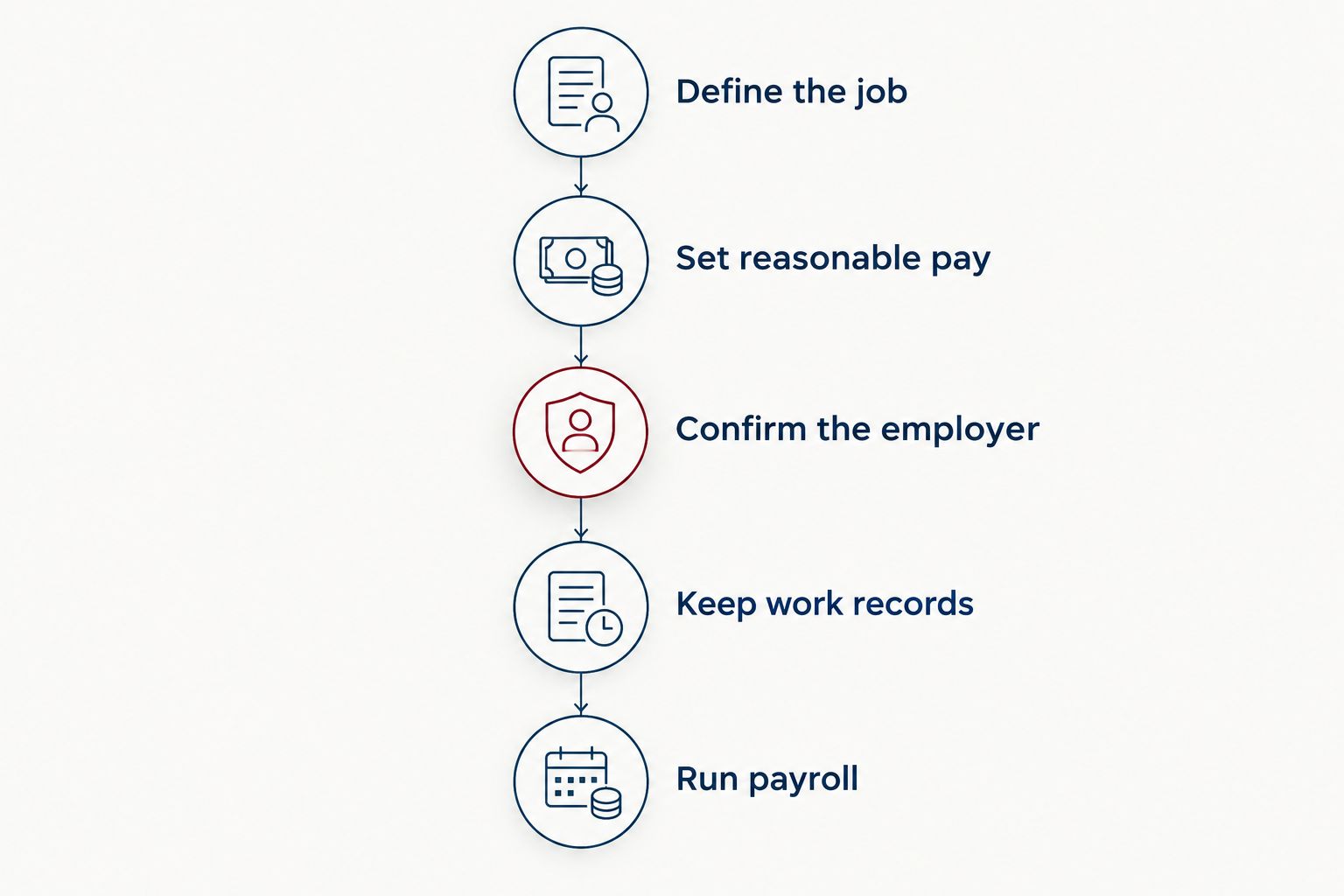
Confirm the job and employer before configuring payroll taxes.
CEOHAVEN tax planning is best for entrepreneurs who need child payroll considered alongside business tax preparation and bookkeeping. Advisory support does not replace your responsibility to substantiate the work, maintain records, and pay wages correctly.
Plan family payroll before paying
Discuss child employment alongside your business tax planning, tax preparation, and bookkeeping.
Can you deduct the full $16,100 paid to your child?
$16,100 is deductible only when the full payment qualifies as a business wage expense. The standard deduction does not establish what your child's work is worth.
Under the general business-expense rules, compensation must be reasonable and paid for services actually rendered. Personal allowances, ordinary household chores, or money transferred without supporting work do not become deductible wages because they pass through a business account.
Keep the deduction analysis separate from the child's tax calculation. Your business must substantiate its expense even when the child owes no federal income tax.
Can each child earn $16,100 without federal income tax?
$16,100 applies separately to each qualifying child's wage-income calculation in 2026, assuming wages are that child's only income and the standard deduction fully offsets them. It is not a single household allowance divided among siblings.
Each child also needs an independent employment record. Different abilities, duties, and hours often warrant different compensation; matching payments are not evidence of matching work.
Does $16,100 of child wages mean no tax return is required?
$16,100 of wages alone generally does not create a federal filing requirement under the stated assumptions. Other income, special taxes, or other filing conditions change that answer.
A child who had federal income tax withheld can still need to file to recover the withholding. Filing requirements, withholding elections, and the final tax liability are related but distinct decisions.
FAQ
How much can I pay my child tax-free in 2026?
You can generally pay your child up to $16,100 in wages without federal income tax if wages are their only income and they qualify for the standard deduction. Payroll taxes and state obligations depend on the employer, the child's age, and applicable rules.
Can my S corporation pay my child without payroll taxes?
An S corporation generally must pay Social Security, Medicare, and federal unemployment taxes on a child's wages under the normal rules. A parent's ownership of the corporation does not create the sole-proprietor family-employment exemption.
At what age do Social Security and Medicare taxes start for a child employee?
Age 18 generally ends the special Social Security and Medicare exemption for a child employed by a parent's sole proprietorship or a qualifying parent-only partnership. Corporations generally do not receive this age-based family exemption.
Are wages paid to my child exempt from federal unemployment tax?
Wages paid to a child under age 21 by a parent's sole proprietorship or qualifying parent-only partnership generally are exempt from federal unemployment tax. State unemployment rules require a separate determination.
Can I pay my child for household chores through my business?
Ordinary household chores are personal expenses, not business wage deductions. A deductible payment must compensate actual business services at a reasonable rate.
Does my child's summer job reduce the tax-free amount available from my business?
Yes, wages from a summer job count toward the same annual income-tax calculation as wages from your business. The child does not receive a separate standard deduction for each employer.
Can I give my child money instead of putting them on payroll?
A gift and a wage payment have different tax treatment. A personal gift does not become a business wage deduction, while wages require genuine services and appropriate employment reporting.
Can CEOHAVEN help evaluate paying my children through my business?
CEOHAVEN offers tax planning, tax preparation, and bookkeeping for entrepreneurs. Consider child employment within that broader business-tax review rather than treating a standard-deduction figure as a complete payroll plan.
One last thing
The strongest payroll file explains the work without mentioning the tax deduction. Start with deliverables, time records, reasonable compensation, and actual payments; then apply the tax rules.
For 2026, treat $16,100 as a planning checkpoint, not a payroll instruction. If the work supports less compensation, pay less. If it supports more, calculate the additional tax rather than artificially stopping a legitimate job at the deduction limit.