

You can deduct 100% of the eligible depreciable basis of qualifying newly acquired business property placed in service in 2026, with no general annual dollar cap on bonus depreciation. That does not mean every purchase qualifies or that every deduction reduces your current tax bill: acquisition rules, vehicle limits, business use, and loss restrictions still apply.
TL;DR
- The bonus depreciation limit 2026 is 100% of eligible basis for qualifying new acquisitions, without a general dollar cap.
- Rental buildings do not qualify; eligible components identified through cost segregation can qualify.
- A depreciation deduction is not a dollar-for-dollar tax saving, and loss restrictions can delay its use.
- CEOHAVEN fits entrepreneurs and real estate investors seeking coordinated tax planning, tax preparation, and bookkeeping.
How much can you deduct with bonus depreciation in 2026?
The federal bonus depreciation deduction is 100% of qualifying adjusted depreciable basis for eligible new acquisitions placed in service in 2026. Internal Revenue Code Section 168(k) governs the deduction; it is not a flat allowance you claim merely because you bought business equipment.
Your starting point is the asset’s tax basis attributable to qualifying business use. Adjust that basis for applicable credits, other basis reductions, and any Section 179 deduction before calculating bonus depreciation.
For investment property, the distinction between a building and its components matters. The guide to cost segregation on a residential rental property explains the classification question behind an accelerated deduction.
| Depreciation approach | Federal treatment | Best for | Main limitation |
|---|---|---|---|
| Bonus depreciation | Deducts 100% of eligible remaining basis under the applicable rules | Owners seeking accelerated deductions on qualifying property | Eligibility, vehicle restrictions, and loss limitations still apply |
| Section 179 | Allows an elected deduction subject to separate statutory limits | Owners who want asset-by-asset deduction choices | Annual limits, phaseouts, and a business-income limitation apply |
| Regular depreciation | Spreads deductions over the applicable recovery period | Owners preserving deductions for later tax years | Provides less acceleration in the acquisition year |
No general dollar cap is not the same as no restrictions. A large qualifying deduction can exist on the depreciation schedule while some or all of the resulting loss remains unavailable on your current return.
Why this matters
Bonus depreciation changes when you deduct an investment. It does not reimburse the purchase, turn personal spending into business spending, or guarantee that a rental loss offsets your salary.
For a founder buying equipment or an investor improving a property, the decision connects three things: cash committed, deductions created, and deductions actually usable. Treating those as one number produces an unreliable tax forecast.
CEOHAVEN’s tax planning, tax preparation, and bookkeeping services are relevant here because the return depends on both the tax election and the underlying records. A depreciation strategy needs an accurate asset schedule, not just a year-end purchase receipt.
Eligible business equipment: 100% of qualifying basis
Equipment, machinery, computers, and other qualifying tangible property generally fall within Section 168(k) when their recovery period is 20 years or less. Certain other property, including qualifying computer software, also falls within the statutory rules.
New property is not the only possibility. Used property can qualify when the acquisition satisfies the applicable requirements, including restrictions involving prior use by the taxpayer and purchases from related parties.
Your deduction follows the business portion of the asset. Personal use is not depreciable business basis, and an entity’s payment does not automatically establish a business purpose.
Confirm eligibility before treating an equipment purchase as fully deductible. Keep the invoice, acquisition agreement, business-use support, and evidence of when the equipment became ready and available for its intended use.
A 2026 placed-in-service date does not, by itself, establish the 100% rate. Older acquisitions, binding contracts, and special transition rules require separate review under Section 168(k).
Rental property components: 100% when eligible
A rental building does not become fully deductible because bonus depreciation is available. Residential rental buildings generally use a 27.5-year recovery period, and nonresidential real property generally uses 39 years under the general depreciation system.
Land is not depreciable. It remains outside the calculation even when the building and qualifying improvements produce substantial deductions.
Cost segregation identifies property components that belong in different depreciation categories. Properly classified personal property and land improvements can have shorter recovery periods and qualify for bonus depreciation when all other requirements are satisfied.
The classification creates eligibility; the study does not create permission to deduct the entire property. A defensible allocation must distinguish the building, land, and qualifying components rather than apply a blanket percentage to the acquisition.
The second question is whether you can use the resulting loss. Passive activity, basis, at-risk, and other applicable limitations can postpone the benefit even when the depreciation calculation is correct.
Business vehicles: 100% is not a universal write-off
Passenger automobiles have annual depreciation limits under Section 280F. Those limits can restrict the current deduction even when the vehicle otherwise qualifies for bonus depreciation.
For vehicles subject to the listed-property rules, qualified business use generally must exceed 50% to claim accelerated depreciation. Commuting does not become business mileage simply because you own the company.
Heavier vehicles require their own classification analysis. Vehicle weight alone does not establish eligibility, remove the business-use requirement, or resolve every restriction.
Keep contemporaneous mileage records and separate commuting, personal travel, and business travel. Do not approve a vehicle purchase based on a promised full write-off without checking its tax classification and actual use.
Why your bonus depreciation deduction varies
The headline percentage answers only part of the question. These factors determine the deduction you report and the benefit you can use:
- Eligible basis. Business use, credits, and other adjustments change the amount available for depreciation.
- Acquisition rules. Purchase timing, binding contracts, related-party transactions, and prior use affect eligibility and applicable transition treatment.
- Service date. The asset must be ready and available for its intended business use; ordering or paying is not enough.
- Asset classification. Equipment, building components, passenger automobiles, and the building itself follow different rules.
- Loss restrictions. Basis, at-risk, passive activity, and excess business loss rules can limit a current deduction’s use.
- State treatment. A state can require adjustments rather than follow the federal bonus depreciation deduction.
For a 2026 projection, calculate federal and state results separately. A federal deduction does not establish the amount deductible on your state return.
How do you calculate the deduction before filing?
Use a documented sequence rather than applying the headline rate to every asset purchase. Each step answers a different question, and skipping one can overstate the result.
- Confirm ownership. Identify the taxpayer entitled to depreciate the asset. Paying an expense and owning depreciable property are not always the same thing.
- Classify the asset. Establish its recovery period and whether special restrictions apply. Separate land, buildings, improvements, and equipment where required.
- Establish basis. Determine capitalized tax basis and the qualifying business-use portion. Reconcile that calculation to supporting records.
- Verify service date. Document when the property became ready and available for its intended use, not merely when the payment cleared.
- Apply elections. Coordinate Section 179, bonus depreciation, and any election out before calculating remaining regular depreciation.
- Test loss limits. Determine how much of the resulting deduction affects the current return after applicable restrictions.
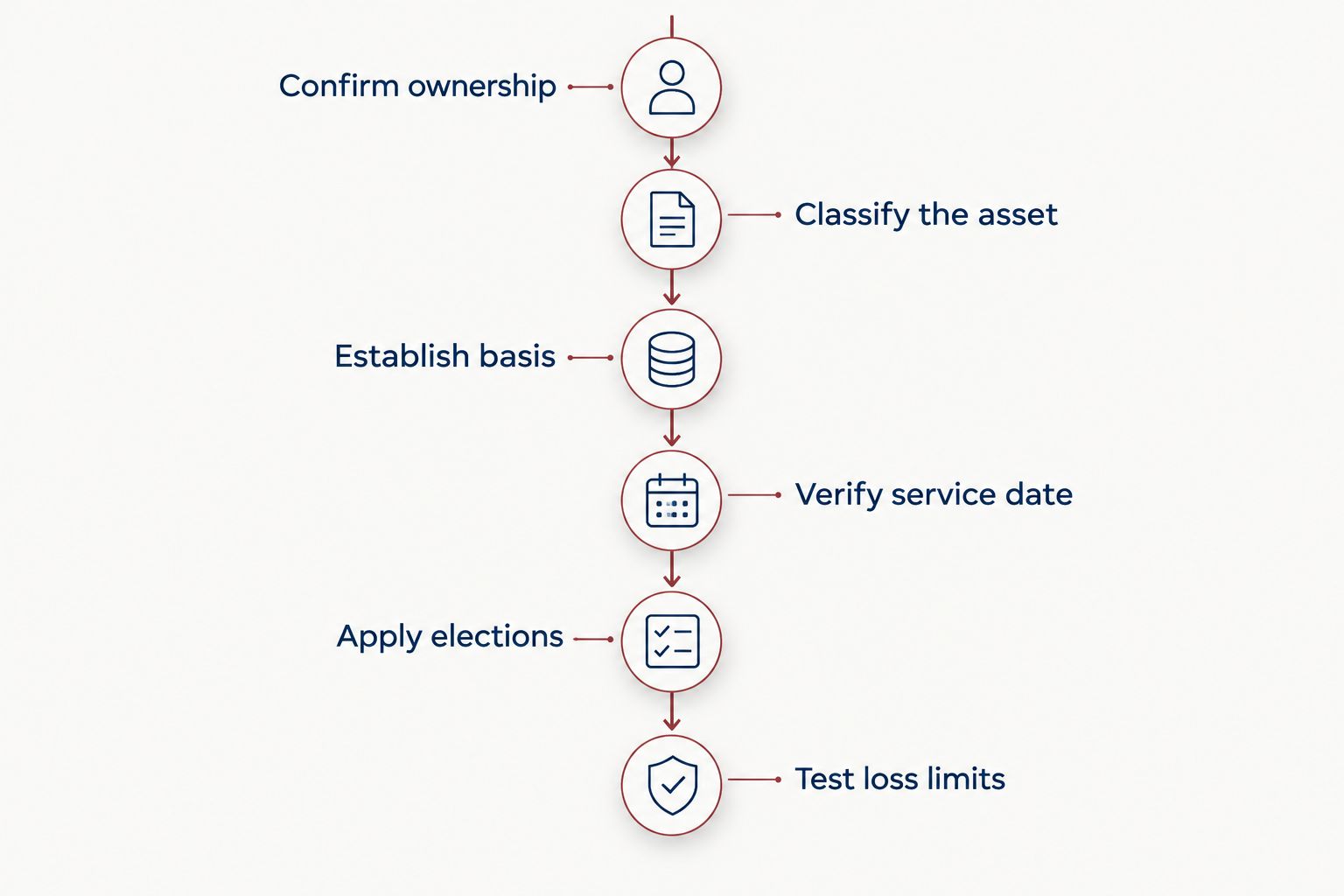
Calculate the deduction first, then determine how much the current return can use.
The finished asset schedule should support both the deduction and the future basis. That second number matters when you sell, dispose of, or change the use of the property.
Can bonus depreciation create a business loss?
100% bonus depreciation can create or increase a business loss, unlike Section 179’s separate business-income limitation. Whether that loss reduces current taxable income depends on the taxpayer and the restrictions that apply.
For a pass-through owner, entity-level depreciation is not the end of the analysis. Owner basis and at-risk limitations can restrict deductions before other individual-level rules enter the calculation.
For a rental investor, a depreciation loss does not automatically offset wages or unrelated business income. Review the activity’s tax treatment and your participation before counting the deduction in an estimated payment calculation.
Can you take bonus depreciation and Section 179 together?
100% bonus depreciation can apply to eligible basis remaining after Section 179. You cannot deduct the same basis twice, and Section 179 has its own eligibility and limitation rules.
The normal calculation applies Section 179 first, then bonus depreciation, then regular depreciation to any remaining basis. Your preparer should model the combination rather than assume that the largest immediate election produces the best tax result.
The guide to using bonus depreciation and Section 179 on the same asset covers that coordination. The decision should account for current income, future deductions, state treatment, and expected ownership duration.
Should you always take the full deduction?
100% is an available deduction rate, not an instruction to accelerate every eligible asset. Taking deductions now leaves less depreciable basis for later years and can affect the tax consequences of a sale.
An election out of bonus depreciation generally applies by property class for the tax year, rather than allowing unrestricted asset-by-asset selection. Section 179 offers different selection mechanics, which is one reason the two provisions are not interchangeable.
Model the election against your broader 2026 return. Consider whether the deduction is usable now, whether later deductions have more value, and whether a planned sale introduces depreciation recapture exposure.
CEOHAVEN is best for entrepreneurs and real estate investors seeking tax planning, tax preparation, and bookkeeping. Those services fit the coordination this decision requires; the firm’s involvement does not replace statutory eligibility or substantiate an unsupported asset allocation.
Plan the deduction before filing
Connect asset records, depreciation elections, and the tax preparation decision.
Which tax rules support this answer?
The federal framework for this 2026 guide is Internal Revenue Code Section 168(k), which governs the additional first-year depreciation deduction. Sections 168(c) and 168(e) address recovery periods and property classification, while Section 179 governs the separate expensing election.
Section 280F supplies passenger automobile limits and listed-property restrictions. Sections 465 and 469 address at-risk and passive activity limitations; other basis and loss rules depend on your ownership structure and return.
These rules explain the distinction between an eligible asset deduction and an immediately usable tax benefit. Confirm the applicable acquisition provisions, elections, and state conformity when preparing the return.
FAQ
What is the bonus depreciation limit 2026 for a business?
The bonus depreciation limit in 2026 is 100% of eligible depreciable basis for qualifying new acquisitions, with no general annual dollar cap. Asset eligibility, acquisition rules, special limits, and loss restrictions still apply.
Does buying equipment before year-end guarantee the deduction?
Buying equipment before year-end does not guarantee bonus depreciation. The equipment must qualify and be placed in service, meaning ready and available for its intended business use, during the relevant tax year.
Can used equipment qualify for bonus depreciation?
Used equipment can qualify for bonus depreciation when the acquisition meets Section 168(k)'s requirements. Prior use by the taxpayer, related-party purchases, and other acquisition restrictions require review.
Can I deduct an entire rental building with bonus depreciation?
You cannot deduct an entire rental building using bonus depreciation. Eligible shorter-life components can qualify, but the building itself generally follows its applicable real-property depreciation schedule, and land is not depreciable.
Will rental bonus depreciation reduce my W-2 taxes?
Rental bonus depreciation does not automatically reduce taxes on W-2 income. Passive activity rules and other loss limitations determine whether the rental loss can offset that income on the current return.
Is bonus depreciation a tax credit?
Bonus depreciation is a deduction, not a tax credit. It reduces taxable income when usable; it does not reduce your tax bill dollar for dollar by the amount deducted.
What happens if I sell an asset after claiming bonus depreciation?
Selling an asset after claiming bonus depreciation can create taxable gain and depreciation recapture. The treatment depends on the asset, adjusted basis, sale proceeds, and applicable recapture rules.
One last thing
A paid invoice proves a purchase, not a placed-in-service date. Save installation records, delivery documentation, commissioning records, or other evidence showing when the asset became ready and available for business use.
For CEOHAVEN tax planning clients and other business owners, that distinction belongs in the bookkeeping workflow before year-end. A deduction supported by the right records is more useful than an impressive projection that the asset file cannot support.