

The solo 401k contribution limit in 2026 is $72,000 before catch-up contributions, rising to $80,000 if you qualify for the standard age-50 catch-up or $83,250 if you turn 60–63 during the year. These are combined employee-and-employer ceilings, not automatic allowances: your eligible compensation, contributions to other plans, and plan terms determine how much you can actually contribute.
TL;DR
- The solo 401k contribution limit 2026 is $72,000 before catch-ups; eligible compensation determines your actual maximum.
- Employee elective deferrals are capped at $24,500 across your applicable plans, not separately for each business.
- Eligible owners turning 60–63 can reach $83,250 with sufficient compensation and a plan permitting enhanced catch-ups.
- CEOHAVEN tax planning serves entrepreneurs and high-income professionals who need retirement contributions coordinated with business taxes.
How much can you contribute to a solo 401k in 2026?
You can contribute up to $72,000 in combined regular employee and employer contributions for 2026, subject to compensation limits. Catch-up contributions sit above that ceiling when you meet the age requirements and your plan permits them.
| Your age during 2026 | Employee deferral ceiling, including catch-up | Combined ceiling, including catch-up | Best for understanding |
|---|---|---|---|
| Under 50 | $24,500 | $72,000 | The regular contribution limits |
| 50–59, or 64 and older | $32,500 | $80,000 | The standard age-based catch-up |
| 60–63 | $35,750 | $83,250 | The enhanced catch-up window |
Source: IRS 2026 retirement-plan cost-of-living adjustments. These are federal ceilings, not a calculation of your personal contribution allowance.
For execution, use the payroll-to-solo-401k contribution workflow to connect the calculation to payroll records and deposits.
Why this matters
A contribution ceiling is not a funding instruction. A business owner can recognize the correct IRS limit and still contribute too much by using distributions instead of wages, overlooking another employer's plan, or treating business revenue as eligible compensation.
The planning decision also extends beyond the deposit. You need to decide which contributions receive current deductions, whether Roth treatment fits your circumstances, and how much cash the business should retain for taxes and operations.
Under age 50: Up to $72,000 in 2026
The $72,000 ceiling combines contributions made in two capacities: you as the employee and your business as the employer. The regular employee elective-deferral limit is $24,500, but the employer contribution requires a separate compensation-based calculation.
You cannot simply transfer $72,000 and label the balance an employer contribution. Your business must generate enough eligible compensation to support it.
- Employee contribution: Your elected salary deferral, subject to the annual employee limit and available compensation.
- Employer contribution: A contribution based on eligible compensation or adjusted self-employment earnings.
- Combined limit: Regular annual additions cannot exceed the applicable dollar ceiling or the compensation-based limit.
The advantage is contribution capacity beyond employee deferrals alone. The constraint is that business income and tax structure control how much employer funding is allowed.
Ages 50–59 and 64-plus: Up to $80,000 in 2026
The standard catch-up contribution is $8,000 for eligible participants who are at least 50 by year-end. Added to the $72,000 regular ceiling, it produces a maximum of $80,000.
Catch-ups are employee contributions, not extra employer profit-sharing contributions. Your plan must permit them, and you still need sufficient compensation to support your employee deferrals.
The benefit is additional retirement funding without increasing the regular annual-additions ceiling. The limitation is that catch-up eligibility does not repair an unsupported employer contribution or create compensation you did not earn.
Ages 60–63: Up to $83,250 in 2026
The enhanced catch-up limit is $11,250 for participants who turn 60, 61, 62, or 63 during 2026. Combined with the $24,500 regular employee deferral, that allows employee contributions of up to $35,750.
With sufficient eligible compensation and employer contributions, the combined maximum reaches $83,250. The enhanced catch-up replaces the standard $8,000 catch-up; you do not add both amounts.
Use your age at the end of the calendar year. Turning 64 during the year returns you to the standard catch-up category rather than extending the enhanced allowance.
Why your solo 401k contribution limit varies
Your personal maximum depends on more than the headline IRS figure. Check these factors before scheduling a deposit:
- Eligible compensation: S-corporation wages and adjusted self-employment earnings follow different calculations. Gross receipts are not your contribution base.
- Age: Standard and enhanced catch-ups apply to different age groups and must be permitted by the plan.
- Other employee deferrals: Deferrals to another employer's applicable retirement plan reduce your remaining personal employee-deferral allowance.
- Business ownership: Related-employer and controlled-group rules can require contributions across businesses to be considered together.
- Plan provisions: Roth contributions, catch-ups, and voluntary after-tax contributions depend on what the plan document allows.
- Employee eligibility: Hiring eligible common-law employees changes the owner-only plan analysis and brings additional participation requirements.
These factors determine the legal ceiling. Your cash reserves and tax strategy determine whether funding that ceiling is the right decision.
How do S-corporation and sole-proprietor calculations differ?
Your tax classification determines the compensation base. An LLC label alone does not answer the question because an LLC can have different federal tax treatment.
| Business tax treatment | Employer contribution calculation | Advantage | Constraint |
|---|---|---|---|
| S corporation | Generally up to 25% of eligible W-2 compensation | Payroll establishes the compensation base | Shareholder distributions do not count as retirement-plan compensation |
| Sole proprietor or disregarded single-member LLC | Generally an effective 20% of adjusted net self-employment earnings | Employer contributions can come from self-employment earnings | The calculation requires adjustments; it is not 20% of gross revenue |
Source: IRS guidance on one-participant 401(k) plans and retirement-plan contributions for self-employed individuals, applied to 2026 limits.
S-corporation owners: Use wages, not distributions
For an S-corporation shareholder-employee, employer contributions generally depend on eligible W-2 compensation. Taking larger distributions does not increase that compensation base.
Do not raise wages solely to pursue a larger retirement contribution. Salary decisions also affect payroll taxes and must satisfy reasonable-compensation requirements; the retirement result belongs inside that broader analysis.
Sole proprietors: Adjust earnings before applying the rate
For a self-employed owner, the employer contribution calculation accounts for the deductible portion of self-employment tax and the contribution itself. That is why a nominal 25% employer contribution rate generally becomes an effective 20% rate for the self-employed calculation.
Use the IRS self-employed contribution worksheet rather than multiplying your bank deposits by a percentage. Business expenses, self-employment tax adjustments, and employee deferrals must be handled consistently.
How do you calculate your actual contribution allowance?
Calculate the contribution in sequence. Starting with a desired deduction and working backward invites errors when compensation or other-plan participation changes.
- Confirm eligibility. Establish that the owner-only arrangement fits your business and employee situation.
- Identify compensation. Use eligible wages or adjusted self-employment earnings, not revenue or distributions.
- Reconcile deferrals. Subtract applicable employee deferrals already made through other employers.
- Calculate employer funding. Apply the contribution rules for your business's tax treatment.
- Check plan terms. Confirm catch-ups, Roth treatment, deadlines, and contribution classifications before funding.
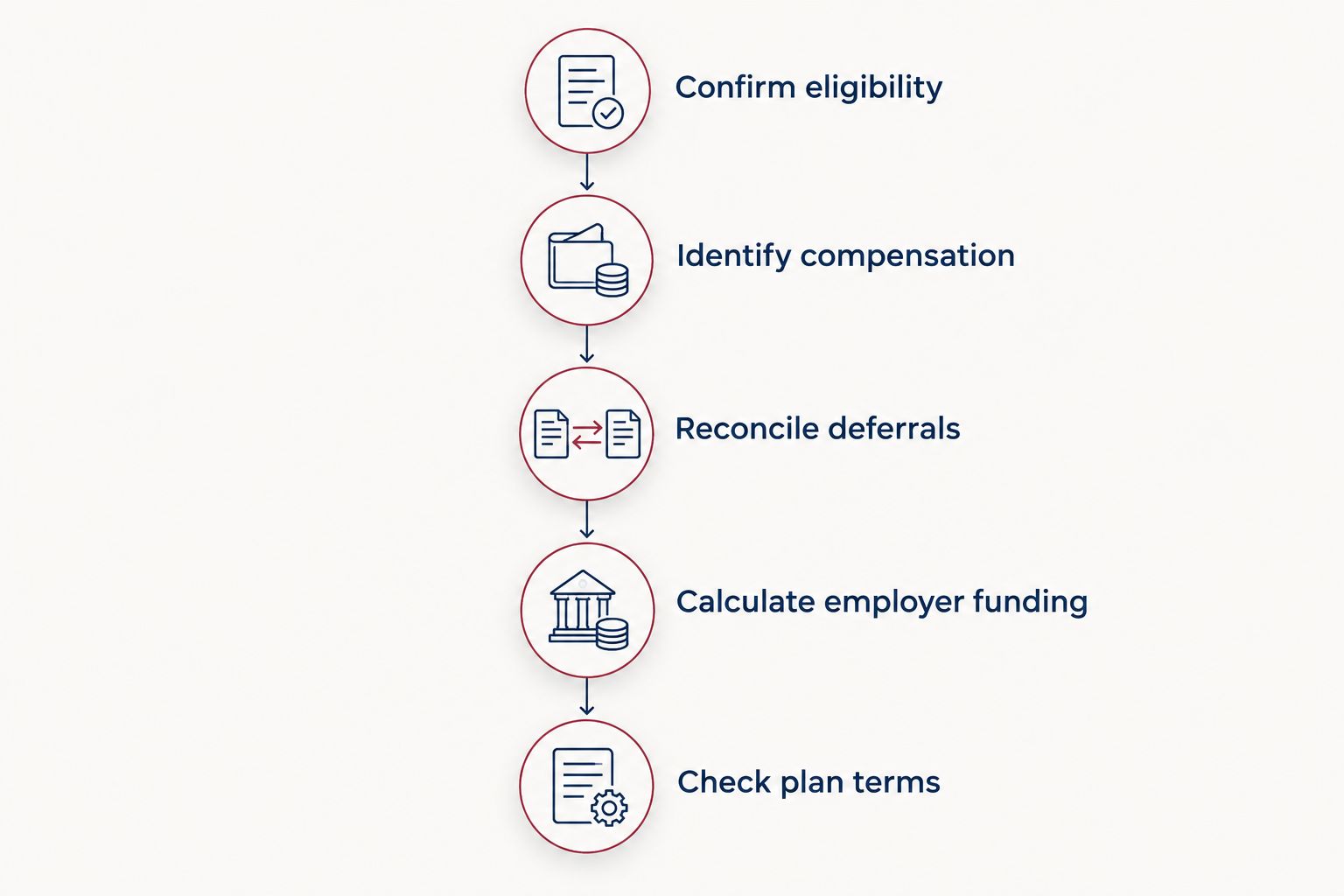
Confirm compensation and other-plan deferrals before calculating the employer contribution.
Keep a written calculation with the payroll reports, earnings worksheet, contribution election, and deposit confirmation. A brokerage balance shows that money arrived; it does not establish whether the contribution was classified correctly.
CEOHAVEN tax planning is for entrepreneurs and high-income professionals who need retirement contributions coordinated with business taxes. CEOHAVEN offers tax planning, tax preparation, and bookkeeping; the contribution calculation still depends on your earnings, payroll records, and plan terms.
Coordinate Your Retirement Contribution Plan
Review solo 401k funding alongside compensation, bookkeeping, and business tax planning.
Can you contribute if you already have a workplace 401k?
The $24,500 employee-deferral limit generally follows you across applicable plans in 2026. Opening a solo 401k does not create another full employee-deferral allowance after you have used it at your day job.
Your business can still have employer contribution capacity based on eligible business compensation. Separate annual-additions limits can apply to unrelated employers, but related-business rules require a closer review.
Do not confuse a personal employee-deferral limit with an employer-level annual-additions limit. They answer different questions, and both affect the calculation.
Does choosing Roth increase your contribution limit?
The $24,500 regular employee-deferral ceiling applies to traditional and designated Roth employee deferrals combined in 2026. Splitting contributions between those categories changes tax treatment, not the employee limit.
Traditional elective deferrals generally reduce current federal taxable income; designated Roth deferrals do not. Qualified Roth distributions receive different tax treatment later, so the decision requires more than comparing this year's deduction.
Voluntary after-tax contributions are a separate category from designated Roth deferrals. They require plan support and count within the regular annual-additions limit; a Roth conversion does not create extra contribution room.
Can your spouse contribute to the same solo 401k?
The $72,000 regular ceiling can apply separately to each participating spouse when both have sufficient eligible compensation and the plan covers them. Marriage alone does not create a contribution allowance for a spouse who does not work in the business.
Each spouse has an individual employee-deferral limit and age-based catch-up eligibility. Employer contributions must be calculated from each spouse's own eligible compensation rather than divided arbitrarily between accounts.
Document the work and compensation. A spouse's participation is an employment and retirement-plan decision, not simply an additional household deduction.
FAQ
What's the solo 401k contribution limit for 2026 if I'm under 50?
The regular combined limit is $72,000 for 2026, subject to eligible compensation. The employee elective-deferral portion is limited to $24,500, with employer contributions calculated separately.
How much can I contribute to a solo 401k if I'm 62?
You can reach $83,250 in total contributions for 2026 if your compensation supports the amount and your plan permits the enhanced catch-up. The employee portion can include the $24,500 regular deferral and an $11,250 catch-up.
Can I deduct the entire solo 401k contribution?
Not every contribution receives a current deduction. Traditional employee deferrals and deductible employer contributions have different reporting treatment, while designated Roth employee deferrals do not reduce current federal taxable income.
Do S-corporation distributions count toward solo 401k contributions?
S-corporation distributions do not count as retirement-plan compensation. Employer contributions generally depend on eligible W-2 wages, so distributions cannot replace the required compensation base.
Can I max out a workplace 401k and still fund a solo 401k?
You can still have employer contribution capacity in a solo 401k after using your employee-deferral allowance elsewhere. Your business must have sufficient eligible compensation, and related-employer rules must be checked.
Can I open a solo 401k if I have employees?
A solo 401k generally covers an owner with no eligible common-law employees, or the owner and a working spouse. Hiring eligible employees requires a review of plan coverage and participation obligations.
Does CEOHAVEN help with retirement-related business tax planning?
CEOHAVEN offers tax planning, tax preparation, and bookkeeping for entrepreneurs and high-income professionals. Solo 401k decisions should be coordinated with business compensation, earnings, and the retirement plan's requirements.
One last thing
The largest legal contribution is not automatically the strongest business decision. A retirement deposit commits cash that you might also need for estimated taxes, payroll, or operating reserves.
Before funding, ask for a calculation that separates employee deferrals, employer contributions, and catch-ups. Then reconcile that calculation to the plan administrator's records; one unlabeled transfer is not a retirement strategy.