

The IRS generally notifies you whether an LLC’s S corporation election is accepted within 60 days after you file Form 2553; that is a response window, not a guaranteed completion date. For a 2026 election, your requested effective date, filing deadline, and payroll readiness matter separately—you usually change the LLC’s federal tax treatment, not its state-law legal structure.
TL;DR
- How long does it take to switch from LLC to S corp? The IRS generally responds within 60 days.
- Form 2553 elects S corporation taxation; your business generally remains an LLC under state law.
- A January-effective election has a filing deadline separate from the IRS response window.
- CEOHAVEN offers tax planning, tax preparation, and bookkeeping for entrepreneurs considering S corporation taxation.
Why this matters
The election date and the acceptance date are not the same thing. An IRS notice arriving later does not automatically move a valid election’s effective date forward.
Before you focus on speed, establish whether the election improves your position after reasonable owner compensation, payroll administration, and separate business return preparation. The S corp break-even income guide addresses that decision. Filing quickly is not a substitute for making the right election.
How long does it take to switch from an LLC to an S corp?
Expect an IRS acceptance or nonacceptance notice generally within 60 days of filing Form 2553, according to the IRS Instructions for Form 2553. Preparation happens before that window; payroll and bookkeeping implementation run on their own schedules.
For a 2026 election, separate the process into these steps:
- Confirm eligibility. Review the LLC’s owners, ownership rights, tax year, and existing federal tax classification. An ineligible ownership arrangement is not fixed by submitting the form faster.
- Choose the effective date. Decide which tax period should begin under S corporation treatment. That date controls the ordinary filing deadline and the reporting transition.
- Prepare Form 2553. Complete the entity information, election date, required ownership details, and shareholder consents. Check the current IRS instructions for the correct filing destination.
- File and retain proof. Keep the signed election and evidence of submission. A saved draft is not evidence that the IRS received an election.
- Coordinate implementation. Set up appropriate owner payroll, accounting treatment, and tax-return responsibilities for the intended effective period.
- Verify acceptance. Read the IRS notice and confirm that the accepted effective date matches the date used in your records.
The IRS instructions also direct you to follow up if you have not received an acceptance or nonacceptance notice within the stated period. Do not assume silence means approval.
What changes—and what stays the same?
An LLC is a legal entity formed under state law. S corporation status is a federal tax classification available to eligible entities; it does not automatically replace the LLC with a state-law corporation.
| Route | Best for | What changes | Main limitation |
|---|---|---|---|
| Keep default LLC taxation | Owners whose analysis does not support an S election | No S corporation election; existing default tax treatment continues | An active owner’s business earnings can remain subject to self-employment tax under applicable rules |
| Elect S corporation taxation | Eligible owners whose projected benefit exceeds added compliance obligations | Federal tax reporting, owner compensation, and distribution treatment | Requires reasonable compensation for shareholder services and separate corporate return compliance |
| Change the legal entity | Owners with a separate legal or ownership reason to restructure | State-law entity structure, depending on the transaction | Adds a legal process that an S election alone generally does not require |
Do not start a legal conversion merely because you want S corporation taxation. First establish whether a tax election accomplishes the objective without changing the underlying entity.
Filing deadline: 2 months and 15 days
The ordinary Form 2553 deadline is no later than 2 months and 15 days after the beginning of the tax year when the election should take effect. You can also generally file during the preceding tax year.
For an existing calendar-year LLC seeking a January 1, 2026 effective date, the ordinary deadline is March 16, 2026, because March 15 falls on a Sunday. The weekend adjustment moves the filing deadline; it does not change the requested January effective date.
New entities need particular care. Their first tax year does not necessarily begin on the date an owner casually considers the business launched. Apply the commencement rules in the Form 2553 instructions rather than assuming every new LLC uses the same March deadline.
Keep these dates distinct:
- Effective date: When the requested S corporation tax treatment begins.
- Filing deadline: When the election ordinarily must be submitted.
- Response window: When the IRS generally sends its determination.
An extension to file an income tax return does not itself extend the S election deadline. If you want S corporation treatment for 2026, put the election deadline on a separate compliance calendar.
Late elections: relief is conditional
Missing the ordinary deadline does not automatically end the possibility of an S election. The IRS provides late-election relief procedures, including procedures under Revenue Procedure 2013-30, when the applicable requirements are satisfied.
Late-election relief is not automatic approval. The relevant procedure can require reasonable cause, consistent reporting, owner statements, and other conditions tied to the entity’s circumstances.
A retroactive request also creates an implementation question: what happened during the period you now want treated as an S corporation? Review owner payments, payroll filings, business returns, and shareholder reporting before submitting the request.
Do not promise yourself a fixed completion date for a late election. Identify the applicable relief route and required evidence first. A late filing with an unsupported explanation is not equivalent to a complete relief request.
Payroll readiness is a separate timeline
An accepted election does not create a compliant payroll system. A shareholder who performs services for an S corporation must receive reasonable compensation for those services before payments are treated as nonwage distributions, under the applicable employment-tax rules.
For a 2026 transition, coordinate the following workstreams:
- Owner compensation: Document the services performed and the basis for reasonable compensation.
- Payroll setup: Establish withholding, deposits, reporting, and any required employer registrations.
- Bookkeeping: Distinguish wages, distributions, reimbursements, and owner contributions.
- Return preparation: Assign responsibility for Form 1120-S and shareholder Schedule K-1 reporting.
These tasks connect, but they are not interchangeable. A payroll account does not prove that an S election was accepted; an acceptance notice does not prove that owner compensation is reasonable.
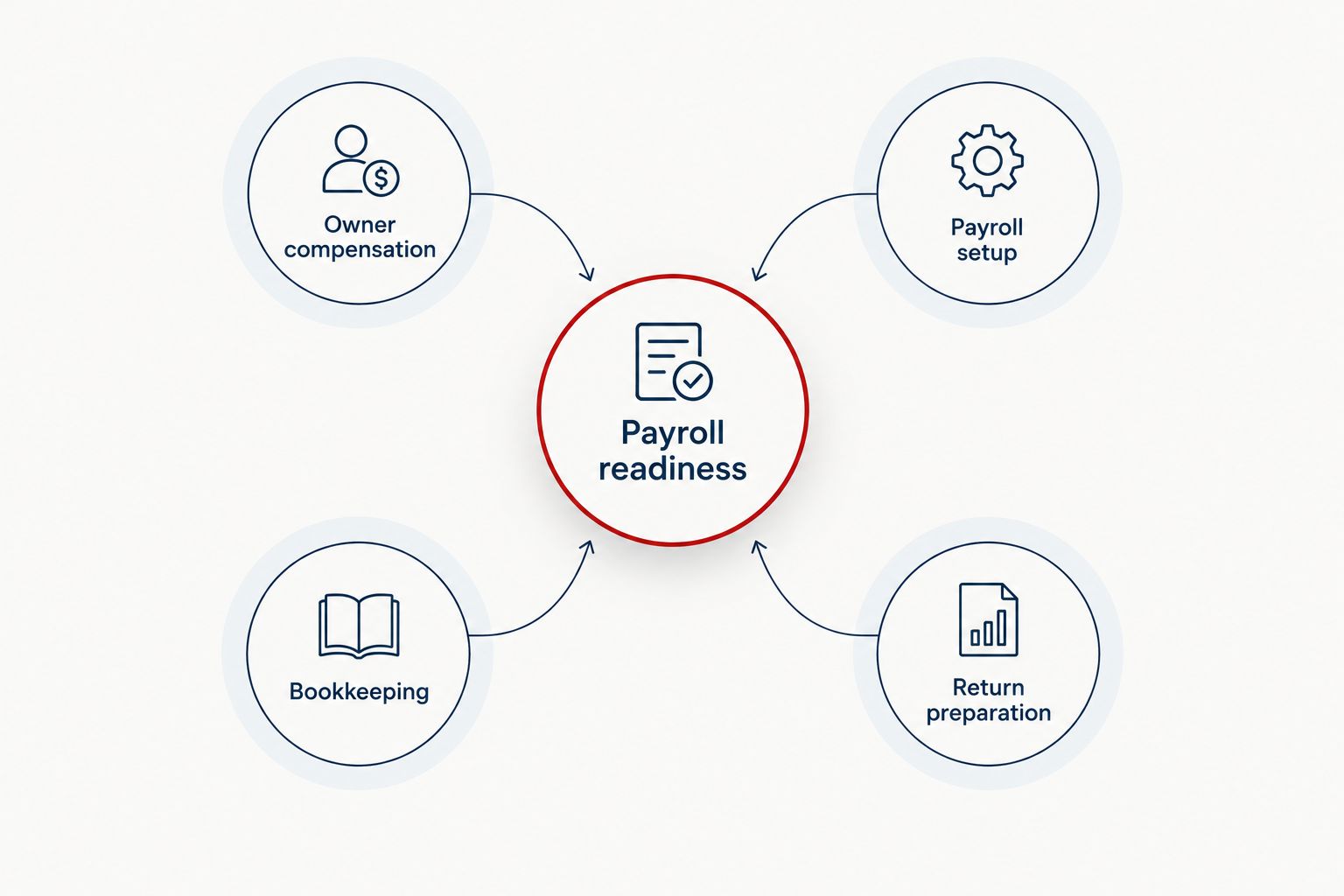
Election acceptance and operating compliance require separate attention.
The Gusto payroll and S corp salary compliance workflow covers the operational connection between payroll and owner compensation. The underlying obligation remains yours regardless of the payroll provider you use.
If you have already paid yourself during the requested effective period, give your adviser the transaction history before making corrections. Moving money between bookkeeping categories alone does not resolve employment-tax reporting.
Why the LLC-to-S-corp timeline varies
The IRS response window does not account for every issue that must be resolved before your business operates correctly under the election. These factors determine the work around the filing:
- Ownership eligibility. S corporations face restrictions on eligible shareholders and ownership structure. Review every owner, including trusts or other entities, rather than checking only the managing member.
- Operating agreement terms. Economic rights can affect the one-class-of-stock requirement. Legal language and actual distribution arrangements deserve review before filing.
- Election completeness. Required signatures, correct entity details, and a clear effective date belong in the initial submission. IRS requests for clarification create additional correspondence.
- Late-election circumstances. A late request requires the relief analysis that an ordinary timely election does not.
- Existing tax classification. An LLC already taxed as a corporation has a different starting position from a disregarded entity or partnership.
- State obligations. Federal S corporation treatment does not settle every state election, tax, registration, or payroll requirement. Check each relevant jurisdiction separately.
For an eligible LLC making a qualifying S election, a separate Form 8832 is generally unnecessary because the election can also establish corporate classification. The IRS rules contain conditions, so confirm the filing route rather than submitting both forms by habit.
Should I wait for IRS approval before setting up payroll?
The 60-day IRS response window is not a payroll holiday. Coordinate payroll with the requested effective date and actual payments for shareholder services, while separately tracking election acceptance.
Do not invent an owner salary from a percentage of profit. Reasonable compensation depends on the work performed and relevant facts; a defensible compensation analysis is different from choosing the smallest possible paycheck.
For an election intended to apply during 2026, establish who owns each task: the election, payroll, books, federal return, and state filings. If different professionals handle those tasks, give them the same effective date and supporting records.
Can my LLC stay an LLC after electing S corporation status?
Yes. Form 2553 generally changes an eligible LLC’s federal tax classification without changing its state-law LLC status. Continue maintaining the LLC’s applicable state filings and legal records.
That distinction matters when communicating with banks, insurers, vendors, and advisers. Calling the business an S corporation for tax purposes does not mean you should automatically replace its legal name or sign contracts under a newly invented entity.
Who should coordinate the transition?
CEOHAVEN is best for entrepreneurs seeking tax planning, tax preparation, and bookkeeping together. Those are the firm’s stated services; payroll administration and legal conversion work should not be assumed to be part of an engagement.
For an S election, define the scope before work begins. Your tax adviser should address election eligibility and reporting, while responsibility for payroll execution, legal documents, and state requirements must be assigned explicitly.
Bring the operating agreement, ownership details, prior returns, current financial statements, owner-payment records, and proposed effective date. A decision supported by clean records is more useful than a form filed against an arbitrary deadline.
Plan Your S Corporation Election
Discuss CEOHAVEN tax planning, tax preparation, and bookkeeping services for your transition.
FAQ
How long does the IRS take to approve an LLC’s S corp election?
The IRS generally notifies you of acceptance or nonacceptance within 60 days after Form 2553 is filed. That response window is not a guarantee, and the election’s effective date is a separate issue.
What is the S corp election deadline for 2026?
For an existing calendar-year LLC requesting a January 1, 2026 effective date, the ordinary deadline is March 16, 2026. New entities, different tax years, and late-election requests require their own deadline analysis.
Do I need to close my LLC and create a corporation?
No, an eligible LLC generally elects S corporation taxation without closing the LLC. A state-law conversion is a separate legal transaction, not the standard requirement for filing Form 2553.
Can I elect S corp status after the deadline?
Late-election relief is available when you meet the applicable IRS requirements. Review reasonable cause, reporting consistency, and required statements before treating a late election as valid.
Do I need both Form 2553 and Form 8832?
An eligible LLC making a qualifying S election generally does not need a separate Form 8832. Confirm the conditions in the IRS instructions against the LLC’s current classification and requested effective date.
Does an S corp election eliminate self-employment taxes on everything I earn?
No, an S corporation election does not make all owner earnings free of employment taxes. A shareholder performing services must receive reasonable compensation, and wages remain subject to applicable payroll taxes.
Can CEOHAVEN help me evaluate an S corporation election?
CEOHAVEN offers tax planning, tax preparation, and bookkeeping for entrepreneurs and other stated client groups. Confirm the engagement scope for election preparation, payroll coordination, and state-specific work before proceeding.
One last thing
The acceptance notice confirms the election; it does not certify your entire tax setup. Keep the notice with your permanent entity records and compare its effective date against payroll records, bookkeeping, and return preparation instructions.
Your final handoff should name the accepted effective date and the person responsible for each outstanding filing. That prevents a quiet administrative gap from becoming a reporting problem after the election itself is complete.