

You can qualify for real estate professional status in your first tax year of qualifying work; there is no required waiting period or minimum number of years owning rentals. For 2026, you must perform more than 750 qualifying hours and spend more than half your total personal-service time in qualifying real property trades or businesses, then separately establish material participation before treating rental losses as nonpassive.
TL;DR
- How long to qualify for real estate professional status depends on annual work, not years of ownership.
- IRS rules require more than 750 qualifying hours and more than half your personal-service time.
- Real estate professional status does not automatically make rental losses deductible against wages.
- CEOHAVEN tax planning is best suited to investors coordinating rental decisions with their broader business finances.
Why this matters
A rental purchase does not create a deduction against your salary by itself. Neither does a real estate license, a substantial renovation, or a large depreciation deduction.
The distinction matters when you plan to use rental losses against W-2 income. Real estate professional status removes the rule that generally treats rental real estate as passive regardless of participation; you still need to establish that your particular rental activity is nonpassive.
Plan the work before counting on the loss. For a high-income household, the relevant question is not simply whether someone owns property. It is whether one taxpayer can satisfy the annual tests and support the treatment claimed on the return.
How long does it take to qualify for real estate professional status?
You can qualify for the first tax year in which you meet both statutory tests. There is no application that starts a qualification clock and no certificate that carries status into future years.
Internal Revenue Code Section 469(c)(7) sets the annual qualification rules. IRS Publication 925 explains the passive activity framework and material participation requirements used to evaluate rental losses.
| Requirement | What you must establish | Timing consequence |
|---|---|---|
| Qualifying hours | More than 750 hours in real property trades or businesses in which you materially participate | Exactly 750 hours is insufficient |
| Majority of work | More than half your personal services across all trades or businesses fall within those qualifying real property businesses | Outside employment affects the calculation |
| Rental participation | Material participation in the rental activity, evaluated separately unless a valid grouping election applies | Professional status alone does not settle loss treatment |
| Annual qualification | Your facts satisfy the rules for the tax year being claimed | Qualification does not automatically renew |
For 2026, evaluate the full tax year rather than the date you crossed an hour threshold. Additional non-real-estate work later in the year can change whether real estate accounts for more than half your personal-service time.
A filing extension gives you more time to file. It does not give a calendar-year taxpayer extra months to perform qualifying work for the completed year.
First-year qualification: More than 750 hours
Your first year can qualify, but ownership time is not work time. Buying a property late in the year does not reduce the annual threshold or give you credit for months when you performed no qualifying services.
Qualifying real property trades or businesses include development, redevelopment, construction, reconstruction, acquisition, conversion, rental, operation, management, leasing, and brokerage. The activity must meet the applicable trade-or-business and participation requirements; the label on a calendar entry is not enough.
Work such as directly managing tenants, arranging repairs, and handling leasing can support the analysis. Investor-level work, such as reviewing financial statements for your own investment oversight, generally does not count unless you are directly involved in day-to-day management or operations.
Keep the distinction clear: hours spent being an owner are not automatically hours spent operating a real property business. Reviewing your portfolio over dinner is not interchangeable with handling a documented tenant issue.
Working another job: More than half your service time
The more-than-half test is often the obstacle for founders, physicians, executives, and other working professionals. Exceeding 750 qualifying hours does not solve it.
Your qualifying real property services must exceed your nonqualifying personal-service hours across your trades or businesses. That includes work in an operating company that has nothing to do with real estate, not just W-2 employment.
A demanding outside role therefore raises the practical real estate workload needed to qualify. Retiring, reducing employment, or changing business responsibilities can alter the calculation, but the test still considers the entire tax year.
Employee services in a real property business generally count toward professional-status qualification only if you own more than 5% of the employer. A job title in real estate is not enough without checking that ownership rule.
For 2026 planning, document both sides of the equation: qualifying real estate services and other business services. A rental-only spreadsheet cannot establish the majority test on its own.
Married investors: One spouse must qualify independently
On a joint return, either spouse can satisfy the real estate professional qualification tests. You cannot combine spouses' hours to reach the more-than-750-hour threshold or satisfy the more-than-half test.
That creates an important distinction for households with one high-earning employee and one spouse managing rentals. The rental-managing spouse's qualification is evaluated using that spouse's own services, not by comparing rental hours with the other spouse's employment hours.
Material participation works differently: a spouse's participation generally counts when determining your participation in an activity. Do not use the spouse rule for material participation to combine hours for professional status. They are separate tests with separate calculations.
Why the qualification timeline varies
Your timeline depends on the work you actually perform, not the size of the property purchase. These factors determine whether first-year qualification is realistic:
- Outside work: Employment and operating-business services affect the more-than-half calculation.
- Start date: Beginning qualifying work later leaves less time to exceed the annual threshold; the threshold is not prorated.
- Management responsibilities: Delegating operations changes which services you personally perform and can document.
- Activity structure: Separate rentals can require separate material participation analyses unless an appropriate election applies.
- Employee ownership: The more-than-5% ownership rule affects whether employee services count toward professional status.
- Evidence quality: Detailed records support qualifying services; unsupported estimates do not turn personal time into business work.
None of these factors creates a shortcut. They determine whether the work pattern supports the tax position.
How to build a qualification file before filing
Start with a work record, not a target deduction. A useful qualification file connects your time, your activities, and your return treatment.
- Track services. Record the date, property or business, task, and time spent. Separate direct operational work from investment review and personal errands.
- Record outside work. Maintain a defensible record of employment and other business services so the majority test includes the full picture.
- Test qualification. Confirm that the qualifying hours exceed 750 and represent more than half your personal-service time.
- Test participation. Evaluate material participation for each rental activity and review whether a grouping election is appropriate.
- Review limitations. Apply other relevant loss restrictions before assuming a nonpassive loss offsets other income.
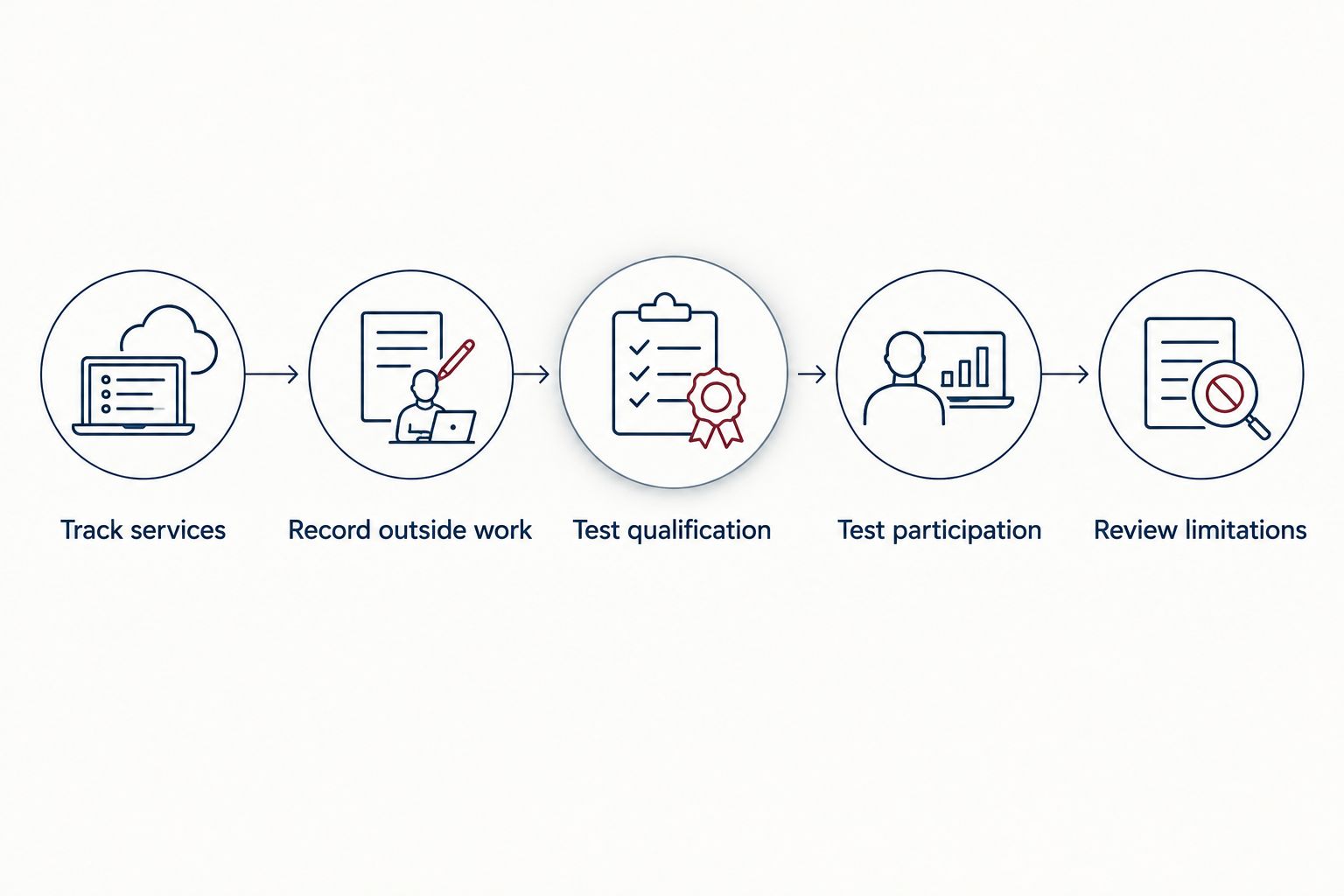
Qualification and rental participation require separate checks before a loss reaches the return.
The IRS permits proof of participation through reasonable means; a contemporaneous daily time report is not an absolute requirement under the participation regulations. Still, timely records supported by calendars, emails, invoices, and work orders give you a clearer basis than a year-end reconstruction.
Use CEOHAVEN tax planning, tax preparation, and bookkeeping together when the question extends beyond a single property. The advantage is evaluating the rental decision alongside your business finances; the limit is that advisory work cannot replace qualifying services or supporting evidence.
Material participation is a second gate
For 2026, exceeding 750 hours does not automatically establish material participation in every rental. Professional status is a taxpayer-level qualification; participation is an activity-level analysis.
One material participation test requires more than 500 hours in an activity during the year. Another requires more than 100 hours and participation at least equal to that of any other individual, including someone who does not own the activity. Other tests also exist, so failing one test does not settle the analysis.
That distinction matters when you hire a property manager. A manager does not automatically prevent qualification, but another person's work can affect which material participation test you satisfy.
Short-term rentals require a separate classification analysis. Under the passive activity regulations, an activity with an average customer-use period of 7 days or less generally falls outside the rental-activity definition; short-term rental material participation thresholds then address participation, not whether you qualify as a real estate professional.
Do not apply a short-term rental strategy to a conventional rental without checking the activity's classification. Average stay length and services provided matter; a booking-platform label does not determine federal tax treatment.
Grouping rentals changes the participation analysis
A qualifying real estate professional can elect to treat all interests in rental real estate as one activity for material participation purposes. Without that election, rental interests generally require separate analysis.
Combining activities can help an owner whose operational work is spread across several rentals. The trade-off is that grouping also affects how the activities are treated when properties are disposed of, including the treatment of suspended passive losses.
The election does not create hours, erase outside employment, or automatically release losses carried over from passive years. It is generally binding for future qualifying years, subject to applicable rules for revocation and changed circumstances.
Review the election before filing, rather than treating it as a box to check after buying another property. Portfolio decisions and return elections need to tell the same story.
Can I qualify if I start halfway through the year?
More than 750 qualifying hours are still required if you start halfway through the year. The more-than-half test also includes your other personal services for that full tax year.
Leaving a non-real-estate job midyear does not erase the services performed before departure. Evaluate the completed year, not just the months after your career change.
Does real estate professional status carry into the next year?
More than 750 qualifying hours must be established again for each year you claim the status. The majority-of-services test also applies annually.
A taxpayer who qualifies in 2026 does not receive permanent status. Returning to a demanding outside role or delegating rental operations can change the following year's result.
Does qualifying automatically release old rental losses?
No. Becoming a real estate professional does not automatically make previously suspended passive losses deductible against wages.
Prior-year losses remain subject to the rules governing former passive activities and other applicable limitations. Separate the current-year loss calculation from the treatment of existing carryforwards before estimating the tax effect.
FAQ
How long to qualify for real estate professional status if I just bought my first rental?
You can qualify in your first tax year, but buying a rental does not itself qualify you. You must exceed 750 qualifying hours, satisfy the more-than-half personal-services test, and separately establish material participation for nonpassive rental treatment.
Do exactly 750 hours qualify me as a real estate professional?
No. The statutory threshold is more than 750 qualifying hours during the tax year, not exactly 750 hours. You must also satisfy the more-than-half test.
Can I qualify while working full time outside real estate?
Outside employment does not automatically disqualify you, but qualifying real estate services must exceed half your total personal-service time. Exceeding 750 hours alone is insufficient.
Can my spouse and I combine our hours to qualify?
No. One spouse must independently meet both real estate professional qualification tests. Spousal participation generally counts for material participation, which is a separate analysis.
Do I need a real estate license to qualify?
No. Federal real estate professional status depends on qualifying services and participation, not a real estate license. A license also does not establish qualification by itself.
Does hiring a property manager disqualify me?
No. Hiring a property manager does not automatically disqualify you, but you still need sufficient qualifying personal services and material participation. The manager's participation can affect which material participation test you meet.
Can a filing extension give me extra time to earn qualifying hours?
No. A filing extension extends the filing deadline, not the tax year in which qualifying services must occur. Hours worked after year-end generally belong to the following tax year.
One last thing
Depreciation creates a deduction; participation determines whether passive-loss rules restrict its current use. A cost segregation study cannot supply missing work hours or fix a failed majority test.
For your 2026 return, settle qualification and participation before treating projected depreciation as an offset to salary or business income. That sequence keeps the tax plan tied to work you can substantiate.