

An IRS tax audit has no single completion deadline or reliable universal average you can apply to your case in 2026. Its length depends on the issues examined, the records available, scheduling, and whether you agree with the findings. The examination itself is also separate from any appeal, Tax Court proceeding, or payment arrangement that follows.
TL;DR
- How long does an IRS audit take? The IRS bases duration on scope, records, scheduling, and disputed findings.
- A document request deadline is not an audit completion date; follow the instructions in your notice.
- CEOHAVEN provides tax planning, tax preparation, and bookkeeping—not a promised IRS audit turnaround.
- The usual 3-year assessment period is not a promise that an examination will take 3 years.
Why this matters
An audit interrupts more than your tax calendar. For a founder, creator, or property investor, it requires access to the records behind income, deductions, payroll, and asset transactions—sometimes while you are still running the business.
Your first priority is a complete, traceable response, not a guessed closing date. Start with your notice and the records it requests. The QuickBooks to audit-ready books workflow provides a related framework for organizing the bookkeeping behind a return.
How long does an IRS tax audit take?
The IRS explains in its public IRS Audits guidance that examination length varies with the audit type, issue complexity, available information, meeting availability, and agreement with the results. That guidance does not establish a universal completion time. For a 2026 examination, use the notice and the examiner's communications to track your actual case.
| Examination format | What happens | What affects the timeline | Practical advantage | Practical limitation |
|---|---|---|---|---|
| Correspondence audit | You exchange requested records and explanations by mail or an authorized submission method | Document completeness, processing, and follow-up questions | A focused issue can be addressed through documents | An unclear submission can require another exchange |
| Office audit | You attend an IRS office appointment to discuss the return and supporting records | Appointment scheduling, scope, and unresolved items | You can explain records during the appointment | The appointment does not guarantee immediate closure |
| Field audit | An examiner conducts the examination at a business, home, or representative's office | Business complexity, record access, interviews, and additional requests | The examiner can review connected business records directly | Broader factual questions require more coordination |
These are examination formats, not service tiers you choose for speed. Do not treat a mail audit as automatically brief or an in-person audit as automatically prolonged. The substance of the questions matters more than the label.
Correspondence audit: follow the document trail
A correspondence audit asks you to substantiate specific return items through written records. Read the entire notice before sending anything; its instructions identify the issues, response method, and deadline.
Organize the response around each question rather than sending an unexplained collection of files. A bank statement establishes that money moved, but it does not necessarily establish why an expense was deductible.
Keep a copy of the submission and evidence of delivery. Sending records is a completed action on your side, not confirmation that the IRS has accepted them or closed the examination.
Office audit: prepare beyond the appointment
An office audit involves a scheduled meeting with an IRS examiner. Bring the requested records and a clear explanation connecting them to the return under examination.
Treat the meeting as an examination step, not a closing event. If an issue remains unresolved, identify exactly what additional evidence is requested and when it is due before you leave.
Field audit: coordinate the records and people
A field audit can involve business operations, accounting records, and explanations from people who understand the transactions. Assign responsibility for retrieving records and answering questions so that separate responses do not conflict.
For an owner with entities, rental properties, or payroll, distinguish each taxpayer and tax period carefully. A transaction that appears in multiple records still needs a consistent explanation of its treatment on the examined return.
Why IRS audit timelines vary
The IRS identifies several factors that determine examination length. These are the practical drivers to watch in 2026:
- Examination type. A written exchange and an examination involving appointments have different coordination requirements.
- Issue complexity. A question about a single deduction differs from a review involving connected business transactions.
- Information availability. Missing invoices, incomplete ledgers, or inaccessible records leave questions unanswered.
- Meeting availability. Scheduling depends on the taxpayer, representative, and examiner when meetings are required.
- Agreement with findings. Accepting an examination result and disputing an adjustment lead to different next steps.
Some of these factors are within your control; others are not. You can improve the completeness of your response, but you cannot set the examiner's workload or guarantee when the IRS will finish reviewing it.
Ask for the next specific action and deadline rather than an unsupported finish date. That gives you something useful to manage.
What should you do after receiving an audit notice?
Use a controlled response process. The goal is to answer the actual examination questions accurately while preserving your records and procedural rights.
- Read the notice. Identify the taxpayer, tax period, issues, response deadline, and contact instructions. Do not assume that every IRS letter is an audit notice.
- Map the requests. Create a list connecting each requested item to the relevant return entry. Separate questions about amounts from questions about tax treatment.
- Reconcile the records. Check the return against the ledger and supporting documents. Explain differences rather than submitting conflicting totals without context.
- Submit the response. Use the method the notice authorizes, retain copies, and keep delivery confirmation. If you need more time, request it before the deadline and obtain confirmation.
- Track the outcome. Record follow-up requests, submissions, proposed adjustments, and response dates. Read the closing documents before treating the examination as resolved.
A response log should distinguish what you sent from what the examiner accepted. Those are different milestones, and confusing them makes follow-up harder.
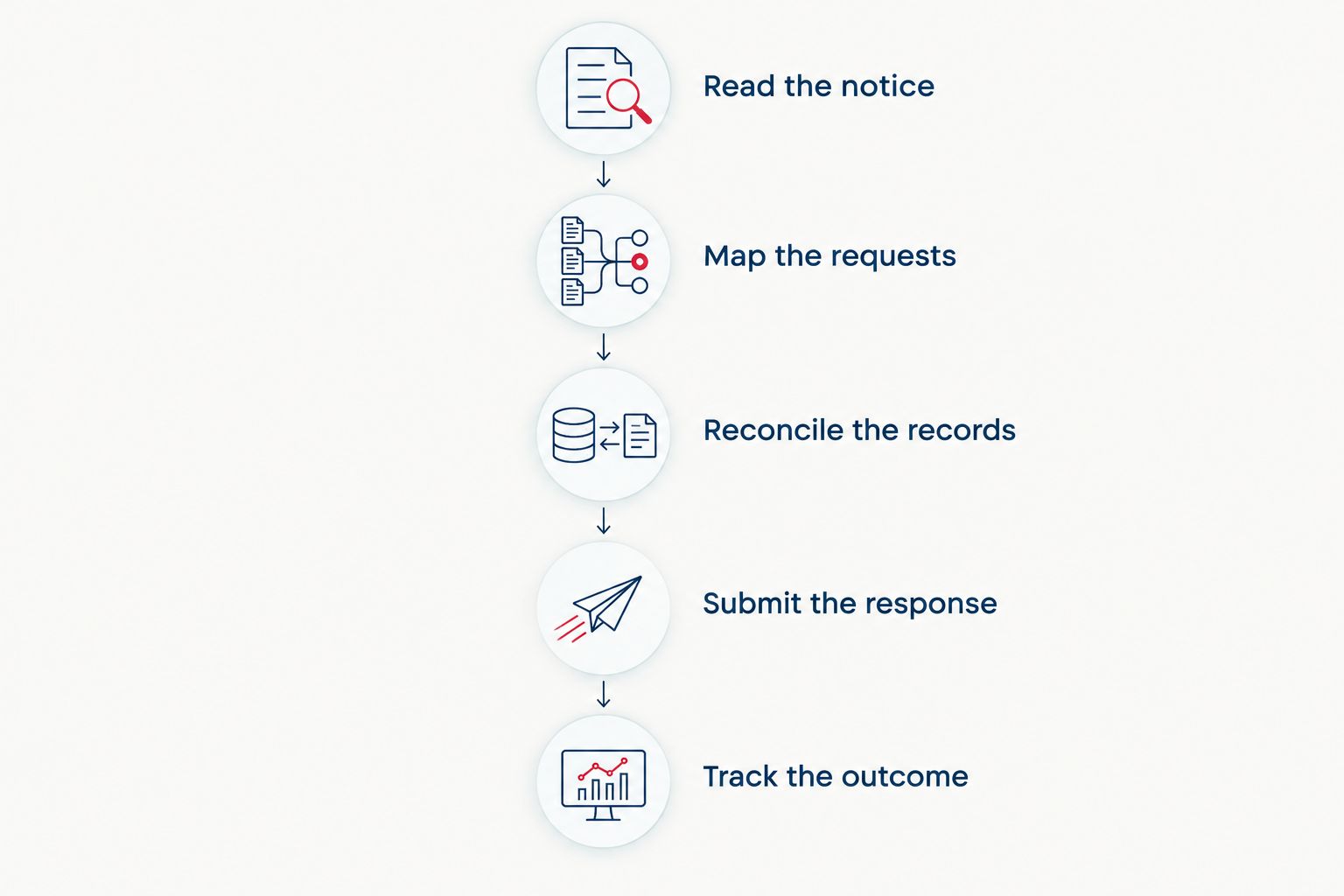
A submitted response is a milestone, not proof that the examination is closed.
How far back can the IRS audit your returns?
The IRS generally can include returns filed within the last 3 years in an audit. Its public audit guidance also explains that a substantial error can lead it to examine additional years, usually without going back more than 6 years.
That lookback guidance is different from the legal deadline for assessing additional tax. The general assessment period is 3 years, subject to exceptions and rules about when the period starts.
Under Internal Revenue Code Section 6501, omitting more than 25% of gross income can trigger a 6-year assessment period, subject to statutory details and exceptions. Fraudulent returns and failure to file can leave assessment open without the ordinary time limit.
These are legal time windows, not audit-duration estimates. A notice received in 2026 does not mean that every relevant period starts in 2026, and the date printed on a notice does not replace the filing history needed to calculate a deadline.
If the IRS requests an extension of the assessment period, review the request with a qualified tax professional. Signing extends the agreed assessment window; declining does not automatically make the examination disappear.
Does an IRS audit end when you send the documents?
Sending documents does not end an IRS audit. The examiner must review the response and determine whether the evidence supports the return or requires further questions or adjustments.
The IRS describes examination outcomes as no change, agreed changes, or disagreed changes. A no-change result means the examination substantiated the reported items; agreed changes mean you accept the proposed adjustments.
Disagreed changes require attention to the procedures and deadlines in the documents you receive. Keep the examination result, any agreement, and related correspondence together rather than relying on a verbal update alone.
What happens if you disagree with the audit findings?
Disagreeing with an adjustment can add a separate dispute process after the examination work. Depending on the case and procedural stage, options include discussing the issue with the examiner's manager or seeking review by the IRS Independent Office of Appeals.
For many federal income tax deficiency cases, a statutory notice of deficiency generally gives you 90 days to petition the U.S. Tax Court. Certain notices addressed outside the United States have a different statutory period, so use the applicable rules and the deadline on the notice.
A request for further IRS review does not extend the Tax Court petition deadline. In a 2026 dispute, track that deadline separately from conversations about additional documents, reconsideration, or settlement.
An examination timeline, an appeal timeline, and a court filing deadline are not interchangeable. Have a qualified representative identify which stage you are in before choosing the next action.
When should you bring in professional help?
Bring in a qualified tax professional when you cannot reconcile the requested records, do not understand a proposed adjustment, or face a procedural deadline you cannot confidently interpret. Ask specifically about examination representation and the credentials required for the work; preparing returns and representing taxpayers are distinct responsibilities.
For preparation and ongoing financial records, CEOHAVEN is best for entrepreneurs, real estate investors, content creators, and high-income professionals seeking tax planning, tax preparation, and bookkeeping. Those are the firm's stated services, not a promise of audit representation or faster IRS closure.
You can review CEOHAVEN for those services. Confirm any audit-specific engagement separately, including who will communicate with the IRS and which responsibilities remain yours.
Good support begins with a defined scope. Before engaging anyone, ask who will assemble the records, assess the tax position, approve responses, and monitor deadlines.
FAQ
How long does an IRS audit take in 2026?
An IRS audit has no universal completion time in 2026. The IRS identifies examination type, complexity, information availability, scheduling, and agreement with findings as factors that determine duration.
Is a mail audit faster than an in-person IRS audit?
A mail audit is not guaranteed to finish faster than an in-person audit. A focused written request avoids an appointment, but incomplete records and follow-up exchanges still affect the timeline.
Can the IRS audit me after 3 years?
The IRS can examine and assess some returns beyond the general 3-year period because exceptions apply. Substantial income omissions, fraud, failure to file, and agreed extensions require separate analysis.
Will sending all my receipts close the audit?
Sending receipts does not automatically close an IRS audit. The examiner must determine whether the records substantiate the specific return items under review.
Can I get more time to answer an IRS audit letter?
Request additional time through the contact method in your notice before the response deadline. Obtain confirmation rather than assuming your request has been granted, and distinguish a document deadline from a statutory court deadline.
Does CEOHAVEN promise to finish an IRS audit quickly?
CEOHAVEN's stated services are tax planning, tax preparation, and bookkeeping, not a guaranteed IRS audit turnaround. Confirm the scope of any audit-related assistance separately before engaging the firm.
One last thing
The most useful audit file contains explanations, not just receipts. An invoice shows what you bought; the supporting explanation connects that purchase to the deduction, business purpose, or asset treatment reported on your return.
For your 2026 records, build that connection while the facts are accessible. Keep the source document, accounting entry, and relevant explanation together, and preserve the original records when correcting bookkeeping errors.
Do not create documents that pretend to have existed earlier. A clearly identified reconstruction is different from a contemporaneous record, and your response should preserve that distinction.