

Yes—if your corporation reimburses you as an employee for qualifying home office expenses, use an accountable plan so properly substantiated payments stay out of taxable wages. For 2026, the arrangement must establish a business connection, require timely expense substantiation, and require you to return excess advances; a sole proprietor generally claims eligible expenses directly instead.
TL;DR
- Accountable plan home office reimbursements let corporations repay qualifying employee expenses without treating properly documented payments as wages.
- S-corp owners need expense substantiation, a defensible business-use calculation, and a process for returning excess advances.
- A sole proprietor generally deducts eligible home office expenses directly rather than reimbursing themselves as an employee.
- CEOHAVEN offers tax planning, tax preparation, and bookkeeping for entrepreneurs managing these connected obligations.
Do you need an accountable plan for home office reimbursements?
Use an accountable plan when your corporation repays qualifying home office expenses you incur as its employee. The tax result depends on how the arrangement operates, not whether a bank transfer says reimbursement.
For an owner on payroll, reimbursement procedures belong alongside S-corp salary compliance. Reimbursements repay business expenses; they do not replace reasonable compensation for services.
Treasury Regulation Section 1.62-2 sets the federal accountable-plan requirements. Apply them through this sequence:
- Confirm eligibility. Identify your federal tax classification, employee relationship, and qualifying business use of the home.
- Document expenses. Keep bills, proof of payment, the expense period, and records supporting the business purpose.
- Calculate allocation. Separate eligible business expenses from personal expenses using a defensible method.
- Approve reimbursement. Submit an expense report and preserve the corporation's approval and payment record.
- Return excess. Repay advances that exceed substantiated expenses within the required reasonable period.
The regulation generally does not require a written plan document. Put the policy in writing anyway: it gives the owner, bookkeeper, and payroll provider the same instructions and makes inconsistent treatment easier to catch.
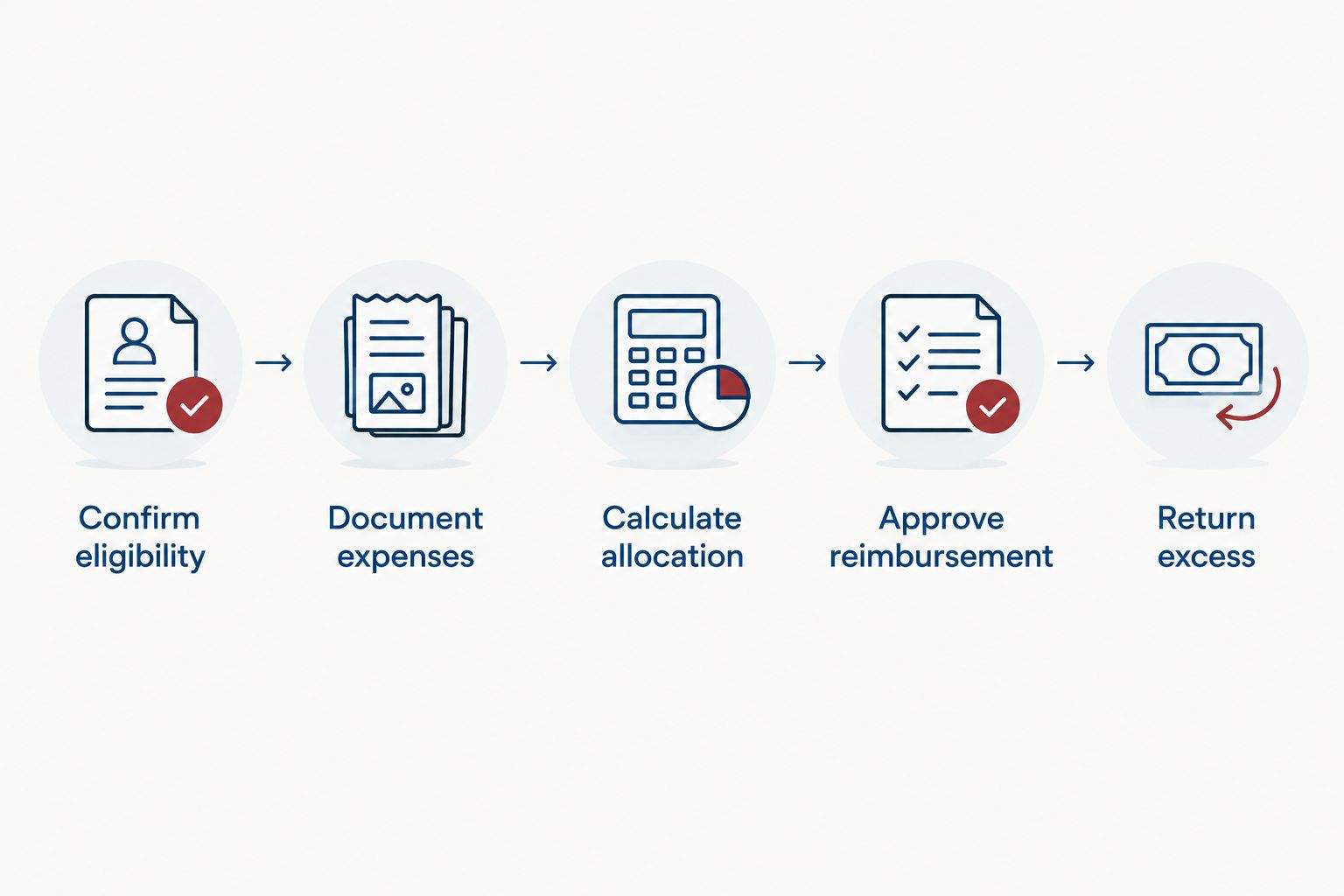
The reimbursement follows the documentation, not the other way around.
Why this matters
A founder's personal payment of a business expense creates two separate questions: does the expense qualify, and how should the business repay it? An accountable plan addresses the repayment. It does not make a personal expense deductible.
For your 2026 books, keep salary, shareholder distributions, loans, and expense reimbursements distinct. A distribution entry does not establish substantiation, and a receipt does not establish that a room qualifies as a home office. You need both the underlying tax eligibility and the correct accounting treatment.
S-corporation owner-employees: reimburse through the corporation
Best for: an S-corporation shareholder who works as an employee and personally pays qualifying business expenses. A properly administered accountable plan provides a route for the corporation to reimburse those expenses without including the qualifying payments in the employee's wages.
The benefit is clean separation: the corporation records the qualifying expense, while the employee receives repayment rather than additional compensation. The limitation is administrative discipline. Ownership does not excuse missing expense reports, unsupported allocations, or retained excess advances.
Do not deduct the same expense personally after the corporation reimburses it. Also, do not reduce an agreed salary and relabel the replacement payment as reimbursement; Treasury Regulation Section 1.62-2 prohibits arrangements that recharacterize wages as expense payments.
An accountable plan is not an S-corporation-only provision. A C corporation can also use one for qualifying employee expenses under the same federal framework.
Sole proprietors: claim eligible expenses directly
Best for: a sole proprietor, including an individual owner of a disregarded single-member LLC. You generally claim eligible home office expenses through your business tax reporting rather than running employee reimbursements to yourself.
The advantage is avoiding an unnecessary owner-employee reimbursement structure. The limitation remains substantial: your home office must qualify, and your deduction must follow the applicable rules and limits.
An LLC label alone does not answer the question. If the LLC elected corporate tax treatment, analyze the corporate route instead. For 2026 planning, confirm the federal tax classification before drafting a reimbursement policy.
Partners: review the partnership agreement first
Best for: a partner whose partnership needs a documented process for repaying business expenses. Partners generally are not employees of their partnership for federal tax purposes, so do not copy an S-corporation owner-employee policy without adapting it.
Partnership reimbursement provisions can establish who bears expenses and how repayment works. The trade-off is that the agreement matters: a partner's deduction for unreimbursed partnership expenses generally depends on being required to pay those expenses under the partnership agreement.
Resolve the agreement, reimbursement obligation, and reporting treatment together. Paying personally does not, by itself, establish a deduction.
| Tax treatment | Best for | Main advantage | Main limitation |
|---|---|---|---|
| Corporate accountable plan | Employees, including qualifying owner-employees | Qualifying reimbursements stay outside wages | Requires substantiation and return of excess advances |
| Direct business deduction | Sole proprietors and disregarded individual-owned LLCs | No owner-employee reimbursement structure | Home office eligibility and deduction limits still apply |
| Partnership reimbursement arrangement | Partners incurring partnership expenses | Defines repayment responsibilities | Partnership agreement and partner tax rules control |
What makes the home office eligible?
An accountable plan cannot repair a nonqualifying workspace. Internal Revenue Code Section 280A and IRS Publication 587 provide the underlying home office framework.
For the usual home office claim, you must use the relevant area regularly and exclusively for qualifying business purposes. A dining table used for both family meals and administrative work generally fails the exclusive-use requirement. Special rules exist for certain storage and daycare uses; they are not a general exception for mixed-use rooms.
A principal place of business can include a home office used for administrative or management activities when you have no other fixed location where you conduct substantial activities of that kind. Having clients elsewhere does not automatically disqualify a home office.
For an employee, business use must also satisfy the employer-convenience requirement. Choosing to work at home for personal convenience is not the same as establishing that the workspace serves the employer's business needs.
Keep a short eligibility memo with your 2026 records. Describe the work performed, the space used, whether anyone uses it personally, and the business reason for maintaining it at home.
Why home office reimbursements vary
Your reimbursement follows eligible expenses and documented business use—not a preferred monthly transfer. These factors determine the calculation:
- Tax classification. A corporate employee, sole proprietor, and partner follow different reporting routes.
- Workspace eligibility. Regular use, exclusive use, and the applicable business-purpose tests come before allocation.
- Direct versus shared expenses. An expense solely for the qualifying office differs from an expense benefiting the entire home.
- Allocation method. Measurements and a reasonable calculation must support the business share of shared expenses.
- Expense category. Housing costs, utilities, repairs, and communication expenses do not all receive identical treatment.
- Changes in use. Moving, changing the office area, or beginning personal use requires you to reassess the calculation.
Do not apply one percentage blindly to every bill. Internet and telephone expenses require their own business-use analysis, and mortgage principal is not a deductible home office expense.
What should your expense report contain?
Your reimbursement file should let another person understand the calculation without reconstructing it from bank statements. Keep the policy, eligibility memo, and recurring allocation method together; attach each period's supporting documents to its expense report.
Include:
- The employee's name and the period covered.
- Each expense's date, category, amount, and business purpose.
- The underlying bill and evidence of payment.
- Office and home measurements supporting any area-based allocation.
- The calculation separating business and personal amounts.
- Approval, payment, and any excess-advance repayment records.
For an owned home, have your tax adviser distinguish reimbursable expenses from basis, depreciation, and sale-related consequences. Do not treat every item appearing on a mortgage statement as an eligible operating expense.
CEOHAVEN is best for founders who want tax planning, tax preparation, and bookkeeping coordinated around business decisions. Those services do not replace your responsibility to preserve expense evidence and establish qualifying use. Discuss the reimbursement process with CEOHAVEN before unsupported transfers accumulate.
How quickly must you substantiate expenses?
Treasury Regulation Section 1.62-2 provides reasonable-period safe harbors, including substantiating expenses within 60 days after payment or incurrence. Its fixed-date framework also includes advances made within 30 days before the expense and returning excess advances within 120 days after payment or incurrence.
These are safe harbors, not a declaration that every arrangement outside those windows automatically fails. Other facts-and-circumstances rules and a periodic-statement method exist. A recurring reporting schedule is easier to administer than relying on an exception after records go missing.
For 2026 administration, set a regular submission and review date. If an advance exceeds supported expenses, reconcile it and return the excess; do not quietly carry the difference as a permanent owner payment.
Can you use a flat monthly home office allowance?
A flat allowance without expense substantiation is not an accountable-plan reimbursement. The name on the payment does not change that result.
You can use an advance process, but you still need qualifying expenses, timely substantiation, and repayment of excess amounts. A recurring transfer becomes defensible through reconciliation—not repetition.
Likewise, the simplified home office deduction is a separate tax-return method, not a substitute for documenting an employee reimbursement. Do not assume its formula authorizes a corporation to pay an unsupported tax-free allowance.
What happens if the reimbursement does not qualify?
Nonaccountable-plan payments generally belong in wages for an employee. Payroll tax and reporting obligations then apply rather than the exclusion available for qualifying accountable-plan reimbursements.
If only an excess amount remains unreturned under an otherwise qualifying arrangement, the treatment can differ from an arrangement that fails the underlying business-connection or substantiation requirements. Have the accountant determine the scope of the failure before changing entries.
Do not solve a documentation problem by backdating reports or inventing receipts. Reconstruct legitimate records where possible, identify unsupported amounts, and correct the accounting and payroll treatment.
FAQ
Do I need a written accountable plan for home office reimbursements?
Federal accountable-plan rules generally do not require a written document, but a written policy makes the process clearer. The arrangement must actually satisfy business connection, substantiation, and return-of-excess requirements.
Can my S corporation reimburse my home office expenses?
An S corporation can reimburse qualifying home office expenses incurred by its employee under an accountable plan. The workspace must qualify, and the employee must substantiate the expenses and return excess advances.
Can I reimburse myself if I have a single-member LLC?
A single-member LLC disregarded for federal income tax purposes generally follows the sole-proprietor deduction route for its individual owner. An LLC taxed as a corporation requires a different analysis.
How long do I have to submit home office expenses?
Substantiation within 60 days after payment or incurrence falls within a federal reasonable-period safe harbor. Other permitted timing methods exist, so establish the policy before relying on a different schedule.
Can I deduct an expense after my company reimburses it?
You cannot claim a second personal deduction for the same expense your company reimbursed. Keep the reimbursement and tax-return treatment coordinated to prevent duplicate deductions.
Does a guest bedroom count as a home office?
A room used by guests generally fails the exclusive-business-use requirement for the usual home office claim. A separately identifiable area used only for qualifying business activity requires its own factual analysis.
Can CEOHAVEN help connect reimbursements with bookkeeping?
CEOHAVEN offers bookkeeping, tax planning, and tax preparation for entrepreneurs. Discuss how expense reports, reimbursement entries, and payroll treatment should fit your business's tax classification.
One last thing
A reimbursement policy is not a home office lease. Renting part of your home to your employer introduces separate tax rules, including restrictions under Section 280A(c)(6); it is not a shortcut around accountable-plan documentation.
Before your next 2026 reimbursement, verify the workspace, support the expense, and record the payment correctly. The paperwork should explain the transfer—not follow it months later as an attempted justification.
This article provides general federal tax information, not advice for your individual circumstances. State treatment and your specific facts require separate review.