

You should use an Augusta rule rental invoice to document a business renting your home, but federal law does not prescribe a special invoice form. In 2026, the invoice supports the transaction; it does not establish the business deduction or replace the requirement that a qualifying residence be rented for fewer than 15 days during the tax year.
TL;DR
- Use an Augusta rule rental invoice alongside an agreement, business-purpose records, rate support, and payment evidence.
- Internal Revenue Code Section 280A(g) requires a qualifying residence to be rented for fewer than 15 days.
- An invoice documents the charge; it does not prove that the business expense qualifies for a deduction.
- CEOHAVEN offers tax planning and bookkeeping for entrepreneurs who need the rental transaction reviewed alongside their business records.
Why this matters
The homeowner's income exclusion and the business's deduction are separate tax questions. A payment can satisfy the homeowner's short-term rental exclusion without automatically becoming a deductible expense for the business paying it.
For your 2026 records, connect the rental agreement, meeting evidence, invoice, and payment rather than treating each as an isolated document. The QuickBooks-to-audit-ready-books workflow addresses the broader task of connecting supporting records to bookkeeping entries.
The federal framework comes from Internal Revenue Code Section 280A(g), covering qualifying short-term residential rentals, and Section 162, governing ordinary and necessary business expenses. Neither provision turns an invoice into permission to deduct a personal gathering.
Do you need a rental invoice for the Augusta rule?
Use an invoice, but do not confuse recommended documentation with a specifically mandated federal form. Section 280A(g) does not require an Augusta-rule-branded invoice. General recordkeeping obligations still apply, including the need to substantiate a business deduction under Section 6001 and its regulations.
The invoice should fit into a connected file:
| Record | What it supports | What it does not establish alone |
|---|---|---|
| Rental agreement | Parties, property, rental dates, and agreed terms | That the meeting occurred or served a business purpose |
| Rental invoice | The homeowner's charge to the business | That the charge was reasonable or paid |
| Meeting records | Attendees, agenda, and business activity | That the rental amount was reasonable |
| Comparable venue evidence | Support for the amount charged | That the business actually used the property |
| Payment record | Transfer of money between the parties | That the expense qualifies for a deduction |
| Annual rental calendar | Total rental days for the residence | That every other eligibility condition is satisfied |
Each record answers a different question. A polished invoice with no agreement, no meeting evidence, and no payment trail leaves the central tax issues unresolved.
What makes the residence eligible?
Section 280A(g) applies to a dwelling unit used as a residence and actually rented for fewer than 15 days during the tax year. The residence requirement has its own rules under Section 280A(d); ownership alone does not establish eligibility.
The familiar shorthand is a maximum of 14 rental days per tax year. Count rentals to every renter, not just your own business, when evaluating the residence's annual rental activity.
What must the business establish separately?
The business needs an ordinary and necessary business reason for the rental and support for the amount deducted. Document why the space served the business event, what happened there, and how you determined the charge.
Related-party transactions deserve particular care because you control both sides. An invoice cannot turn personal use into business use, and an entity's existence does not make every payment to its owner deductible.
What should an Augusta rule rental invoice include?
Your 2026 invoice should describe the actual rental clearly enough that someone outside the transaction can follow it. Use the homeowner as the landlord and the correct business entity as the customer, consistent with the agreement and tax treatment.
Include these fields:
- Invoice reference: A unique identifier that connects the invoice to the bookkeeping entry.
- Issue date: The actual date you prepare the invoice.
- Landlord details: The name and address of the party renting out the residence.
- Business details: The legal name and billing address of the renting business.
- Property address: The location where the business event occurred.
- Rental dates: Each date covered by the charge, matching the rental calendar.
- Rental description: The space provided and the business event it supported.
- Charge calculation: The agreed rental basis and resulting amount, matching the agreement.
- Payment terms: When and how payment is due under the agreement.
- Supporting references: The rental agreement and relevant meeting records.
You do not need elaborate invoice software to capture these facts. Accuracy and consistency matter more than presentation. Keep the invoice with the underlying evidence, not as a substitute for it.
Should the invoice describe the meeting?
Yes. Describe the event specifically enough to distinguish it from a personal gathering, such as a management planning meeting or documented business training session, when that description is true.
Keep detailed agendas, attendees, and notes in the supporting file. An invoice labeled only as consulting or miscellaneous services obscures the fact that the transaction was a property rental.
Should you write tax-free on the invoice?
Do not use a tax-free label as a substitute for a tax analysis. The homeowner's federal income treatment depends on the residence's actual use and total rental days, not a statement printed on the bill.
Likewise, avoid language promising that the business receives an automatic deduction. The invoice records a charge, not a tax conclusion.
How do you document the rental from start to finish?
Build the file as the transaction happens. A reconstructed file prepared during tax-return season has less contemporaneous evidence than records created around the actual event.
- Confirm eligibility. Review the residence requirement, ownership, business structure, and all rental activity for the tax year.
- Document the purpose. Identify the business event, expected attendees, agenda, and reason for using the property.
- Support the rate. Retain relevant venue comparisons and explain differences in space, use, and included facilities.
- Agree the terms. Prepare a rental agreement identifying the parties, dates, space, and payment obligations before use.
- Record the event. Keep actual attendance, meeting notes, and evidence of the business work performed.
- Invoice and reconcile. Issue the invoice, retain payment evidence, and match the transaction to the business books.
These steps separate eligibility from execution. Completing the paperwork does not repair an event that was personal or a charge that lacks support.
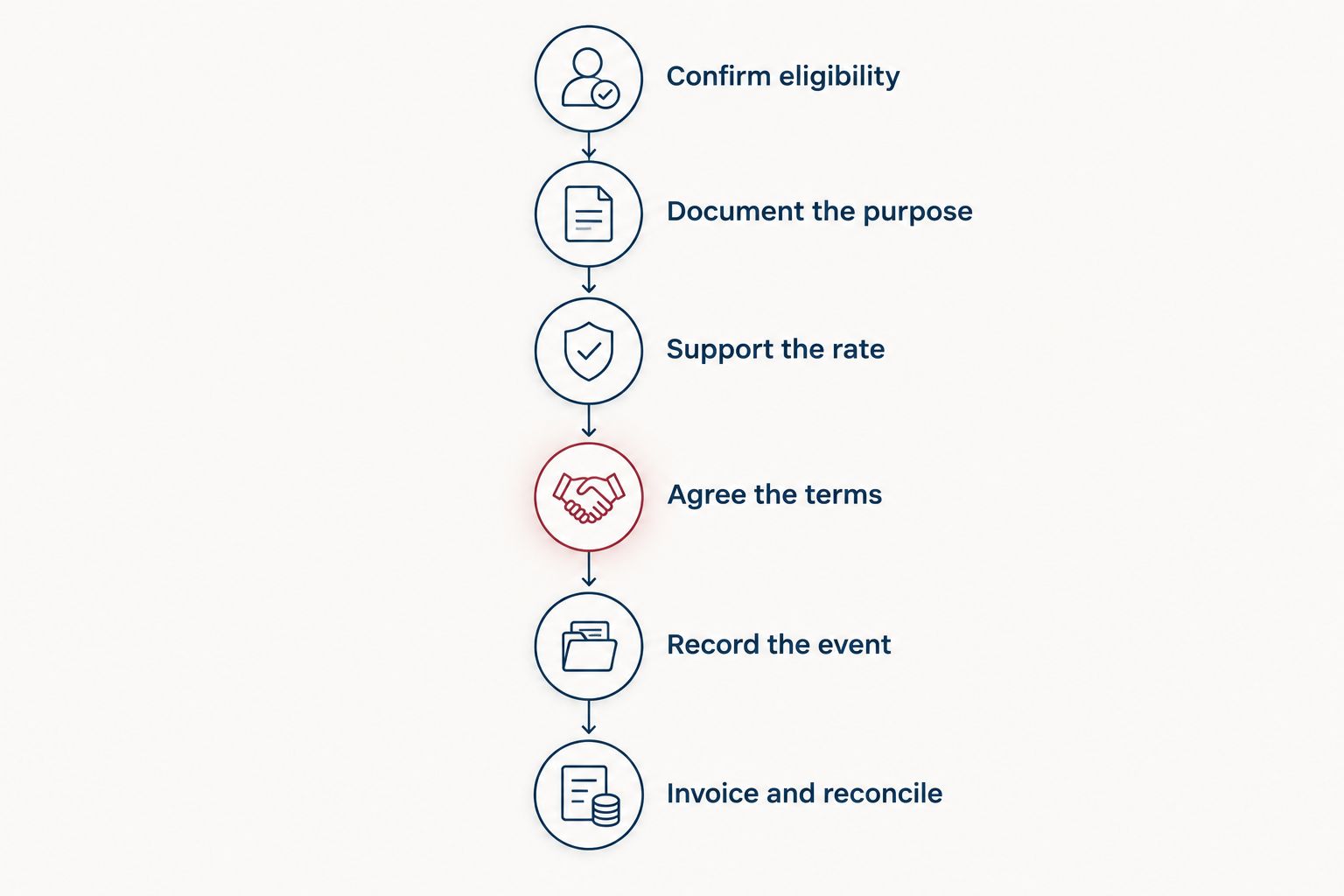
Confirm the tax treatment before documenting and paying the rental charge.
For 2026 planning, assign responsibility for maintaining the annual rental calendar as well as the business file. Your company bookkeeper does not necessarily see rentals arranged personally through another channel.
Why Augusta rule documentation varies
The core evidence stays consistent, but the transaction determines how much supporting detail you need. Focus on these factors:
- Business structure: A corporation renting from its shareholder presents a different arrangement from a sole proprietor attempting to rent personally owned property to themselves.
- Property use: The dwelling must meet the residence requirement; a property's label as a home or investment does not settle its tax classification.
- Other rentals: Rentals to unrelated guests affect the same annual rental-day count.
- Event substance: A planning meeting needs evidence of planning work, not just an entry on a calendar.
- Rate support: The comparison should reflect the space and use actually provided, rather than an unrelated luxury venue.
- Payment timing: The business's accounting method and related-party rules affect when an otherwise allowable expense is deductible.
Do not copy another founder's invoice and assume their treatment applies to you. The invoice format is the easy part; entity structure, residence use, and substantiation determine the tax analysis.
What happens if you rent the home for 15 days?
At 15 rental days, the Section 280A(g) exclusion no longer applies for that tax year. The consequence is not limited to taxing only the final rental day; the rental activity must be evaluated under the otherwise applicable income and expense rules.
For example, 14 days rented to your company plus 1 day rented to another guest equals 15 rental days. Your company invoice cannot exclude the unrelated rental from the property's annual count.
Keep one property-level calendar for your 2026 review. Do not maintain separate counts that each assume their own exclusion.
Can a sole proprietor rent their home to themselves?
A sole proprietor generally cannot create a separate federal income-tax rental transaction by moving money between personal and sole-proprietorship accounts. A single-member LLC disregarded for federal income-tax purposes does not become a separate taxpayer merely because it has its own bank account.
A corporation is a different starting point, but corporate status does not establish deductibility. The rental still needs a genuine business purpose, reasonable terms, and supporting evidence.
Have the entity classification reviewed before issuing an invoice. An invoice cannot create a separate taxpayer.
Is an invoice enough if you already have meeting minutes?
No. Meeting minutes support what happened; the invoice supports what the homeowner charged. Neither independently establishes the entire rental transaction.
Retain both, along with the agreement, rate support, rental calendar, and payment evidence. Match dates and descriptions across the file so the records describe the same event rather than several inconsistent versions.
If you discover a missing record, document what you can establish truthfully. Do not backdate an agreement, manufacture attendance, or describe a planned meeting as completed when it never occurred.
When should you bring in a tax adviser?
Get advice before the rental when you are uncertain about entity classification, residence eligibility, related-party timing, or the support for the charge. Return preparation is too late to change the underlying facts of a completed transaction.
CEOHAVEN's tax planning services are best suited to entrepreneurs seeking advice alongside tax preparation and bookkeeping. That service combination is relevant when a home-rental arrangement needs to agree with the business's accounting records.
CEOHAVEN offers those services, but an engagement does not replace the evidence you must maintain. You still need truthful meeting records, property-use information, and documentation of the transaction.
Review your rental tax treatment
Discuss the rental arrangement alongside your tax planning, tax preparation, and bookkeeping needs.
FAQ
Does the IRS require a special Augusta rule rental invoice?
No. Internal Revenue Code Section 280A(g) does not prescribe a special rental invoice form. An invoice is useful supporting evidence, but the business still needs records substantiating its deduction.
How many days can I rent my home under the Augusta rule?
A qualifying residence must be rented for fewer than 15 days during the tax year, meaning no more than 14 rental days. Count rental activity involving all renters, not just your own business.
Does an Augusta rule invoice make the business payment deductible?
No. The business must independently establish that the rental expense qualifies under the applicable deduction rules. The homeowner's income exclusion does not automatically establish the business's deduction.
Can I use my own invoice template for the home rental?
Yes. Use a template that clearly records the parties, property, rental dates, description, agreed charge, and payment terms. Make the details consistent with the agreement and supporting records.
Can I use the Augusta rule for a family dinner with business talk?
Business conversation alone does not establish a deductible business rental. The business needs evidence that the rental served a genuine business purpose rather than a personal gathering.
Do I need proof that my company paid the invoice?
Keep payment evidence because an invoice alone does not establish payment. Deduction timing also depends on the business's accounting method and applicable related-party rules.
Can CEOHAVEN help review the rental alongside my bookkeeping?
CEOHAVEN offers tax planning, tax preparation, and bookkeeping for entrepreneurs and other clients. Discuss the rental's eligibility and documentation as part of that review rather than treating the invoice as a standalone tax strategy.
One last thing
Review the residence's rental calendar before you finalize the deduction—not just before the company event. Another rental later in 2026 can change whether Section 280A(g) applies for the entire tax year.
A complete file therefore has two review points: when you arrange the transaction and when you close the year. The invoice stays the same; the eligibility facts can change.