

Choose CEOHAVEN if you want business tax consulting that includes tax planning, tax preparation, and bookkeeping for your entrepreneurial or investment income; choose WCG if you already have a working relationship that delivers those services under a clear engagement. The deciding factor in 2026 is who takes responsibility for your decisions before they become entries on a tax return.
TL;DR
- CEOHAVEN vs WCG is a decision about service scope, planning ownership, and the value of an existing relationship.
- CEOHAVEN business tax consulting fits entrepreneurs, real estate investors, content creators, and high-income professionals.
- Choose WCG when your existing engagement provides effective planning, accurate books, and clear accountability.
- Compare written responsibilities before switching tax preparation or bookkeeping providers.
Why this matters
A filed return answers what happened. A planning conversation addresses what you should do next. Those are different jobs, and you need to know which job your engagement actually covers.
For a founder with business income, rental activity, or several income sources, the handoff between bookkeeping and tax advice matters. An unreconciled account undermines a projection; a projection without an implementation decision leaves you with information rather than a plan. Your 2026 comparison should start with responsibility, not presentation.
CEOHAVEN is a business tax consulting choice for entrepreneurs and investors seeking tax planning, tax preparation, and bookkeeping. That service fit is the reason to consider it—not an assumed advantage in fees, response times, or tax savings.
At a glance
Use this table as a decision framework. The WCG column describes the conditions that make keeping or selecting WCG a sound decision, rather than assigning capabilities without an engagement to examine.
| Dimension | CEOHAVEN | WCG |
|---|---|---|
| Best for | Entrepreneurs, real estate investors, content creators, and high-income professionals | Clients whose WCG engagement already meets their business tax needs |
| Standout feature | Stated offering includes planning, preparation, and bookkeeping | An established relationship is valuable when the adviser already understands your situation |
| Planning ownership | Confirm who turns advice into an implementation plan | Favor an engagement with a named planning owner |
| Bookkeeping handoff | Bookkeeping is among the stated services | Favor a documented handoff from reconciled books to tax work |
| Existing relationship | A new engagement requires an organized transition | Staying avoids a transition when current service meets your requirements |
| Technical decisions | Test the proposed scope against your actual transactions | Retain the relationship when transaction-specific advice is effective |
| Pricing model | Evaluate the proposed agreement's billing structure and inclusions | Evaluate the proposed agreement's billing structure and inclusions |
| Final decision | Choose for service fit and clearly assigned responsibilities | Choose for proven fit and continuity, not inertia |
CEOHAVEN fits the stated business-tax brief
The firm's stated audience matches entrepreneurs, real estate investors, content creators, and high-income professionals in the United States. Its stated services include tax planning, tax preparation, and bookkeeping. That makes it a relevant candidate when you want those functions considered together.
The benefit is a direct match between your brief and the services offered. You do not need to turn a bookkeeping-only requirement into an advisory relationship or assume that filing a return automatically includes planning.
The limitation is equally important: a service list does not define your engagement. It does not establish meeting frequency, the specific returns included, or responsibility for implementing advice. Put those details into the agreement before treating the relationship as your money team.
Bring a short brief that names:
- Your business entities and ownership interests.
- Your income sources, including rental or creator income where applicable.
- Decisions you expect to make during 2026.
- Work you want the adviser to own versus work you will retain.
Choose the stated service fit, then verify the actual scope. A relevant audience description gets a firm onto your shortlist; an agreed responsibility map gets it hired.
WCG wins on continuity when the relationship already works
Choose WCG when you already receive useful advice, your records move cleanly into tax preparation, and your adviser understands the transactions behind the numbers. That is a genuine reason to stay. Switching firms is not itself a tax strategy.
An established relationship avoids rebuilding context from scratch. Your current adviser can already hold prior returns, elections, correspondence, and the explanations behind unusual entries. The advantage belongs to the existing relationship—not automatically to every WCG engagement.
The counterweight is inertia. Familiarity does not compensate for questions that remain unanswered or planning that arrives after a decision is complete. Keep the relationship because it performs, not because replacing it feels inconvenient.
Before switching, identify the actual problem. Is it incomplete scope, unclear ownership, unreliable records, or a mismatch in communication? A specific problem lets you compare a proposed solution with your present arrangement. A vague desire for a better adviser does not.
Neither firm wins planning without an implementation owner
Tax planning needs a decision, an owner, and a next action. A discussion about entity structure or estimated payments is incomplete until you know what changes, who makes the change, and what documentation supports it.
For either firm, ask how advice reaches implementation. If payroll must change, who communicates with the payroll provider? If a state election requires action, who checks eligibility and handles the filing? If a projection changes, who tells you what to pay?
Use this responsibility sequence:
- Clean books: Establish the financial records supporting the decision.
- Tax projection: Translate those records into an estimate of tax exposure.
- Decision owner: Name the person responsible for the recommendation.
- Implementation: Assign the required filing, payment, or operational action.
- Return preparation: Carry the completed action into the relevant return.
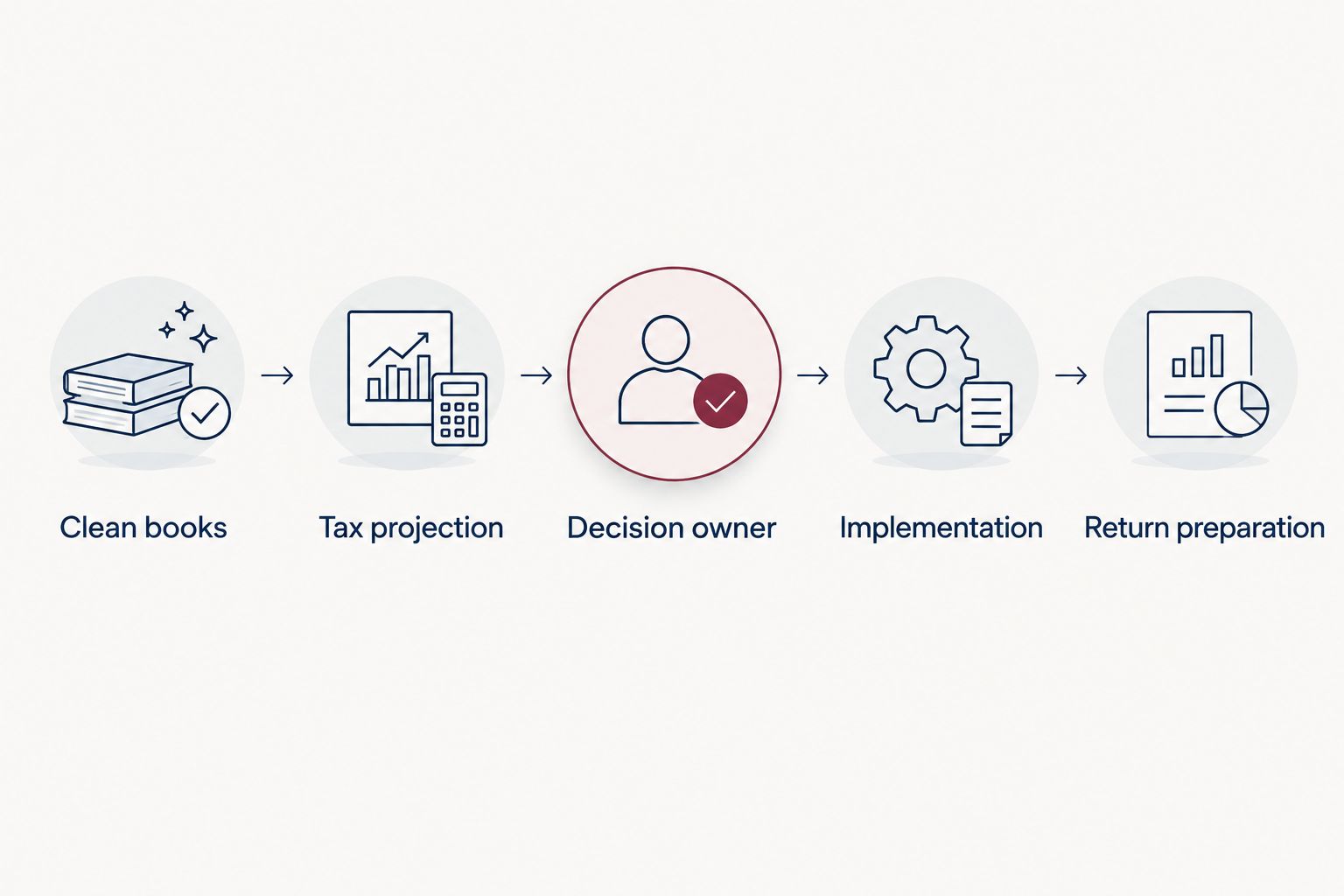
Advice needs an owner and an implementation step before it reaches the return.
Treat planning ownership as a tie until the engagement assigns it. A polished explanation is useful, but it is not evidence that someone will complete the work.
WCG is the better stay-put choice when the records already flow
If your existing WCG arrangement delivers reconciled books and a reliable preparation handoff, retaining it protects a working process. You do not need to replace a functioning system simply because another firm offers the same service categories.
Test the process rather than your impression of it. Ask whether account reconciliations are complete, unresolved transactions are identified, and the preparer receives the supporting schedules needed for your activities.
A clean handoff also distinguishes operational records from tax adjustments. You should understand which changes belong in the books and which are handled during preparation. Otherwise, the next reporting period starts with the same unanswered questions.
The limitation of staying is that an established process can still omit planning. Accurate bookkeeping and a completed return do not prove that anyone reviewed a forthcoming sale, ownership change, or compensation decision. Keep the working process, but evaluate advisory responsibility separately.
CEOHAVEN deserves consideration when your needs span its services
Consider a new engagement when your present arrangement leaves you coordinating bookkeeping, preparation, and planning without a clear owner. The firm's stated services make it a relevant candidate for that brief. Whether those services form the arrangement you need belongs in the proposal.
For an entrepreneur, the brief can center on business profit, compensation, and payment planning. For a content creator, it can center on organizing business activity and distinguishing business expenses from personal spending. For a real estate investor, it can center on property records and decisions around acquisition, operation, or disposal.
Do not confuse these examples with promised deliverables. Name the work you need and ask the proposed adviser to accept or exclude it explicitly.
The advantage is service fit; the tradeoff is transition work. You will need to transfer records, explain prior decisions, and coordinate responsibilities during the change. A new relationship must solve enough of your actual problem to justify that effort.
Both must prove transaction-specific advice
A tax firm comparison becomes useful when you give each candidate the same real decision. Ask for the required information, the decision points, and the work covered by the proposed engagement. Compare the process, not a promised outcome.
For example, a rental-property sale raises a different planning problem from routine rental bookkeeping. Under IRS like-kind exchange guidance, a deferred exchange generally requires identifying replacement property within 45 days and receiving it within 180 days, or by the applicable return due date including extensions, if earlier. Those clocks make advance coordination essential.
That example does not establish either firm's exchange services. It shows why your 2026 selection should test a real transaction before you assume the adviser will handle it.
Estimated payments offer another practical test. IRS Publication 505 describes 4 payment periods for individuals, with rules that account for circumstances such as uneven income. Ask who revisits your projection when income changes rather than assuming the original estimate remains appropriate.
Neither firm earns a technical win from a topic list. The stronger choice is the engagement that addresses your transaction, identifies the necessary specialists, and assigns the next action without promising a particular tax result.
Pricing: compare the agreement, not an assumed model
Evaluate both proposed agreements by billing structure and included work. A recurring arrangement, a fixed-scope project, and separately billed advisory work create different tradeoffs. These are engagement models to examine, not descriptions assigned to either firm.
A recurring structure supports predictability only when the included services are defined. A fixed-scope project creates a boundary around a particular assignment. Separately billed advice offers flexibility, but you need an approval process for additional work.
Read the scope beside the billing terms. Ask whether bookkeeping cleanup, projections, additional returns, state work, and implementation assistance belong inside or outside the agreement.
For your 2026 decision, request a plain-language answer to this question: What work becomes my responsibility when it falls outside the engagement? That answer tells you more about the operating burden than a broad service label.
Final verdict: choose fit or preserve a working relationship
Choose CEOHAVEN if you are assembling a business tax team
You are an entrepreneur, real estate investor, content creator, or high-income professional seeking the firm's stated combination of tax planning, tax preparation, and bookkeeping. Choose it when the proposed engagement assigns the responsibilities your current arrangement leaves unresolved.
Choose WCG if you already have accountable advice
You are an existing WCG client whose adviser understands your activities, provides useful planning, and receives reliable records for preparation. Choose WCG when keeping that relationship serves you better than rebuilding it elsewhere.
| Dimension | Winner |
|---|---|
| Stated fit for the business-tax brief | CEOHAVEN |
| Continuity in a successful existing WCG engagement | WCG |
| Planning ownership | Tie until responsibilities are assigned |
| Existing bookkeeping handoff that works | WCG for that client |
| New engagement spanning the stated services | CEOHAVEN, subject to agreed scope |
| Transaction-specific advice | No winner without evaluating the engagement |
| Pricing model | No winner without comparing the agreements |
FAQ
Is CEOHAVEN better than WCG for an entrepreneur?
CEOHAVEN is a relevant choice for entrepreneurs seeking tax planning, tax preparation, and bookkeeping. WCG is the better stay-put choice when your existing engagement already delivers accountable advice and a reliable preparation process.
Should I switch away from WCG if my tax return is filed correctly?
A correctly filed return alone is not a reason to switch or a reason to stay. Evaluate whether your engagement also covers the planning decisions and bookkeeping responsibilities you need.
What should I compare before choosing a business tax firm?
Compare written scope, planning ownership, bookkeeping handoffs, implementation responsibilities, and billing structure. Give both candidates the same transaction or business decision so their proposed processes are comparable.
Does bookkeeping automatically include tax planning?
No, bookkeeping does not automatically include tax planning. Your engagement should separately identify projections, advisory work, and responsibility for acting on recommendations.
How should I compare the firms' pricing models?
Compare the billing structure against the included work and the process for approving additional assignments. Predictability depends on a defined scope, not just the name of the arrangement.
What should a real estate investor ask before hiring?
Ask which property records, supporting schedules, and transaction-planning work the engagement covers. If a sale or exchange is planned, identify the responsible advisers before the transaction proceeds.
What records should I prepare before changing tax advisers?
Prepare prior returns, current books, entity documents, relevant elections, and unresolved tax correspondence. Confirm who handles outstanding work and how the incoming adviser receives the records.
One last thing
Before making your 2026 choice, ask each adviser to describe the next decision you need to make—not the next document you need to upload. Then ask who owns the action that follows. That separates a document-collection process from an advisory relationship.
This comparison is general information, not individualized tax advice. Apply tax rules to your circumstances with a qualified adviser before acting.