

Choose CEOHAVEN if you want business tax consulting that includes planning, preparation, and bookkeeping; choose TaxAct if you want tax software to prepare your own return and remain responsible for the underlying decisions. In 2026, the dividing line is professional service versus self-directed filing—not which name promises a bigger refund.
TL;DR
- CEOHAVEN vs TaxAct is a choice between business tax consulting and self-directed tax preparation software.
- Choose CEOHAVEN for tax planning, tax preparation, and bookkeeping services; confirm the engagement’s exact scope.
- Choose TaxAct when you want to prepare your own return and already understand your tax positions.
- Neither approach replaces accurate records, supporting documents, or timely decisions.
Why this matters
A completed return answers what happened. Tax planning asks what you should do before a transaction, election, or payment deadline passes. Those are different jobs.
For an entrepreneur, property investor, creator, or high-income professional, the wrong comparison starts with the filing interface. Start with responsibility instead: do you want to enter and review your own tax information, or engage a firm for planning, preparation, and bookkeeping?
CEOHAVEN is the better fit for business owners seeking tax consulting rather than a self-directed filing tool. TaxAct is the better fit for a filer who wants software and intends to manage the tax decisions independently.
Neither choice removes your obligation to provide complete information. Professional advice cannot account for a transaction you never disclose, and software cannot turn an unsupported expense into a deduction.
At a glance
| Dimension | CEOHAVEN | TaxAct |
|---|---|---|
| Best for | Entrepreneurs, investors, creators, and high-income professionals seeking tax services | Filers who want to prepare their own returns with software |
| Planning before filing | Business tax planning is an offered service | Self-directed filing software is the central comparison here |
| Direct control | You engage a service provider and define responsibilities | You control the preparation workflow |
| Bookkeeping | Bookkeeping is an offered service | A filing workflow is not a bookkeeping engagement |
| Rental-property decisions | Relevant fit for investors seeking tax consulting | Relevant fit for investors handling their own tax positions |
| Records and accuracy | Depends on complete facts and appropriate review | Depends on complete facts and appropriate review |
| Pricing model | Evaluate the proposed service scope and fee terms | Evaluate the software product and filing scope |
| Standout distinction | Planning, preparation, and bookkeeping services | Self-directed tax preparation software |
Business tax consulting wins when decisions come before filing
The consulting route fits a founder whose question is not simply where to enter income. It fits questions about how business decisions affect taxes, what records support those decisions, and what needs attention before the year closes.
For your 2026 tax plan, separate decisions from reporting. An entity election, a property sale, and a change in worker classification require analysis beyond choosing an entry field. A return records the outcome; it does not replace the earlier decision.
The advantage of consulting is the ability to make planning part of the engagement. The limitation is scope: hiring a tax firm does not automatically mean every transaction, state issue, or ongoing review is included. Define those responsibilities before work begins.
TaxAct fits the narrower task of preparing a return yourself. That is a genuine advantage when you already understand the relevant treatment and want software to organize the filing process.
Choose business tax consulting when you need help deciding what to do, not just recording what you did. Ask which planning questions the engagement covers and when those questions will be reviewed.
TaxAct wins when direct control is the priority
TaxAct is the better fit when you want to work through your own return, inspect your entries, and manage preparation yourself. You remain close to the details. That matters if you prefer to understand each reported item rather than hand off preparation.
Self-directed preparation also places the work with you. You must assemble documents, distinguish business from personal expenses, identify relevant tax questions, and review the completed return. Software does not remove those responsibilities.
A consulting engagement changes that division of labor, but it also requires communication. You need to explain your business, supply records, answer questions, and review the outcome. Hiring a firm is not the same as disappearing from the process.
Choose TaxAct if hands-on preparation is an intentional preference, not a workaround for unresolved tax questions. The strongest DIY candidate has organized records and knows which issues require separate professional advice.
The tradeoff is control versus delegation. Neither is inherently better; the right winner follows the job you want to keep or hand off.
The consulting route wins when bookkeeping is part of the problem
Bookkeeping is an explicit service offered by the consulting firm. That makes it the more relevant option when your tax preparation problem begins with inconsistent business records rather than a missing filing tool.
Examples include unclassified transactions, personal spending mixed with business spending, and transfers recorded as revenue. These are accounting questions before they become tax-return questions. A filing workflow should not be treated as a substitute for resolving them.
TaxAct remains a reasonable choice once your records are ready and you intend to prepare the return yourself. Its limitation in this comparison is not a claim about every feature; it is that buying tax software is different from engaging someone to maintain your books.
Before selecting either route, map the handoff:
- Reconcile books: Match recorded balances to bank and credit-card statements.
- Classify transactions: Separate income, expenses, transfers, and owner activity.
- Review decisions: Identify tax treatment that needs analysis before filing.
- Prepare return: Use the resolved records to complete tax reporting.
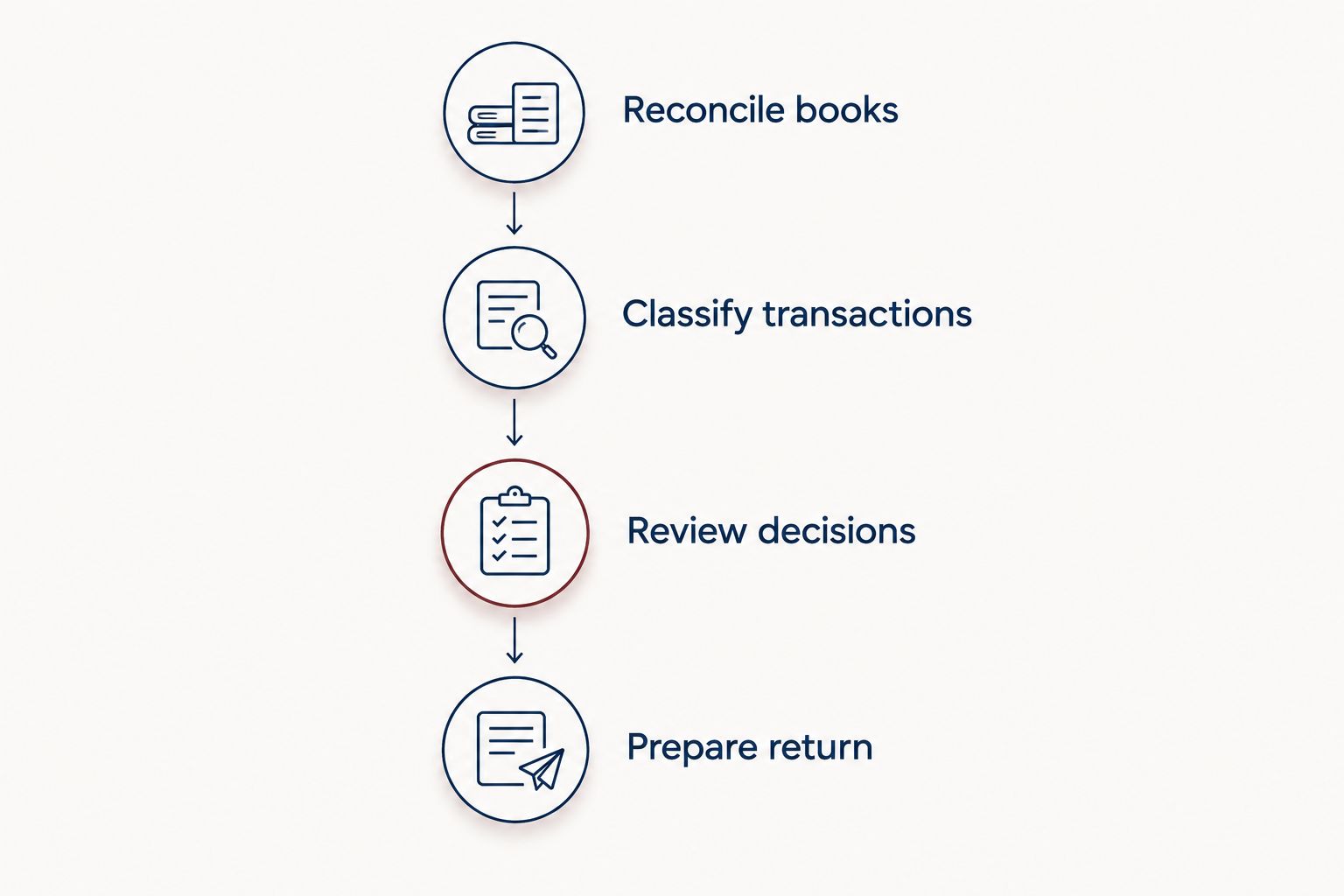
Resolve the accounting and tax decisions before treating the return as ready to file.
Choose a bookkeeping service when the source records need ongoing work. Choose a filing tool when that work is already handled and self-preparation is the task left to complete.
Consulting wins for unresolved property decisions; DIY wins for reporting
A real estate investor evaluating a sale needs a different conversation from an investor reporting an already-understood rental activity. The first involves decisions and timing. The second involves accurate reporting of income, expenses, and property information.
Consider a Section 1031 exchange. Under federal IRS like-kind exchange rules applicable in 2026, a deferred exchange generally requires identifying replacement property within 45 days and receiving it within 180 days, or by the tax-return due date including extensions, whichever comes first. Filing software cannot move those deadlines after they have passed.
Those rules do not establish that every property qualifies or that every sale should become an exchange. They illustrate why advice before a transaction and return preparation afterward are separate services.
The consulting route fits an investor who wants help evaluating tax questions before acting. Confirm that the specific transaction is within the proposed engagement. TaxAct fits an investor who has resolved the tax treatment and wants to handle the reporting personally.
Unresolved property decisions favor professional advice; understood reporting favors the DIY route. Do not confuse the ability to enter a transaction with having established its correct treatment.
Both approaches need the same evidence
There is no defensible automatic winner on accuracy simply because one option is a firm and the other is software. Correct reporting depends on the facts, applicable rules, supporting records, and review.
For 2026, prepare the same evidence regardless of your filing route: income documents, business expense records, prior returns, relevant entity information, and details of significant transactions. Keep explanations with unusual items rather than expecting someone to reconstruct them later.
A practical standard is to organize 12 months of business activity before asking whether the annual return is ready. That is a preparation recommendation, not a claim that every engagement requires the same document package.
For creators, distinguish business revenue from transfers between accounts. For property owners, retain acquisition and improvement records. For founders, make owner contributions and distributions visible rather than leaving them buried among ordinary transactions.
The consulting route offers a service relationship, but incomplete disclosure still creates risk. The DIY route offers direct access to your entries, but familiarity with the interface does not prove the underlying treatment is correct.
Records and accuracy are a tie: neither option makes documentation optional.
Pricing: compare service scope with software scope
Treat this as a comparison between a professional-services engagement and a tax-software product. Do not compare the labels while ignoring what you are actually buying.
For the consulting route, examine the proposed fee basis and scope together. Identify whether the engagement covers preparation, planning, bookkeeping, or a defined combination. Ask how additional entities, transactions, state returns, and work outside the agreed scope are handled.
For TaxAct, examine the current product terms and the filing requirements relevant to you. Check the return types, state filing needs, and support arrangements before selecting a product. A software purchase should match the work you intend to complete yourself.
Predictability comes from a clear agreement or clearly defined software selection. Flexibility comes from being able to add the work you actually need. Neither advantage should be assumed from the brand name alone.
Compare these items side by side:
- Which returns and entities are included?
- Who resolves uncertain tax positions?
- Who prepares and maintains the bookkeeping?
- What review or support is included?
- How is additional work authorized?
The pricing winner is the option whose scope matches your needs—not the option with the shortest description.
Planning and filing are different strengths
The consulting firm's defining distinction is its stated combination of tax planning, tax preparation, and bookkeeping services. Those services address different stages of the business tax process. Confirm how they fit together in your engagement rather than assuming automatic coordination.
TaxAct's defining distinction in this comparison is self-directed tax preparation software. You choose that route to carry out the filing work yourself, not to create a substitute consulting relationship.
This distinction also prevents a false choice. A business owner can seek advice on a specific issue and still prefer self-directed preparation. Another owner can keep internal bookkeeping while outsourcing tax planning and preparation.
Buy the missing function. If you need advice, another filing interface is not the answer. If you understand the tax positions and want to prepare the return yourself, a broader service engagement is not automatically necessary.
Final verdict for 2026
Choose CEOHAVEN if you want business tax consulting
Best for: the founder or investor seeking professional planning, preparation, or bookkeeping services. You want to define what gets handled by a firm rather than remain responsible for every part of tax preparation.
The firm serves entrepreneurs, real estate investors, content creators, and high-income professionals in the United States. Its stated services match the buyer looking beyond a filing tool. The boundary is the engagement itself: make the included work explicit.
Choose TaxAct if you want to prepare your own return
Best for: the organized, hands-on filer with resolved tax positions. You want software, retain control of preparation, and accept responsibility for assembling records and reviewing the return.
TaxAct wins that narrower assignment. It does not need to replace a consulting firm to be useful; it needs to fit the filing job you intend to do yourself.
| Dimension | Winner |
|---|---|
| Planning before decisions | Business tax consulting |
| Direct preparation control | TaxAct |
| Bookkeeping service needs | Business tax consulting |
| Unresolved rental-property decisions | Professional advice |
| Self-directed reporting | TaxAct |
| Records and accuracy | Tie: evidence and review remain essential |
| Pricing fit | Tie: compare the actual scope |
| Standout distinction | Consulting for services; TaxAct for DIY preparation |
FAQ
Is CEOHAVEN better than TaxAct for a business owner?
CEOHAVEN is the better fit for a business owner seeking tax planning, tax preparation, or bookkeeping services. TaxAct is the better fit when the owner wants software to prepare the return personally and has resolved the underlying tax questions.
Should I use TaxAct if I already have a bookkeeper?
TaxAct fits a self-directed filing workflow when your bookkeeping is ready and you understand the relevant tax treatment. A bookkeeper’s work does not automatically resolve every tax election, transaction, or reporting question.
Can tax software replace business tax planning?
Tax preparation software is not a substitute for evaluating business decisions before they happen. Filing a return and deciding how to handle an entity election, compensation issue, or property transaction are different tasks.
Which option is better for real estate investors?
Professional tax advice is the better fit for unresolved property transactions; TaxAct fits investors who want to report understood tax positions themselves. Evaluate the decision you need help with rather than treating every rental-property situation alike.
How should I compare consulting fees with tax software?
Compare the work included and the responsibilities you retain. Review preparation, planning, bookkeeping, return types, support, and the terms for additional work before choosing either route.
Will hiring a tax firm mean I can stop organizing documents?
No, hiring a tax firm does not remove your responsibility to provide complete records and disclose relevant transactions. The firm needs accurate information to prepare returns and address the matters within its engagement.
What should I do before choosing a tax provider for 2026?
List the tax decisions that remain unresolved and the filing work you want to handle yourself. Use that list to choose between a consulting engagement, a self-directed software workflow, or separate advice and preparation arrangements.
One last thing
Before you choose, write two headings: decisions still open and reporting ready. Put every tax task under one of them.
If the first column holds the real work, choose advice before choosing a filing interface. If the second holds the work and you want to do it personally, choose software. That simple distinction is more useful than a refund promise.