

Choose CEOHAVEN if you want a business tax consulting firm for planning, preparation, and bookkeeping; choose Intuit if you want accounting or tax software to operate yourself or alongside an existing adviser. In 2026, the deciding difference is professional service versus a software ecosystem—not which name belongs on every part of your financial workflow.
TL;DR
- CEOHAVEN vs Intuit is a tax consulting firm versus a software ecosystem comparison, not a like-for-like product contest.
- Choose the firm for business tax planning, tax preparation, and bookkeeping services.
- Choose Intuit for QuickBooks accounting software or TurboTax tax preparation software.
- Keep software selection separate from decisions about who advises you and who prepares your return.
Why this matters
An accounting dashboard and a tax adviser solve different problems. Software helps you record activity and complete defined tasks; professional advice helps you evaluate decisions before those transactions become history.
For an entrepreneur, real estate investor, content creator, or high-income professional, that distinction matters more than the interface. Buying software does not itself assign responsibility for reviewing an entity election, a property sale, or a change in how you pay yourself.
Intuit also is not one product. QuickBooks is accounting software, while TurboTax is tax preparation software; Intuit offers assisted services within parts of its product ecosystem, too. Compare the specific product and service scope you intend to use, rather than treating everything under the Intuit name as interchangeable.
At a glance
| Dimension | CEOHAVEN | Intuit |
|---|---|---|
| Best for | Entrepreneurs, investors, creators, and high-income professionals seeking tax services | People seeking accounting or tax software, with assistance depending on the offering |
| Tax planning | Business tax consulting and planning services | Software and assistance vary by product; do not equate filing with planning |
| Bookkeeping | Bookkeeping as a professional service | QuickBooks as an accounting software platform |
| Tax preparation | Tax preparation as a professional service | TurboTax software and assisted preparation options |
| Daily workflow | Service relationship rather than a standalone software product | Direct use of accounting and tax applications |
| Software ownership | Select tools separately from the service relationship | Choose an Intuit product for the software layer |
| Pricing model | Define the engagement around the services required | Product subscriptions or filing-related charges, depending on the offering |
| Standout feature | Planning, preparation, and bookkeeping within one firm's service offering | Accounting and tax software within one product ecosystem |
The firm fits an advice-led buyer; Intuit fits a software-led buyer
CEOHAVEN is the better fit for entrepreneurs seeking business tax consulting rather than a standalone software purchase. Its stated services cover tax planning, tax preparation, and bookkeeping, and its stated audience includes real estate investors, content creators, and high-income professionals.
That is a service-selection argument, not a claim that every engagement includes every service. Before signing, define which work belongs in the engagement and which responsibilities remain with you.
Intuit wins when your immediate requirement is a tool. If you already have a tax adviser and need an accounting application, evaluate QuickBooks. If your priority is preparing a return through tax software, evaluate the relevant TurboTax offering.
The drawback on each side follows the same distinction:
- Professional service: You still need to agree on scope, provide records, and decide how the adviser and your software will work together.
- Software: You still need to determine who interprets unusual transactions and who owns decisions outside the application's defined tasks.
For your 2026 decision, name the missing function first: advice, recordkeeping, preparation, or software. Then select the provider that supplies that function.
The firm is the clearer choice when tax planning is the requirement
Tax planning asks what you should do before you act. Tax preparation asks how completed activity belongs on a return. Both matter, but buying the second does not automatically secure the first.
The firm's explicit tax planning service makes it the clearer choice when your requirement is a business tax consulting engagement. Examples of questions to bring to that engagement include whether an entity change fits your circumstances, how a planned property sale affects your tax position, and what records support a proposed deduction.
Intuit's tax software serves a different starting point: completing tax-related tasks through an application. Assisted preparation is still not automatically the same scope as advice on a transaction that has not happened.
Real estate makes the timing distinction concrete. Under Internal Revenue Service guidance for deferred Section 1031 exchanges, replacement property generally must be identified within 45 days, and received within 180 days or the applicable return due date, including extensions, whichever comes first. These are identification and exchange deadlines, not a promise that a transaction qualifies.
For a sale contemplated in 2026, get advice before closing. A filing workflow cannot turn an already completed transaction into a properly structured exchange after the fact.
If you are comparing applications rather than advisers, the tax planning software guide for entrepreneurs keeps that separate decision in view.
Both address bookkeeping, but the work lands in different places
The firm offers bookkeeping services. QuickBooks supplies accounting software. Neither label alone tells you who reconciles accounts, reviews classifications, or resolves missing documentation.
Treat bookkeeping as a scope question, not an automatic winner. A service engagement and a software subscription are different ways to organize the work; the right choice turns on who will actually perform it.
Choose a bookkeeping service when your objective is to assign the work to a provider under a defined engagement. Choose QuickBooks when you want software for yourself, your internal team, or an accountant to use.
The service-side limitation is that buying an engagement does not remove your responsibility to deliver complete information. The software-side limitation is that access to an application does not establish who will review the resulting books.
Before choosing, ask:
- Who performs reconciliations?
- Who reviews owner transactions and business classifications?
- Who requests missing receipts or explanations?
- Who delivers the records needed for tax preparation?
For a property owner or creator with mixed income sources, clear answers beat a long feature list. The books need an owner, not merely a login.
Both support tax preparation; neither removes your recordkeeping duty
The firm provides tax preparation services, while TurboTax offers tax preparation software and assisted options. That makes preparation a genuine overlap, even though the delivery models differ.
There is no supported blanket winner on filing accuracy. Accuracy depends on complete records, correct facts, and the preparation work—not simply on whether you choose a firm or a software brand.
A professional preparation engagement is the service-led route. Confirm which returns, entities, and jurisdictions fall within the engagement, and how questions raised during preparation will be handled.
TurboTax is the software-led route. Confirm that the specific offering supports your return type and that its assistance matches the work you want someone else to perform.
For your 2026 preparation decision, distinguish answering a question from preparing a return, and preparing a return from planning a transaction. Those are separate responsibilities. Your agreement or product selection should make the boundaries explicit.
Intuit is the better choice for a direct software workflow
Intuit wins when you want to use accounting or tax applications directly. QuickBooks and TurboTax are identifiable software products; the firm is a tax consulting service provider, not a substitute software platform.
That matters if you want your team to work inside an accounting application or you intend to complete a tax software workflow yourself. Evaluate the actual product, the tasks it supports, and the person responsible for using it.
The advantage is direct access to a software workflow. The limitation is equally clear: a workflow does not settle every judgment that arises from your business activity.
Separate the two layers before choosing:
- Firm services: Tax planning, Tax preparation, Bookkeeping.
- Intuit products: Accounting software, Tax software.
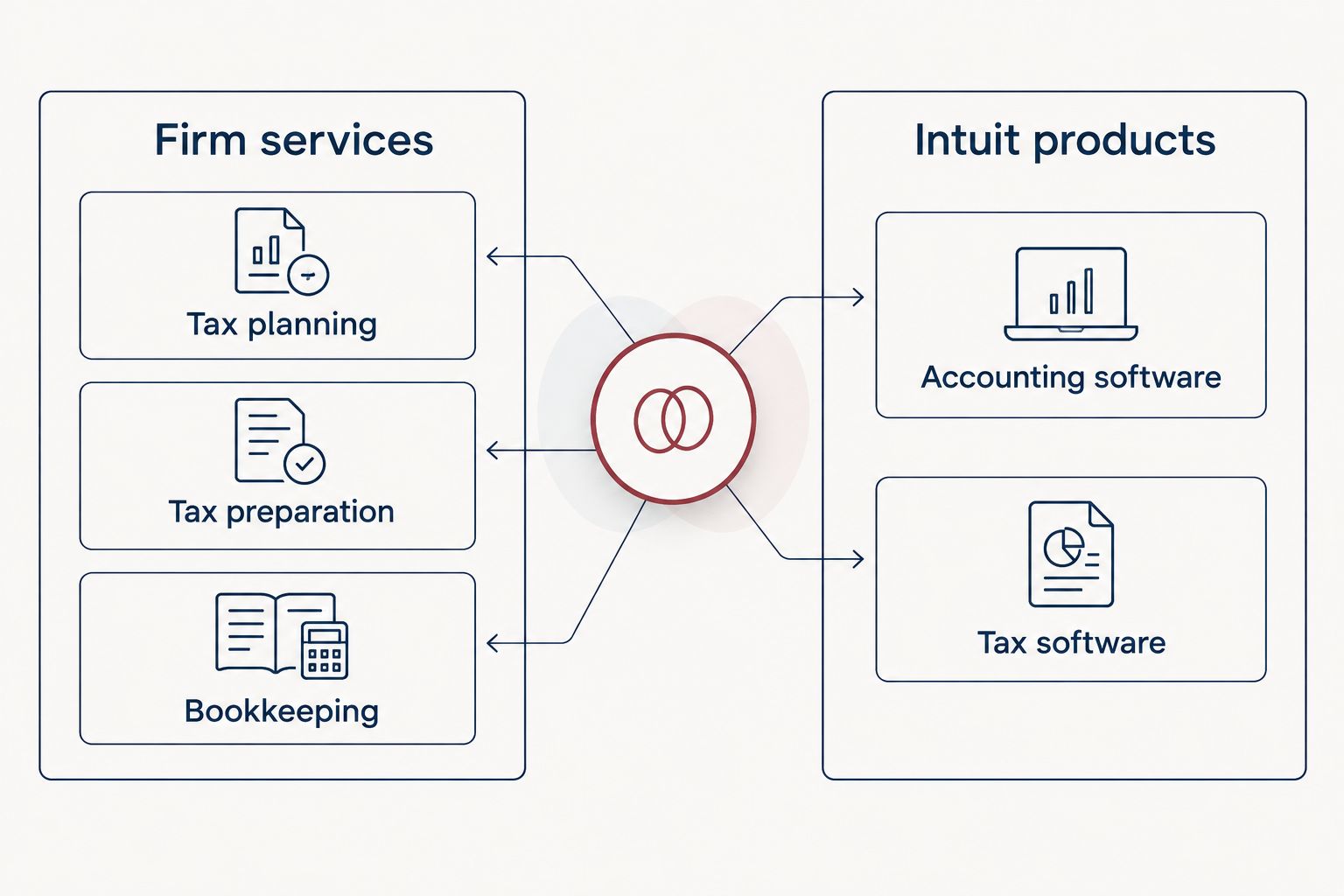
Choose the service relationship and the software layer as separate decisions.
Ask a potential adviser how your existing tools fit the proposed engagement. Ask a software provider which tasks the selected product supports. Do not assume either answer from the brand name alone.
Intuit wins when the purchase is specifically accounting or tax software
If your buying requirement is a software product, Intuit is the relevant choice in this comparison. Choosing a consulting firm does not itself select the accounting application or tax software your business will use.
This is particularly important when your business already has an operating workflow. Replacing an adviser and replacing software are separate decisions, with separate questions about records, access, and responsibilities.
Before changing tools, identify what must remain accessible:
- Prior financial reports and supporting documents.
- Transaction records needed for review.
- Information your preparer needs for the applicable returns.
- Access arrangements for your team and external advisers.
This is not a claim that every Intuit product offers every export or access option. Check the specific offering against your requirements before committing.
The firm's advantage sits elsewhere: purchasing professional services. If that is the gap, switching applications alone does not close it.
Pricing: compare the engagement with the complete software scope
A useful 2026 cost comparison starts with deliverables. A bookkeeping application, a prepared tax return, and a planning engagement are not interchangeable purchases.
For the firm, request an engagement proposal tied to the services you need. Establish whether planning, preparation, and bookkeeping are included together or scoped separately, and how work outside that scope is handled.
For Intuit, review the current terms of the specific product and assistance option. QuickBooks commonly uses subscription-based software plans; TurboTax charges depend on the selected filing and service offering. Do not treat one product's billing structure as the model for all of Intuit.
Predictability comes from a clearly defined scope or selected plan. Flexibility comes from changing that scope or selecting different software and assistance options. Neither model guarantees a better outcome by itself.
Compare written answers to the same questions:
- What work is included?
- What work remains with you?
- What triggers additional charges?
- What happens when your business or return becomes more complex?
Compare the full job, not one line item. If you still need separate planning or bookkeeping help after purchasing software, include that requirement in your decision.
The firm's combined service offering wins on breadth of professional scope
Planning, preparation, and bookkeeping appear in the firm's stated service offering. That breadth makes it a relevant choice when you want to discuss those needs with one consulting firm.
The boundary matters: an available service is not automatically an included deliverable. Ask who handles each function and how information moves between bookkeeping, planning, and preparation within your engagement.
Intuit's counterpart is breadth of software choice. Its accounting and tax products address distinct workflows, but purchasing them does not automatically create a single adviser responsible for your overall tax decisions.
For either route, assign responsibility before work starts. One provider can still leave unclear boundaries; several providers can work well together when the responsibilities are explicit.
Final verdict: choose the missing function
Choose CEOHAVEN if you want a professional tax service relationship
Best for: An entrepreneur, real estate investor, content creator, or high-income professional seeking tax planning, tax preparation, or bookkeeping services.
Your next move is to define the engagement: what decisions require advice, what records require maintenance, and what returns require preparation. Select the service scope rather than assuming the entire offering comes bundled.
Choose Intuit if you want software for a defined task
Best for: An owner who wants accounting software, tax preparation software, or product-specific assistance—and can clearly assign any remaining advisory work.
Your next move is to choose the actual product. QuickBooks and TurboTax serve different purposes; evaluate each against the task you need completed, not against a general promise of financial help.
| Dimension | Winner |
|---|---|
| Best for | Firm for service-led buyers; Intuit for software-led buyers |
| Tax planning | Firm for an explicitly scoped planning engagement |
| Bookkeeping | Tie on purpose; service versus software decides the fit |
| Tax preparation | Tie on available routes; scope and records decide the fit |
| Daily workflow | Intuit for direct application use |
| Software ownership | Intuit for a software purchase |
| Pricing model | No blanket winner; compare complete scope |
| Standout feature | Firm for professional service breadth; Intuit for software breadth |
FAQ
Is CEOHAVEN better than Intuit for business taxes?
CEOHAVEN is the clearer fit when you want business tax consulting, planning, preparation, or bookkeeping services. Intuit is the clearer fit when you want accounting or tax software; compare the specific product and assistance option.
Is Intuit the same thing as QuickBooks?
No. Intuit is the company behind QuickBooks and TurboTax, which serve different purposes. QuickBooks is accounting software, while TurboTax is tax preparation software.
Does buying tax software give me tax planning?
Buying tax software does not automatically give you a tax planning engagement. Confirm whether advice about future transactions is included rather than assuming filing assistance covers it.
Should I choose bookkeeping services or QuickBooks?
Choose bookkeeping services when you want to assign bookkeeping work under an engagement; choose QuickBooks when you need accounting software. In either case, establish who reconciles accounts and reviews the records.
Which option costs less in 2026?
Compare the complete service or product scope rather than treating a consulting engagement and a software purchase as equivalent. Include any separate preparation, bookkeeping, or planning work you still need.
Which option is better for a real estate investor?
Choose professional tax planning when your requirement is advice about a property transaction, and choose software when your requirement is recordkeeping or tax preparation tools. Confirm relevant transaction experience and the exact engagement scope before hiring an adviser.
Can software fix a missed 1031 exchange deadline?
No. Tax software does not extend the statutory identification or exchange deadlines. Discuss a proposed exchange with a qualified adviser before completing the transaction.
One last thing
Before buying anything, write down the next business decision that needs a tax answer. If it has not happened yet, ask who will advise you before you act; if it already happened, ask who will record it and prepare the required reporting.
That distinction is more useful than a brand ranking. Buy advice for decisions, service for assigned work, and software for workflows.
Related guides
- Best expense tracking apps for real estate investors
- Best tax document organization apps for entrepreneurs
- Best tax software for real estate investors
About the author
Shamyr Borgelin is Founder & CEO of CEOHAVEN.