

Choose CEOHAVEN if you want a tax consulting firm that offers planning, preparation, and bookkeeping for your business and personal financial decisions; choose Bench if your primary need is outsourced bookkeeping. The deciding question in 2026 is whether you need help making tax decisions or keeping the books behind those decisions.
TL;DR
- CEOHAVEN vs Bench is a tax consulting versus bookkeeping-first decision, not a contest over identical services.
- CEOHAVEN is the better fit for entrepreneurs seeking tax planning alongside preparation and bookkeeping.
- Bench is the better fit when outsourced bookkeeping is your main requirement.
- Compare engagement scope, tax responsibilities, and record access before signing with either provider.
Why this matters
Accurate books tell you what happened. Tax planning helps you decide what to do before a transaction, election, or filing deadline closes your options. You need both functions, but you do not necessarily need the same provider to perform them.
CEOHAVEN is the better fit for entrepreneurs seeking tax consulting alongside bookkeeping. That recommendation follows its stated service offering and audience, not a claim about guaranteed savings or service quality.
For your 2026 decision, separate the accounting task from the advisory task. A founder who needs reconciled accounts has a different buying problem from a real estate investor deciding how to structure an upcoming sale. Neither problem becomes easier because a service package sounds extensive.
At a glance
| Dimension | CEOHAVEN | Bench |
|---|---|---|
| Best for | Entrepreneurs, real estate investors, content creators, and high-income professionals seeking tax consulting | Business owners whose main requirement is outsourced bookkeeping |
| Standout feature | Tax planning, preparation, and bookkeeping within its stated offering | Bookkeeping-first service focus |
| Bookkeeping priority | Best considered when bookkeeping supports a broader tax engagement | Best considered when bookkeeping is the central purchase |
| Tax planning | An explicitly offered service | Evaluate the advisory scope separately from bookkeeping |
| Tax preparation | An explicitly offered service; confirm the returns covered | Confirm the filing services and responsible preparer in your proposed engagement |
| Real estate decisions | Real estate investors are an explicitly served audience | Evaluate against your property-level bookkeeping requirements |
| Pricing model | Assess the proposed service scope and billing terms | Assess subscription terms and the services included |
| Records and handoffs | Confirm ownership, access, and export arrangements | Confirm ownership, access, and export arrangements |
This table compares service fit. It does not rank response times, accountant credentials, software integrations, or tax outcomes. Those belong in your engagement review, where you can evaluate actual commitments rather than assumptions.
Tax-first wins when decisions come before reporting
A tax consulting engagement fits when the unresolved question is what you should do, not simply where a transaction belongs in the ledger. Examples include evaluating business structure, preparing for a property transaction, or coordinating business income with your individual return.
Tax planning is explicitly part of CEOHAVEN's offering. Choose the tax-first route when you need advice before acting. Ask which decisions the engagement addresses, when discussions occur, and what written work supports the recommendation.
The limitation is equally important: a listed planning service does not establish that every specialized issue falls within the engagement. A multistate business, complex partnership, or unusual transaction needs a clearly defined scope.
Do not treat bookkeeping as evidence that a tax strategy has been evaluated. Equally, do not buy a broader consulting engagement when your actual problem is an unreconciled bank account. Match the work to the decision.
Bench wins the bookkeeping-first brief
Bench is best considered when outsourcing bookkeeping is the central objective. That makes it a genuine alternative for an owner who already has a tax adviser and wants a separate service focused on maintaining business records.
The advantage is focus. You can evaluate the engagement against bookkeeping deliverables rather than asking a tax consulting relationship to solve an operational problem it was not scoped to address.
Before choosing, define what completed bookkeeping means for your business:
- Bank and card accounts reconcile to supporting statements.
- Transfers do not appear as duplicate income or expenses.
- Reports distinguish business activity from owner contributions and distributions.
- Unresolved transactions have a clear review process.
- Your tax preparer can use the resulting records.
Choose Bench for the bookkeeping-first brief, not as an assumed substitute for every tax advisory need. Confirm any advisory or filing work separately. The limitation is the boundary between recording a decision and advising on that decision; your contract should make that boundary explicit.
Tax preparation is a scope check, not an automatic winner
Neither a tax consulting label nor a bookkeeping relationship tells you exactly which returns an engagement covers. Your business return and individual return are connected, but they remain separate pieces of work.
Tax preparation is part of the consulting firm's stated offering. When evaluating Bench, ask what filing work belongs in the proposed engagement and who is responsible for it. Do not infer filing coverage from a bookkeeping description.
For 2026, put the following questions in writing:
- Which business, individual, and state returns are included?
- Who prepares each return, and who reviews it?
- Who requests missing information and tracks unresolved questions?
- How are extensions and estimated payments handled?
- What happens when bookkeeping adjustments change a draft return?
This dimension is a tie until the filing scope is defined. That is not a claim that the providers deliver identical preparation. It means there is no defensible winner for your returns without matching responsibilities to your actual filing needs.
Real estate investors benefit from a tax-first starting point
Real estate investors are an explicitly named audience for the tax consulting firm. That makes it a more direct starting point when your question concerns the tax implications of owning, operating, or selling investment property.
Consider a like-kind exchange. IRS rules generally require identification of replacement property within 45 days and receipt within 180 days, or the applicable return due date including extensions, whichever comes first. Those deadlines make pre-transaction advice materially different from recording a sale after closing.
This does not establish that either provider manages exchanges. It establishes why you should name the transaction and confirm the required expertise before engaging an adviser.
If your tax advice is already covered and the unresolved problem is property bookkeeping, evaluate Bench against that narrower brief. Ask how your proposed setup will distinguish each property's income, expenses, financing activity, and owner transfers.
The tax-first firm wins on stated audience fit; Bench remains a bookkeeping candidate. Neither audience fit nor general bookkeeping experience proves that your specific property structure is covered.
Pricing models must match the work you are buying
Do not compare a bookkeeping subscription with a broader tax engagement as though they buy the same result. Start with deliverables, then evaluate the billing arrangement attached to them.
For the tax consulting route, request engagement terms that separate planning, preparation, and bookkeeping. Establish whether recurring work and transaction-specific advice belong in the same agreement or require separate approval. Treat the proposal—not the firm's category—as the authority on billing.
For Bench, evaluate the subscription scope and its boundaries. Ask what work is included, how additional work is authorized, and what happens when your business becomes more complex.
The tradeoff is predictability versus scope flexibility:
- Recurring defined scope: easier to budget, but exceptions need clear treatment.
- Separately scoped advice: easier to connect work to a specific decision, but requires approval discipline.
- Combined engagement: puts several responsibilities into one agreement, but still needs explicit exclusions.
Neither model wins without a comparable scope. In 2026, compare bookkeeping with bookkeeping and advisory work with advisory work. A predictable arrangement loses its usefulness if the task you actually need sits outside it.
Records and handoffs are a tie—and a contract requirement
Neither provider should win this category based on its name. Record access, export formats, and responsibility for unresolved items are terms you must establish before signing.
Your business needs access to its financial history when changing providers, preparing returns, seeking financing, or reviewing a transaction. Ask what records you receive during the engagement and after it ends.
A useful handoff includes the relevant financial statements, supporting ledger detail, reconciliation information, and an explanation of open issues. Agree on the exact deliverables rather than assuming that access to a dashboard supplies everything your next accountant needs.
Treat records and handoffs as a tie until the commitments are written. Do not confuse this with an equal-performance rating. It is a buying rule: an attractive service description does not replace a workable exit and transfer process.
Make the choice in this order
Before choosing a provider for 2026, define your requirements in a sequence that keeps the conversation attached to your business. Start with the facts, identify the decisions, and then assign responsibility.
Map income
List the entities and activities that generate income: your operating business, rental properties, creator revenue, employment income, or other relevant sources. Include the accounts and existing records connected to each activity.
The point is not to send an unfiltered document pile. It is to show the prospective provider what must be accounted for and which returns or decisions connect to that income.
Name decisions
Identify the unresolved questions. Is the immediate need reconciled books, an upcoming filing, estimated payments, or advice before a transaction?
Federal individual estimated tax generally uses 4 payment periods. Whether you must make payments depends on your circumstances, including withholding and applicable rules. That distinction illustrates why reporting income and planning how to meet a tax obligation are different tasks.
Confirm scope
Assign each task to a named responsible party and agree on the deliverable. If one provider handles bookkeeping and another handles tax advice, establish how questions and adjustments move between them.
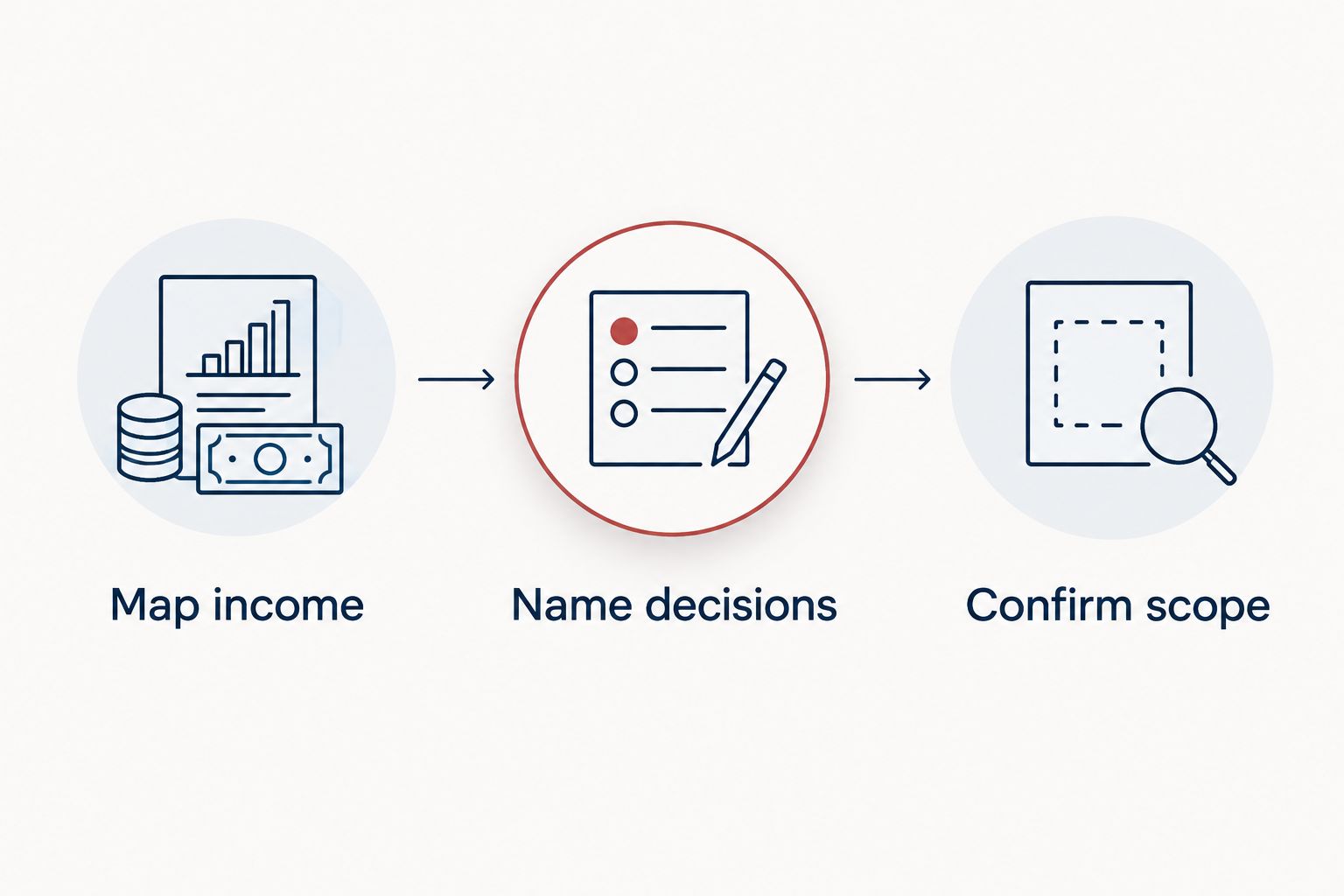
Define the work before choosing the provider.
This sequence prevents the wrong purchase. A bookkeeping problem needs a bookkeeping solution; a pending tax decision needs advice before execution. A combined engagement is useful only when it assigns both responsibilities clearly.
Define your tax engagement
Discuss tax planning, preparation, and bookkeeping against your business needs.
Final verdict: choose by the unresolved problem
Choose CEOHAVEN if you need a tax consulting relationship
Best for: an entrepreneur, real estate investor, content creator, or high-income professional seeking tax planning alongside preparation and bookkeeping. Those services and audiences match its stated offering.
Choose this route when an upcoming decision needs advice and you want to evaluate the accounting work in that context. Confirm specialized expertise, covered returns, and communication responsibilities before signing. Do not infer a guaranteed tax outcome from the service description.
Choose Bench if you need outsourced bookkeeping first
Best for: a business owner whose primary requirement is maintaining usable books, especially when tax advice is already assigned elsewhere. Evaluate Bench against the accounts, reports, and handoff your business requires.
Choose this route when the unresolved work is accounting maintenance rather than transaction advice. Confirm any additional tax services independently and establish who turns the finished books into filing inputs.
| Dimension | Winner |
|---|---|
| Tax-first buyer fit | Tax consulting route |
| Bookkeeping-first buyer fit | Bench |
| Tax planning as a stated service | Tax consulting route |
| Tax preparation coverage | Tie pending engagement scope |
| Stated real estate audience fit | Tax consulting route |
| Pricing-model suitability | Tie pending comparable terms |
| Records and handoffs | Tie pending written commitments |
FAQ
Is CEOHAVEN better than Bench for tax planning?
CEOHAVEN is the more direct fit for a tax-planning brief because tax planning is explicitly part of its offering. Confirm the particular decisions, deliverables, and specialist requirements your engagement will cover.
Is Bench better if I only need bookkeeping?
Bench is the more direct option to evaluate when outsourced bookkeeping is your main requirement. Match the proposed service to your accounts, reporting needs, and tax-preparer handoff.
Can I use Bench and keep a separate tax adviser?
You can structure your accounting responsibilities around separate bookkeeping and tax advisory providers. Confirm each provider's terms and assign responsibility for questions, adjustments, and filing inputs.
Which option is better for real estate investors?
The tax consulting route is the stronger starting point for real estate investors who need advice about tax decisions. If your advice is already covered, evaluate the bookkeeping option against your property-level recordkeeping needs.
Does hiring a bookkeeper mean my tax planning is covered?
No, bookkeeping alone does not establish that tax planning is included. Confirm advisory responsibilities separately from reconciliation, transaction classification, and financial reporting.
How should I compare the two providers' billing arrangements?
Compare the work covered and the billing terms attached to that work. Separate recurring bookkeeping, return preparation, and transaction-specific advice before deciding which arrangement fits.
What should I ask before switching accounting providers in 2026?
Ask for the record-transfer process, the outstanding work list, and the party responsible for each upcoming obligation. Confirm access to ledger detail and supporting records before ending the existing engagement.
One last thing
Ask each provider to identify what you would still need someone else to do. That question reveals the boundary of the engagement faster than a long feature list.
For your 2026 decision, write those remaining responsibilities beside the proposal. If nobody owns the tax decision, filing, or record handoff, the accounting arrangement is unfinished—even when every listed service sounds relevant.