

Yes, content creators can write off the documented business use of a car when the driving serves a genuine, profit-seeking content business. For 2026, the deduction depends on your eligible business miles, expense method, and records—not whether the car appears in a video; personal driving and ordinary commuting remain nondeductible.
TL;DR
- Can content creators write off a car? Yes—document business use and exclude personal driving and ordinary commuting.
- Standard mileage and actual vehicle expenses are alternative methods; do not deduct the same operating costs twice.
- Filming a personal trip does not automatically turn the drive into deductible business mileage.
- CEOHAVEN offers tax planning, tax preparation, and bookkeeping for content creators who need coordinated financial support.
CEOHAVEN is a fit for content creators seeking tax planning, tax preparation, and bookkeeping. The right vehicle decision starts with the work the car performs, not the deduction you want.
Can content creators write off a car?
Content creators can deduct eligible vehicle expenses attributable to their business. IRS Publication 463 explains the federal rules for business transportation, the standard mileage method, actual expenses, and supporting records. Those rules apply to creators just as they apply to other self-employed business owners.
| Deduction method | Best for | What it covers | Main limitation |
|---|---|---|---|
| Standard mileage | Eligible creators seeking simpler expense calculations | Eligible business miles multiplied by the applicable IRS rate | Does not permit separate deductions for operating costs already covered by the rate |
| Actual expenses | Creators prepared to track vehicle costs and business use | Business share of eligible operating costs, plus applicable depreciation or lease expenses | Requires more records; depreciation and method-switching restrictions apply |
A car appearing in your content is not the same as a car being used for business. You need a defensible connection between the trip and your income-producing work.
Why this matters
A vehicle deduction reduces taxable income. It does not reimburse your purchase or make a personal vehicle a business asset simply because you have an LLC.
For 2026 planning, separate three decisions: whether the vehicle serves your business, which trips qualify, and how eligible costs should be deducted. Buying first and reconstructing the justification later reverses that order.
A creator with substantial revenue also needs consistency across bookkeeping, entity records, and the tax return. An aggressive deduction unsupported by a mileage log is not a tax strategy.
Which creator trips count as business driving?
Start with the purpose of the drive. A trip to perform paid production work, transport equipment for a shoot, or meet a sponsor can qualify when it is ordinary and necessary for your business.
The destination alone does not establish deductibility. Your starting location, whether the destination is a regular workplace, and any personal detour also matter.
| Driving situation | General treatment | Record that supports the classification |
|---|---|---|
| Travel between business locations for a contracted shoot | Business transportation when the applicable requirements are met | Production agreement, itinerary, and mileage log |
| Travel between business locations for a sponsor meeting | Business transportation when connected to your work | Meeting details and mileage log |
| Drive from home to a regular studio or office | Generally nondeductible commuting | Workplace details establish the commuting pattern |
| Personal outing with incidental filming | Personal driving is not converted automatically | Separate evidence is needed for any claimed business segment |
| Personal detour during a business trip | Personal detour miles are excluded | Route and mileage entries separating each purpose |
A qualifying home office changes some transportation outcomes. Under IRS Publication 463, travel between a home that qualifies as your principal place of business and another work location in the same trade or business can be deductible.
That is a qualification test, not a shortcut. A kitchen table where you occasionally edit does not establish the home-office exception by itself.
Does filming while driving make the mileage deductible?
No. Recording a personal errand does not, by itself, change the errand's purpose. Posting the footage later does not establish that the original trip was ordinary and necessary for your business.
If the trip exists specifically to produce business content, document the production purpose before you leave. Keep the brief, client correspondence, shoot schedule, or other evidence alongside your mileage record.
Standard mileage: simpler calculations, eligibility restrictions
The standard mileage method uses eligible business miles and the IRS rate applicable to the travel date. It replaces separate deductions for covered operating costs, including fuel, maintenance, insurance, and depreciation.
Best for: eligible creators who want simpler expense calculations. You still need mileage records; a simpler calculation does not mean lighter proof of business purpose.
For an owned vehicle, IRS Publication 463 generally requires choosing standard mileage in the first year the vehicle is available for business use to preserve that option. For a leased vehicle, choosing standard mileage generally means continuing it throughout the lease period, including renewals.
Business parking and tolls can generally be deducted separately. Do not assume that every vehicle-related payment is already included—or automatically additional; check the category before recording it.
For your 2026 return, use the applicable IRS guidance rather than an old rate saved in a spreadsheet. The method remains familiar, but the rate must match the miles being claimed.
Actual expenses: more detail, more allocation
The actual-expense method starts with eligible vehicle costs and allocates the business portion. That can include fuel, insurance, repairs, maintenance, registration, and eligible lease costs or depreciation.
Best for: creators willing to maintain complete expense records and compare both eligible methods. Its advantage is a calculation tied to actual costs; its drawback is the additional documentation and tax treatment each category requires.
Business-use percentage generally comes from business miles divided by total miles. Track personal mileage too: without total mileage, you cannot establish the allocation reliably.
Loan principal is not an operating expense. A financed purchase generally enters the depreciation calculation through the vehicle's tax basis; eligible business interest is evaluated separately.
The same principle applies to a cash purchase. Paying for the car does not automatically create an immediate deduction for the entire payment.
Can you deduct gas and mileage together?
No—not when the standard mileage deduction already covers the fuel for those miles. Claiming both duplicates the same operating expense.
The distinction is explained further in whether you can deduct mileage and actual vehicle expenses in the same year. Compare allowable methods before filing, rather than stacking them together.
Can you write off the entire purchase?
A full purchase write-off is not the default. Personal use must be excluded, and depreciation rules can restrict both the amount and timing of the deduction.
IRS Publication 946 explains depreciation, Section 179, and related limitations. Passenger automobiles can face annual depreciation limits, while other vehicle classifications have different restrictions.
For Section 179 treatment of a vehicle used for both business and personal purposes, qualified business use generally must exceed 50%. That threshold is not permission to deduct 100% of a mixed-use vehicle.
If qualified business use later falls to 50% or less, recapture rules can require previously claimed deductions to be included in income. A large initial deduction therefore deserves a multiyear review, not just a purchase-year calculation.
For a 2026 purchase, review acquisition timing, placed-in-service timing, vehicle classification, business-use expectations, and current federal and state rules before selecting accelerated depreciation. Do not buy a vehicle solely because someone calls it a write-off.
Why the vehicle deduction varies
Two creators with similar vehicles can have different allowable deductions. The differences come from the underlying facts, not their follower counts.
- Business mileage: More eligible business driving changes the mileage calculation and the business-use allocation.
- Personal use: Personal miles reduce the share available for business deductions; ordinary commuting is generally personal.
- Expense method: Standard mileage and actual expenses calculate deductions differently and carry different eligibility rules.
- Vehicle classification: Passenger-auto limits and other depreciation restrictions depend on the vehicle's tax classification.
- Timing and prior elections: When business use begins, prior depreciation choices, and lease-method commitments affect the available treatment.
- Entity arrangement: Personally owned vehicles used for corporate business require different handling from vehicles owned by the corporation.
A bigger car payment does not establish a bigger allowable deduction. Neither does a wrap, logo, or business bank account.
Build the record before you claim the deduction
IRS Publication 463 and Internal Revenue Code Section 274(d) set substantiation requirements for vehicle expenses. Keep timely records of mileage, dates, destinations, and business purposes, with supporting expense documentation where required.
Use this sequence for your 2026 records:
- Establish ownership. Identify whether you, your business, or a leasing company owns the vehicle, and when business use begins.
- Record mileage. Capture total mileage and each business trip close to when it occurs. Review automated classifications rather than accepting them blindly.
- Document purpose. Describe the production, meeting, or assignment. A vague entry such as content work is weaker than a specific business explanation.
- Save evidence. Retain receipts, invoices, lease documents, and production records that support the chosen method and business purpose.
- Reconcile expenses. Match the mileage log to the books, remove personal costs, and check for duplicate deductions or reimbursements.
A calendar supports your log; it does not supply missing mileage by itself. Bank statements show payments, but they do not establish why you drove.
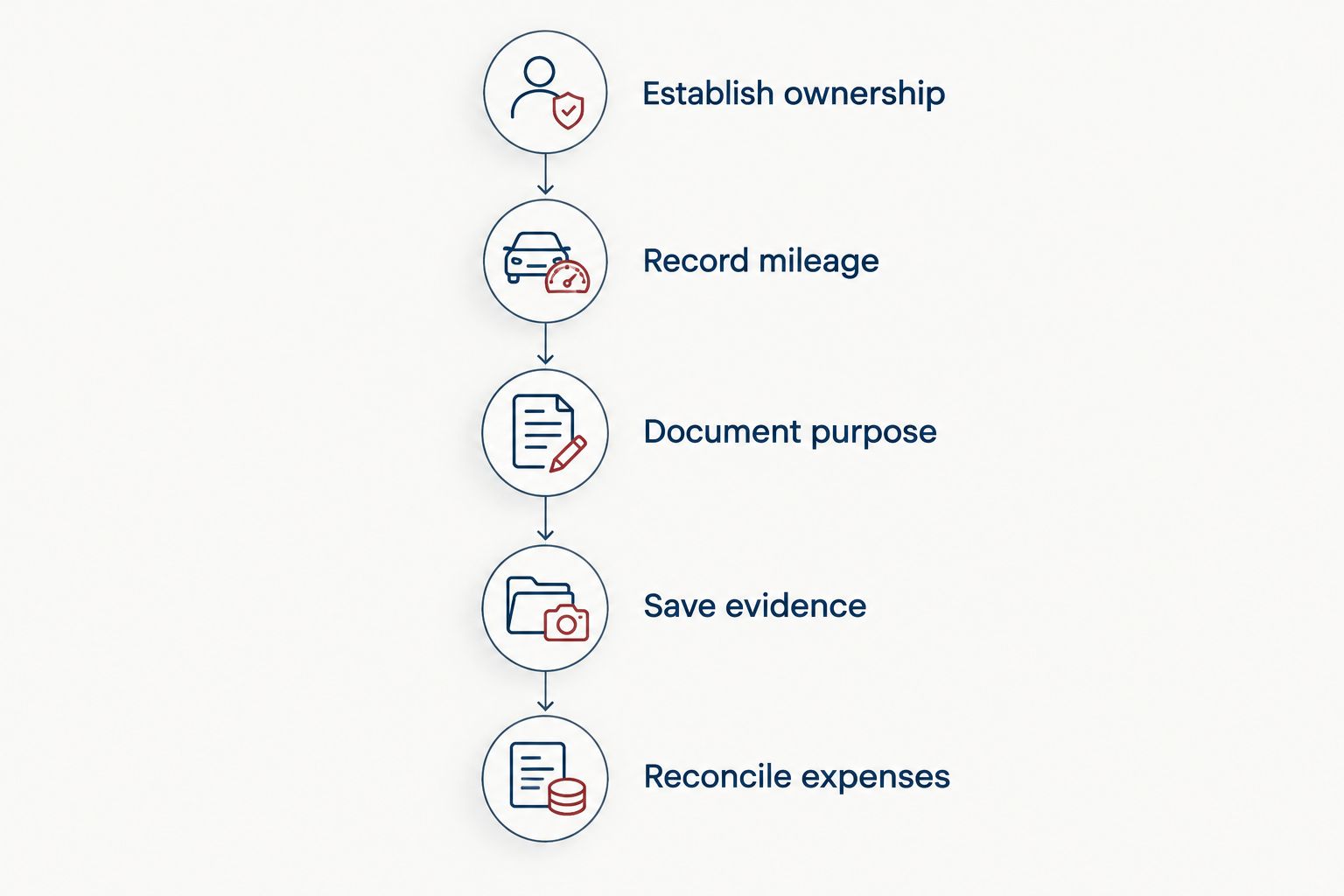
The deduction needs both a calculation and evidence of business use.
Does an LLC or S corporation change the deduction?
An LLC does not turn personal driving into business driving. For federal tax purposes, a single-member LLC taxed as a disregarded entity generally reports its owner's business vehicle expenses through the owner's business return.
An S corporation requires a different process. When you personally own the car and drive it for corporate business, a properly administered accountable reimbursement arrangement can reimburse substantiated eligible expenses without treating the reimbursement as wages.
The arrangement must have a business connection, require adequate substantiation, and require excess advances to be returned. Merely labeling a payment reimbursement does not satisfy those conditions.
If the corporation owns the car, personal use generally requires valuation and wage reporting unless an exclusion applies. Keep that issue separate from the corporation's deduction calculation.
Best for: S corporation owners using personally owned cars—a documented reimbursement process rather than informal transfers. The benefit is clear separation between corporate and personal spending; the trade-off is ongoing substantiation and administration.
What if the car is part of your on-camera identity?
A car-review business and a lifestyle creator who occasionally films inside a car do not present identical facts. The vehicle's actual role in production matters, but personal use still needs to be identified.
Keep evidence of the vehicle's business function: production schedules, sponsored deliverables, published work, and records linking the vehicle to specific assignments. A recognizable on-camera presence supports context; it does not replace the mileage log.
For a trip combining work and leisure, separate the transportation analysis from other travel expenses. A deductible shoot does not automatically make every meal, hotel night, or family activity deductible.
FAQ
Can content creators write off a car if they also drive it personally?
Yes, content creators can deduct eligible business use while excluding personal use. Maintain records of business and total mileage and apply the rules for the chosen deduction method.
Can I write off my car because it appears in every video?
No, appearing in videos does not automatically establish deductible vehicle use. Document the vehicle's business function and separate personal driving from qualifying business transportation.
Can I deduct gas if I already claim standard mileage?
No, fuel is already included in the standard mileage deduction. Eligible business parking and tolls can generally be deducted separately.
Do I need more than 50% business use to deduct any car expenses?
No, the more-than-50% qualified-business-use requirement concerns certain accelerated deductions, not every vehicle deduction. Eligible business transportation can still qualify under the applicable method when business use is lower.
Can I deduct driving from home to my filming studio?
Driving from home to a regular filming studio is generally nondeductible commuting. A home that qualifies as your principal place of business can change the treatment of travel to another work location in the same business.
Can my S corporation reimburse me for business mileage?
Yes, an S corporation can reimburse substantiated eligible business mileage under a properly administered accountable arrangement. The process must meet business-connection, substantiation, and excess-reimbursement requirements.
Can CEOHAVEN help with content creator vehicle deductions?
CEOHAVEN offers tax planning, tax preparation, and bookkeeping for content creators. Bring mileage records, ownership documents, vehicle expenses, and entity information so the deduction can be evaluated in context.
One last thing
The most useful vehicle tax decision can happen before you buy the car. Your first-year method election can restrict later choices, and personal use can change the value of accelerated depreciation.
Bring your expected driving pattern—not just a dealer invoice—to the planning conversation. For 2026, CEOHAVEN's tax planning and bookkeeping services are relevant to that decision: establish the business purpose, maintain the evidence, then claim the deduction the records support.