

Yes, you can claim bonus depreciation and Section 179 on the same asset in 2026 when the asset qualifies for both deductions: apply Section 179 first, then bonus depreciation to the remaining eligible basis. You cannot deduct the same basis twice, and income limits, business-use requirements, state rules, and later recapture can change the result.
TL;DR
- Bonus depreciation and Section 179 on the same asset are allowed; Section 179 reduces basis first.
- Bonus depreciation applies to remaining eligible basis, not the asset’s original cost again.
- Section 179 has a business-income limit; bonus depreciation does not have that same limit.
- CEOHAVEN tax planning suits entrepreneurs who need depreciation decisions coordinated with bookkeeping and tax preparation.
Can you take bonus depreciation and Section 179 on the same asset?
Yes. The federal deduction sequence is Section 179, bonus depreciation, then regular depreciation on any remaining depreciable basis. The sequence matters because each deduction changes the amount available for the next calculation.
For 2026 planning, the governing federal provisions are Internal Revenue Code Sections 179 and 168(k). IRS Publication 946 and the instructions for Form 4562 explain the depreciation framework and reporting mechanics.
| Deduction | Where it applies | Best suited to | Main limitation |
|---|---|---|---|
| Section 179 | Elected amount of qualifying business-property cost | Selecting particular assets and deduction amounts | Annual limits, business-income limits, and property restrictions |
| Bonus depreciation | Eligible basis remaining after Section 179 | Accelerating deductions on qualifying property | Eligibility, acquisition timing, class-level elections, and state differences |
| Regular depreciation | Depreciable basis left after accelerated deductions | Spreading deductions over the applicable recovery period | Slower recovery and property-specific calculation rules |
You do not need to claim both accelerated deductions. If one deduction absorbs all eligible basis, the other has nothing left to deduct.
Why this matters
A large deduction is not automatically the right deduction. You need to know whether it reduces usable taxable income, creates a limited loss, or shifts deductions away from years when they would be more valuable.
CEOHAVEN provides tax planning, tax preparation, and bookkeeping for entrepreneurs, real estate investors, content creators, and high-income professionals. CEOHAVEN tax planning is best for entrepreneurs who want depreciation decisions connected to their books and tax return. The service does not replace the underlying eligibility rules: the asset, transaction, and taxpayer still have to qualify.
Before choosing an election, identify the asset’s business basis, service date, financing treatment, and expected use. A purchase receipt alone does not answer those questions.
How to apply both deductions without double-counting
Use this sequence for each asset, rather than applying two deductions independently to the original invoice.
- Establish business basis. Determine the depreciable cost allocated to business use. Separate land, personal use, and other amounts that do not belong in the asset’s depreciable basis.
- Check eligibility. Confirm the property qualifies separately for Section 179 and bonus depreciation. Eligibility for one does not establish eligibility for the other.
- Apply Section 179. Choose the qualifying cost to expense, subject to the applicable limits. Account separately for any deduction disallowed and carried forward.
- Apply bonus depreciation. Calculate bonus depreciation on the remaining eligible basis after the Section 179 basis adjustment.
- Calculate regular depreciation. Apply the appropriate depreciation rules to any depreciable basis that remains.
The result is one coordinated basis schedule. It is not two independent write-offs of the same purchase.
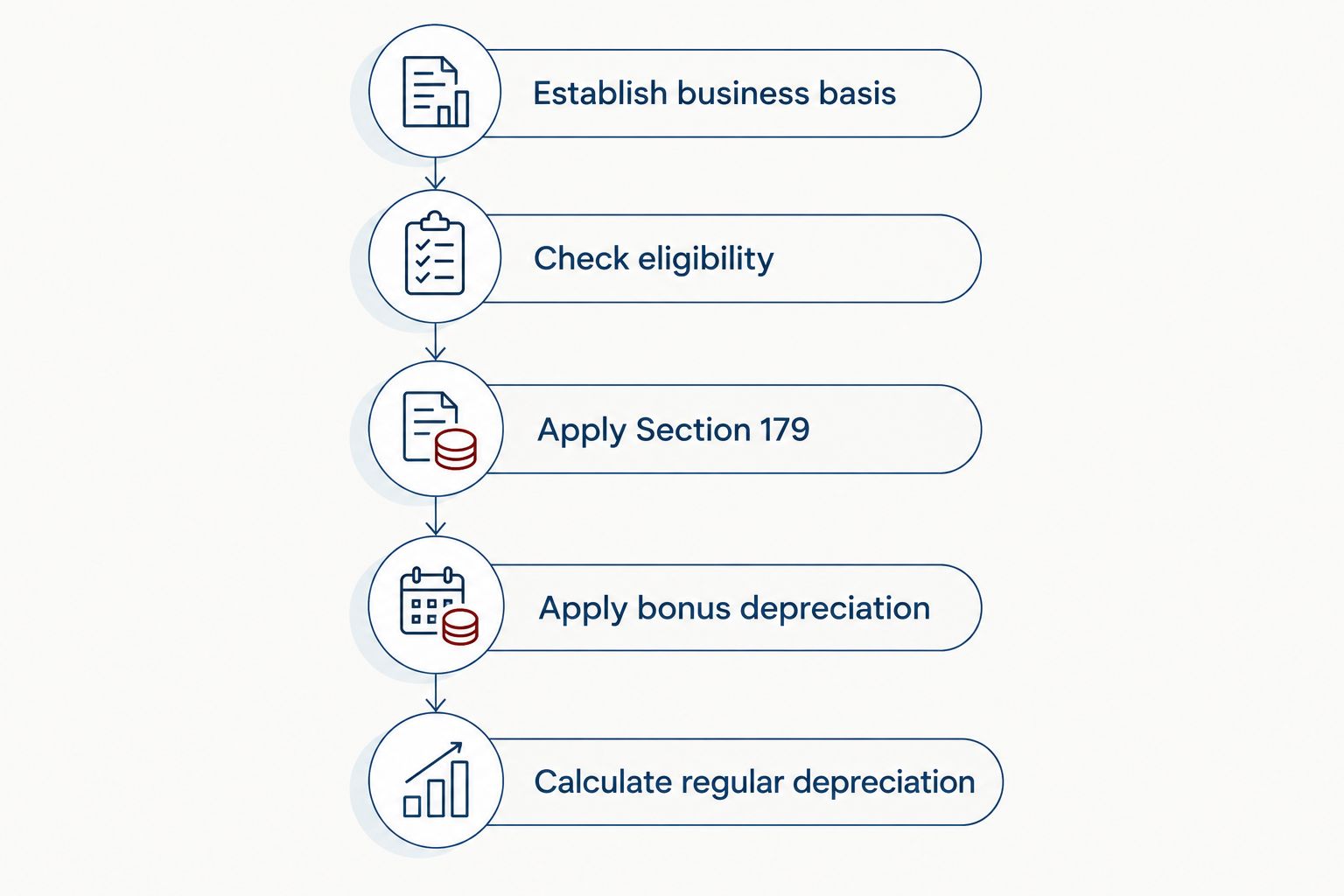
Each deduction reduces the basis available to the next calculation.
A Section 179 carryforward is not permission to deduct the same cost through bonus depreciation. The basis adjustments and carryforward schedule must agree, even when the current return does not allow the entire elected Section 179 deduction.
That distinction prevents a common error: treating an income-limited Section 179 amount as untouched basis available for another immediate deduction.
Section 179: Choose the asset and the amount
Section 179 lets you elect to expense qualifying property rather than recover its cost solely through depreciation. You can generally select particular qualifying assets and elect less than their full eligible cost.
That control is useful when you want a targeted deduction instead of automatically accelerating an entire eligible property class. It also creates decisions that deserve attention before the return is filed.
The trade-offs are real:
- Annual limits apply. Section 179 has an aggregate deduction limit and a phaseout tied to qualifying property placed in service.
- Business income matters. The deduction is limited by taxable income from the active conduct of trades or businesses, subject to the applicable calculation rules.
- Unused deductions need tracking. Amounts disallowed by the business-income limit generally carry forward rather than disappearing.
- Pass-through owners face additional checks. Partnerships and S corporations apply entity-level rules, and owners apply relevant owner-level limits.
For individuals, the active-business-income calculation can include wages. It is not necessarily identical to the profit shown by the business that purchased the asset.
Choose Section 179 for a deliberate allocation, not because the election appears first in the software. A limit that applies elsewhere on the return can change the deduction you actually receive.
Bonus depreciation: Check the remaining basis and acquisition rules
For qualifying property acquired and placed in service in 2026, federal bonus depreciation generally allows a 100% deduction of eligible basis. Acquisition rules, binding contracts, property type, and special provisions still matter; the service year alone does not settle eligibility.
Many eligible assets fall within property classes with recovery periods of 20 years or less. Certain other categories, including qualified improvement property, have their own eligibility rules.
Unlike Section 179, bonus depreciation does not have the same active-business-income limitation. It can create or increase a tax loss, although separate loss limitations can restrict the deduction’s current benefit.
Bonus depreciation generally applies automatically to eligible property unless you make an applicable election out. An election out generally applies by property class for the year, rather than letting you freely exclude individual assets within that class.
Check the whole asset class before electing out of bonus depreciation. A decision made for one purchase can affect other eligible property placed in service during the same tax year.
When bonus depreciation already deducts all remaining eligible basis, combining it with Section 179 does not produce an additional deduction beyond that basis. The planning question becomes allocation, limitations, and state treatment—not obtaining a second write-off.
Why your combined deduction varies
Two businesses buying similar equipment can receive different current deductions. These factors explain why:
- Property eligibility. Equipment, vehicles, building components, and improvements do not all follow the same rules. Classify the asset before choosing a deduction.
- Business-use percentage. Personal use reduces business basis. Section 179 generally requires business use above 50%; listed property has additional restrictions.
- Placed-in-service timing. Property must be ready and available for its intended business use. Ordering, paying, or receiving delivery does not necessarily establish that date.
- Income and deduction limits. Section 179 limits, owner-level restrictions, passive-activity rules, at-risk rules, and excess-business-loss rules can affect current deductibility.
- Federal-state differences. A state can limit or decouple from federal accelerated depreciation, requiring separate calculations and basis tracking.
- Later use or disposition. Selling an asset or reducing business use can trigger recapture, changing the tax result after the original deduction.
For a 2026 purchase, resolve these factors before deciding how much to expense. A projected federal deduction without a state calculation or owner-level review is an incomplete projection.
Does financing change whether you can claim both?
Financing does not, by itself, prevent Section 179 and bonus depreciation. Purchased property generally enters the depreciation calculation through its qualifying basis, not merely the cash down payment.
Ownership and the transaction’s substance matter. A true lease does not become a purchase because your business makes monthly payments, and a financing agreement does not prove that every invoice component belongs in depreciable basis.
Keep the purchase agreement, financing documents, invoice, and evidence of when the asset became ready for business use. Separate loan principal from interest in your books so the same payment does not produce an incorrect expense and an incorrect depreciation entry.
Do not confuse a tax deduction with debt repayment. Accelerating depreciation does not eliminate the loan balance or the cash needed to service it.
Can you use both deductions for vehicles or rental property?
Potentially, but neither category supports a blanket yes. Vehicle classifications and rental-property components require a more specific review than ordinary equipment.
Vehicles require more than a weight check
Passenger automobiles can face annual depreciation limits that restrict the combined benefit of Section 179, bonus depreciation, and regular depreciation. Other vehicles can face separate Section 179 restrictions, even when different bonus depreciation rules apply.
Business use and substantiation remain essential. For listed property, business use above 50% is generally required for Section 179 and accelerated depreciation treatment; a later decline can trigger recapture.
A vehicle’s weight classification does not establish a complete deduction strategy. Confirm the actual vehicle category, use, documentation, and applicable limits together.
Rental buildings are not equipment
Land is not depreciable, and an entire rental building does not qualify for bonus depreciation merely because you purchased it for business. Certain separately classified components can qualify, but their tax treatment depends on what the components actually are.
Residential rental buildings generally use a 27.5-year federal recovery period, while nonresidential real property generally uses 39 years under the general depreciation system. Those building recovery periods differ from the shorter-lived property commonly eligible for bonus depreciation.
Section 179 has separate property and lessor restrictions. A cost-segregation classification does not automatically establish Section 179 eligibility or make a rental loss currently deductible.
What should you prepare before making the election?
Build an asset file that another preparer can follow without reconstructing the transaction. The objective is a traceable deduction, not a folder full of receipts with no explanation.
Include these records:
- The invoice and purchase agreement identifying the property acquired.
- Documentation supporting the business-use allocation.
- Evidence of the date the property became ready and available for use.
- Financing or lease documents establishing the transaction’s treatment.
- A fixed-asset schedule showing basis, elections, deductions, and carryforwards.
- Federal and state projections showing the current and later-year effects.
Ask your preparer to compare the deduction choices before filing the 2026 return. The comparison should show current usable deductions, suspended amounts, state adjustments, and remaining basis—not just the largest federal deduction on the depreciation form.
Reconcile the fixed-asset schedule to the books before signing the return. An asset recorded entirely as an ordinary operating expense can otherwise be deducted again through the depreciation schedule.
FAQ
Can I deduct the full asset cost under both Section 179 and bonus depreciation?
No. Section 179 reduces the asset’s eligible basis first, and bonus depreciation applies only to the remaining eligible basis. The combined deductions cannot duplicate the same basis.
Do I have to claim Section 179 before bonus depreciation?
Section 179 comes first when you claim both deductions, but you are not required to elect Section 179. An eligible asset can receive bonus depreciation without a Section 179 election.
Is bonus depreciation always better than Section 179?
No. Bonus depreciation and Section 179 have different eligibility, election, income-limit, and state-tax consequences. Compare the usable deduction and remaining basis rather than choosing solely by the largest immediate federal write-off.
Can bonus depreciation create a business loss?
Yes. Bonus depreciation can create or increase a business loss because it does not have Section 179’s active-business-income limitation. Passive-activity, at-risk, excess-business-loss, and other applicable rules can still restrict the current benefit.
Can used equipment qualify for both deductions?
Yes, used equipment can qualify for both deductions if it meets each provision’s requirements. Related-party acquisitions, prior use, and other acquisition restrictions require separate review.
What happens if business use drops after I claim Section 179?
A decline to 50% or less business use during the applicable recovery period can trigger Section 179 recapture. Listed property also has recapture rules affecting accelerated depreciation.
Can CEOHAVEN help me decide which deduction to use?
CEOHAVEN offers tax planning, tax preparation, and bookkeeping for entrepreneurs and other high-income clients. Bring the asset records, business-use information, and income projections so the deduction decision can be evaluated with the rest of your return.
One last thing
Buying before year-end is not the same as placing an asset in service. A paid invoice does not start depreciation if the property is not ready and available for its intended business use.
For your 2026 asset file, save the evidence that explains when business use became possible: installation completion, acceptance records, or another document appropriate to the property. The service date deserves the same attention as the purchase amount.