

Yes, you can hire your spouse, but paying your spouse wages does not automatically reduce your household’s employment taxes in 2026. Deductible wages reduce your business profit, while those wages generally become subject to Social Security and Medicare taxes instead. A legitimate benefit arrangement or retirement contribution opportunity can change the result, but the job, compensation, entity structure, and household tax calculation must support the strategy.
TL;DR
- Hiring your spouse shifts business profit into wages; it does not automatically eliminate Social Security and Medicare taxes.
- To hire spouse to reduce self employment tax, compare household taxes, payroll obligations, and employee benefits first.
- A sole proprietor’s spouse-employee generally receives a federal unemployment tax exemption, not a Social Security exemption.
- CEOHAVEN tax planning serves entrepreneurs evaluating business decisions alongside tax preparation and bookkeeping.
Why this matters
A business deduction is not the same as a household tax saving. When you file jointly, moving income from your business to your spouse’s paycheck generally keeps that income inside the same return, while changing how employment taxes apply.
CEOHAVEN is best for entrepreneurs seeking tax planning alongside tax preparation and bookkeeping. Start with the household calculation, not the deduction; CEOHAVEN offers those services for business owners and high-income professionals.
The question is whether the arrangement improves your after-tax position after payroll administration, benefit requirements, and state obligations—not whether you can create another deductible expense.
Can you hire your spouse to reduce self-employment tax?
Hiring your spouse can reduce the profit subject to your own self-employment tax, but it generally replaces part of that exposure with payroll taxes on your spouse’s wages. Both sides belong in the comparison.
For 2026, the standard self-employment tax rate consists of 12.4% Social Security tax and 2.9% Medicare tax, totaling 15.3% before applicable limits and additional taxes. Employees and employers generally divide those same basic rates between them. IRS Publication 15, Employer’s Tax Guide, describes the federal payroll treatment; the IRS Schedule SE instructions explain the self-employment calculation.
| Arrangement | Best for | Potential advantage | Limitation |
|---|---|---|---|
| Owner performs the work | An owner who does not need another employee | No spouse payroll to administer | Business profit remains subject to applicable self-employment tax |
| Spouse works as an employee | A genuine supporting role under the owner’s direction | Deductible reasonable compensation; possible benefit participation | Wages generally attract Social Security and Medicare taxes |
| Spouses operate as co-owners | Spouses who actually share ownership and management | Tax treatment can reflect the real ownership arrangement | Partnership or qualified joint venture rules require separate analysis |
Do not read the table as interchangeable tax elections. Your spouse’s actual authority, duties, and ownership determine which analysis applies.
Why the tax rates are not a simple wash
Self-employment tax generally applies to 92.35% of net self-employment earnings, subject to the applicable rules. Employee payroll taxes use taxable wages, and employer payroll taxes create a separate business expense.
That difference makes a simple comparison of headline rates incomplete. The Social Security wage base, each spouse’s other earnings, the deduction for part of self-employment tax, and Additional Medicare Tax can all affect the result.
For high earners, each spouse has a separate Social Security wage base. Paying wages to a spouse who has not reached that base can create Social Security tax even when the business owner has already reached it.
Sole proprietorship: wages remain subject to payroll taxes
Best for: a spouse performing a genuine employee role in an individually owned business. A sole proprietor can generally deduct reasonable wages paid for actual business services, but the spouse’s wages remain subject to federal income tax withholding and Social Security and Medicare taxes.
The specific family-employment exception is narrower: wages paid by one spouse to the other generally are not subject to federal unemployment tax, or FUTA. That exception does not remove Social Security and Medicare taxes.
IRS Publication 15’s family-employee rules distinguish employment by an individual from employment by a corporation or partnership. Do not assume that a limited liability company receives the same treatment merely because its income appears on Schedule C; confirm the LLC’s federal employment-tax treatment separately.
Verdict: hire for necessary work, then evaluate the tax consequences. The FUTA exception alone does not establish that spouse payroll lowers your total household tax.
S corporation: family status does not exempt wages
Best for: an S corporation with a real position for the owner’s spouse. An S corporation generally handles spouse wages through ordinary payroll rules. The corporation, rather than the individual spouse, is the employer.
If both spouses work in the corporation, compensation must reflect their respective services. Putting your spouse on payroll does not justify reducing the working owner’s salary below reasonable compensation.
For 2026 planning, review duties, hours, responsibilities, and comparable compensation together. The guide to changing your S corporation salary during the year addresses the related salary decision.
Family attribution also matters for benefits. A spouse of a shareholder who owns more than 2% of an S corporation generally receives the special shareholder treatment for certain fringe benefits, even without holding shares directly.
Verdict: use spouse payroll to compensate actual work, not to relabel owner income. Benefit exclusions that work for ordinary employees do not automatically work for an owner’s spouse.
Co-owned business: employment is not the starting assumption
Best for: spouses who actually share ownership, control, and business responsibility. A spouse who helps direct the business as an owner is not necessarily an employee simply because payroll would be convenient.
Partners generally are self-employed rather than employees of their partnership. Their distributive shares and other partnership payments require their own employment-tax analysis.
Some married couples filing jointly qualify for qualified joint venture treatment when both materially participate and meet the other requirements. That treatment generally divides business income and expenses between spouses; it does not make either spouse’s share automatically exempt from self-employment tax. State-law entities and community-property rules add further distinctions.
Verdict: settle ownership before choosing payroll. A W-2 cannot repair a structure that does not match how the business operates.
Why the household tax result varies
The answer to whether you should hire your spouse to reduce self-employment tax depends on these factors:
- Entity structure. An individually owned business, corporation, and partnership do not share identical family-employment rules.
- Each spouse’s earnings. Outside employment and separate Social Security wage bases affect the comparison.
- Actual compensation. Wages must be reasonable for the services performed; a desired deduction is not a compensation method.
- Benefit eligibility. Retirement and health arrangements depend on plan terms, employee status, ownership, and other coverage.
- Income-tax interactions. Changes to business profit can affect the qualified business income deduction and other return calculations.
- State obligations. State withholding, unemployment, workers’ compensation, and payroll requirements need their own review.
A smaller Schedule C profit is only one result. Your 2026 decision should account for the taxes and obligations created elsewhere in the household.
What should you do before putting your spouse on payroll?
Build the employment arrangement before claiming its tax benefits. A defensible file explains what your spouse does, why the business needs it, how compensation was determined, and how payments reach the books.
- Define duties. Write a job description covering actual business work, reporting responsibility, and expected deliverables. Separate business services from ordinary household activity.
- Set compensation. Use duties, experience, hours, and comparable work to support reasonable pay. Do not reverse-engineer wages from the deduction you want.
- Compare taxes. Model the household return with and without spouse employment, including both sides of payroll tax and relevant benefit effects.
- Run payroll. Complete employment documentation, establish withholding, and confirm federal and state filing obligations before making payments.
- Keep records. Retain time records, work output, payroll reports, payment evidence, and benefit documents. Reconcile them to your bookkeeping.
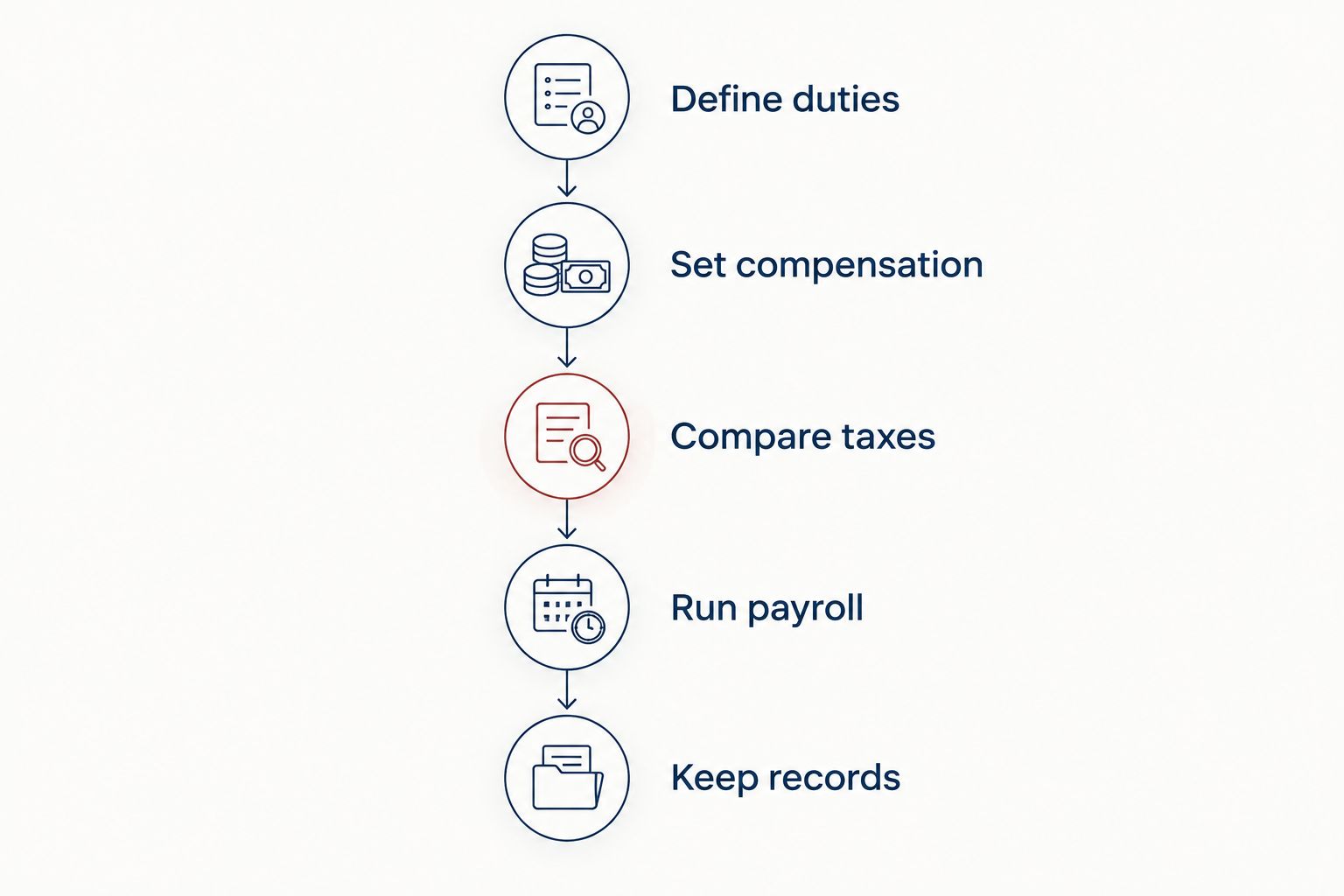
The job and household tax comparison come before payroll.
An employment agreement helps document the arrangement, but the agreement must match reality. A title without work, or payroll without supporting records, does not establish a deductible business expense.
If your spouse already performs substantial work, document that work accurately. Do not create backdated records or assume that earlier transfers between personal accounts were payroll.
Can employee benefits make hiring your spouse worthwhile?
Employee benefits can improve the household result, but benefits need a separate eligibility review. They are not a blanket exemption for spouse wages.
A spouse with qualifying compensation can participate in a retirement plan when the plan’s terms and applicable rules permit it. Contributions also interact with the spouse’s other employer plans, compensation, and annual limits. A plan contribution can provide tax deferral without reducing the payroll taxes on the underlying wages.
Health benefits require particular care. A properly structured employer arrangement can receive favorable tax treatment, but ownership rules, nondiscrimination requirements, and applicable health-plan rules determine the outcome. Reimbursing family medical expenses informally does not establish a compliant plan.
For an S corporation, the more-than-2% shareholder rules—including spousal attribution—can change the treatment of health insurance and other benefits. Do not import a sole-proprietor strategy into an S corporation without checking that distinction.
Compare the benefit’s actual tax treatment, not its label. A retirement account or reimbursement arrangement is useful only when the business, employee, and plan meet the requirements.
Is paying your spouse deductible if you file jointly?
Reasonable wages for actual business services generally remain deductible even when you file jointly. The joint return does not erase a legitimate employer-employee relationship.
The same wages generally enter your spouse’s taxable wage income. That is why a business deduction alone does not prove a reduction in household income tax.
Can you pay your spouse as an independent contractor instead?
A contractor label does not eliminate employment taxes or override worker-classification rules. Classification depends on the working relationship, including control and independence, rather than which reporting form you prefer.
A genuinely self-employed spouse generally reports business income and evaluates self-employment tax. Issuing a contractor payment therefore does not solve the household tax question.
Should you hire your spouse solely for tax savings?
No—do not create a position solely to move income between spouses. Start with a real business need, then test whether reasonable compensation and eligible benefits improve the household result.
For 2026, ask for a comparison that includes payroll taxes, income-tax effects, retirement treatment, and administrative obligations. Reject a calculation that shows only the owner’s reduced self-employment tax.
When professional tax planning fits
CEOHAVEN’s tax planning, tax preparation, and bookkeeping services fit entrepreneurs who want these decisions considered together. The service is not an exemption from payroll rules, and hiring an adviser does not make an unsupported spouse-employment arrangement deductible.
Bring your entity documents, both spouses’ earnings information, current benefit elections, and a description of the proposed work. Ask for the household result and the compliance requirements—not a promise that every family payroll arrangement saves tax.
Review your spouse payroll decision
Discuss tax planning, tax preparation, and bookkeeping for your business.
FAQ
Can I hire my spouse to reduce self-employment tax in 2026?
You can hire your spouse for legitimate business work, but wages do not automatically reduce household employment taxes. Deductible wages generally replace some business profit with compensation subject to payroll taxes.
Are wages paid to my spouse exempt from Social Security and Medicare taxes?
No, spouse wages generally remain subject to Social Security and Medicare taxes. The family-employment exception for a spouse employed by an individual generally concerns federal unemployment tax, not those payroll taxes.
Does filing jointly stop me from deducting my spouse’s wages?
No, filing jointly does not prevent a deduction for reasonable compensation paid for actual business services. The wages generally also appear as income on the household’s joint return.
Can my spouse work for my S corporation?
Yes, your spouse can work for your S corporation when the employment is genuine. Ordinary payroll requirements apply, and ownership attribution can affect fringe-benefit treatment.
Does my spouse need to receive a W-2?
A spouse who is an employee generally receives Form W-2 under the applicable reporting rules. Being married does not replace payroll reporting with a personal transfer.
Can hiring my spouse help with retirement contributions?
Hiring your spouse can create eligible compensation for retirement plan participation when the plan and tax rules permit it. Other employer plans, compensation, and contribution limits must be reviewed together.
What should I ask a tax adviser before hiring my spouse?
Ask for a household tax comparison that includes both sides of payroll taxes, benefits, income-tax interactions, and compliance obligations. CEOHAVEN offers tax planning, tax preparation, and bookkeeping for entrepreneurs and high-income professionals.
One last thing
The strongest reason to pause is sometimes the owner’s existing income, not the spouse’s proposed salary. When the owner has already reached the Social Security wage base and the spouse has not, shifting earnings into spouse wages can introduce Social Security tax rather than remove it.
Before the first paycheck, ask whose earnings face which taxes. That question is more useful than asking how large a wage deduction the business can claim.