

Yes, you can do cost segregation on residential rental property to identify eligible components that depreciate faster than the building’s standard 27.5-year recovery period. For 2026 planning, the critical caveat is that faster depreciation does not automatically create a deduction you can use against salary or business income; passive activity rules and other loss limitations still apply.
TL;DR
- Cost segregation on residential rental property accelerates eligible depreciation; land remains nondepreciable.
- Residential rental buildings generally use 27.5 years; eligible components can use shorter recovery periods.
- Passive activity rules can suspend rental losses instead of reducing current salary income.
- CEOHAVEN offers real estate investors tax planning, tax preparation, and bookkeeping—not just return filing.
Why this matters
A large depreciation deduction and a lower current tax bill are not the same result. If your rental losses are suspended, accelerating depreciation changes your tax records without necessarily changing your current payment.
Decide whether you can use the deduction before commissioning the study. Then connect the findings to your fixed-asset schedule, tax return, and supporting records. The workflow for connecting rental property software to cost segregation addresses that accounting handoff.
For a 2026 decision, compare the timing benefit with the study expense, additional tax preparation work, state treatment, and expected sale. A deduction deserves a model, not applause.
Can you do cost segregation on a residential rental property?
Yes. Residential rental status does not prevent cost segregation. A study separates the depreciable property into components with supportable tax classifications rather than treating every depreciable dollar as part of the building.
IRS Publication 527, Residential Rental Property, explains the federal depreciation framework for rental buildings and separate assets. IRS Publication 946, How To Depreciate Property, addresses recovery periods and depreciation methods. The IRS Cost Segregation Audit Technique Guide describes examination considerations and study documentation; it is not approval of any particular study.
| Asset classification | General federal recovery treatment | Main benefit | Main limitation |
|---|---|---|---|
| Residential rental building | Generally 27.5 years under the general depreciation system | Spreads building deductions over time | Does not accelerate eligible shorter-lived assets if everything is grouped together |
| Qualifying personal property | Often 5 or 7 years, depending on the asset | Recovers eligible basis sooner | Requires a defensible classification and allocation |
| Qualifying land improvements | Often 15 years | Separates eligible improvements from the building | Not every exterior expenditure qualifies |
| Land | Not depreciable | Keeps the basis allocation accurate | Produces no depreciation deduction |
These are general classifications, not permission to assign every appliance, installation, or outdoor feature the same treatment. Alternative depreciation system requirements can change applicable recovery periods.
Residential rental building: generally 27.5 years
The residential rental building generally remains on a 27.5-year schedule under the general depreciation system. Cost segregation does not turn the entire house or apartment building into short-lived property.
Structural components, including a building’s general electrical and plumbing systems, generally remain part of the building. An asset’s function matters more than whether a contractor invoiced it separately.
Best for: the building structure and components that properly belong to it. The advantage is straightforward treatment; the limitation is slower cost recovery than eligible shorter-lived assets receive.
If your property must use the alternative depreciation system, do not copy the standard schedule into the analysis. Confirm the applicable method before comparing deductions.
Qualifying personal property: often 5 or 7 years
Separate rental assets, such as appliances and certain carpeting, can qualify for shorter recovery periods. A cost segregation analysis identifies eligible property and supports how much of the property’s depreciable basis belongs to it.
The classification does not follow your preferred tax outcome. A separately identified asset still needs the correct recovery period, method, and supporting cost allocation.
Best for: identifiable personal property with documented costs or defensible allocated basis. Faster recovery is the benefit; classification errors and incomplete records are the trade-offs.
For 2026, also evaluate bonus depreciation separately. Eligibility depends on the asset, acquisition and placed-in-service facts, applicable law, and elections—not merely on the existence of a cost segregation report.
Qualifying land improvements: often 15 years
Certain improvements outside the building, such as qualifying parking areas, fencing, and landscaping, can fall into a 15-year asset class. The land underneath them remains nondepreciable.
An exterior location alone does not establish the classification. Work connected to the building, land preparation, and later improvements require analysis of what the expenditure actually created.
Best for: separately identifiable qualifying land improvements. The benefit is faster recovery than the residential building schedule; the limitation is the need to distinguish improvements from land and building costs.
Do not apply a standard allocation percentage to every property. A rental house with limited exterior improvements and an apartment property with extensive paved areas present different facts.
How do you decide whether a study is worth doing?
Use this sequence before authorizing a report. The decision starts with usable deductions and ends with filing—not the other way around.
- Establish basis. Assemble closing documents, the land allocation, improvement records, and the existing depreciation schedule. Reconcile the tax basis before reallocating it.
- Test loss usability. Determine whether additional depreciation would offset passive income, qualify for another permitted deduction, or become a suspended loss. Include applicable basis, at-risk, and excess business loss limitations.
- Model the exit. Compare keeping the property with the expected sale. Include reduced adjusted basis and potential depreciation recapture rather than modeling only the first deduction.
- Coordinate filing. Confirm how the study enters the return, whether an accounting method change is needed, and how the asset records will be maintained.
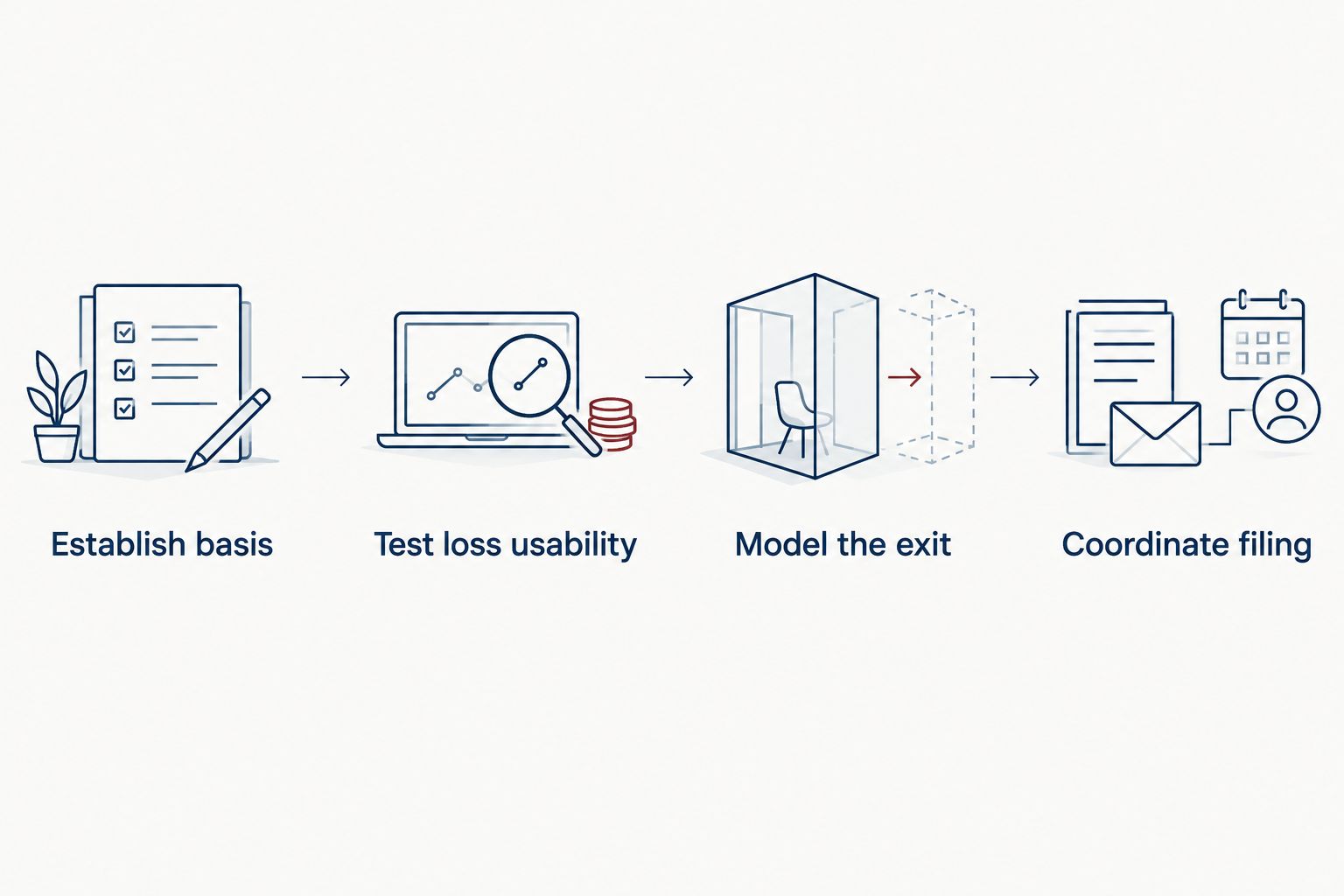
Test whether the deduction is usable before paying for a report.
Ask for a written comparison of the existing depreciation schedule and the proposed treatment. That comparison should distinguish additional depreciation from the portion that actually reduces current tax.
Proceed when the documented, usable timing benefit supports the added work. Defer when the analysis depends on unsupported allocations or treats suspended losses as immediate cash savings.
Why cost segregation results vary
There is no reliable universal savings percentage for residential rentals. Your result depends on the property and your return.
- Depreciable basis: Land is excluded, and prior depreciation affects the remaining tax position.
- Asset composition: The amount properly assigned to shorter-lived components depends on what the property contains.
- Placed-in-service facts: Depreciation begins when property is ready and available for its rental use, not automatically on the closing date.
- Loss limitations: Passive activity, basis, at-risk, and excess business loss rules affect current deductibility.
- Holding period: A planned sale changes the value of acceleration and the relevance of recapture.
- State treatment: State conformity and adjustments can produce a different result from the federal return.
For 2026 planning, ask for the federal and state outcomes separately. A federal deduction is not evidence that your state allows identical treatment.
Can you do cost segregation after owning the rental for years?
Yes, an existing rental can be evaluated after its original placed-in-service year. Prior ownership does not by itself disqualify the property, but the correction procedure matters.
A qualifying change in depreciation treatment can require Form 3115, Application for Change in Accounting Method, and a section 481(a) adjustment. That adjustment accounts for the difference between depreciation under the old and new methods; it is not a second deduction for the same basis.
Do not assume that amending an earlier return is always the correct route. The answer depends on the filing history, the type of error or method change, and the applicable procedures in the Form 3115 instructions.
For a previously owned rental reviewed in 2026, bring every available depreciation schedule. A report built without the prior deductions can produce an incorrect catch-up calculation.
Can rental cost segregation reduce taxes on W-2 income?
Not automatically. Rental real estate losses are generally passive, even when the owner handles meaningful management work. Passive losses generally do not offset wages.
IRS Publication 925, Passive Activity and At-Risk Rules, explains the relevant limitations and exceptions. The special allowance for qualifying active participation is subject to income limitations, so high earners should not assume it applies.
Real estate professional status requires more than 750 hours of qualifying services and more than half of your personal service time in qualifying real property trades or businesses. Material participation in the relevant rental activity must also be established; the status alone does not make every rental loss nonpassive.
Short-term rental activities can have different passive activity treatment depending on average rental periods, services, and participation. A listing platform does not determine your tax classification.
What should your tax adviser handle?
CEOHAVEN is best for real estate investors seeking tax planning, tax preparation, and bookkeeping together. Those services connect the deduction decision with the return and the records behind it.
The limitation is equally important: tax consulting is not a substitute for a defensible asset classification report. Confirm who prepares the study, what documentation supports the allocations, and who handles questions about the methodology.
Ask CEOHAVEN to evaluate the tax position before you treat an estimated depreciation amount as spendable cash. Your decision file should include:
- A reconciled basis and land allocation.
- A supported asset classification schedule.
- A current-year loss limitation analysis.
- Federal and state projections.
- The filing procedure and an updated depreciation schedule.
No adviser can make a suspended loss currently deductible merely by presenting a larger study result. The work is deciding which deductions belong on your return and when they matter.
FAQ
Can I use cost segregation on a single-family rental house?
Yes, a single-family rental house can qualify for cost segregation. The analysis must separate eligible shorter-lived components from the building and exclude land; eligibility alone does not establish that a study is worthwhile.
Does cost segregation increase my property's tax basis?
No, cost segregation generally reallocates existing depreciable basis among asset classes rather than increasing total basis. Separate capital improvements can affect basis, but the study itself does not create additional property cost.
Do I need to buy another rental in 2026 to use cost segregation?
No, you do not need to buy another rental in 2026 to evaluate cost segregation. An existing rental can qualify, with the filing treatment determined by its depreciation history and applicable accounting method rules.
Is every component identified in a study eligible for bonus depreciation?
No, identifying a component in a study does not automatically make it eligible for bonus depreciation. The asset must independently satisfy the applicable requirements, and the residential rental building itself does not qualify merely because a study was completed.
What happens when I sell a rental after cost segregation?
Selling after cost segregation requires accounting for adjusted basis and the character of gain on the assets sold. Some depreciation can be subject to ordinary-income recapture, while other gain follows different rules; the treatment depends on the asset classification and sale facts.
Can CEOHAVEN help me decide whether to pursue cost segregation?
CEOHAVEN offers tax planning, tax preparation, and bookkeeping for real estate investors. Use that planning discussion to evaluate deduction usability and filing consequences, and confirm the scope of any separate cost segregation study.
One last thing
A larger deduction can be a smaller decision than it looks. If you cannot currently use the loss, the report’s headline depreciation amount is not your immediate tax savings.
Before proceeding, request a projection showing three distinct outcomes: additional depreciation, currently deductible loss, and the resulting change in tax. Keep the projected sale treatment beside them. That is how you distinguish a useful timing strategy from an impressive-looking schedule.