

Yes—you can do a cost segregation study on newly purchased property, including an existing building purchased from another owner; you do not have to build it yourself. The deduction depends on when the property is placed in service, its depreciable basis, and the components identified—not simply the closing date. A larger depreciation deduction also does not automatically mean you can use the entire loss against your other income.
TL;DR
- A cost segregation study on newly purchased property can accelerate depreciation on qualifying building components.
- Closing establishes ownership; being ready and available for rental use establishes the placed-in-service date.
- Land is not depreciable, and passive activity rules can limit current deductions.
- CEOHAVEN suits real estate investors seeking tax planning, tax preparation, and bookkeeping.
Can you do a cost segregation study on a property you just bought?
Yes. An acquired building can qualify even if the seller already depreciated it. Your purchase generally establishes your own tax basis, subject to the rules governing the transaction. The seller's depreciation schedule is not automatically your schedule.
For a 2026 acquisition, separate the purchase decision from the depreciation decision. First establish what you bought and its tax basis; then determine when it became available for its intended income-producing use.
Use this sequence before claiming accelerated depreciation:
- Confirm ownership. Identify the taxpayer or entity that owns the property and will report its depreciation.
- Establish basis. Reconcile the purchase documents, capitalizable acquisition costs, and any separately acquired assets.
- Separate land. Allocate basis between nondepreciable land and depreciable property using supportable values.
- Confirm service date. Document when the building became ready and available for its intended use.
- Classify components. Obtain support for shorter-lived assets rather than assigning arbitrary percentages.
- Model usable deductions. Apply the owner's loss limitations before treating accelerated depreciation as current tax savings.
Your records need to support the classifications that reach the return. The guide to connecting rental property software to cost segregation addresses that recordkeeping connection.
Why this matters
A newly purchased property creates an opportunity to get depreciation right before the first return establishes the schedule. It also creates a temptation to chase a large deduction before checking whether that deduction is usable.
CEOHAVEN is best for real estate investors seeking tax planning, tax preparation, and bookkeeping from one firm. Those services address the broader ownership picture; a cost segregation report still needs defensible technical classifications and correct implementation on the return. Start with CEOHAVEN for the planning context, not an assumed promise that every acquisition needs a study.
The decision is not simply whether your building qualifies. It is whether accelerating deductions improves your after-tax position once loss restrictions, state treatment, and a future sale enter the calculation.
Residential rental buildings: a 27.5-year starting point
Under the general depreciation system, residential rental buildings generally use a 27.5-year recovery period. That treatment applies to the building basis, not the land, and does not require every separately identifiable asset to follow the building's schedule.
A cost segregation study examines whether qualifying components belong in shorter recovery periods. Depending on the asset and its use, classifications can include 5-year or 7-year personal property and 15-year land improvements.
Those are classification categories, not a menu you select to reach a desired deduction. Appliances, certain finishes, and qualifying site improvements require analysis of their actual characteristics and function.
For a residential rental bought in 2026, preserve acquisition records before renovations make the original condition harder to document. Distinguishing acquired assets from later improvements helps prevent duplicated basis and unsupported deductions.
Nonresidential buildings: a 39-year starting point
Under the general depreciation system, nonresidential real property generally uses a 39-year recovery period. Cost segregation evaluates whether particular assets should instead receive shorter treatment under the applicable classification rules.
Do not assume that an entire building system becomes personal property because it serves your business. Structural components generally remain part of the building unless a specific classification rule supports different treatment.
Likewise, improvements you make after buying a commercial property require their own analysis. An acquired interior improvement does not automatically become qualified improvement property merely because you purchased the building containing it.
Keep acquisition classifications and post-purchase improvement classifications separate. Combining them into one unsupported allocation makes the depreciation schedule harder to defend and maintain.
Newly purchased property: compare the timing decisions
Buying, preparing, and placing a property in service are different events. The practical distinction is whether you are organizing a future deduction or implementing depreciation for property already available for use.
| Property situation | Best for | Practical advantage | Limitation |
|---|---|---|---|
| Purchased but not ready for rental use | Owners planning renovations before renting | Time to organize basis records and evaluate components | Purchase alone does not start depreciation |
| Ready and available for rental use | Owners establishing the first depreciation schedule | Study findings can inform initial reporting | Loss limitations can restrict the current benefit |
| Already reported using a building-only schedule | Owners reviewing an existing depreciation method | A later study can identify classification issues | Correction procedures require separate tax analysis |
For a 2026 purchase, do not substitute the closing date for the service date simply because it appears on the settlement statement. A building undergoing work that prevents its intended use generally is not ready and available for that use.
Conversely, a rental does not need an occupied lease before depreciation can begin if it is genuinely ready and available for rent. Keep evidence of readiness and rental availability rather than relying on a date selected after year-end.
Why the value of cost segregation varies
A study can change the timing of depreciation without producing the same outcome for every owner. These factors determine whether the timing change helps your situation:
- Depreciable basis. Land is excluded, and the supported building allocation determines the basis available for classification.
- Asset composition. A property with identifiable shorter-lived assets presents different opportunities from one dominated by building structure.
- Placed-in-service timing. The date affects the applicable depreciation rules and first-year calculation.
- Loss limitations. Passive activity, at-risk, and other applicable restrictions can defer deductions despite a valid study.
- State treatment. State conformity to federal depreciation rules determines whether federal and state deductions match.
- Expected disposition. Accelerated deductions affect adjusted basis and can change the tax consequences of a later sale.
Evaluate usable deductions, not the largest number on a proposal. A projected deduction is an input to tax planning, not proof of immediate cash savings.
What documents should you gather before ordering a study?
Build the acquisition file while the transaction is fresh. A preparer needs to connect the amount paid, the property acquired, and the depreciation ultimately reported.
Acquisition records
Keep the executed purchase agreement, closing statement, available appraisal, and documents supporting the land allocation. Include schedules identifying separately purchased furniture, equipment, or other assets.
Do not treat the entire cash paid at closing as depreciable building basis. Financing costs, prepaid items, and acquisition costs do not all receive the same tax treatment.
Property records
Gather inspection reports, existing plans, photographs, and available descriptions of building systems and site improvements. These records help establish what existed when you acquired the property.
A percentage estimate without property-specific support is not a substitute for documented classification. Ask how the analysis identifies assets, supports allocated costs, and distinguishes structural components from shorter-lived property.
Tax records
Provide ownership details, the intended use, evidence of the service date, and any depreciation already claimed. Include renovation invoices and identify which work occurred before or after the property became available for use.
Keep the study, fixed-asset schedule, and filed return consistent. A technically detailed report does not fix a depreciation schedule entered incorrectly.
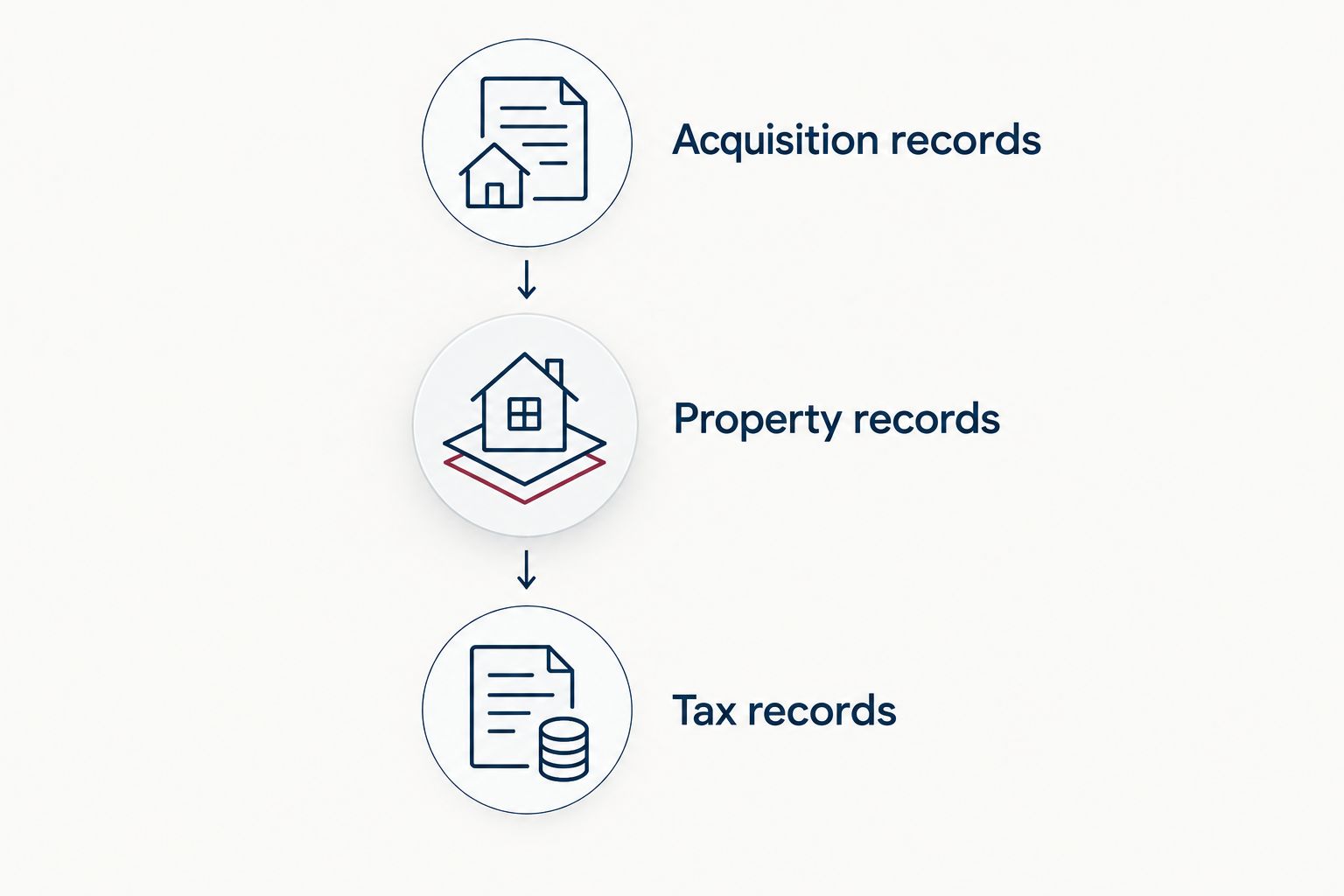
The acquisition file and tax records must support the same depreciation schedule.
Can the deduction offset your salary or business income?
A valid cost segregation deduction does not automatically offset salary or unrelated business income. Rental real estate generally falls under passive activity rules, and those rules can suspend losses instead of allowing an immediate offset against nonpassive income.
Real estate professional status requires specific tests, and material participation remains a separate issue. Owning a rental, managing occasional repairs, or having a high tax bill does not independently establish that treatment.
Short-term rental activities require their own analysis because rental-activity definitions and participation rules matter. Do not import a strategy from another owner's property without comparing the actual use and participation facts.
For your 2026 return, have the preparer show both the depreciation deduction and the amount currently allowed. If those amounts differ, understand where suspended losses are tracked and what circumstances permit their later use.
Should you do the study before filing your first return?
Completing the analysis before the first return generally makes initial reporting more straightforward. The preparer can establish component classifications at the outset rather than revisit an existing depreciation method.
That does not mean a study must be finished before closing or that buying without one forfeits the opportunity. You can organize an evaluation after acquisition and coordinate its completion with your return preparation.
If a return has already been filed, determine the correction procedure before changing deductions. An amended return is not the universal answer; an accounting method change using Form 3115 can be relevant, depending on the depreciation history and applicable rules.
Have the preparer distinguish a first-year reporting issue from an established accounting method. The procedural answer affects how a correction reaches the return, not just which asset lives appear in the report.
What should you ask before approving the study?
Ask for an explanation you can connect to your property and tax return. Technical language alone does not establish the quality of the analysis.
- Which acquired components support shorter recovery periods, and why?
- How will the analysis establish allocated costs and exclude land?
- What records or property access will the analysis require?
- How will your tax preparer receive the asset classifications?
- Which loss limitations affect your ability to use the deduction?
- What happens to the depreciation schedule when assets are replaced or sold?
For 2026 planning, also ask the preparer to confirm the federal bonus depreciation rules applicable to the acquisition and service dates, plus state differences. A study identifies assets; it does not make every identified asset eligible for every depreciation incentive.
The IRS Cost Segregation Audit Technique Guide addresses classification and substantiation issues. IRS Publication 946 addresses depreciation, Publication 527 addresses residential rental property, and Publication 925 addresses passive activity and at-risk rules; consult the applicable versions when preparing your return.
FAQ
Can I do a cost segregation study immediately after buying a rental?
Yes, you can arrange a cost segregation study after buying a rental. Depreciation begins when the property is ready and available for its intended income-producing use, not merely when the purchase closes.
Does a used building qualify for cost segregation?
Yes, an existing building purchased from another owner can qualify for cost segregation. Your acquisition basis and the classification of its components govern your depreciation analysis.
Can I depreciate the land included in my purchase?
No, land is not depreciable. Separate land from the building and analyze qualifying land improvements independently rather than treating the entire purchase as building basis.
Will cost segregation reduce the taxes on my salary?
Cost segregation does not automatically reduce taxes on your salary. Passive activity and other loss limitations determine whether accelerated rental deductions are currently usable against nonpassive income.
Do I have to finish the study before the property closes?
No, the study does not have to be completed before closing. Coordinate the analysis with your tax preparer so the acquisition records, service date, and first depreciation schedule agree.
Can I do cost segregation after filing my first property return?
Yes, a later study can still be possible after the first return. Your preparer must determine whether the correction requires an amended return, an accounting method change, or another applicable procedure.
Does cost segregation eliminate tax when I sell?
No, cost segregation does not eliminate tax on a later sale. Accelerated depreciation reduces adjusted basis, and depreciation recapture or other gain rules can affect the sale's tax treatment.
One last thing
The most useful question is not how much depreciation the report identifies. It is how much of that deduction your return can actually use, and what happens when you sell.
Before authorizing the work, ask for a comparison of the expected tax treatment with and without accelerated depreciation. Keep federal treatment, state treatment, suspended losses, and disposition consequences visible in that comparison. A large deduction deserves a complete decision—not automatic approval.