

Yes, you can complete a 1031 exchange on a short term rental when both the property you sell and the replacement real estate are held for investment or productive use in a business. Short guest stays do not disqualify the real estate; personal use, investment intent, and exchange execution determine whether it qualifies. The exchange defers eligible gain rather than erasing it, and cash received or nonqualifying assets can still create current tax.
TL;DR
- A 1031 exchange on short term rental real estate requires qualifying investment or business use—not merely a rental listing.
- The IRS dwelling-unit safe harbor uses 24-month ownership periods, rental-day requirements, and personal-use limits.
- Identify replacement property within 45 days; the completion deadline is generally 180 days, subject to your return deadline.
- CEOHAVEN offers tax planning for real estate investors; exchange execution also requires a properly structured transaction.
Why this matters
A vacation rental can produce income and still carry a personal-use problem. A booking calendar alone does not establish that you held the property for investment, particularly when your family regularly occupies it.
For a 2026 sale, separate the property's qualifying use from the exchange mechanics before signing closing instructions. The broader tax strategy for short-term rental hosts also includes income reporting and depreciation, but those questions do not replace the Section 1031 eligibility test.
Can you do a 1031 exchange on a short-term rental property?
Yes. Section 1031 focuses on qualifying real property and its use, not the length of each guest's reservation. A short-term rental held for investment or business use can be exchanged for other qualifying real estate, including a long-term rental.
The governing sources are Internal Revenue Code Section 1031, IRS Revenue Procedure 2008-16 for the dwelling-unit safe harbor, and IRS Publication 544 for exchange rules. Apply them separately: eligibility does not excuse a missed deadline, and meeting a deadline does not establish investment use.
| Property situation | Best fit for exchange planning | Supporting facts | Main limitation |
|---|---|---|---|
| Short-term rental with no personal stays | Investors maintaining documented rental operations | Paid bookings, operating records, and investment intent | Exchange structure and deadlines still apply |
| Short-term rental with occasional personal stays | Owners who can document the dwelling-unit safe harbor | Required ownership, fair-market rental days, and limited personal use | Each relevant annual period must satisfy the safe-harbor tests |
| Primarily personal vacation home | Owners evaluating whether genuine investment conversion is possible | Actual rental use and evidence of changed purpose | Occasional rentals do not establish qualifying investment intent by themselves |
| Property held primarily for resale | Sellers assessing alternatives to an exchange | Acquisition purpose and resale activity | Real property held primarily for sale is excluded from Section 1031 |
A personal residence does not become exchange property because you publish a listing before selling. The property's actual use and holding purpose must support the position you take.
Dwelling-unit safe harbor: 24 months of ownership
IRS Revenue Procedure 2008-16 provides a safe harbor under which the IRS will not challenge a dwelling unit's investment or business holding purpose for Section 1031. The rules differ depending on whether you are selling the property or acquiring it as replacement property.
For the relinquished property, you must own it for at least 24 months immediately before the exchange. In each of the two preceding 12-month periods:
- You must rent the dwelling to another person at fair rental value for 14 days or more.
- Your personal use must not exceed the greater of 14 days or 10% of the days rented at fair rental value.
For the replacement property, you must own it for at least 24 months immediately after the exchange. The same rental-day minimum and personal-use limit apply separately to each of the two following 12-month periods.
These periods are measured around the exchange, not automatically by calendar year. A strong rental season in one period does not cure a failure in the other.
For a 2026 transaction, build the safe-harbor review from dated occupancy records. Do not substitute annual revenue totals for rental-day evidence.
What counts as personal use?
Personal use generally includes your own vacation stays and certain stays by family members or people paying less than fair rental value. Special rules and exceptions apply, including rules for qualifying repair and maintenance days.
Keep a calendar distinguishing paid rentals, personal stays, and documented maintenance work. Charging a relative does not automatically make the stay a qualifying rental day; the family-use rules need their own review.
Does missing the safe harbor automatically disqualify the exchange?
No. The safe harbor is a protected route, not the only possible route to establishing investment or business use. Outside it, eligibility depends on the facts and circumstances.
That distinction is not permission to ignore personal use. If you fall outside the safe harbor, have your adviser assess the evidence before you commit to the exchange rather than treating a rental listing as sufficient proof.
Exchange deadlines: 45 days and generally 180 days
A standard deferred exchange has separate identification and completion deadlines. Neither pauses while you negotiate financing, inspect a property, or resolve a title issue.
- Before closing: Engage a qualified intermediary and establish the exchange documents before transferring the relinquished property. Structure the transaction so you do not receive or control the sale proceeds.
- Within 45 days: Identify replacement property in a signed writing delivered to the appropriate exchange party. Follow the applicable identification rules; a private wish list is not enough.
- By the completion deadline: Receive the replacement property by the earlier of 180 days after the transfer or the due date of your federal income tax return for the transfer year, including extensions.
- At reporting: Report the exchange on IRS Form 8824 and reconcile the transaction with your depreciation and basis records.
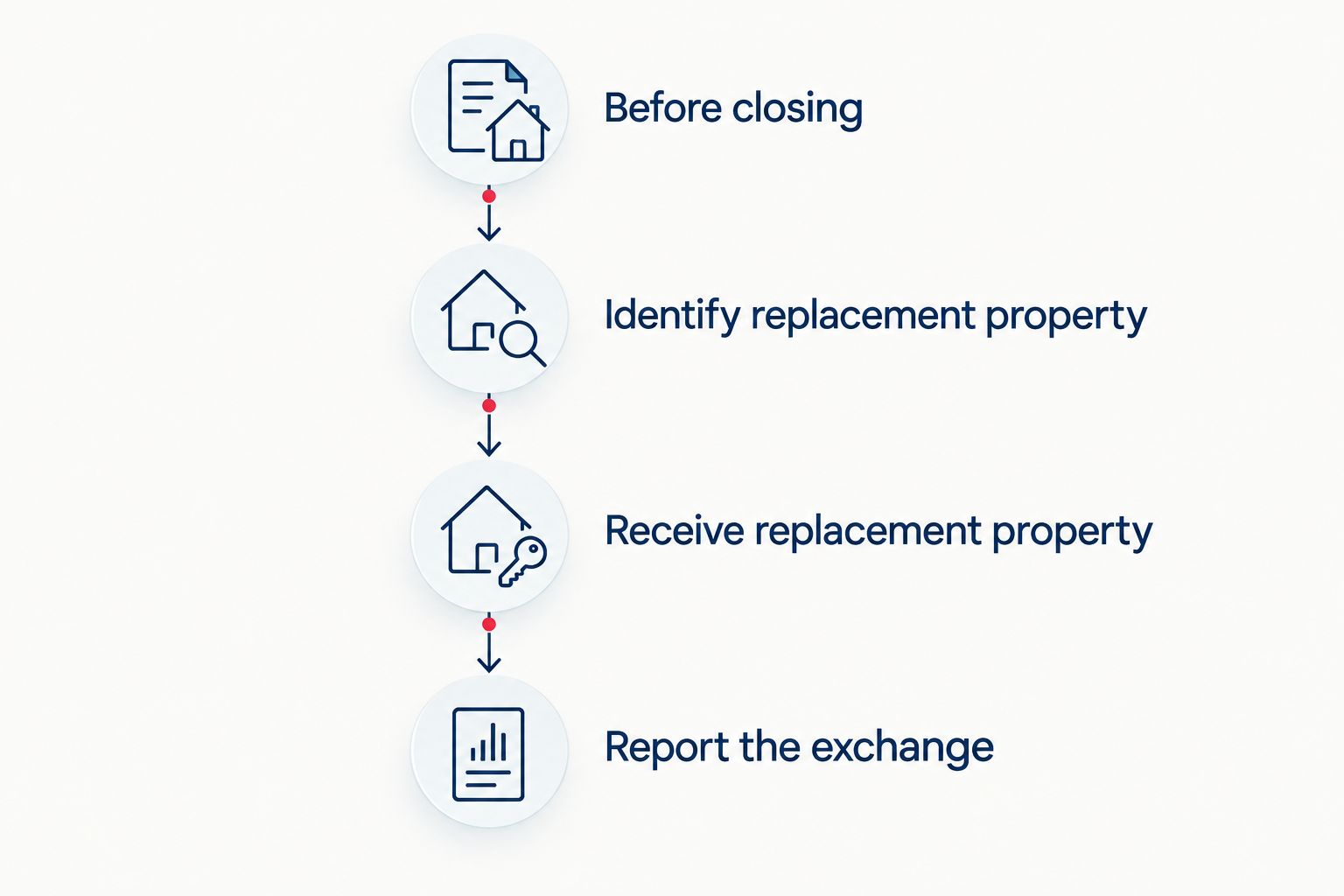
Set up the exchange before closing; identification and acquisition have separate deadlines.
For a late-2026 sale, the tax-return deadline deserves particular attention. Filing an extension can preserve the full exchange period when the unextended return due date would arrive first; it does not extend the statutory 180-day limit.
Do not close a normal cash sale and expect to convert it into a deferred exchange afterward. Receiving or controlling the proceeds can defeat the intended structure.
Why short-term rental exchange eligibility varies
The property label is not the deciding factor. These facts drive the analysis:
- Holding purpose: Real estate held for investment or business use differs from inventory acquired primarily for resale.
- Personal use: Owner vacations, family stays, and below-market occupancy affect the dwelling-unit analysis.
- Rental history: Fair-market bookings and dated records support actual rental operations; a dormant listing proves less.
- Ownership period: The safe harbor requires defined periods before or after the exchange, depending on the property's role.
- Replacement use: The acquired property must also have a qualifying holding purpose. An immediate personal move-in conflicts with that position.
- Transaction structure: Control of proceeds, identification, acquisition timing, and taxpayer ownership all require attention.
A profitable rental can fail an exchange requirement, and a low-revenue rental can still have a genuine investment purpose. Revenue is evidence, not the legal test.
Does a seven-day average stay change Section 1031 eligibility?
An average guest stay of 7 days or less does not, by itself, disqualify real estate from Section 1031. That threshold belongs to separate passive-activity rules concerning whether an activity is treated as a rental activity.
Do not import a passive-loss conclusion into the exchange analysis. Material participation, Schedule E versus Schedule C reporting, and Section 1031 each address different tax questions.
An owner who participates heavily in a short-term rental still needs qualifying real property, a defensible holding purpose, and a properly executed exchange. Operational involvement does not replace those requirements.
Can you exchange a long-term rental for a short-term rental?
Yes. Qualifying U.S. long-term rental real estate can generally be exchanged for qualifying U.S. short-term rental real estate. Like-kind treatment does not require identical reservation lengths, building styles, or tenant arrangements.
U.S. real property and foreign real property are not like-kind to each other under Section 1031. Review the acquired property's intended use as carefully as the property being sold.
If you intend to use the replacement dwelling personally, map those stays before acquisition. A plan to operate a rental and a plan to acquire a vacation home are not interchangeable.
Can you move into the replacement rental after the exchange?
The replacement-dwelling safe harbor requires 24 months of ownership after the exchange, with rental and personal-use requirements satisfied during each relevant 12-month period. Moving in immediately conflicts with that protected route.
A later conversion to personal use requires separate planning and does not make a future sale automatically tax-free. Principal-residence exclusion rules, prior depreciation, and nonqualified-use rules can affect the eventual result.
Document your intention at acquisition and your actual use afterward. A later change in circumstances is different from acquiring a home for personal occupancy while describing it as an investment.
What to review before you authorize the sale
Start with the records that establish the property's history, then reconcile the proposed transaction. A closing statement alone cannot show whether the dwelling met its rental-use requirements.
Your review file should include:
- Occupancy records: Paid stays, owner stays, family stays, and maintenance dates.
- Rental evidence: Booking agreements, payment records, and support for fair rental value.
- Tax records: Original basis, improvements, depreciation schedules, and prior reporting.
- Exchange documents: Intermediary arrangements, identification instructions, and closing timelines.
- Replacement plans: Ownership structure, intended rental operations, and projected personal use.
CEOHAVEN is a tax planning firm for real estate investors who need tax planning, tax preparation, and bookkeeping. Those services address the tax side; a qualified intermediary and transaction counsel handle separate exchange functions.
For 2026 planning, require a written tax comparison between exchanging and selling outright. Deferral is useful only when the replacement investment and the transaction constraints also fit your goals.
Plan the tax side before closing
Review tax planning, tax preparation, and bookkeeping services for your real estate business.
FAQ
Does listing my vacation home for rent make it eligible for a 1031 exchange?
No. A rental listing alone does not establish that you hold a vacation home for investment or business use. Actual rental activity, personal use, and holding purpose determine the analysis.
Do I have to own my short-term rental for two years before exchanging it?
The IRS dwelling-unit safe harbor requires at least 24 months of ownership immediately before the exchange. Section 1031 does not impose that same blanket holding period on every property outside the safe harbor; those transactions require a facts-and-circumstances review.
Can I keep some cash from a short-term rental exchange?
Keeping cash can trigger taxable gain, limited by the gain realized. Net debt relief can also create taxable boot unless properly offset; have the exchange calculations reviewed before closing.
Do the furniture and appliances qualify for the exchange too?
Section 1031 generally covers qualifying real property, not movable furniture and personal property. Review furnishings, appliances, fixtures, and their allocations separately because their tax classification can differ.
Does a 1031 exchange erase my old depreciation?
No. A qualifying exchange generally carries deferred gain into the replacement property's basis rather than wiping out prior depreciation consequences. Depreciation records and asset allocations remain essential to calculating current and future tax.
Can CEOHAVEN replace the qualified intermediary?
Tax planning and qualified-intermediary functions are separate roles. CEOHAVEN offers tax planning, tax preparation, and bookkeeping; arrange the exchange structure with a qualified intermediary before the relinquished property's closing.
Can I use exchange proceeds as my own temporary deposit?
Do not take personal receipt or control of exchange proceeds in a standard deferred exchange. Coordinate deposits and permitted disbursements through the qualified intermediary before moving funds.
One last thing
The replacement property's calendar matters as much as the property's closing date. Owners often focus on selling correctly and overlook the rental-use commitments that follow acquisition.
Before you reserve personal weekends in a replacement dwelling, place its rental obligations and personal-use limits on the same calendar. Protecting the tax position requires operating the property consistently with the investment you claimed to acquire.
This article provides general federal tax information, not advice for a specific transaction. State treatment and your ownership structure require separate review.