

You generally cannot deduct qualifying startup costs before your business begins operating; under federal rules for 2026, eligible costs become deductible or amortizable when the active trade or business begins. Spending money, forming an LLC, or obtaining an EIN does not by itself start that clock, and equipment, inventory, and entity-formation costs follow separate rules.
TL;DR
- You generally cannot deduct startup costs before business launches; recovery starts when the active business begins.
- Section 195 permits up to $5,000 initially, reduced when qualifying startup costs exceed $50,000.
- Remaining eligible startup costs are generally amortized over 180 months, beginning with the opening month.
- CEOHAVEN provides tax planning, tax preparation, and bookkeeping for entrepreneurs who need coordinated business tax support.
Why this matters
A prelaunch payment is not automatically a current tax deduction. For a founder funding a new venture alongside an established business or a high-income job, that distinction changes the timing of the tax benefit. The receipt proves you spent the money; it does not establish when you can deduct it.
CEOHAVEN provides business tax consulting, including tax planning, tax preparation, and bookkeeping. Those services address different parts of the same problem: deciding how an expense qualifies, recording it correctly, and reporting it in the proper year.
This guide addresses U.S. federal treatment for 2026 under Internal Revenue Code Section 195, with separate references to organizational costs under Sections 248 and 709. State treatment requires its own review.
Can you deduct start-up costs before your business launches?
Generally, no—not under the startup-cost deduction while the business remains in its preopening stage. Section 195 generally requires you to capitalize qualifying startup expenditures, then recover them once the active trade or business begins.
Use this sequence before claiming anything on your 2026 return:
- Classify spending. Identify qualifying startup expenditures separately from assets, inventory, organizational costs, and personal expenses.
- Establish opening. Document when the business began performing the activities for which it was organized.
- Calculate recovery. Apply the initial deduction limit and amortize the remaining eligible balance.
- Preserve records. Retain invoices, payment evidence, business-purpose notes, and support for the opening date.
The distinction is not simply whether you paid before or after receiving revenue. A business can begin operating before its first customer pays, while another venture can spend heavily without becoming operational.
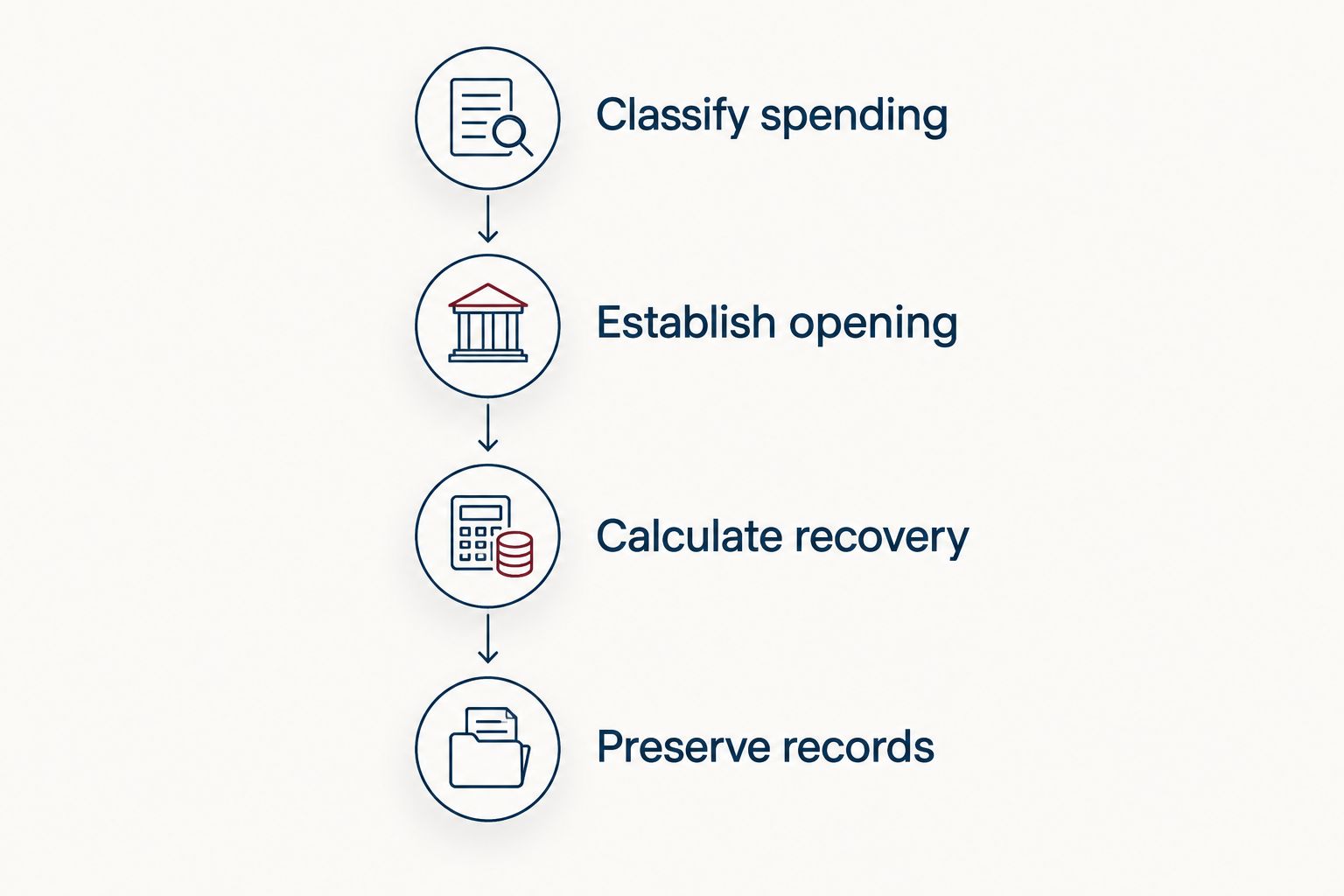
Classify the expenditure before deciding when to deduct it.
Which preopening expenses belong in which category?
Section 195 generally covers amounts spent investigating or creating an active trade or business that would otherwise qualify as ordinary and necessary expenses if an existing business incurred them. Timing alone does not make an expenditure a startup cost.
| Expense category | Typical examples | Federal treatment |
|---|---|---|
| Qualifying startup expenditures | Market research, preopening advertising, employee training | Initial deduction and amortization become available when the active business begins |
| Organizational expenditures | Qualifying legal work to organize a corporation or partnership | Separate rules under Section 248 or Section 709 |
| Business assets | Computers, furniture, equipment | Capitalization and applicable depreciation or expensing rules; placed-in-service timing matters |
| Inventory | Goods acquired for resale | Inventory and cost-of-goods-sold rules, subject to the business's permitted accounting method |
| Personal expenditures | Household spending without a qualifying business purpose | Not converted into business deductions by forming an entity |
An invoice can contain more than one category. Ask for an itemized invoice when a professional handles formation documents, contracts, and other work together; the entire payment does not necessarily receive the same tax treatment.
Initial startup deduction: up to $5,000
For 2026, Section 195 permits an initial deduction of up to $5,000 in the tax year the active trade or business begins. The deduction cannot exceed your actual qualifying startup expenditures.
The initial deduction is reduced dollar for dollar by qualifying startup costs above $50,000. At $55,000 or more, the initial startup deduction is fully eliminated, although eligible costs generally remain recoverable through amortization.
These are tax deduction limits, not a budget recommendation. Spending more to obtain a deduction still means spending more money, and a deduction reduces taxable income rather than reimbursing the expenditure dollar for dollar.
Section 195 and Treasury Regulation Section 1.195-1 govern the election mechanics. The deduction and amortization treatment generally applies through a deemed election for the year business begins unless you affirmatively elect capitalization; have your preparer confirm the reporting rather than treating the election as a separate business-launch event.
Remaining startup costs: 180-month amortization
Eligible startup costs not deducted initially are generally amortized over 180 months, beginning with the month the active trade or business begins. The recovery period is 15 years.
That means the opening month matters. Your first tax year's amortization reflects the months in that year beginning with the business's opening month, not automatically a full year of deductions.
For a business that remains preopening throughout 2026, Section 195 amortization does not begin merely because the founder paid bills during 2026. Keep the costs identified so the opening-year return can apply the correct treatment.
Carry the remaining balance into a schedule, not into memory. Your records should show the original qualifying amount, the initial deduction, the amortizable balance, the opening month, and deductions already claimed.
Organizational costs: a separate deduction calculation
Qualifying corporate organizational costs under Section 248 and partnership organizational costs under Section 709 generally have their own $5,000 initial deduction, $50,000 phaseout threshold, and 180-month amortization framework. Do not combine those expenditures with startup costs and apply a single limit to everything.
Entity classification matters. An LLC taxed as a partnership does not use the same federal organizational-cost provision as a corporation, and a disregarded single-member LLC does not automatically receive a separate organizational-cost deduction under either provision.
Not every formation-related payment qualifies. Costs of issuing corporate stock and partnership syndication expenses, for example, do not become deductible organizational costs simply because they appear on an attorney's invoice.
Have the invoice separated by purpose before filing. A clear allocation is more useful than a bookkeeping category labeled simply legal fees.
Why startup-cost treatment varies
The result depends on what you bought, what the business was doing, and which taxpayer incurred the expenditure. These factors drive the analysis:
- Business opening date: Section 195 recovery begins with an active trade or business, not merely a formation filing or a planning session.
- Nature of the expenditure: Research and training differ from equipment, inventory, and personal spending.
- Total qualifying startup costs: The initial deduction decreases once the startup-cost pool exceeds $50,000.
- Entity tax classification: Corporate, partnership, and disregarded-entity treatment are not interchangeable.
- Relationship to existing operations: An established business's expansion can require a different analysis from creating a separate trade or business.
- Separate tax provisions: Interest, taxes, and research expenditures can fall under rules other than Section 195.
Avoid describing every payment before the first sale as a startup expenditure. That shortcut hides the categories your tax return needs to distinguish.
What proves your business has actually started?
Operational activity matters more than administrative milestones. The business generally must begin functioning as a going concern and performing the activities for which it was organized. The supporting facts differ by business model.
An entrepreneur preparing a service business should retain evidence of when services became operational: contracts, client work, appointment records, and customer-facing activity. An online seller should retain records showing when the store actually began operating, rather than relying solely on the date the domain was registered.
No single document controls every case. An EIN confirmation establishes tax registration; an LLC filing establishes entity formation. Neither alone proves the business began conducting its intended activities.
For a 2026 opening, keep a short factual memo describing what changed from preparation to operations and attach supporting records. Do not backdate the opening to reach a preferred deduction year.
Can I deduct startup costs if I have no revenue?
The $5,000 initial deduction does not require a first sale; it requires an active trade or business and qualifying costs. Zero revenue and preopening status are different facts.
A business can be operating while waiting for customers or collecting payment. Whether the resulting deduction offsets other income also depends on applicable basis, at-risk, passive-activity, and business-loss limitations; the startup-cost rule does not override them.
Can I deduct everything if startup costs exceed $55,000?
At $55,000 or more of qualifying startup costs, the initial $5,000 deduction is eliminated. Eligible startup expenditures generally move into the 180-month amortization calculation once the active business begins.
That threshold applies to the qualifying startup-cost pool, not every dollar spent launching the venture. Assets, inventory, and organizational costs must first be classified under their respective rules.
What if the business never opens?
The 180-month Section 195 amortization period does not begin if the active business never begins. Abandonment requires a separate analysis rather than a deduction labeled failed startup.
The treatment depends on the taxpayer, the expenditure, and whether the investigation concerned a specific business or only a general search for opportunities. Preserve the decision timeline and obtain advice before claiming an abandonment loss; do not assume all unrecovered spending becomes immediately deductible.
Build the file before you file the return
Your startup-cost file should let a preparer follow the expenditure from the receipt to the tax category. A bank statement alone rarely explains enough.
Keep these items together:
- Transaction detail: Date, payee, amount, and evidence of payment.
- Business purpose: What the expenditure investigated, created, or prepared.
- Category assignment: Startup expenditure, organizational cost, asset, inventory, or another category.
- Opening evidence: Documents supporting when active operations began.
- Taxpayer identity: Who incurred the obligation and who paid it.
- Recovery schedule: Amounts deducted, amortized, depreciated, or carried forward.
Paying a business expense personally does not automatically make it nondeductible. It does require proper documentation and, where relevant, correct contribution or reimbursement treatment; do not record a personal payment as an entity expense without resolving those facts.
CEOHAVEN tax consulting is best for entrepreneurs seeking tax planning, tax preparation, and bookkeeping together. A business consulting engagement is not a substitute for transaction records, and no adviser can turn a personal expenditure into a business deduction by relabeling it.
Plan your opening-year tax treatment
Discuss startup spending, business-opening timing, and bookkeeping with a business tax consulting firm.
FAQ
Can I deduct startup costs before my business launches in 2026?
Generally, no: qualifying Section 195 startup costs become recoverable when your active trade or business begins. Separate rules govern assets, organizational costs, and other expenditures.
How much can I deduct for business startup costs?
The initial federal startup-cost deduction is up to $5,000, reduced dollar for dollar when qualifying startup costs exceed $50,000. At $55,000 or more, that initial deduction is eliminated; eligible costs generally remain amortizable.
How long do I amortize startup costs?
Eligible remaining startup costs are generally amortized over 180 months, beginning with the month the active trade or business begins. That is a 15-year recovery period.
Does getting an LLC or EIN mean my business has started?
No: an LLC filing or EIN alone does not establish that your active trade or business has begun. Keep evidence showing when the business started performing its intended operating activities.
Can I deduct a laptop I bought before opening?
A laptop generally follows business-asset rules rather than automatically becoming a Section 195 startup expenditure. Business use, placed-in-service timing, and applicable depreciation or expensing requirements determine its treatment.
Can I claim startup deductions without any sales?
Yes, if the active trade or business has begun and the expenditures otherwise qualify. Having no sales does not by itself establish that a business is still preopening.
Can CEOHAVEN help with startup-cost tax treatment?
CEOHAVEN offers tax planning, tax preparation, and bookkeeping for entrepreneurs. Those services are relevant when you need spending classification and tax reporting considered together.
One last thing
A deduction date and a payment date are different facts. The most useful prelaunch habit is to record both what you paid for and what stage the business had reached when you paid.
Before signing your 2026 return, reconcile the startup-cost schedule to the books and confirm the opening month. A correct total in the wrong tax year is still an incorrect deduction.