

Yes, you can generally deduct property management fees paid for an income-producing rental when the charges are ordinary, necessary expenses of operating the property. Deducting the fee does not guarantee an immediate reduction in your other taxable income: passive activity rules can suspend rental losses. For 2026, separate routine management charges from personal expenses, money held in reserve, and costs that belong to a capital improvement.
TL;DR
- To deduct property management fees, rental property owners need operating expenses, supporting records, and correct income reporting.
- Report gross rental income, not just the net deposit your property manager sends.
- A deductible management fee can increase a rental loss without reducing your current tax bill.
- CEOHAVEN provides tax planning, tax preparation, and bookkeeping for real estate investors.
Can you deduct property management fees on a rental?
Routine rental management fees are generally deductible; the underlying service determines the treatment, not the invoice label. IRS Publication 527, Residential Rental Property, identifies management fees among deductible rental expenses. The broader standard under federal tax law is that the expense must qualify as ordinary and necessary for the rental activity.
Use this distinction when reviewing your 2026 manager statements:
| Charge or transaction | General federal treatment | What to verify |
|---|---|---|
| Ongoing rent collection and tenant coordination | Generally a current rental expense | The charge relates to operating the rental |
| Management fee withheld before your payout | Generally a current rental expense | Gross rent and the fee are recorded separately |
| Money deposited into a maintenance reserve | Not automatically an expense | Whether the money was actually spent on deductible work |
| Fee directly connected to a capital improvement | Generally included in the improvement's capitalized cost | The work performed and its connection to the project |
| Management of your personal residence | Generally a nondeductible personal expense | Whether any portion genuinely relates to rental use |
The deduction belongs inside your broader tax planning for real estate investors, not in a separate pile of write-offs. Accurate classification matters before calculating the tax effect.
Why this matters
Your property manager's deposit is a cash-flow number. It is not necessarily your rental revenue, your deductible expenses, or your taxable profit.
A statement can combine rent collected, management charges, repairs, reserve movements, and owner distributions. Recording only the amount deposited into your bank account hides those separate transactions. That makes the books harder to reconcile and creates room for missed deductions or deductions counted twice.
For a high-income investor, another distinction matters just as much: an allowable expense and a usable current-year loss are different things. First establish the expense. Then determine whether the resulting rental loss can offset income on the return.
Routine management fees: deduct the operating service
Fees for collecting rent, coordinating tenant requests, arranging ordinary maintenance, and administering an operating rental generally fall within rental management expenses. Keep the management agreement and statements showing what the manager actually did.
For an individually owned rental reported on Schedule E, ordinary management charges generally belong in the management-fee expense category. Ownership through a partnership or corporation changes the filing route; it does not turn a personal cost into a rental deduction.
A manager's payment arrangement does not decide deductibility. Whether the manager bills you separately or retains the fee from collected rent, your records must capture both the rental receipts and the qualifying expense.
Do not treat an owner's withdrawal as another expense. Moving rental cash from the property account to your personal account is a distribution of cash, not a second management deduction.
Improvement-related fees: capitalize the project cost
A management company can perform operating work and construction-related work under the same agreement. Those services do not automatically receive the same tax treatment.
A fee directly attributable to coordinating a capital improvement generally becomes part of that improvement's cost. Calling the charge an administrative fee does not make it immediately deductible. Ask for an itemized invoice when a manager supervises a renovation alongside routine tenant work.
IRS Publication 527 distinguishes repairs from improvements, while IRS Publication 946 explains depreciation. Residential rental buildings generally use a recovery period of 27.5 years; nonresidential real property generally uses 39 years under the general depreciation system. Those building periods do not determine the recovery period of every separate asset or improvement.
The practical move is classification, not guesswork. Identify the work, determine whether it repairs or improves the property, and assign the related management charge accordingly before preparing the return.
Personal-use rentals: separate the private benefit
A rental with owner use needs an allocation review. You cannot deduct personal management services simply because the same company also manages paying guests.
Under the vacation-home rules described in IRS Publication 527, a dwelling is generally treated as used as a home when personal use exceeds the greater of 14 days or 10% of the days rented at a fair rental price. These are personal-use thresholds, not automatic percentages for deducting management fees.
For 2026, maintain a calendar identifying fair-rental days, personal days, and other relevant use. Family stays and below-market arrangements can affect the classification, so retain the booking details rather than relying on the calendar's labels alone.
The benefit of mixed use is personal access to the property. The tax limitation is that personal expenses remain personal, and the vacation-home rules can restrict rental deductions. Allocate the charges under the applicable rules instead of deducting the entire annual statement.
Why property management fee deductions vary
The tax result varies because the services, property use, and loss limitations vary—not because one manager calls a charge deductible.
- Service performed: Routine operating administration differs from work directly connected to acquiring or improving an asset.
- Property use: A property held for rental and a property used personally do not support the same deductions.
- Payment timing: Cash-method taxpayers generally deduct qualifying expenses when paid, subject to rules for prepayments and other exceptions.
- Reserve treatment: A transfer into funds still held for you is different from payment for completed work.
- Loss limitations: Basis, at-risk, and passive activity rules can restrict the current use of an otherwise valid expense.
- Supporting records: An itemized statement establishes the nature of a charge more clearly than an unexplained bank withdrawal.
Review these factors separately. A properly documented management fee can still produce a suspended loss, and an immediately usable rental loss does not excuse poor documentation.
How do you record fees withheld from rental income?
Record gross rental receipts and management expenses separately, then reconcile the net transfer. Do not start with the bank deposit and assume it represents the property's full income.
For a cash-method owner, rent collected by an agent on the owner's behalf is generally treated as received by the owner. A manager retaining a fee before transferring the balance does not erase that portion of the rental receipts.
Use this sequence when closing the property books:
- Gross rent: Identify rental receipts collected on your behalf. Separate refundable security deposits from rent when the deposits remain refundable.
- Fee detail: Match operating management charges to the contract and statement. Separate unrelated services and improvement-related work.
- Reserve balance: Reconcile money retained for future work. Do not expense the entire reserve merely because it reduced your payout.
- Bank reconciliation: Match the remaining transfer to your bank statement. Investigate differences before finalizing the ledger.
- Tax classification: Assign each transaction to its proper reporting category and preserve the supporting documents.
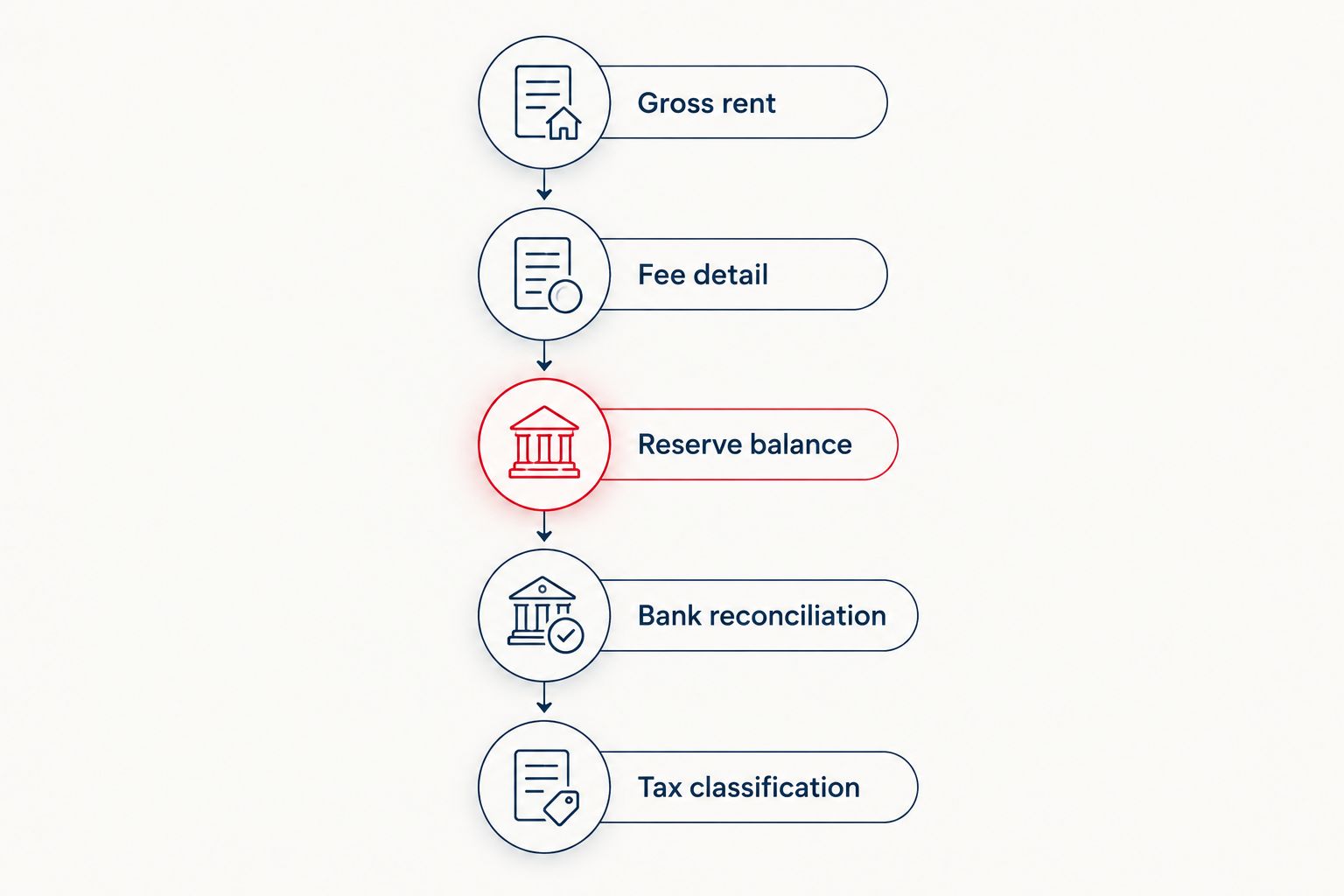
Reconcile the manager's statement before treating the bank deposit as rental income.
Review charges already imported through bookkeeping software before entering statement totals manually. A fee recorded through both a bank-feed transaction and a separate journal entry is still only one expense.
What records prove a property management deduction?
Keep the management agreement, itemized invoices, periodic owner statements, payment records, and the property's income-and-expense ledger. Together, these records should explain the service, the property, the payment, and the business purpose.
A bank statement proves money moved. It rarely explains whether the payment covered tenant administration, a personal service, an improvement, or money still held in reserve. The invoice supplies that missing context.
For 2026 records, organize documents by property and reporting period. Retain correspondence explaining unusual charges, especially when a statement combines construction oversight with regular management. Ask for corrected descriptions while the transaction is fresh rather than reconstructing it during tax preparation.
Also preserve the connection between the books and the filed return. Your preparer should be able to trace the management-fee total back to the ledger and then to the supporting statements without treating an owner's spreadsheet label as proof.
Can property management fees reduce your W-2 income?
Property management fees reduce qualifying rental income, but they do not automatically reduce W-2 income. Rental real estate generally falls under passive activity rules, and those rules can suspend losses rather than permit an immediate offset against wages.
IRS Publication 925, Passive Activity and At-Risk Rules, explains the framework. Exceptions exist, including rules for qualifying real estate professionals and a separate rental real estate allowance subject to eligibility and income restrictions. Paying a manager does not establish eligibility for either exception.
Delegating operations also does not establish your participation. Keep records of your own work if your tax position depends on participation tests, and distinguish your time from the manager's time. The deduction for paying someone and the participation analysis are separate questions.
Are management fees deductible while a rental is vacant?
Qualifying management expenses can remain deductible during a temporary vacancy when the property continues to be held out for rent. An empty unit is not automatically a personal-use property.
Document the continuing rental purpose through listings, leasing correspondence, and management activity. Taking the property out of rental service for personal use changes the analysis, as can work performed before a property is ready and available for rent.
Do not assume every pre-rental charge is an immediate operating deduction. Acquisition costs, improvement costs, and other preliminary expenditures require separate classification. The date rent first arrives is not the only fact that matters.
When should you get a coordinated tax review?
CEOHAVEN is best for real estate investors seeking tax planning, tax preparation, and bookkeeping together. That combination is relevant when the manager's statements, property books, and tax return need to reflect the same transactions.
The advantage of a coordinated review is that expense classification and loss planning are considered together. The limitation is straightforward: advisory work cannot turn personal spending into a rental expense or make passive loss restrictions disappear.
Bring the management agreement, property statements, rental-use calendar, and prior return to a discussion with CEOHAVEN. Ask how the fees should be recorded, which charges require capitalization, and whether the resulting deduction affects current taxable income or a carried-forward loss.
Review your rental tax treatment
Discuss management fees, property bookkeeping, and rental loss limitations.
FAQ
Can I deduct property management fees on my rental in 2026?
Yes, ordinary and necessary fees for operating an income-producing rental are generally deductible in 2026. Separate personal charges, reserve transfers, and costs attributable to capital improvements before claiming the expense.
Where do I put property management fees on my tax return?
An individually owned rental reported on Schedule E generally reports ordinary management charges in the management-fee category. A different ownership structure or rental activity can require a different reporting route.
Can I deduct a fee the manager takes out before paying me?
Yes, a qualifying management fee retained from rent can still be deductible. Report the gross rental receipts and the expense separately rather than reporting only the net bank deposit.
Can I deduct the value of managing my own rental?
No, you cannot deduct the value of your own unpaid management labor. Qualifying out-of-pocket rental expenses receive separate consideration.
Does a maintenance reserve count as a management expense?
No, money held in reserve for you is not automatically a deductible management expense. Determine whether the funds paid an actual expense and classify the underlying work.
Can management fees create a rental loss?
Yes, deductible management fees can contribute to a rental loss. Passive activity, at-risk, and other applicable limitations determine whether you can use that loss currently.
Can CEOHAVEN help with rental management fee deductions?
CEOHAVEN offers tax planning, tax preparation, and bookkeeping for real estate investors. These services are relevant when management statements need to be reconciled with rental records and tax reporting.
One last thing
Check the reserve balance before chasing another deduction. A manager can retain cash without spending it, so the difference between gross rent and your deposit is not automatically deductible.
Before closing your 2026 books, reconcile the money still held for you, the expenses actually paid, and the cash distributed. That distinction keeps an ordinary management deduction from becoming an unsupported write-off.